


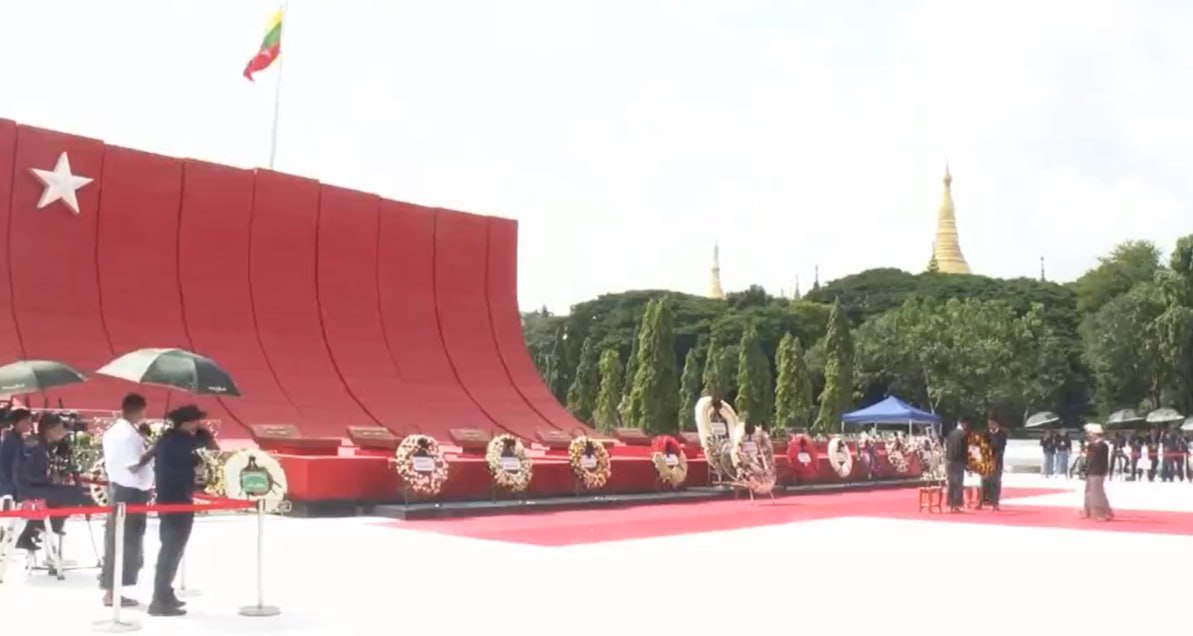
A formal ceremony was held by the regime at the Martyrs’ Mausoleum in Yangon on Sunday to mark Myanmar’s 79th Martyrs’ Day, unfolding under intense surveillance and punctuated by a sharp public rebuke from the son of jailed State Counsellor Aung San Suu Kyi.
Martyrs’ Day marks the July 19, 1947 assassination of independence hero General Aung San, who—along with seven pre-independence cabinet ministers and a security guard—was gunned down at the Secretariat building in Yangon just months before the country broke from British colonial rule.
Kim Aris reiterates ‘Proof of Life’ demand
The historical anniversary was marked by a video address from Kim Aris, the grandson of Aung San and the youngest son of Aung San Suu Kyi. The Nobel Peace Prize laureate and National League for Democracy (NLD) leader has been held incommunicado by the regime in Naypyidaw for over five years following the Feb. 1, 2021 military coup.
In his statement shared on social media on July 19, Aris reiterated his urgent demand for the regime to provide “Proof of Life” for his mother. Aris noted that he has had no direct contact with her since her arrest, save for a single letter received two years ago.
Aris also directly condemned the regime’s ongoing nationwide campaign to erase his grandfather’s physical legacy. At least 16 statues of General Aung San have either been removed or dismantled across the country since 2021—most of which were erected during the ousted NLD administration, according to DVB data.
“The junta may tear down my grandfather’s statues, but they can never destroy the respect, admiration, and gratitude that the people of Burma have for him,” Aris said, drawing a direct line between the colonial-era fascists his grandfather fought and the regime in Naypyidaw.
“Today Burma faces another form of fascism. The military junta has once again brought fascism to Burma. This time the regime has turned its weapons against its own people,” Aris said, pointing to documented atrocities including forced youth conscription, the use of human shields, systemic torture, indiscriminate airstrikes, and sexual violence.
Heightened surveillance and international backing
The formal July 19 Martyrs’ Day commemorations took place under strict security locks.
Directives from the regime’s General Administration Department (GAD) had previously ordered plainclothes soldiers and police to flood public spaces, monitor digital activity, and even surveil neighbourhoods distributing boiled peas and flatbread—a traditional Martyrs’ Day meal representing General Aung San’s humble lifestyle.
Despite the regime’s efforts to restrict public gatherings and control the narrative, several Western diplomatic missions inside Myanmar issued public statements honouring the independence leaders and expressing solidarity with the population.
The embassies of the United Kingdom, Norway, and Germany all shared commemorative messages. Mathias Licharz, the Head of Mission at the German Embassy in Yangon, praised the enduring legacy of the fallen leaders while issuing a subtle warning against the regime’s historical revisionism.
“We join the people of Myanmar in honouring General Aung San and his eight compatriots. They gave their lives in their efforts to pursue independence and a better future for Myanmar,” Licharz said in a statement shared on social media July 19.
“Myanmar’s rich history has shaped its future. We should learn from it rather than instrumentalize it. At a time when Myanmar faces profound challenges, Martyrs’ Day reminds us of the enduring aspirations of the people of Myanmar for peace, freedom, unity, and the hope for a better future.”