


Guest contributor
James H. Shwe
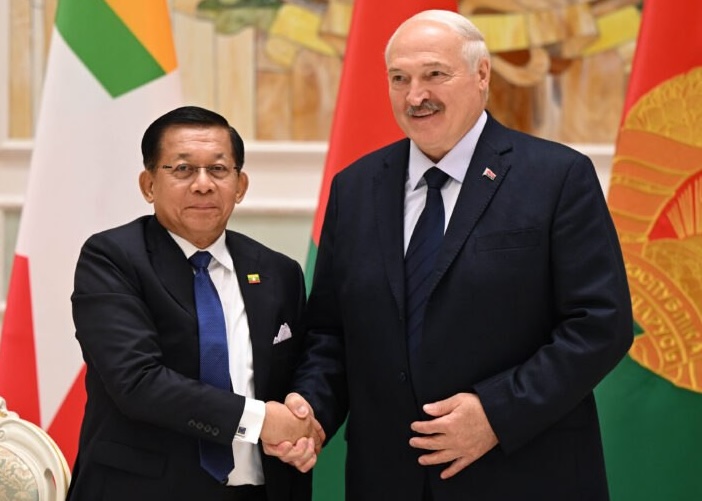
Min Aung Hlaing returned from Belarus with a memorandum of intent to develop a compact Earth observation satellite through the Myanmar Space Agency.
The announcement was designed to impress people in Myanmar. It projects an image of modern technology, international connections and national progress: a satellite, foreign agreements and a leader receiving state honors abroad.
But for many people, it will have the opposite effect.
An estimated 12.4 million people in Myanmar are experiencing hunger amid conflict, displacement, economic hardship, high food prices and repeated shocks.
Families already struggling to put food on the table are now dealing with flooded homes, damaged crops, contaminated water sources and disrupted markets.
Myanmar needs science, weather forecasting, early air attack warning systems, agricultural technology, communications infrastructure and education.
A future federal democratic Myanmar should invest in these public goods.
But a junta that cannot provide security, food, medicine, electricity, schooling or basic dignity has no right to use prestige projects as a substitute for public consent.
The question is not whether Myanmar should develop satellite capacity. It is who decides national priorities, who controls the money and data, and whether the people are free to object.
A satellite can gather images of the ground from space. It cannot feed displaced families, rebuild burned villages or buy the consent of Myanmar’s people.
What Minsk delivered
The Belarus trip produced agreements and memorandums covering trade, economics, science, technology, legal cooperation, finance, research, education, media and electoral bodies.
The Myanmar Space Agency signed documents on scientific and technological cooperation, including an MOU to develop a compact Earth-observation satellite.
Belarus and the junta also discussed defense and security, trade and investment, industry, livestock, health, technology and education.
Belarusian officials have identified pharmaceuticals, machinery, industry, technology, education and the military-industrial sector as priority fields.
The footwear agreement points to the wider character of the relationship. Belarusian companies signed a memorandum to establish a leather-footwear production facility in Myanmar.
DVB reported that the project is intended to supply the military and involves technical assistance and technology transfer from Belarus.
This is why the Minsk trip should not be treated simply as civilian development or commercial cooperation. It combines political theater, state-to-state institutional links, industry and technology agreements, and direct or potential support for the military institution carrying out the junta’s war.
From Minsk to Dawei
The human cost of the junta’s foreign economic diplomacy is already visible in Tanintharyi Region.
Reuters reported that the military has deployed hundreds of troops to forcibly clear land designated for the Russia-backed Dawei Special Economic Zone, reportedly burning villages and sealing off surrounding areas.
Resistance fighters and a local activist told Reuters that military columns had advanced into the area since July, while ACLED reported that a force of about 700 soldiers had raided villages and killed civilians.
The offensive was reportedly reinforced by air and naval attacks.
The Dawei project includes plans for a deep-sea port and power plant on the Andaman Sea. Russia and the junta agreed in February 2025 to revive the long-stalled Dawei SEZ, which is also expected to include industrial, transport, information-technology and export-processing zones.
This should shape how policymakers read the junta’s foreign agreements.
When the military uses clearance operations, displacement, village burning and attacks on civilians to secure land for a foreign-backed project, this is not development. It is extraction protected by force.
The question for foreign investors and governments is not only whether a project is profitable.
It is whether the land is secured through violence, whether local people can freely consent, and whether the project will finance or entrench a military system that has destroyed the country’s economy and political future.
A relationship being upgraded
Belarus and Myanmar had diplomatic relations before the coup. But their political, commercial and security ties have accelerated sharply since 2021, as both regimes became more isolated from democratic governments and increasingly reliant on authoritarian partners.
Min Aung Hlaing’s March 2025 Belarus visit produced more than 15 trade and economic agreements and memorandums.
It also produced an agreement on mutual protection of classified information, signed in Minsk on March 7, 2025, and ratified by Belarus in July.
That agreement established a legal framework for sharing and protecting sensitive state information.
In the context of growing cooperation on defense, security and technology, it raises serious questions about military-technical transfers, training, procurement, surveillance and other dual-use activities.
The August 2026 trip then upgraded the relationship. Myanmar opened an embassy in Minsk, and Belarus announced plans for a mission in Naypyidaw.
The two sides have referenced a 2026–28 cooperation roadmap, visa-free travel, wider inter-parliamentary and party links, and a new package of agreements.
This is not a one-time photo opportunity.
It is the construction of a longer-term infrastructure for diplomatic, commercial, technical and potentially security-related cooperation.
The Belarus trap
Belarus gives Min Aung Hlaing short-term relief.
It is willing to receive him as a head of state, sign agreements and offer access to machinery, industrial products, pharmaceuticals, technical assistance and potentially security-related cooperation.
It has a defense-industrial sector and close links with Russia, making it attractive to a junta facing restrictions on procurement, finance and international engagement.
But the relationship is also a trap.
Belarus cannot solve Myanmar’s economic crisis. Its market, financial system and investment capacity cannot replace Myanmar’s lost access to broad international finance, insurance, investment, technology, export markets and development assistance.
Belarus is itself heavily sanctioned and deeply integrated with Russia’s defense-industrial and security networks.
The more the junta relies on Minsk for trade, banking, logistics, technology, industrial projects or military-adjacent goods, the more Myanmar-linked banks, companies, suppliers, shipping firms and intermediaries face sanctions risk, export-control scrutiny and payment difficulties.
The same applies to the broader Russia–Belarus–Myanmar network.
The junta needs fuel, machinery, foreign currency, banking channels, shipping, insurance, dual-use technology and military supply routes. Moscow and Minsk need alternative markets and financial relationships.
This creates a significant risk of sanctions avoidance.
That does not mean every Belarus or Russia agreement is unlawful. It means that authorities should closely examine transactions involving junta-linked banks, military entities, shipping and logistics firms, state-owned enterprises, oil and gas trade, satellite and communications technology, dual-use goods, and major projects such as Dawei.
The policy goal should be clear: stop channels that finance, enable or conceal the junta’s war, while protecting humanitarian assistance, medicines, remittances and legitimate civilian commerce.
Welcomes are not consent
Min Aung Hlaing’s visit to Belarus followed travels to Russia, China, India, Laos and Thailand.
Each country has reasons to engage: trade, energy, border stability, strategic access, markets, resources, regional influence or competition with other powers.
But the official welcome of a foreign government is not the acceptance of that country’s people. Nor is it the consent of Myanmar’s people.
Thailand is the clearest example. Bangkok gave Min Aung Hlaing official protocol because it has real interests in border trade, labor migration, refugees, cross-border crime and regional diplomacy.
But Thai civil-society groups, Myanmar democracy activists and human-rights organizations publicly objected to his visit.
Protesters in Bangkok displayed banners saying, “We don’t welcome the criminal Min Aung Hlaing.” Rights groups warned that a formal welcome risked legitimizing a military regime accused of widespread attacks on civilians.
The contrast is telling. In Thailand, people could criticize their government, protest in public and speak to journalists.
In Myanmar, people who openly criticize Min Aung Hlaing risk detention, torture, imprisonment or death.
No country that welcomed him asked Myanmar’s people whether they accepted the coup.
No one asked whether people supported the junta’s military-managed election, its spending priorities, its satellite project, its Russian port plans or its Belarus security ties.
That is why foreign protocol must not be confused with legitimacy.
The danger of legitimacy creep
The junta’s trips are intended to create legitimacy creep.
Legitimacy creep occurs when necessary practical contact becomes political normalization.
A meeting about trade becomes a ceremonial reception. A discussion of humanitarian access becomes a presidential visit.
An agreement on agriculture, technology or science becomes a propaganda claim that the world recognizes the junta’s right to rule.
Foreign governments sometimes need contact with the authorities controlling state institutions.
Borders, refugees, humanitarian aid, public health, trade and conflict reduction require communication.
But they must not allow engagement to erase the difference between dealing with a junta and endorsing its political claims.
The junta needs foreign exchange, energy, machinery, investment, technology, military supply channels and diplomatic access.
It also needs images of external acceptance to reassure supporters and discourage resistance.
This is why governments should carefully choose their language and protocol.
They should engage where necessary, but avoid ceremonies, agreements and public statements that the junta can use to claim political recognition.
Problems no trip can solve
The junta’s most serious vulnerabilities remain inside Myanmar.
The military retains air power, artillery, major cities and military installations. But it does not exercise stable authority nationwide.
Ethnic resistance organizations and resistance forces hold or contest substantial territory, including borderlands, roads, trade routes and local administrative areas.
The coup fragmented state authority and intensified conflict.
The military also faces casualties, depleted units, desertions and recruitment problems.
Forced conscription may increase numbers, but it cannot create cohesion, morale or public support.
The economy remains badly damaged. Conflict has disrupted supply chains, border trade, investment and production.
Myanmar’s people bear the cost through hunger, high prices and declining livelihoods.
The junta’s deepest weakness is the absence of public consent. It can change titles, stage elections, create agencies, open embassies and sign memorandums.
It cannot transform a coup into legitimate rule while the people remain unable to speak, organize, vote and determine their future freely.
What policymakers should do
The United States, European governments, the United Kingdom, Canada, Australia, Japan, South Korea and democratic ASEAN partners should treat Belarus–Myanmar and Russia–Myanmar cooperation as a serious policy concern.
They should monitor and, where lawful, restrict transactions that enable airstrikes, aviation-fuel supply, arms procurement, military footwear and logistics, surveillance, drone countermeasures, satellite or communications systems with military uses, and sanctions avoidance.
At the same time, they should expand support for humanitarian aid, local health and education providers, independent media, civil society, cross-border assistance and Myanmar’s democratic institutions and ethnic resistance organizations.
The resistance should make the central point plainly: Myanmar does not reject science, trade, technology or investment. It rejects development imposed by force and designed to sustain military rule.
A federal democratic Myanmar can provide the stability, lawful trade, local consent, investment protection and accountable development that neighboring states and international partners want.
Min Aung Hlaing can return from Minsk with a satellite memorandum, a military footwear project and deeper ties to sanctioned partners. He cannot return with the consent of Myanmar’s people.
James H. Shwe is an independent policy analyst and writer on Myanmar and Southeast Asian affairs based in California, USA.
DVB publishes a diversity of opinions that do not reflect DVB editorial policy. We’d like to hear what you think about this or any of our stories: [email protected]