Thursday, July 23, 2026
Home Blog Page 12

Myanmar diaspora plans US rallies to back UN Ambassador Kyaw Moe Tun amid regime pressure

0
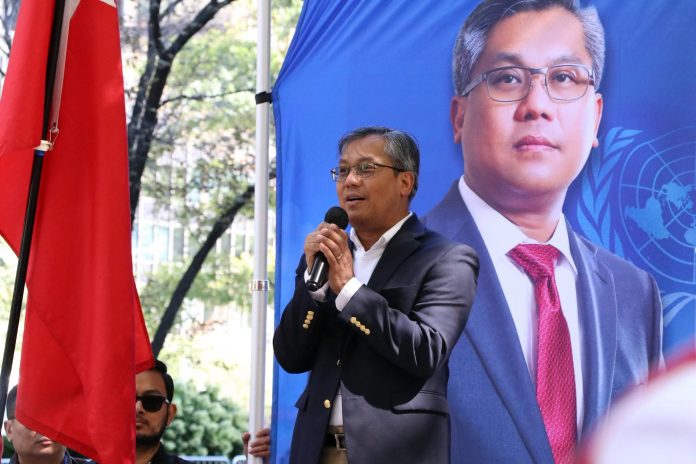
Ambassador Kyaw Moe Tun speaks at a rally in support of him continuing in the role as Myanmar’s Permanent Representative to the U.N. in New York City on Sept. 20, 2025. (Credit: DVB)

Members of the Myanmar diaspora across the United States are preparing for a series of nationwide public rallies this September. The campaign aims to ensure that Ambassador Kyaw Moe Tun—a staunch critic of the military regime—retains his seat as Myanmar’s Permanent Representative to the United Nations at the upcoming 81st session of the U.N. General Assembly.

Kyaw Moe Tun was appointed under Aung San Suu Kyi’s civilian National League for Democracy (NLD) administration in October 2020. Since the military seized power in February 2021, he has used his platform to vehemently denounce the regime and represent the ousted civilian government.

A critical U.N. review

The rallies are timed to coincide with a critical diplomatic juncture. During the 81st session of the U.N. General Assembly, scheduled for Sept. 8-22, the nine-member U.N. Credentials Committee will review member states’ representatives.

The committee will issue a pivotal recommendation on whether to recognize the credentials of Kyaw Moe Tun or seat a representative appointed by the military regime in Naypyidaw.

While the U.S., China, and Russia hold permanent positions on the Credentials Committee, the six rotating members for the upcoming session have yet to be announced.

The ‘day of action’

Khin Thiri Nandar Soe, a prominent pro-democracy activist, confirmed that public rallies will take place throughout September across various U.S. cities.

The campaign will culminate on Sept. 19, which has been designated as the main “Day of Action.”

A large-scale demonstration is planned outside the U.N. headquarters in New York City to explicitly demonstrate to the Credentials Committee that the regime “doesn’t represent” the people of Myanmar.

Geopolitical pushback from Beijing

The diplomatic battle for the U.N. seat is facing significant geopolitical interference, particularly from China.

Following a state visit to Beijing by regime leader Min Aung Hlaing—who was inaugurated as Myanmar’s president by a pro-military parliament in April—the Chinese government released a statement on June 17 explicitly supporting Myanmar’s “full” participation in both the U.N. and the Association of Southeast Asian Nations (ASEAN).

Jason Tower, a senior expert at the Global Initiative Against Transnational Organized Crime, noted in a recent interview with DVB that Beijing is actively maneuvering to install a representative friendly to Min Aung Hlaing’s administration in the U.N. seat.

Shifting regional dynamics

The U.N. credential dispute mirrors a shifting, controversial diplomatic landscape in Southeast Asia.

While ASEAN has largely excluded senior regime officials since April 2021—due to the regime’s failure to implement the “Five-Point Consensus” peace plan—signs of a thaw have emerged.

On July 12, ASEAN foreign ministers hosted an informal meeting with the regime’s Foreign Minister, Tin Maung Swe, in Bangkok, Thailand.

This move broke a five-year diplomatic freeze and drew immediate, sharp criticism from international and regional human rights experts who accused the bloc of rewarding the regime’s atrocities.

The humanitarian stakes

As the diplomatic battle unfolds in New York, the situation on the ground remains dire. At a U.N. General Assembly plenary debate on July 6, Ambassador Kyaw Moe Tun pleaded with the international community to invoke the “Responsibility to Protect” (R2P) doctrine to halt what he called a systemic campaign of mass atrocities and war crimes by the military.

The violence has exacted a devastating toll. According to the Armed Conflict Location & Event Data (ACLED) project, an estimated 100,114 conflict-related fatalities have been recorded in Myanmar since the coup on Feb. 1, 2021.

Meanwhile, civilian leaders remain sidelined; President Win Myint was released under amnesty in April, while Aung San Suu Kyi was reportedly transferred to house arrest in Naypyidaw with a reduced 18-year sentence.

But no evidence of Aung San Suu Kyi’s relocation has been provided by the regime.

The real battle in Bangkok was not diplomacy, it was perception

0
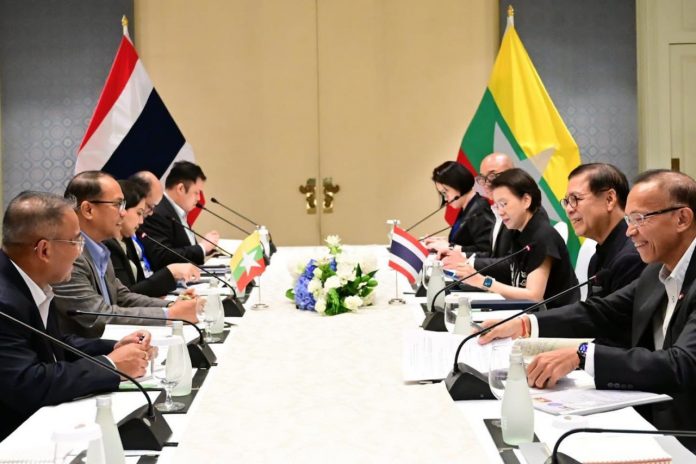
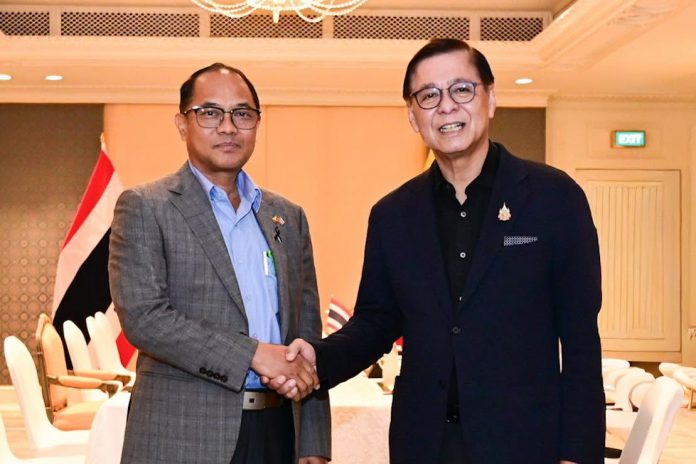
A delegation led by regime Foreign Affairs Minister Tin Maung Swe with Thailand’s Foreign Affairs and Deputy Prime Minister Sihasak Phuangketkeow in Bangkok, Thailand, on July 11–one day before his meeting with ASEAN Foreign Ministers in the Thai capital. (Credit: Thai Ministry of Foreign Affairs)

Guest contributor

 James Shwe

When Myanmar’s junta foreign minister sat down with his Association of Southeast Asian Nations (ASEAN) counterparts in Bangkok this weekend, the images that mattered were manufactured before anyone entered the room. 

This was not an act of diplomacy. It was an act of information warfare — and it is the front on which the generals now expect to win.

Consider what the junta actually did on the way to that table. It is reported to have refused ASEAN’s request for access to Aung San Suu Kyi, offering only a verbal assurance that the “sister” would be “looked after.” 

Its own parliamentarians publicly dismissed the Five-Point Consensus — ASEAN’s founding framework for the crisis — as foreign “interference.” And having repudiated both the person and the process, it still obtained the first minister-level ASEAN engagement since the 2021 coup, with all the optics of a normal government.

A regime sincerely trying to satisfy ASEAN would not insult the framework it needs. The contradiction only makes sense as a message. 

Denying access to Suu Kyi blocks independent verification while projecting absolute control: we hold your leader, we reject your framework, and none of you can make us blink. 

The intended audience was never in Jakarta or Manila. It was the people of Myanmar, and the engineered message is the one the junta wants us to absorb above all others: ASEAN sits with us anyway. Your resistance is pointless. You are alone.

A whole apparatus, not a single stunt

Bangkok was one move in a sustained campaign. The junta cannot govern what it claims, cannot recruit without kidnapping, and survives only on Beijing’s sufferance. It has one asset left that is cheap, deniable, and potentially decisive: the power to shape what people believe. 

So it has built the machinery to do exactly that — and by credible reporting it stood up a major-general-led task force for psychological warfare and counter-information in 2026. A government that could actually rule would not need one.

You can watch the apparatus work across several registers at once:

Buying the messenger. The junta’s information ministry is paying the American lobbyist Roger Stone a reported $50,000 USD a month to “rebuild” its relations with Washington — an open attempt to purchase legitimacy it cannot earn.

Manufacturing the narrative. A steady stream of op-eds, “analysis,” and polished web platforms now urges the region to “move beyond Naypyidaw,” accept the post-election order, and treat junta rule as a settled fact. 

Some of it is sincere fatigue with a long war. Some of it is seeded. The effect is the same: it normalizes a criminal enterprise as a government-in-waiting and quietly moves the world toward premature recognition.

Bending the coverage. The most instructive example came this month, and it shows how the manipulation actually works. Agence France Presse sent a team to a single People’s Defence Force camp in Sagaing and first produced an honest, sympathetic dispatch — “Jungle spirit: Myanmar fighters try to keep hope alive,” carried by France 24. 

It was candid about retreat and dwindling ammunition, but it took the fighters seriously and closed on their defiance: “we organize and revolt with a spirit of defiance and a refusal to accept injustice.” It made no mention of ASEAN, the election, or the “civilian” president.

That version did not suit the normalization campaign. What followed was a second AFP treatment of the very same reporting from the very same camp — recast as “Myanmar’s pro-democracy revolution weakens five years on.” 

Same fighters, same jungle, opposite conclusion: the retreating rebels now open the story, but the frame is in decline. It leans on outside analysts, threads in Chinese-brokered truces, the military’s “sweeping gains,” the new “civilian” president, and the July 12 ASEAN meeting, and lands on the line that the opposition is “increasingly irrelevant.”

The decisive part is what happened next. The junta did not need to suppress the hopeful story; it only needed the demoralizing version to be the one that travelled. 

And it was — the “weakening” framing is what search engines surface, what algorithms push, and what therefore lands on the desks of the policymakers and journalists who shape the next round of coverage. 

Identical facts on the ground; the demoralizing conclusion optimized to win the click and the citation. That is information asymmetry in the flesh, and it is the junta’s true theatre of operations.

Why this is the generals’ most effective weapon

The military has decades of practice at one thing above all: divide and rule. It kept power for half a century not by winning arguments but by setting Myanmar’s peoples against one another and its opponents against themselves. 

It is now applying that same craft to the resistance — and it has found the seam.

Because here is the uncomfortable truth the junta understands better than we sometimes do: it does not need to defeat the National Unity Government or the ethnic revolutionary organizations on the battlefield. 

It only needs Myanmar’s people to lose faith in them. So it invests relentlessly in two ideas, repeated until they feel like common sense: the resistance has no real leadership, and the resistance is not united. Every grievance is amplified, every failure magnified, every internal disagreement dressed up as terminal rot. 

And crucially, the junta attacks the very habit that would inoculate us — critical thinking — because a public is trained to ask “who benefits from this framing?” is a public it cannot manipulate.

This is why perception, not territory, is the junta’s growing advantage. On the ground it is losing the ability to win. In the mind, it still has a chance — and we keep handing it openings.

The common sense no one is saying out loud

Somewhere in all of this, an obvious truth has gone strangely unspoken. The resistance does have an organized political leadership. The NUG and its partners are not a rumor or an aspiration; they are a functioning, if imperfect, structure that has held together under exile, bombardment, and blockade for five years. 

They are not flawless. No government-in-exile, with no territory of its own, no reliable revenue, no recognized army, and no seat at the U.N., could be.

But the practical choice in front of us is not between this leadership and a perfect one. It is between improving what we have and dismantling it to start again from scratch — in the middle of a war, against an enemy praying for exactly that. 

It is far more sensible to strengthen, reform, and hold accountable the institutions we have built than to tear them down and hand the junta the collapse it cannot achieve by force. That is not blind loyalty. It is the most basic strategic realism.

I notice that the loudest calls to dismantle rarely come from those with a workable alternative. They come, most often, from people inside our own movement who feel slighted — capable, committed individuals who believe the NUG has denied them the recognition or role they deserve, and who answer that private wound with public demolition. 

I understand the grievance; in a revolution of this scale, many sacrifice enormously and feel unseen. But a personal sense of injury is not a political program, and airing it as a broadside against the leadership is not accountability. 

It is, however unintentionally, the finished product the junta’s psychological-warfare unit is trying to manufacture. The generals cannot break our institutions from outside. They are betting we will break them for them, one indignant post at a time.

What discipline looks like

None of this is an argument for silence. Criticism of the NUG and the ethnic revolutionary organizations is necessary — a federal democratic future cannot be built by institutions no one may question. The discipline is about how, where, and when. Push hard inside the room. 

Send the tough letter through the proper channel. Demand answers in the councils built for exactly that. But resist the vanity of the public denunciation, because in a war of narrative it is not courage — it is a supply drop to the other side. 

Much of the resistance’s most delicate work right now — the quiet courtship of ethnic armies still outside the coalition — would collapse the moment it is dragged into public view.

And when the junta stages its next perception operation, refuse the effect it is designed to produce. Change the subject from optics to conditions. The only honest question after any handshake in Bangkok or anywhere else is: what, concretely, has the junta done? 

Hold every engagement against ASEAN’s own measurable benchmarks — a genuine end to violence against civilians, the release of all political prisoners including Aung San Suu Kyi with independent access to verify her condition, and humanitarian aid reaching everyone in need, including resistance-held areas. 

Until those moves, “ASEAN met them” must never be allowed to become “ASEAN accepted them.”

The NUG has already shown the right instinct — moving quickly to press its case directly to ASEAN by letter and seeking its own engagement with the bloc’s foreign ministers, rather than ceding the diplomatic field to the junta’s envoy. 

That is the model: speed, unity, and a refusal to let the generals define reality.

The junta has decided the war will be won in the mind. It is the one arena where a regime that cannot govern, cannot recruit, and cannot survive on its own still imagines it can prevail. 

Let us deny that victory — not by looking away from its theatre, but by seeing through it, by thinking critically, by improving rather than destroying what we have built, and by keeping our disagreements where they belong: inside the house, not on the enemy’s stage.


James Shwe is a Myanmar-American engineer and democracy advocate. The views expressed are the author’s own.

DVB publishes a diversity of opinions that do not reflect DVB’s editorial policy. We’d like to hear what you think about this or any of our stories: [email protected]

ASEAN Foreign Ministers meet with regime ‘counterpart’; Over 300 Myanmar women killed by military

0
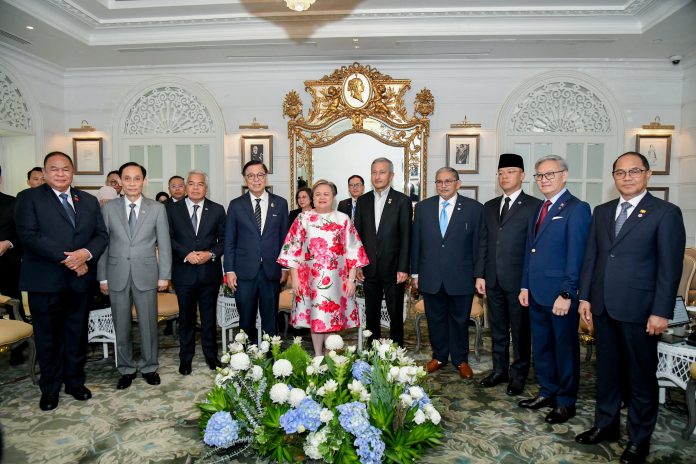
East Timor's Bendito dos Santos Freitas, Vietnam's Le Hoai Trung, Malaysia's Shamsul Azri Abu Bakar, Thailand's Sihasak Phuangketkeow, Philippines' Theresa Lazaro, Singapore's Vivian Balakrishnan, Brunei's Erywan Yusof, Indonesia's Sugiono, Laos' Thongsavanh Phomvihane and Myanmar's regime Foreign Minister Tin Maung Swe at an informal meeting of ASEAN foreign ministers in Bangkok, Thailand, on July 12. (Credit: Thailand Ministry of Foreign Affairs)

ASEAN Foreign Ministers meet with regime ‘counterpart’

Foreign ministers from the 11-member Association of Southeast Asian Nations (ASEAN) met with regime Foreign Minister Tin Maung Swe at an “informal” gathering in Bangkok, Thailand, on Sunday. Billed as a meeting with their ASEAN “counterpart” from Burma, foreign ministers from the 10 other ASEAN member countries decided to end a five-year-long freeze to meet with a senior Burma regime official from Naypyidaw.

Regime Foreign Minister Tin Maung Swe told the ASEAN Foreign Ministers that jailed State Counsellor Aung San Suu ​Kyi is in good health and is being “looked after,” according to ASEAN Special Envoy to ‌Burma Ma. Theresa P. Lazaro at a press ​conference in Thailand on July 12. The 2026 ASEAN Chair the Philippines had its request to have a meeting with Aung San Suu Kyi rejected by the regime in Naypyidaw on June 30

On July 11, Thai Foreign Minister Sihasak Phuangketkeow met with Tin ⁠Maung Swe in Bangkok to discuss border security, trade and environmental concerns. Thailand has sought to position itself as a bridge between Burma and ASEAN. Following earlier bilateral talks in February, Sihasak Phuangketkeow called on Naypyidaw to reduce violence and prevent attacks on civilians. Read more on our website

Over 300 Myanmar women killed by military 

A total of 332 women have been killed and over 300 others have been injured during air and artillery attacks, as well as other “violent acts” nationwide, since January, according to women’s rights group the Burmese Women’s Union (BWU). The data released by BWU on July 10 was collected and compiled from reports published by independent media from Burma, now in exile, between January to June.

A total of 242 women were killed during airstrikes carried out by the Burma Air Force. Another 29 women were killed by artillery attacks. Meanwhile 61 women were killed by other unnamed “violent acts” committed by regime forces on civilians in Burma. An additional 302 women have been injured during air and artillery attacks, as well as by landmines and sexual assault, perpetrated by regime troops. 

In a breakdown at the state and regional level, BWU added that Sagaing Region has the highest number of women killed at 102. Bago has the second highest number of women killed at 47. Arakan State has the third highest number of women killed at 41. In Magway, Mandalay and Tanintharyi regions, a total of 72 women were killed. In Karen, Chin, Kachin, Karenni, Shan and Mon states, a total of 70 women were killed. 

Wage theft allegations by migrant workers in Thailand

More than 210 legal migrant workers from Burma have been abruptly laid off or suspended without pay across Thailand’s Chonburi Province, triggering allegations of severe wage theft and labor violations. The mass dismissals highlight a growing trend of sudden staff cuts at factories outside the Thai capital Bangkok as employers grapple with declining manufacturing orders.

According to the Workers’ Assistance Group (WAG), an organization providing legal aid to migrant laborers from Burma in Thailand, the affected workers have been denied mandatory severance packages and accumulated back pay, leaving hundreds stranded in deep debt. The crisis spans two major sectors in Chonburi, an industrial hub located roughly 50 miles southeast of Bangkok.

On July 1, an estimated 106 Myanmar nationals employed at a Chinese-owned electronics factory were terminated without prior notice. WAG confirmed that all the terminated individuals held legal status under Memorandums of Understanding (MOU), Certificates of Identity (CI), and official work permits. Most had been at the factory for nearly seven months. None received the severance pay mandated under Thai labor law. Read more on our website

News by Region

Smoke rises in Karen State’s Myawaddy Township after retaliatory airstrikes were carried out by the regime against the Karen National Liberation Army in Minletpan village along the Thailand border on July 10. (Credit: DVB)

KAREN—Thai soldiers were deployed along the Burma border after artillery landed inside Thailand on Friday during fighting between regime forces and the Karen National Liberation Army (KNLA) in Myawaddy Township’s Minletpan village. Myawaddy is located 81 miles (130 km) east of the state capital Hpa-An.

Residents in the Thai border town of Mae Sot told DVB that they fear being struck by artillery. No casualties have been reported. Regime forces launched a counteroffensive to regain control of Minletpan after the KNLA seized it from the pro-regime Democratic Karen Benevolent Army (DKBA) in November

MAGWAY—Residents of Yesagyo Township told DVB that two civilians were killed and at least four others were injured when artillery fired by regime forces struck Khin Mun village on July 9. An unknown number of homes were also damaged. Yesagyo is located 93 miles (150 km) north of the region’s capital Magway.

Residents added that one civilian was injured by artillery fired on June 18. Regime media reported on July 9 that a counteroffensive was launched against the People’s Defence Force (PDF) “using schools as temporary bases” in Chauk Township, located 53 miles (85 km) north of Magway and 68 miles (110 km) south of Yesagyo.

NAYPYIDAW—The regime Ministry of Foreign Affairs stated that “a reciprocal visa exemption agreement” between Burma and Belarus went into effect on July 8, allowing holders of valid passports visa-free up to 30 days per visit at a maximum of 90 days per calendar year. The agreement was signed on Nov. 28, 2025. 

Belarusian President Aleksandr Lukashenko met with Min Aung Hlaing in Naypyidaw on July 2 during a one-day visit to Burma. Min Aung Hlaing also traveled to the Belarusian capital Minsk twice this year, first in March, and again in June as the two countries have expanded diplomatic and economic cooperation.

(Exchange rate: $1 USD = 4,260 MMK) 

Watch our latest report on DVB English News YouTube or Spotify. Listen on Apple, Audible, Amazon Music, or wherever you get podcasts.

Regime admits to systematic removal of Aung San statues, claims ‘substandard’ proportions

0
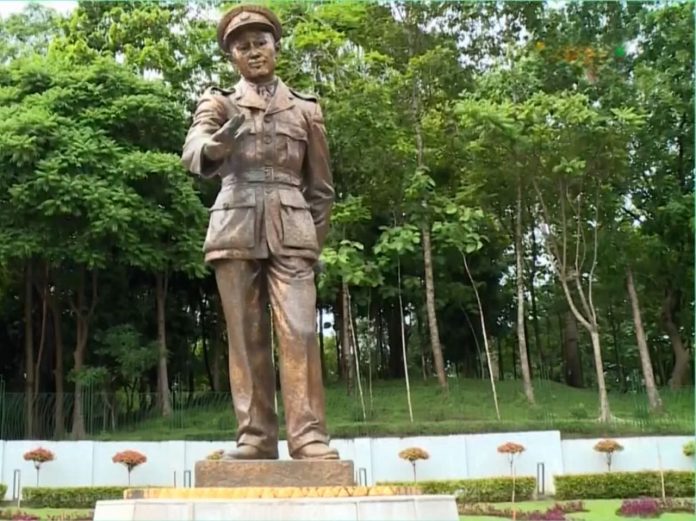
A General Aung San statue in Bogyoke Aung San Park in Yangon was unveiled on Feb. 13, 1955. (Credit: Regime)

In a rare public acknowledgement of an escalating nationwide campaign, the military regime has confirmed it is removing statues of General Aung San, the country’s independence hero and father of jailed State Counsellor Aung San Suu Kyi.

Regime spokesperson Khaing Khaing Soe stated on July 10 that authorities have been inspecting monuments in over 100 townships. She claimed the removals are not a wholesale erasure of the General’s legacy, but rather a review to address statues that are “substandard,” “incorrectly shaped,” or lack proper “dignity.”

“Some media outlets are currently reporting the removal of General Aung San statues in certain areas. In reality, not all statues… are being removed; rather, only statues with incorrect proportions and shapes are being reviewed and handled in accordance with the law,” Khaing Khaing Soe said in a statement.

She cited the Protection and Preservation of Ancient Monuments Law (1962) as the legal basis for the review, stating the goal is to ensure the General’s image is preserved “correctly” for future generations.

Contradicting reports and public outcry

The regime’s justification has been met with widespread skepticism and anger. Independent media tallies suggest a much more systematic effort to erase the General’s image from the public sphere, with at least 16 statues removed or destroyed since the February 2021 coup, according to DVB data.

Local reports describe a clandestine operation, with authorities frequently cutting electricity to parks and deploying heavy machinery under the cover of darkness to dismantle the monuments. Residents and activists have noted that the removals have surged in regions including Magway, Bago, Yangon, Ayeyarwady, Sagaing, and Mandalay.

  • Opposition Condemnation: The National League for Democracy (NLD) issued a formal statement on July 8, decrying the move as a calculated attempt to “destroy Myanmar’s national identity and history.”
  • Legal Warnings: The Burma Lawyers’ Council (BLC) has argued that the deliberate destruction of these statues—which were largely funded by public donations—constitutes criminal mischief under Section 425 of the Penal Code, punishable by up to seven years in prison.

Erasure beyond Public squares

The campaign against General Aung San’s image appears deeply linked to the broader suppression of the NLD and Aung San Suu Kyi’s influence.

In June, authorities stripped NLD symbols and a portrait of General Aung San from the walls outside 54 University Avenue in Yangon—the historic family home where Aung San Suu Kyi spent 15 years under house arrest.

Furthermore, the regime has continued its campaign of state-sponsored violence against the NLD, having dissolved the party in 2023, arrested thousands of its members, and systematically seized the private properties of hundreds of elected lawmakers.

While regime officials announced that a special exhibition would be held at the General Aung San Residence Museum in Natmauk, Magway Region for the upcoming Martyrs’ Day on July 19.

But critics argue the demolition campaign is a transparent attempt by the current pro-military administration to suppress symbols that inspire anti-coup resistance and to consolidate a state narrative that favours the military’s own version of history.

Myanmar tells ASEAN detained Aung San Suu Kyi will be looked after, special envoy says

0
Regime Foreign Affairs Minister Tin Maung Swe with Thailand’s Foreign Affairs and Deputy Prime Minister Sihasak Phuangketkeow in Bangkok, Thailand, on July 11–one day before his meeting with ASEAN Foreign Ministers in the Thai capital. (Credit: Regime)

Foreign ministers from the 11-member Association of Southeast Asian Nations (ASEAN) were told on Sunday by their Myanmar regime “counterpart” that jailed State Counsellor Aung San Suu ​Kyi is in good health and would be looked after, ASEAN’s special envoy to ‌Myanmar told a press conference in Thailand.

Ma. Theresa P. Lazaro, the Philippine foreign minister, has been seeking access to Suu Kyi, 81, who has been detained since her elected government was ousted in a 2021 military coup.

“My recollection of the statement of the Myanmar ​foreign minister on Aung San Suu Kyi is that she’s in good health and ​that the premise of how he said this is that she is a ⁠relative, she’s a sister and therefore we will take care of her,” Lazaro said in Bangkok on July 12.

Suu Kyi is serving a 27-year sentence, recently commuted by one-third, on a series of charges that ​her allies said were fabricated to keep her out of politics, including incitement, corruption, election fraud and violations of the state secrets law. She has denied wrongdoing.

Failed peace effort

The top diplomats of ASEAN met in person with Myanmar regime Foreign Minister Tin Maung Swe on July 12 for the first time since the ​coup, in an effort to kick-start a five-year-old peace initiative that has failed to end a civil war gripping ‌the ⁠country.

The conflict has killed an estimated 100,000 people and displaced several million more.

Myanmar’s senior regime officials have been banned from top-level ASEAN meetings since the military seized power because of their failure to implement a “five-point consensus” peace plan agreed with the bloc.

Regime leader Min Aung Hlaing, who led the 2021 military coup as commander-in-chief and jailed State Counsellor Aung San Suu Kyi, was appointed Myanmar’s president on April 10 following the regime’s 2025-26 elections that ended on Jan. 25.

Now a pro-military parliament, formed after what the U.N. and several western countries called “sham” elections, have sought to normalize relations with ASEAN.

Aung San Suu Kyi’s whereabouts are unknown, but Lazaro earlier said she had been ​transferred to a “designated location” in Naypyidaw, without elaborating further.

Thai Foreign Minister Sihasak Phuangketkeow said Tin ⁠Maung Swe had faced questions during the informal meeting in Bangkok on July 12 about the status of the Nobel Peace Prize laureate.

“We also made our comment that if the ASEAN special envoy could be given the ⁠opportunity to ​meet with Daw Aung San Suu Kyi, that would be ​even better so that we can be able to verify the claims that the foreign minister made,” he said, referring ​to her using a Myanmar honorific.

REUTERS

Myanmar airstrikes send munitions into Thailand as foreign ministers discuss border security

0
A delegation led by regime Foreign Affairs Minister Tin Maung Swe with Thailand’s Foreign Affairs and Deputy Prime Minister Sihasak Phuangketkeow in Bangkok, Thailand, on July 11–one day before his meeting with ASEAN Foreign Ministers in the Thai capital. (Credit: Thai Ministry of Foreign Affairs)

Thailand foreign minister met with his Myanmar regime “counterpart” on July 11 to discuss border security, trade and environmental concerns ahead of a rare gathering between Association of Southeast Asian Nations (ASEAN) foreign ministers and a senior Myanmar regime official in Bangkok, Thailand, on July 12.

The Bangkok meeting marks the first in-person talks between ASEAN foreign ministers and senior Myanmar regime officials since the military seized power in 2021.

Thailand has sought to position itself as a bridge between Myanmar and ASEAN. Following earlier bilateral talks in February, Deputy Prime Minister and Foreign Minister Sihasak Phuangketkeow called on Naypyidaw to reduce violence and prevent attacks on civilians.

The diplomatic discussions on border security took place as Myanmar military airstrikes on Karen National Liberation Army (KNLA) positions in Myawaddy Township sent munitions landing on Thai territory. Myawaddy is located 81 miles (130 km) east of the Karen State capital Hpa-An.

The regime deployed YAX-130 and Y-12 aircraft over three days to bomb KNLA positions near Myawaddy’s Minletpan village, located along the Myanmar-Thailand border directly across from Mae Sot district in Tak province.

The bombing intensified with 500-pound bombs before the area fell quiet overnight into July 11. Thai soldiers were deployed along the border after artillery landed inside Thailand on July 10, with residents in Mae Sot expressing fears of being struck.

The Tak Border Area Command Center for Thailand Myanmar Relations confirmed munitions landed in Moo 4 and Moo 9 of Mahawan subdistrict. Police cleared the explosives while military, administrative and community leaders briefed residents.

Task Force Rachamanu filed a formal protest through the Township Border Committee, urging caution over weapons use near the border, Thai media reported.

The Naresuan Task Force is coordinating the response to protect Thai sovereignty. Task Force Rachamanu, the 35th Ranger Regiment Task Force and the 34th Border Patrol Police Task Force in Mae Sot remain on standby with personnel and weapons ready.

The Royal Thai Air Force is prepared to scramble fighters should Myanmar Air Force jets violate Thai airspace.

Karen forces are believed to have suffered casualties from the airstrikes, though Thai officials are still verifying details. Homes on the Myanmar side of the border also sustained damage.

Regime forces launched the counteroffensive to regain control of Minletpan after the KNLA seized it from the pro-regime Democratic Karen Benevolent Army (DKBA) in November.

Thai officials stressed that Thailand is not a party to the conflict and does not support either side using Thai territory to further their aims. Residents who spot suspicious objects or possible unexploded ordnance are urged to report them immediately.

Contact