
Thursday, July 23, 2026
Home Blog Page 13

Myanmar airstrikes send munitions into Thailand as foreign ministers discuss border security

0
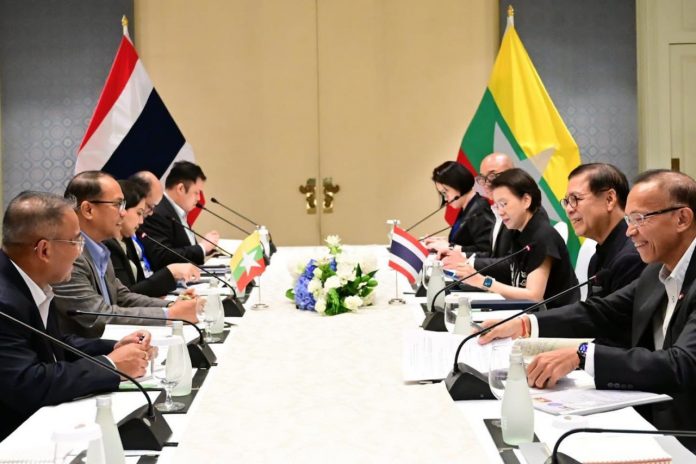
A delegation led by regime Foreign Affairs Minister Tin Maung Swe with Thailand’s Foreign Affairs and Deputy Prime Minister Sihasak Phuangketkeow in Bangkok, Thailand, on July 11–one day before his meeting with ASEAN Foreign Ministers in the Thai capital. (Credit: Thai Ministry of Foreign Affairs)

Thailand foreign minister met with his Myanmar regime “counterpart” on July 11 to discuss border security, trade and environmental concerns ahead of a rare gathering between Association of Southeast Asian Nations (ASEAN) foreign ministers and a senior Myanmar regime official in Bangkok, Thailand, on July 12.

The Bangkok meeting marks the first in-person talks between ASEAN foreign ministers and senior Myanmar regime officials since the military seized power in 2021.

Thailand has sought to position itself as a bridge between Myanmar and ASEAN. Following earlier bilateral talks in February, Deputy Prime Minister and Foreign Minister Sihasak Phuangketkeow called on Naypyidaw to reduce violence and prevent attacks on civilians.

The diplomatic discussions on border security took place as Myanmar military airstrikes on Karen National Liberation Army (KNLA) positions in Myawaddy Township sent munitions landing on Thai territory. Myawaddy is located 81 miles (130 km) east of the Karen State capital Hpa-An.

The regime deployed YAX-130 and Y-12 aircraft over three days to bomb KNLA positions near Myawaddy’s Minletpan village, located along the Myanmar-Thailand border directly across from Mae Sot district in Tak province.

The bombing intensified with 500-pound bombs before the area fell quiet overnight into July 11. Thai soldiers were deployed along the border after artillery landed inside Thailand on July 10, with residents in Mae Sot expressing fears of being struck.

The Tak Border Area Command Center for Thailand Myanmar Relations confirmed munitions landed in Moo 4 and Moo 9 of Mahawan subdistrict. Police cleared the explosives while military, administrative and community leaders briefed residents.

Task Force Rachamanu filed a formal protest through the Township Border Committee, urging caution over weapons use near the border, Thai media reported.

The Naresuan Task Force is coordinating the response to protect Thai sovereignty. Task Force Rachamanu, the 35th Ranger Regiment Task Force and the 34th Border Patrol Police Task Force in Mae Sot remain on standby with personnel and weapons ready.

The Royal Thai Air Force is prepared to scramble fighters should Myanmar Air Force jets violate Thai airspace.

Karen forces are believed to have suffered casualties from the airstrikes, though Thai officials are still verifying details. Homes on the Myanmar side of the border also sustained damage.

Regime forces launched the counteroffensive to regain control of Minletpan after the KNLA seized it from the pro-regime Democratic Karen Benevolent Army (DKBA) in November.

Thai officials stressed that Thailand is not a party to the conflict and does not support either side using Thai territory to further their aims. Residents who spot suspicious objects or possible unexploded ordnance are urged to report them immediately.

Rights groups condemn ASEAN for breaking five-year freeze to meet senior Myanmar regime official

0
Philippine Foreign Affairs Secretary Theresa Lazaro delivers an opening statement during the Association of Southeast Asian Nations Foreign Ministers' Meeting ahead of the 48th ASEAN Summit and Related Meetings in Cebu, Philippines, on May 7. (Credit: Reuters)

The Association of Southeast Asian Nations (ASEAN) is facing severe backlash from international human rights experts ahead of an informal summit in Bangkok on Sunday.

The meeting will mark the first face-to-face engagement between ASEAN foreign ministers and a senior Myanmar regime official since the military seized power in 2021.

The talks, hosted by Thailand, will include Myanmar’s regime-appointed Foreign Affairs Minister, Tin Maung Swe.

The move signals a highly controversial shift for the 11-member bloc, which has barred senior regime officials from high-level meetings for the past five years due to their refusal to halt violence against civilians.

‘Precipice of Irrelevance’

The decision to re-engage with the regime has drawn immediate and fierce condemnation from regional watchdogs. On July 11, both the Special Advisory Council for Myanmar (SAC-M) and ASEAN Parliamentarians for Human Rights (APHR) issued statements denouncing the summit.

  • Yanghee Lee, a prominent member of SAC-M, issued a stark warning, stating that by agreeing to meet with the regime’s representative, ASEAN risks complete “irrelevancy” and is actively undermining its own diplomatic frameworks.
  • Mercy Chriesty Barends, Chairperson of the APHR, accused the bloc of explicitly “rewarding” Naypyidaw’s ongoing atrocities and its blatant non-compliance with the Five-Point Consensus—ASEAN’s official peace plan. She demanded the regime be held legally accountable for its crimes against the people of Myanmar rather than being granted a seat at the table.

A history of defiance and snubs

The diplomatic olive branch comes on the heels of yet another direct snub by the military regime toward ASEAN leadership.

On June 30, the regime outright rejected a formal request from Philippine Secretary of Foreign Affairs Ma. Theresa P. Lazaro, the 2026 ASEAN Chair Special Envoy on Myanmar. Manila had requested Lazaro meet with jailed State Counsellor Aung San Suu Kyi—a core requirement for inclusive dialogue under the ASEAN peace plan—but was denied access.

The regime’s refusal to cooperate is part of a years-long pattern. Regime leader Min Aung Hlaing personally attended an ASEAN summit in April 2021 and agreed to the peace plan, which mandates an immediate end to violence, the release of all political prisoners, and inclusive dialogue among all stakeholders.

Upon returning to Myanmar, he abandoned the agreement, launching a brutal nationwide crackdown that has killed thousands and displaced millions, leading to the initial diplomatic freeze that ASEAN now appears to be thawing.

Typhoon Bavi makes landfall in eastern China as more than 1 million are evacuated

0
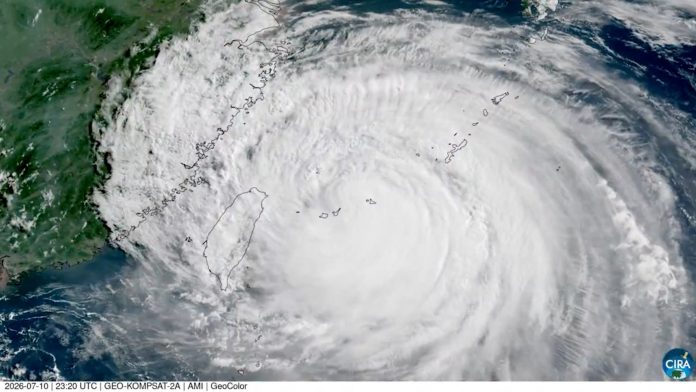
A satellite image shows Typhoon Bavi reaching Japan's Ryukyu Islands, bringing impact to them and Taiwan, on July 10, 2026. (Credit: NASA)

Typhoon Bavi made landfall in China’s eastern province of Zhejiang late on Saturday night and was expected to gradually weaken, according to China’s national weather center.

Bavi previously brought strong winds and rain to Japan’s southern islands and Taiwan. It was the second typhoon to impact China in just over a week’s time. The first, Maysak, made landfall in southern China on July 3.

Chinese authorities have evacuated more than 1.7 million people as of Saturday and issued high alerts while eastern China braced for Bavi, which had maximum sustained winds of 144 kph (89 mph) near its center.

After passing north of Taiwan on Saturday and making landfall in the coastal city of Yuhuan in Zhejiang, Bavi is expected to move northwestward inland, the National Meteorological Center said.

Earlier, at least 17 people were killed in the southern Philippines, mostly due to landslides that were set off by seasonal monsoon rains that Bavi intensified before the typhoon blew away toward Taiwan, Philippine officials said Saturday.

China evacuates over 1.7 million people

Authorities in Zhejiang had evacuated more than 1.7 million people by Saturday morning, the official Xinhua News Agency said. By noon, Shanghai, also on China’s eastern coast, relocated around 34,000 residents from high-risk areas, according to Xinhua.

Southeastern Chinese cities near the coast prepared for the impacts. In Ningde in Fujian province, more than 3,700 people were relocated from high-risk onshore areas as of Friday evening, Xinhua said. Authorities in Fujian province placed over 17,000 emergency rescue workers on standby.

China’s weather center issued an orange typhoon alert, the second-highest on a four-tier level, with many schools and ferry services suspended. Hundreds of flights have been canceled, and some high-speed railway services halted.

The center on Saturday also issued the first red alert for rainstorms of the year, according to state broadcaster CCTV.

Chinese authorities said Saturday they have allocated 40 million yuan ($5.9 million USD) in central natural disaster relief funds to support Zhejiang and Fujian provinces’ typhoon prevention and emergency rescue and relief efforts.

Landslides kill more than a dozen in the Philippines

In the Philippines, a landslide set off by monsoon rains that Bavi intensified hit a village before dawn Friday in the coastal town of Malapatan in southern Sarangani province, killing at least 10 villagers and leaving three others missing, Office of Civil Defense spokesperson Diego Mariano said.

A separate landslide in Calanogas town in southern Lanao del Sur province before dawn on Friday killed five people, with six others missing, he said.

Two people drowned in floodwaters Wednesday in the southern province of Bukidnon, Mariano said without providing other details.

Office of Civil Defense deputy administrator Bernardo Rafaelito Alejandro IV said about 11,000 villagers moved to 77 emergency shelters mostly in southern Philippine provinces in recent days due to the stormy weather.

More than 110 people injured in Taiwan as high winds hit Japan

As of Saturday at 7 p.m., Taiwanese authorities registered at least 113 injuries from Typhoon Bavi, some sustained while riding motorcycles in rain and winds on slippery roads.

More than 14,200 people had also been evacuated around the island, including from the eastern county of Hualien and the central city of Taichung. Schools and offices in most parts of Taiwan were suspended Saturday.

Across Japan’s southern islands in the prefecture of Okinawa, local authorities earlier warned of high waves, strong winds and storm surges, with more than 200 flights canceled across the region, according to Japan’s public broadcaster NHK. Strong winds and rain had hit islands including Ishigaki.

AP

Protest against China-backed Myanmar mines in Thailand

0
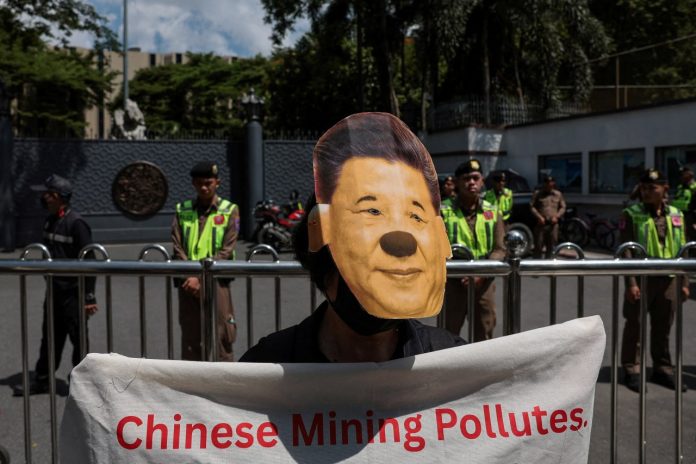
A Thai activist wears a mask of Chinese President Xi Jinping at a protest on July 8 against an alleged use of violence by Thai police on behalf of the Chinese consulate in Chiang Mai on July 6, when a protest was held to demand action by Beijing over cross-border toxic contamination affecting the Kok, Sai, Ruak and Mekong rivers, which they say is caused by unregulated mining operations backed by China in Myanmar. (Credit: Reuters)

Environmental defenders and civil society networks converged on the Chinese Embassy in Bangkok, Thailand, on July 8 to demand immediate accountability from Beijing for toxic transboundary pollution destroying northern Thailand’s waterways.

Read more about the Bangkok protest.

See our photos from the Chiang Mai protest.

Protests outside Lao, Chinese Missions in US on anniversary of Student Uprising in Myanmar

0
Myanmar pro-democracy activists in the U.S. stage a protest holding National League for Democracy party flags and banners condemning the military in front of the Embassy of Myanmar in Washington D.C. on July 9. (Credit: DVB)

Myanmar pro-democracy activists in the United States staged a series of protests across the nation’s capital on July 9, gathering outside the Embassies of Myanmar and Laos, as well as the residence of the Chinese ambassador.

The demonstrations were held to commemorate the 64th anniversary of the historic “7 July Student Uprising” and to condemn neighboring countries for their continued support of the military regime in Naypyidaw.

The protests highlight growing frustration among the Myanmar diaspora regarding international engagement with regime leader Min Aung Hlaing.

Following his inauguration as Myanmar’s president by a pro-military parliament on April 10, Min Aung Hlaing has embarked on a series of high-profile state visits to bolster diplomatic ties.

Frustration over international complicity

Activists specifically targeted the diplomatic missions of Laos and China due to their recent engagements with the regime leader.

“We oppose Laos and China for supporting the Myanmar military,” Dr. Tun Wai, an activist at the Washington D.C. protest, told DVB.

The diplomatic visits in question include:

For the protesters, these diplomatic receptions grant unwarranted legitimacy to a regime responsible for ongoing violence against civilians.

“Min Aung Hlaing is not a real president,” said Myat Yin Chaw, a Myanmar activist participating in the U.S. protests. “People are dying because of him and his troops. We condemn everyone and every government that supports him.”

Honoring the 7 July Student Uprising

The timing of the protests coincided with the 64th anniversary of the ‘7 July Student Uprising’ in 1962. The historical event is a cornerstone of Myanmar’s pro-democracy movement.

On July 7, 1962, students at Rangoon University (now University of Yangon) held mass demonstrations against severe campus restrictions imposed by General Ne Win, who had seized power in a military coup earlier that year.

The regime responded with brutal force, killing dozens of unarmed students. The following day, military authorities dynamited the historic Rangoon University Students’ Union building to physically crush the symbol of student resistance.

Today, activists globally continue to invoke the spirit of the 1962 protests as a symbol of defiance against the current military dictatorship, linking the historical struggle for democracy to the ongoing resistance against the Feb, 1, 2021 military coup.

US extends work permits for immigrants with Temporary Protected Status

0
The U.S. Department of Homeland Security seal is displayed ahead of an expected press conference at the FEMA National Response Coordination Center in Washington, D.C. on January 24, 2026. (Credit: Reuters)

U.S. President ⁠Donald ⁠Trump’s administration on Friday extended ⁠work permits for hundreds of thousands of immigrants with ​temporary protected status from Haiti and six other countries, hours before they were due ‌to expire. 

The U.S. Citizenship and Immigration ‌Services, which is part of the Department of Homeland Security, said work ⁠permits for ⁠Haitians with temporary protected status will now expire on July ​24. Permits for recipients from Ethiopia, Syria, Somalia, Yemen, South Sudan and Myanmar will end in a week’s time. 

The U.S. Supreme Court ruled last month that the Trump administration ​could end temporary protected status for Haitians and Syrians. 

Temporary protected status allows people ⁠already in ⁠the United States to ⁠remain in ​the country and work legally if their home countries are affected by natural ​disasters, armed conflict or ⁠other extraordinary conditions.

Rights advocates and community members have expressed fear that the Supreme Court’s decision could strip hundreds of thousands of people of work authorization and protection from deportation.

Labor groups had urged an extension of the work permissions, arguing ⁠that their removal could result in “chaos in workplaces and disrupt key industries.”

Trump ⁠has pursued a hardline immigration crackdown and deportation drive, which has been widely condemned by human rights groups as being in violation of free speech and due process rights. 

Human rights groups also say the crackdown has created an unsafe environment for ethnic minorities and raised concerns of racial profiling.

While Trump campaigned in 2024 on a platform of stopping illegal immigration, his administration has also made legal immigration more difficult – or ⁠example, by imposing new and expensive fees for applicants of certain visas and by enforcing the vetting of social media of applicants and immigrants already in the country.

Trump says his actions aim at improving domestic ​security and at securing jobs for U.S. citizens.

REUTERS

Contact