Thursday, July 23, 2026
Home Blog Page 14

US extends work permits for immigrants with Temporary Protected Status

0
The U.S. Department of Homeland Security seal is displayed ahead of an expected press conference at the FEMA National Response Coordination Center in Washington, D.C. on January 24, 2026. (Credit: Reuters)

U.S. President ⁠Donald ⁠Trump’s administration on Friday extended ⁠work permits for hundreds of thousands of immigrants with ​temporary protected status from Haiti and six other countries, hours before they were due ‌to expire. 

The U.S. Citizenship and Immigration ‌Services, which is part of the Department of Homeland Security, said work ⁠permits for ⁠Haitians with temporary protected status will now expire on July ​24. Permits for recipients from Ethiopia, Syria, Somalia, Yemen, South Sudan and Myanmar will end in a week’s time. 

The U.S. Supreme Court ruled last month that the Trump administration ​could end temporary protected status for Haitians and Syrians. 

Temporary protected status allows people ⁠already in ⁠the United States to ⁠remain in ​the country and work legally if their home countries are affected by natural ​disasters, armed conflict or ⁠other extraordinary conditions.

Rights advocates and community members have expressed fear that the Supreme Court’s decision could strip hundreds of thousands of people of work authorization and protection from deportation.

Labor groups had urged an extension of the work permissions, arguing ⁠that their removal could result in “chaos in workplaces and disrupt key industries.”

Trump ⁠has pursued a hardline immigration crackdown and deportation drive, which has been widely condemned by human rights groups as being in violation of free speech and due process rights. 

Human rights groups also say the crackdown has created an unsafe environment for ethnic minorities and raised concerns of racial profiling.

While Trump campaigned in 2024 on a platform of stopping illegal immigration, his administration has also made legal immigration more difficult – or ⁠example, by imposing new and expensive fees for applicants of certain visas and by enforcing the vetting of social media of applicants and immigrants already in the country.

Trump says his actions aim at improving domestic ​security and at securing jobs for U.S. citizens.

REUTERS

When History Changes the Question

0
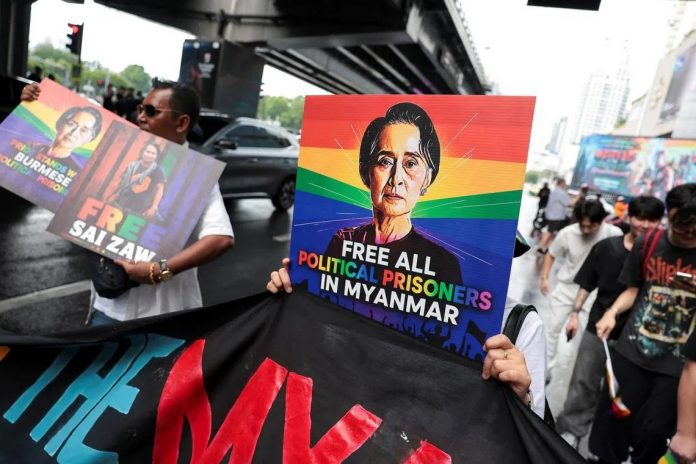
A protester holds up a sign demanding Myanmar free all political prisoners held since the 2021 military coup, including jailed State Counsellor Aung San Suu Kyi, at the Pride Parade in Bangkok, Thailand, on May 31. (Credit: Reuters)

Guest contributor

Alan Clements

History has rendered its verdict, but the tragedy is that so few were listening when the verdict still had the power to save lives. When Aung San Suu Kyi stood before the International Court of Justice in The Hague in December 2019, much of the world believed it was witnessing the moral collapse of a woman it had once sanctified.

What the world largely failed to see was the machinery behind the moment: a military system that had brutalized Myanmar for generations, perfected impunity as governance, and would soon reveal that its appetite for violence was never limited to one people, one frontier, one religion, or one allegation before a court.

The catastrophe after the coup of February 1, 2021, has made one truth impossible to evade. The Burmese military was never an instrument of law. It was an architecture of domination. It burned Rohingya villages, and it burned Karen villages. It bombed Kachin, Chin, Karenni, Shan, Bamar, and countless civilian communities across the nation.

It imprisoned elected leaders, students, monks, poets, journalists, physicians, teachers, and children. It made democracy itself the newest ethnic identity under attack.

By 2026, the United Nations estimated 3.6 million people displaced, more than 12 million facing acute hunger, and nearly one third of the country requiring humanitarian assistance; the Assistance Association for Political Prisoners has reported tens of thousands detained since the coup, while the war continues to devour the civilian body of the nation.

What was missed in 2019 was not the reality of suffering. The suffering was real, immense, and unbearable. What was missed was the deeper structure of power. The world became absorbed in the moral drama of one woman while failing to confront the institution that had trapped an entire nation inside a constitution designed to preserve military supremacy.

It judged personality while neglecting machinery. It debated symbols while the generals retained the guns, the courts, the prisons, the ministries, the money, and the constitutional veto. The result was not justice. It was historical blindness dressed in moral certainty.

Aung San Suu Kyi did not create the Tatmadaw (military). She spent much of her life imprisoned by it. She did not design the 2008 constitution that guaranteed the military control over key ministries and gave it the power to paralyze democratic transition.

She did not command the battalions that had terrorized ethnic nationality areas for decades before she entered elected office.

Yet the world, intoxicated by the simplicity of betrayal, found it easier to condemn the fallen icon than to understand the prison in which Myanmar’s democracy had been forced to operate.

That prison has now become visible to everyone, because the generals, once they seized total power again, did what they had always done.

They unleashed the state upon the people.

The crime has not changed. Only the victims have multiplied. The military has always been ideologically impartial in one respect: it will brutalize anyone who stands between it and absolute power. Rohingya, Karen, Kachin, Chin, Karenni, Shan, Bamar, Muslim, Christian, Buddhist, student, monk, villager, journalist, elected official, farmer, doctor, mother, child: the categories change, but the logic remains the same.

The military’s enemy is not one ethnicity. Its enemy is accountability. Its enemy is federal democracy. Its enemy is civilian life organized beyond the reach of command.

This is what history now forces us to understand. The international community spent years debating whether Aung San Suu Kyi had fallen from grace while insufficiently asking what would happen if the military were allowed to retain its coercive sovereignty beneath the costume of transition.

The answer is everywhere now: in the burned villages, in the bombed schools, in the emptied townships, in the refugee columns, in the mothers searching for children, in the prisoners disappeared into interrogation centers, in the bodies buried without witnesses, in the silence surrounding a woman who once embodied the democratic aspirations of an entire people.

There is a terrible arrogance in assuming that moral outrage is the same as moral understanding. Outrage can be necessary. It can awaken conscience, interrupt denial, and force the world to look where it would rather not look.

But outrage without historical comprehension can become another form of violence. It reduces the living complexity of a nation to a courtroom of spectators demanding purity from those trapped inside impossible structures.

Myanmar was never a morality play arranged for the emotional convenience of distant observers. It was, and remains, a nation attempting to free itself from one of the world’s longest-running military dictatorships while holding together one of the most ethnically, linguistically, religiously, and historically diverse societies on Earth.

The tragedy is that much of the world confused the failure of a constrained democratic transition with the failure of one woman. It mistook propaganda for analysis, fragmentation for truth, and ideological certainty for knowledge.

It underestimated the capacity of authoritarian systems to manipulate perception, isolate leaders, weaponize ethnic suffering, and divide natural allies.

It ignored what many inside Myanmar’s democracy movement understood with painful clarity: that without federal democracy, without constitutional transformation, without the removal of military supremacy from the heart of the state, every community remained vulnerable.

That prophecy has now become reality.

Myanmar is no longer merely a tragedy. It is a warning to every democracy on Earth. When military power is permitted to stand above civilian authority, when truth becomes subordinate to narrative, when institutions are hollowed out from within, when law becomes performance, when international attention is episodic and morally selective, authoritarianism does not retreat.

It waits. It adapts. It learns the language of diplomacy while preparing the next assault. It survives condemnation because condemnation without strategy is theatre.

Justice delayed does not disappear. It metastasizes.

The lesson of Myanmar is not simply “Never Again.” That phrase has become too easy, too ceremonial, too frequently uttered after the machinery of destruction has already completed its work.

The lesson is more demanding. Freedom cannot be defended selectively. Human rights cannot be universal only when they are politically convenient. Democracy cannot survive if the world waits until fire reaches its own doorstep before recognizing the smoke rising elsewhere.

The defense of one people must never require the abandonment of another, and the suffering of one community must never be weaponized to obscure the system that threatens all.

Aung San Suu Kyi’s deepest political warning was always that fear destroys truth. Fear makes dictatorships possible, but it also makes democracies cowardly. It tempts observers to choose certainty over inquiry, slogans over history, punishment over understanding.

Fear prefers heroes and villains because structures are harder to confront. Fear wants one name to bless and one name to destroy, while the machinery of domination continues in the background, patient, disciplined, armed, and unashamed.

This is where Aung San Suu Kyi is today: more than five years imprisoned since the coup, reportedly held in severe isolation, with her family and supporters repeatedly demanding credible proof of life and access to her.

Her son has publicly demanded proof that she is alive, and reports in 2026 described continuing uncertainty over her health, whereabouts, and conditions, despite junta claims of sentence reductions and house arrest.

And this is where Myanmar is today: millions displaced, millions hungry, tens of thousands detained, villages burned, hospitals bombed, schools shattered, journalists imprisoned, ethnic homelands devastated, cities terrorized, and an entire people’s democratic future held hostage by men who have mistaken coercion for legitimacy.

All for what? For the preservation of military power. For the vilification of one woman based on propaganda, misinformation, selective memory, and the inability—or refusal—of too many people to understand the true architecture of the circumstance.

Myanmar is not asking for pity. Pity is too small for a nation of such courage. Myanmar is demanding moral imagination, historical honesty, and the courage to see what should have been seen long ago: that democracy does not die only when tanks enter a capital.

It dies when the world mistakes the smoke for the fire, the symbol for the structure, the accused for the architect, and the suffering of a people for a story too complicated to sustain our attention.

History has rendered its verdict. The question now is whether anyone, finally, will listen.


Alan Clements is an author, former Buddhist monk ordained in Burma, and longtime human-rights advocate whose life’s work has centered on conscience, nonviolence, and the struggle against authoritarian rule. He is the author of seventeen books.

DVB publishes a diversity of opinions that do not reflect DVB’s editorial policy. We’d like to hear what you think about this or any of our stories: [email protected]o

Mass layoffs of Myanmar migrant workers in Thailand spark wage theft allegations

0
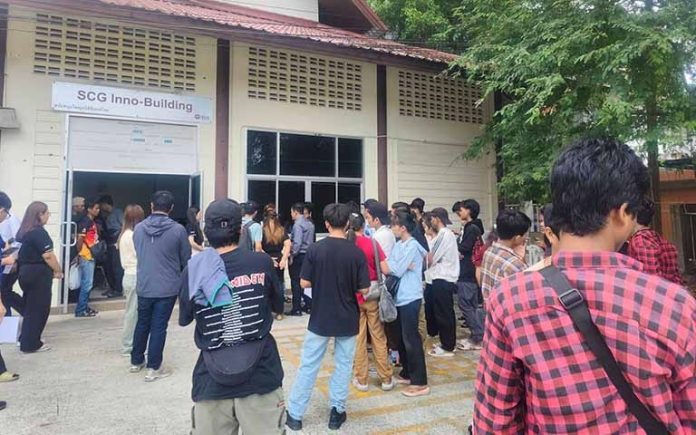
Myanmar migrant workers outside of a factory in Thailand’s Chonburi Province in March. (Credit: MHAC)

More than 210 legal and irregular migrant workers from Myanmar have been abruptly laid off or suspended without pay across Thailand’s Chonburi Province, triggering allegations of severe wage theft and labor violations.

The mass dismissals highlight a growing trend of sudden staff cuts at factories outside the Thai capital Bangkok as employers grapple with declining manufacturing orders.

According to the Workers’ Assistance Group (WAG), an organization providing legal aid to migrant laborers, the affected workers have been denied mandatory severance packages and accumulated back pay, leaving hundreds stranded in deep debt.

Sudden dismissals and suspended wages

The crisis spans two major sectors in Chonburi, an industrial hub located roughly 50 miles southeast of Bangkok:

  • The Electronics Sector: On July 1, an estimated 106 Myanmar nationals employed at a Chinese-owned electronics factory were terminated without prior notice. WAG confirmed that all the terminated individuals held legal status under Memorandums of Understanding (MOU), Certificates of Identity (CI), and official work permits. Most had been at the factory for nearly seven months. None received the severance pay mandated under Thai labor law.
  • The Construction Sector: In a separate incident, 111 Myanmar construction workers were suspended without warning. The employer withheld a total of 40 days of wages. WAG estimates that the company owes each worker approximately 20,000 baht ($615 USD), totaling more than two million baht ($61,500 USD) in unpaid wages.

Adding to the financial strain, the construction workers had each paid a 2,000 baht ($61 USD) recruitment fee to an intermediary agency just to secure the employment.

“When they lay people off, most factories say orders have run out and they need to reduce staff,” said Htet, a Myanmar factory worker living in Chonburi.

He emphasized that because many migrants borrow heavily to finance their trip to Thailand, losing a job without compensation immediately plunges families into severe financial distress.

WAG confirmed they are actively assisting the workers to file formal complaints through the Chonburi District Social Security Office to reclaim their lost wages and secure legal remedies.

The broader migration crisis

The labor exploitation in Chonburi takes place against the backdrop of an unprecedented migration surge out of Myanmar.

According to data released by the U.N. International Organization for Migration (IOM), a staggering 687,000 Myanmar nationals entered Thailand through major border checkpoints (including Tak, Ranong, Kanchanaburi, and Chiang Rai) in just the first four months of the year.

The IOM estimates that 4.6 million Myanmar nationals currently reside in Thailand. Of that total, roughly 64 per cent are formally registered with the Department of Employment, while 36 percent live in “irregular situations.”

Independent assessments link the recent spike in migration to two major destabilizing events inside Myanmar:

[Feb 2024: Conscription Law Enacted] 
       │
       ▼ (Forces thousands of young adults to flee)
[Mar 2025: 7.7-Magnitude Earthquake]
       │
       ▼ (Destroys infrastructure, forcing 687k+ across Thai borders)
[July 2026: Industrial Exploitation]
       │
       ▼ 
Mass layoffs hit vulnerable migrant workforce in Thai industrial hubs

The IOM’s border research, based on interviews with 3,504 respondents, revealed that 41 per cent of recent arrivals entered Thailand without legal documentation.

While 11 per cent expressed an intention to remain in Thailand long-term, a significant portion cited the regime’s mandatory conscription law—which forces young men and women into military service—and the economic fallout of the March 2025 earthquake as their primary reasons for fleeing.

As thousands continue to cross the border daily to escape conflict, labor advocates warn that migrant workers face heightened vulnerability, with predatory employers taking advantage of their desperation to bypass basic labor protections.

ASEAN to discuss engagement with Myanmar at special meeting, Philippines says 

0
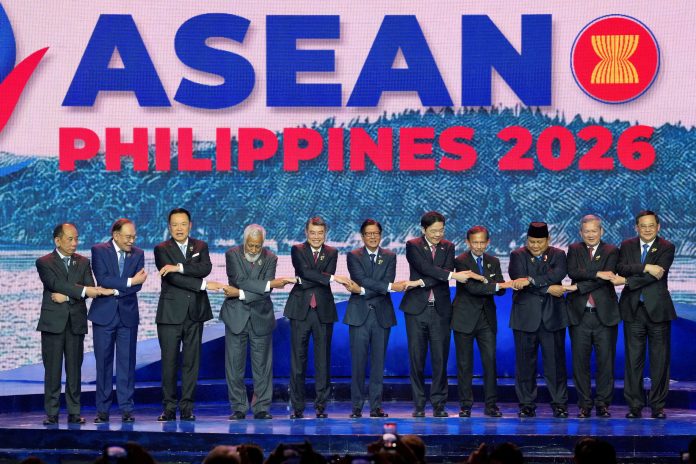
Myanmar regime Permanent Secretary of the Ministry of Foreign Affairs Hau Khan Sum, Malaysia's Prime Minister Anwar Ibrahim, Thailand's Prime Minister Anutin Charnvirakul, East Timor's Prime Minister Xanana Gusmao, Vietnam's Prime Minister Le Minh Hung, Philippine President Ferdinand Marcos Jr., Singapore's Prime Minister Lawrence Wong, Brunei's Sultan Hassanal Bolkiah, Indonesia's President Prabowo Subianto, Cambodia's Prime Minister Hun Manet, and Laos’ Prime Minister Sonexay Siphandone pose for a group photo during the opening ceremony of the 48th ASEAN Summit and Related Meetings, in Cebu, Philippines, on May 8, 2026. (Credit: Reuters)

An upcoming meeting between foreign ministers of the Association of Southeast Asian Nations (ASEAN) and Myanmar’s regime Foreign Minister Tin Maung Swe will tackle the regime’s engagement with the ‌regional bloc after being excluded from it over the last five years, the Philippines said on Friday.

As 2026 chair of the 11-member ASEAN, the Philippines will lead Sunday’s gathering in Bangkok, the first in-person meeting with Myanmar’s regime since it seized power during a 2021 ​military coup, which led to an uprising against military rule in Myanmar.

An estimated 100,000 people have been killed and over 3.7 million civilians have been displaced from their homes, according to the Armed Conflict Location & Event Data (ACLED) project and the U.N.

Myanmar is now ruled by a pro-military administration led by regime leader Min Aung Hlaing, who was inaugurated president by a pro-military parliament on April 10 following highly controversial elections held by the regime from Dec. 28, 2025 to Jan. 25.

The Philippine foreign ministry stressed Myanmar remained an integral part of ASEAN ​and Sunday’s meeting would be informal, giving Myanmar’s foreign minister a chance to brief counterparts on the ​situation in the country.

“They are expected to exchange views on ASEAN’s engagement with Myanmar, as well as on possible concrete ‌steps ⁠in which Myanmar may address concerns on the cessation of violence, constructive dialogue among concerned parties, and humanitarian assistance,” it said in a statement.

Myanmar pushback on peace plan

Min Aung Hlaing is seeking to end the impasse with ASEAN and made his first state visit to an ASEAN member country, Laos, last week.

Central to Myanmar’s exclusion ​was his failure to implement ​the ASEAN Five Point Consensus, the regional bloc’s peace plan that he ⁠agreed to implement in April 2021 but failed to implement over the last five years.

Normalising ties with Naypyidaw could be made more challenging by a motion in ​Myanmar’s pro-military parliament to counter the peace plan, calling it interference in its ​internal affairs ⁠and a violation of ASEAN’s core principles.

An article on Friday that stretched across two pages of the Global New Light of Myanmar, the military’s mouthpiece, said lawmakers had endorsed a resolution asking the government to review and ⁠challenge ASEAN’s ​position.

“During the discussions, lawmakers from both houses largely supported the ​motion, arguing that ASEAN should reassess its position on Myanmar following political developments and the formation of a new elected government,” regime media reported.

REUTERS

‘Education for All’: Thailand expands access to Myanmar migrants [AUDIO]

0
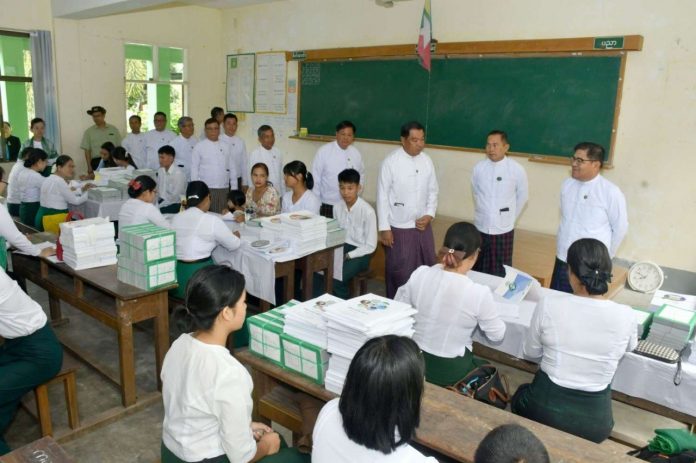
Students with their parents enrol for the 2026–27 academic year at a basic education school in Naypyidaw in May. (Credit: Regime media)

Thailand’s new “Education for All” policy allows migrant and undocumented children from Myanmar to attend government schools. UNICEF Thailand has reported that migrant and stateless children are guaranteed 15 years of free education.

Yet many remain out of school. The gap, education groups say, is not in the policy. It is in enrolment. They say better coordination between migrant learning centers and Thai government schools could help children continue their education.

Watch the report on DVB English News YouTube.

‘Education for All’: Thailand expands access to migrants

0
Students with their parents enrol for the 2026–27 academic year at a basic education school in Naypyidaw in May. (Credit: Regime media)

Thailand’s new “Education for All” policy allows migrant and undocumented children from Myanmar to attend government schools. UNICEF Thailand has reported that migrant and stateless children are guaranteed 15 years of free education.

Yet many remain out of school. The gap, education groups say, is not in the policy. It is in enrolment. They say better coordination between migrant learning centers and Thai government schools could help children continue their education.

Contact