Thursday, July 23, 2026
Home Blog Page 4

TNLA wants formal recognition of ‘Ta’ang State’ from regime in Naypyidaw

0
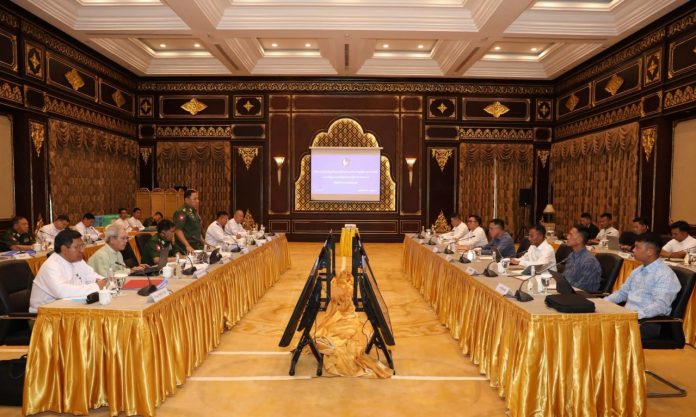
Representatives from the Ta’ang National Liberation Army met with the regime’s National Solidarity and Peacemaking Negotiation Committee in Naypyidaw on July 19. (Credit: Regime)

Representatives from the ethnic Palaung armed group, the Ta’ang National Liberation Army (TNLA), met with the regime’s National Solidarity and Peacemaking Negotiation Committee (NSPNC) in Naypyidaw on Sunday to negotiate terms on regional development, healthcare, and territorial stability.

The talks marked a significant diplomatic push by the TNLA, which formally requested that the regime recognize territory currently under its governance as an autonomous “Ta’ang State.”

In exchange, TNLA delegates assured regime negotiators that the proposed state would remain an integral part of the Union of Myanmar and would not attempt to secede. The group did not publicly detail the exact geographical boundaries it proposes for the new state.

Parallel consolidation: MNDAA establishes ‘civilian-led’ administrations

While the TNLA engaged in direct talks in the capital, its former alliance partner, the ethnic Kokang Myanmar National Democratic Alliance Army (MNDAA), executed a major administrative expansion.

The MNDAA officially announced the rollout of civilian-led administrative bodies across four newly designated districts within Special Region 1 in northern Shan State.

The move highlights a broader trend among major Ethnic Armed Organizations (EAOs) in northern Myanmar to institutionalize state-like governance over territories liberated or claimed during recent years of conflict.

A volatile territorial map: From offensive to ceasefire

The TNLA’s political demands follow nearly three years of dramatic territorial shifts across northern Shan State and Mandalay Region.

Northern Shan State & Mandalay Timeline
├── Oct 2023: Launch of 'Operation 1027' by Three Brotherhood Alliance (TNLA, MNDAA, AA)
├── 2024–2025: TNLA captures 12 townships across Shan State and Mandalay Region
├── Late 2025: Regime counteroffensives retake Kyaukme, Hsipaw, and Nawnghkio
├── Oct 28, 2025: TNLA signs China-brokered ceasefire with Naypyidaw
├── Nov 28, 2025: TNLA hands over Mogok and Momeik to regime per ceasefire terms
├── Mar 15, 2026: MNDAA takes full control of Kutkai from TNLA after territorial dispute
└── May 12, 2026: Regime orders TNLA to surrender Namhkam, Namtu, Mongngawt, and Monglon

The TNLA initially gained massive ground alongside the MNDAA and Arakan Army (AA) during Operation 1027, capturing the constitutionally recognized Palaung Self-Administered Zone (SAZ)—comprising Namhsan and Manton—alongside Namtu, Namhkam, Mongngawt, Monglon, Kutkai, Momeik, Kyaukme, Hsipaw, Nawnghkio, and Mogok in Mandalay Region.

However, maintaining control over this expansive footprint proved challenging:

Tactical realignments in northern Shan

The TNLA’s decision to negotiate in Naypyidaw reflects a pragmatic political pivot. Following Min Aung Hlaing’s inauguration as president by a pro-military parliament on April 10, the TNLA joined the ethnic Wa armed group, the United Wa State Army (UWSA), and the Mongla-based National Democratic Alliance Army (NDAA), in sending formal congratulations to Min Aung Hlaing following his inauguration as Myanmar’s president on April 10.

By seeking official recognition for a “Ta’ang State” while maintaining a China-backed ceasefire, the TNLA appears focused on consolidating its core administrative holdings in Namhsan and Manton, even as Naypyidaw continues to press for further territorial concessions along critical northern trade routes.

A Q&A with Myanmar youth activist Nan Lin on the 2026 Democracy Award

0
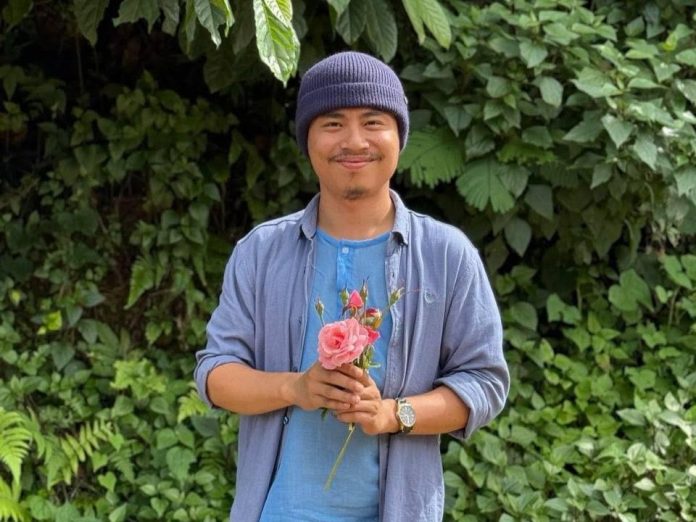
Myanmar pro-democracy youth activist Nan Lin participated in the "Flower Strike" to mark jailed State Counsellor Aung San Suu Kyi's 80th birthday on June 19, 2025. (Credit: Nan Lin)

Following the announcement on July 8 that Myanmar activist and strike leader Nan Lin would accept the 2026 Democracy Award from the National Endowment for Democracy (NED) on behalf of “pro-democracy community organizers of Burma’s Spring Revolution,” he spoke to DVB on the five years of resistance to the Feb. 1, 2021 military coup.

In an exclusive interview, Nan Lin discusses accepting the award on behalf of the Spring Revolution, the current “low tide” facing the resistance, the critical balance between armed struggle and non-violent mass political organizing, and the geopolitical pressures facing Myanmar—including China’s support for the military regime’s “sham” elections.

Part 1: Accepting the Democracy Award for the Mass Movement

DVB: First of all, congratulations on receiving the Democracy Award from the National Endowment for Democracy (NED).

Nan Lin: Thank you. For me, it is a very proud moment. However, this award is truly for all our comrades participating in the mass movement. I am deeply honoured to accept it on their behalf. This serves as a great source of strength for our comrades, our movement, and our people.

DVB: How do you feel receiving this recognition at this specific juncture in the revolution?

NL: When we were notified about this award, it came at a time that we view as a “low tide” in the revolution. As we rebuild during this temporary low tide and prepare our next steps to raise the tide once again, receiving this award gives us immense strength.

Our people are facing immense oppression on one side and bitter economic and social crises on the other. Yet, even through all of this, the public remains firmly committed to the revolution. I see this award as a recognition of the people’s struggle, their fight, and their endurance.

DVB: An NED official mentioned that the award was given to you and fellow political activists to serve as an inspiration—recognizing your collective resilience and adaptability. What are your thoughts on that?

NL: The foundation of this adaptability and resilience praised by the NED is, in fact, the people’s endurance and fighting spirit. If we look back at the past five years, the mass movement was remarkably strong. I have always said: a battle that begins with the people must end with the people.

Over these five years, we moved with great momentum, but we also had weaknesses. Our main flaw was relying too much on short-term tactics without connecting them strategically to a long-term revolutionary vision.

Despite our shortcomings as revolutionary forces, the people’s participation remains our greatest strength. Look at the recent Rose Movement or the widespread boycott of the junta’s illegal, sham elections where the public flatly refused to vote. The people see the flaws in the revolution, yet they continue to participate dutifully through whatever means possible.

DVB: To whom specifically do you dedicate this honour?

NL: Every single comrade fighting amidst these struggles is the true winner of this award. I am merely accepting it on their behalf. Specifically, I dedicate this to:

  • The Unyielding CDMers: Those in the Civil Disobedience Movement who completely refused to participate in the regime’s machinery, many of whom are now treating the wounded or teaching displaced children.
  • Protesters in Enemy Territories: Comrades in Yangon, Mandalay, and urban centers who faced vehicle rammings, live ammunition, and arrests while hanging protest banners or marching.
  • Political Prisoners: Those fighting for the Spring Revolution from behind bars, enduring extreme oppression.
  • Civilians in Liberated Zones: Communities facing constant travel hardships and regime air attacks—such as the October 2023 airstrike on Bonto village during a peaceful Thadingyut protest.

Part 2: Mass Movement vs. Armed Struggle (Soft Power vs. Hard Power)

DVB: You often highlight the pillars of the movement—mass strikes, the CDM, Social Punishment, and armed resistance. How do you evaluate the balance and impact of these strategies?

NL: If we condense them, there are really two main approaches: the Mass Movement (Soft Power) and the Armed Struggle (Hard Power). We have constantly advocated for ending the dictatorship by balancing these two.

“Armed struggle physically destroys the junta and liberates territories. The non-violent mass movement involves the entire public using political means. We aimed to merge these smartly, but to be brutally honest, we haven’t yet achieved that balance.”

We had abundant tactics—like electricity tax strikes and product boycotts—but we were weak in ideological organizing. Furthermore, by swinging a wide stick with boycotts (such as social punishment targeting actors or those returning to school), we inadvertently created social fractures between those who boycotted and those who didn’t. Moving forward, we must focus heavily on theoretical and political organizing.

DVB: Some members of the public express frustration, asking if mass protests and boycotts are still necessary when “guns are doing the talking.” How do you respond to that?

NL: Relying solely on armed struggle without a connected mass political movement will not lead us to true federal democracy.

Armed struggle requires military training, weapons, and strict chains of command, which often turns the public into mere spectators or donors. Recently, when the revolution faced junta counter-offensives after reaching a military peak, we realized we couldn’t politically consolidate those military victories because we lacked the political and mass movement connections on the ground.

Historically, Myanmar’s military became corrupt because we failed to use political, mass-based mechanisms to keep them in check. To ensure that today’s armed resistance forces do not become tomorrow’s oppressors, we need a politically awakened public to enforce ethics and accountability right now. The mass movement is the bridge that regulates this.

Part 3: Strategic Priorities for Survival and Rebuilding

DVB: With the public experiencing severe hardship after five years of conflict, what is needed for the mass movement to rebuild?

NL: We are focusing on three main areas:

  1. Developing Human Resources: Training capable political and mass movement organizers, not just for the current revolution, but for the future country.
  2. Updating Organizing Models: Shifting from short-term street actions (like flash strikes) to sustainable, long-term political and ideological cohesion.
  3. Aligning Words with Actions: Ensuring that revolutionary administrative bodies (like local defense forces and administrative committees in liberated zones) act democratically, serve the public, and refrain from abusing power.

Part 4: Geopolitics, Realpolitik, and China’s Role

DVB: Regime leader Min Aung Hlaing is attempting to legitimize his power as President through illegal elections, backed by countries like China, India, and Thailand. How will these relationships impact Myanmar long-term?

NL: Global politics has shifted toward pragmatic, interest-based “realpolitik.” Neighboring countries are prioritizing short-term “stability” over the democratic freedoms of the Myanmar people.

Appeasing the military has never worked in Myanmar’s history. Believing that a junta that unjustly overthrown an elected government will somehow pave the way back to democracy is completely illogical. Appeasing them only pushes Myanmar back into a vicious cycle. The only path to genuine peace is uprooting the dictatorship entirely.

DVB: How do you view China’s backing of the junta’s elections and their concerns regarding Western influence in the revolution?

NL: China’s main justification seems to be a paranoid fear that revolutionary forces lean too far West or will create a CIA-backed puppet government.

Let me be clear: the Myanmar people are not anyone’s puppets. We are fighting for our own dignity, freedom, and justice. China’s paranoia leads them to prolong the life of a dictator the public despises, creating a massive wedge between the Myanmar people and the Chinese Communist Party (CCP).

If China wants a genuine relationship with Myanmar, they must stop backing puppet dictators and start listening to the voices and will of the Myanmar people.

Part 5: Assessing the Opposition Leadership

DVB: The National Unity Government (NUG) recently formed the Steering Committee for the Emergence of a Federal Democratic Union (SCEF). What are your thoughts on this step?

NL: In a single word: I am unsatisfied. We need to be blunt. Since 2024, we have called for NUG and NUCC (National Unity Consultative Council) reforms because their initial structures were built for early legitimacy battles, not for the complex administrative, political, and military leadership required today.

While forming the SCEF is better than doing nothing, it must demonstrate practical effectiveness on the ground. If it becomes disconnected from the public or fails to deliver real political and military progress, the revolutionary leadership will face a serious crisis of trust. Mass movement forces will continue to press for public accountability.

Final Message to the Public

DVB: What message would you like to leave with the public and the international community?

NL: To the international community: Stand with the Myanmar people, reject the junta’s sham elections, impose heavier sanctions, and help hold the military accountable for its war crimes.

To the people of Myanmar: This journey has been brutal, but the last five years were not a failure. We now hold expansive liberated territories. Reaching a temporary “low tide” is a natural phase in long-term conflict.

I view 2026 as a pivotal year to reorganize, rebuild our mass organizing structures, and raise the revolutionary tide once again. We still hold the fundamental strength in our hands to win.


‘Food brings people together’: a Myanmar refugee chef’s story

0
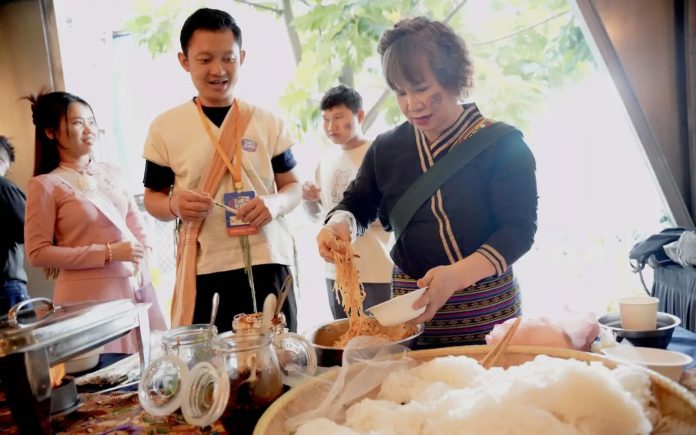
Nang Kham’s Shan noodles proved a crowd favourite at the recent Stand With Myanmar Festival. (Credit: FMT)

Originally published on Free Malaysia Today

For Nang Kham, cooking is a way to preserve her Shan heritage while building connections in the country she now calls home.

Cooking for a crowd can be a daunting task. But whenever she volunteers to prepare meals for members of the Coalition of Burma Ethnics Malaysia (Cobem), 64-year-old Nang Kham insists on doing it all herself.

The Shan refugee from Myanmar firmly believes in the old saying that too many cooks spoil the broth. No one else can quite match the care and attention she puts into every dish.

“I prefer doing things on my own. Other cooks may ask me to add this or add that, but it just won’t turn out right. My food has to be made in a certain way for it to taste good,” she told FMT.

“Cooking makes me happy. Seeing people enjoy my food or eat until they’re full is very satisfying.”

Nang Kham’s love of cooking began in her youth, when she sold noodles to help support her family. She honed her culinary skills by learning from experienced cooks and elders in her village.

Since 2023, she has been living in Malaysia as a refugee after fleeing Yangon to escape Myanmar’s civil war that erupted in 2021. Seeking safety and stability, she has since built a new life here, cooking primarily for her community.

Her culinary talents were recently showcased at Stand With Myanmar, a two-day food festival organised by Cobem, Dari Dapur and Refuge for Refugees, celebrating Myanmar’s food, culture and people.

She prepared a substantial spread for the festival and was delighted to see it disappear within hours.

Most days, she cooks in the kitchen of her modest home in the city, where she is grateful that many of the ingredients needed for traditional Shan dishes can be found at local markets.

Among her signature dishes are som tam (green papaya salad) and Shan tofu, a chickpea-based tofu that can be sliced, fried or added to salads.

Her favourite dish to prepare is Shan Khauk Swe – rice noodles topped with savoury minced chicken or pork, crushed peanuts and pickled greens, served either in a light broth or dry.

“It’s not always easy to get the flavours right, but it’s worth the effort when I see people enjoying it,” she said.

Nang Kham was also recently featured in a Dari Dapur documentary that follows her cooking for Cobem members and radio host Ili Ruzanna.

Dari Dapur producer Elroi Yee describes her as someone who is always eager to lend a hand – the sort of person who would be the first to volunteer at a gotong-royong or cook for a kenduri if circumstances allowed.

“At the same time, she’s going through so many challenges as a refugee. She’s separated from her family, she can’t work legally, she can’t run a business, and she constantly faces the risk of arrest, detention or deportation,” Yee said.

He hopes stories like hers will help Malaysians see the human side of refugees and migrant workers.

“If Malaysians take the time to have a real conversation with refugees – perhaps over a shared meal – we would have a richer understanding of life and humanity,” Yee added.

Nang Kham now leads a quiet life in Kuala Lumpur. A self-confessed homebody, she usually leaves home only to visit the market, the mobile clinic or community events.

While she has yet to try many Malaysian dishes, she has developed a fondness for curry laksa.

“I’m happy here. I have friends in the community. I also hope things get better for my people back in Myanmar,” she said.

“When I was younger, I dreamt of becoming a successful businesswoman. But now I’m happy with the life I have here.”

Although aware of the recent backlash against refugees, Nang Kham chooses to believe in the power of kindness.

Given the chance, she said, she’d love to cook for those who hold negative perceptions of people like her.

“I think once you’ve tried my food, we’ll definitely be friends,” she concluded with a smile.

FMT

ASEAN Special Envoy slams critics over controversial Myanmar meeting with regime official

0
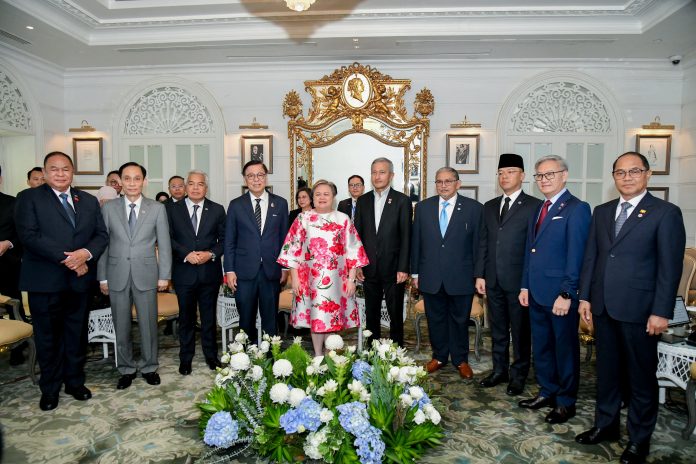
ASEAN 2026 Chair the Philippines’ Special Envoy on Myanmar Ma. Theresa P. Lazaro with ASEAN Foreign Ministers, including Myanmar’s regime Foreign Minister Tin Maung Swe, at a meeting in Bangkok, Thailand, on July 12. (Credit: Thailand Ministry of Foreign Affairs)

In a formal statement released from the Philippines’ Department of Foreign Affairs on Sunday, the Association of Southeast Asian Nations (ASEAN) 2026 Chair Special Envoy on Myanmar, Ma. Theresa P. Lazaro, called a recent public rebuke from the Special Advisory Council for Myanmar (SAC-M) “malicious and misleading” distortions of regional peace efforts.

The trigger: ASEAN Foreign Ministers meet with regime ‘counterpart’

The sudden escalation stems from an informal meeting convened on July 12 in Bangkok, Thailand, where ASEAN foreign ministers engaged directly with their “counterpart,” regime’s Foreign Affairs Minister Tin Maung Swe.

The high-level session marked a stark departure from ASEAN’s previous five-year-long freeze on meeting with senior regime officials from Naypyidaw after Min Aung Hlaing agreed to the ASEAN Five Point Consensus, the regional bloc’s peace plan to end the fighting in Myanmar in April 2021 but didn’t implement it upon his return.

The move for ASEAN to engage with the regime in Naypyidaw triggered immediate outrage from SAC-M on July 18, with the advocacy group accusing the ASEAN Chair under the Philippines of “poor judgment,” timidity, and rewarding the military’s continuing internal atrocities.

In her statement released on July 19, Lazaro categorically rejected the narrative that ASEAN is backing down from its demands. “These meetings form part of the Special Envoy’s mandate to pursue constructive dialogue among all parties concerned,” the statement clarified.

The mandate: Tracing the diplomacy to Cebu

Defending the legality and structure of the outreach, Lazaro emphasized that the Bangkok talks were not a rogue diplomatic experiment, but the direct execution of orders handed down by ASEAN member states.

According to her, the meeting was structurally anchored in two core administrative steps:

  • The Cebu Summit framework: Mandated by ASEAN leaders during the 48th ASEAN Summit in Cebu, which outlined the terms for “constructive and principled engagement” with Myanmar.
  • The May consultations: Developed during a virtual Extended Informal Consultation among ASEAN Foreign Ministers on May 21.
ASEAN Diplomatic Strategy (July 2026)
├── Primary Objective: Force full execution of the Five-Point Consensus (5PC)
├── Operational Tactic: Open communication lines with regime FM Tin Maung Swe
└── Immediate Focus: Unclogging blockaded humanitarian assistance corridors

Standing Firm on the Five-Point Consensus

Amid growing anxieties from parallel opposition groups—including the National Unity Government (NUG)—that direct engagement inadvertently lends political legitimacy to the regime in Naypyidaw, the Philippines used the communique to re-establish its baseline criteria.

Manila reaffirmed that the Five-Point Consensus remains the absolute, non-negotiable benchmark for resolving Myanmar’s crisis since the 2021 coup. Lazaro pledged that upcoming engagement tracks will remain strictly condition-based, prioritizing four operational pillars:

  1. Cessation of hostilities: Demanding an immediate end to the military’s ongoing air campaigns and ground offenses against civilian infrastructure.
  2. Inclusive dialogue facilitation: Opening mediated negotiation channels that encompass all warring factions, ethnic armed organizations (EAOs), and democratic resistance units.
  3. Structured mediation: Serving as the central international referee to build trust between adversarial parties.
  4. Humanitarian expansion: Rapidly scaling up cross-border and internal aid drops to reach the estimated 16 million citizens facing catastrophic food and medical shortages.

The Special Envoy on Myanmar concluded by signaling that while external monitoring groups demand total isolation, ASEAN will continue to operate on the ground, viewing direct communication with Naypyidaw as an essential tool to break the five-year political deadlock.

Myanmar commemorates 79th Martyrs’ Day; Bangladesh forms committee on Rohingya repatriation

0
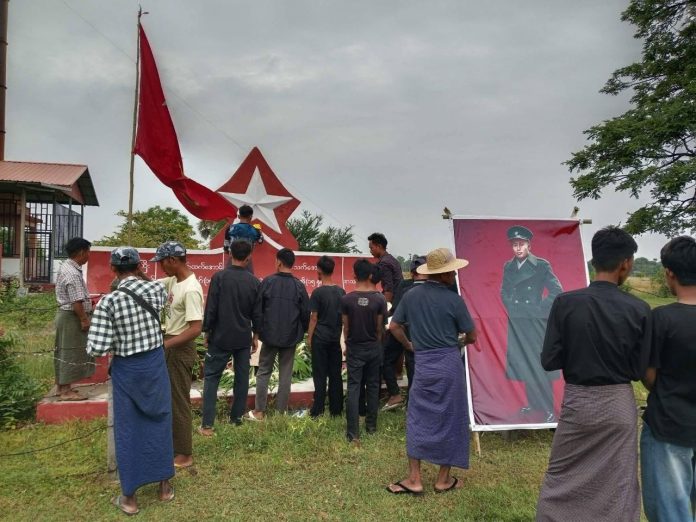
Residents in Sagaing Region’s Khin-U Township, which is partially administered by the National Unity Government, commemorate Martyrs' Day with a ceremony on July 19. (Credit: CJ)

Myanmar’s commemorates 79th Martyrs’ Day

A ceremony was held at the Martyrs’ Mausoleum in Yangon on Sunday to mark Burma’s 79th Martyrs’ Day, unfolding under intense surveillance and punctuated by a sharp public rebuke from the son of jailed State Counsellor Aung San Suu Kyi. Martyrs’ Day marks the July 19, 1947 assassination of independence hero General Aung San, and eight others, just months before the country broke from British colonial rule in 1948.

The historical anniversary was marked by a video address from Kim Aris, the grandson of Aung San and the youngest son of Aung San Suu Kyi. His mother, the Nobel Peace Prize laureate and National League for Democracy (NLD) leader, has been held incommunicado by the regime in Naypyidaw for over five years since the Feb. 1, 2021 military coup. 

In his statement shared on social media on July 19, Aris reiterated his urgent demand for the regime to provide “Proof of Life” for his mother. Aris noted that he has had no direct contact with her since her arrest. He also directly condemned the regime’s ongoing nationwide campaign to erase his grandfather’s physical legacy. Read more on our website

Bangladesh forms committee for Rohingya repatriation

Bangladesh has established an 11-member national committee headed by Prime Minister Tarique Rahman to formulate a comprehensive strategy for Rohingya repatriation, the government announced on July 12. The committee must prepare a national action plan within 90 days, including ministries, law enforcement and intelligence agencies.

The body’s composition, dominated by military, police and intelligence officials, signals a shift towards prioritising security concerns over purely humanitarian approaches, analysts say. The announcement came less than two weeks after Rahman’s visit to Beijing, where discussions with Chinese leaders prominently featured the Rohingya crisis.

The Principal Staff Officer of the Armed Forces Division will serve as chief coordinator, while the director general of the Directorate General of Forces Intelligence (DGFI) has been appointed member-secretary. The DGFI will provide secretarial and administrative support to the national committee. Read more on our website

DVB collaborated with Myanmar Witness on the production of Blood Copper to combine documentary storytelling, investigative journalism, and OSINT methodologies to tell the story of the Letpadaung Copper Mine in Sagaing Region’s Salingyi Township. (Credit: DVB)

Thailand rejects Chinese request to ban Myanmar documentary

The Thai government rejected a direct request from the Chinese Embassy in Bangkok to block the screening of a documentary detailing severe human rights abuses linked to a Chinese-backed copper mine in Burma’s Sagaing Region, press freedom advocates and prominent journalists confirmed this week.

The diplomatic friction centered on the June 15 screening of Blood Copper at the Foreign Correspondents’ Club of Thailand (FCCT). The DVB documentary in collaboration with Myanmar Witness, uses open-source intelligence (OSINT) to detail how regime forces have violently cleared villages in Salingyi Township to expand the Letpadaung Copper Mine.

According to sources, the Chinese embassy pressured the Thai Ministry of Foreign Affairs to cancel the event. But Bangkok ultimately declined to intervene, allowing the screening and panel discussion to proceed. Pravit Rojanaphruk, a prominent Thai journalist and senior staff writer for Khaosod English, verified the incident. Read more on our website

News by Region

CHIN—The military has declared full control over Thantlang Township, following what it described as a months-long “counter-terrorism operation.” The recapture of Thantlang, located 22 miles (35 km) west of the state capital Hakha, marks a significant development in a protracted conflict. 

The town has been a fiercely contested battleground between regime and resistance forces since September 2021, when intense aerial bombardments forced the entire civilian population to flee. Both sides have launched repeated offensives to secure the area over the past five years. Read more on our website

MAGWAY—At least four civilians were killed and at least 50 homes destroyed across six villages in Pauk and Myaing townships July 13-15. According to an aid worker based in Myaing Township, who spoke on the condition of anonymity, the four victims were between 50 and 60 years old. 

They had been temporarily sheltering with relatives in Pauk’s Kannat, Myinkothit, and Kaingtawma villages when they were killed. The two townships, located 130 miles (209 km) north of the region’s capital, had a regime column comprising about 600 military personnel stationed. Read more on our website

SHAN—Residents in Ywangan Township told DVB that the bodies of San Tint, the vice-chair of the Danu National Democracy Party (DNDP), and local businessman Aung Win Sein, were recovered on Tuesday after they were reportedly abducted from their homes in Myinkyadoe village by an unidentified armed group on July 14.

The bodies were discovered in Ywangan’s Nyaungpingwa village, located within the Danu Self-Administered Zone (SAZ) of southern Shan. While no group has claimed responsibility for the double homicide, local sources indicated that San Tint had previously been warned by the PDF. Read more on our website

(Exchange rate: $1 USD = 4,310 MMK) 

Watch our latest Newsroom interview on DVB English News YouTube or Spotify. Listen on Apple, or wherever you get podcasts.

Myanmar civil society groups urge SpaceX to halt Starlink shutdowns

0
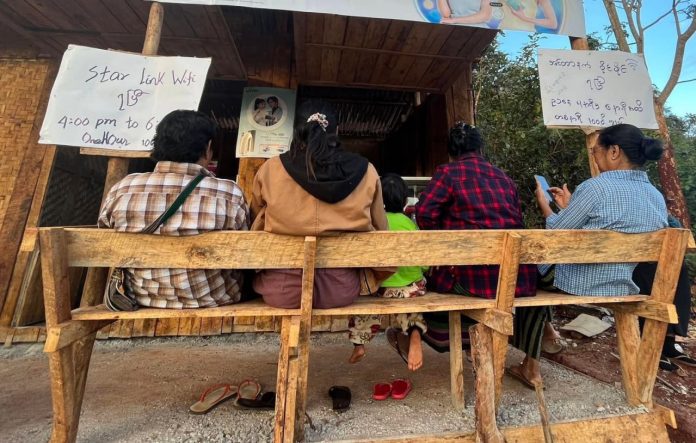
Residents in Karenni State connect to the internet, via satellite, on their mobile phones at an undisclosed location which advertises Starlink at 1,000 MMK ($0.23 USD) per hour in 2023. (Credit: Unknown)

A coalition of 255 Myanmar civil society organizations has issued an urgent appeal to SpaceX CEO Elon Musk, warning that recent disruptions to the company’s Starlink satellite internet network are threatening the lives and education of millions living under military-imposed communication blackouts.

In a joint letter released on July 17, the organizations urged Musk’s company to allow civilians and pro-democracy groups in Myanmar to continue utilizing its satellite internet, even though the service is not officially licensed to operate in the country.

According to the civil society statement, recent Starlink cutoffs have affected over 13 million people inside Myanmar.

The disruptions are described as a “matter of life and death” for nearly 800,000 students who rely on the satellite connections to attend approximately 6,000 virtual schools operated by the National Unity Government (NUG)—the interim administration formed by elected lawmakers ousted in the 2021 military coup.

Sweeping cuts and geolocation restrictions

Nationwide disruptions to Starlink terminals have been widely reported since July 2, heavily impacting resistance-held and conflict-affected areas across Kachin, Karenni, and Arakan states, as well as the Sagaing and Mandalay regions.

Local resistance groups told DVB that more than 20 per cent of Starlink terminals operating inside Myanmar have recently been deactivated.

In Karenni State, the Interim Executive Council (IEC)—a provisional government established by resistance forces—reported that Starlink issued warnings requiring users to register their terminals using government-issued identity documents.

“I think the company has restricted the geolocation of the terminals as Myanmar is not officially licensed,” said Banyar Aung, the IEC’s second secretary.

An internet service provider based in Demoso Township—an area recaptured by regime forces from the resistance in August 2025—confirmed to DVB that their Starlink terminal went offline earlier this month, citing the lack of official licensing.

The scam center dilemma

The abrupt crackdown on Starlink terminals inside Myanmar appears linked to intense international pressure regarding the proliferation of transnational cyber scam operations.

Over the past year, investigations by the U.S. Congress and international media revealed that lucrative cybercrime syndicates operating along the Myanmar-Thailabd border were utilizing smuggled Starlink dishes to bypass local infrastructure and run multi-billion dollar fraud networks.

In response to inquiries from U.S. lawmakers, Lauren Dreyer, SpaceX’s Vice President of Business Operations, stated late last year that the company had proactively disabled over 2,500 terminals suspected of being used by these criminal hubs.

Furthermore, the recent wave of disruptions follows reports that unnamed U.S. officials met with representatives of the Naypyidaw regime in Tokyo last month to discuss efforts to combat the scam operations.

A critical lifeline

However, human rights advocates warn that taking a blunt, sweeping approach to disabling Starlink terminals disproportionately harms the country’s most vulnerable populations.

Following the 2021 military coup, the regime imposed severe, sweeping telecommunications blackouts across central Myanmar and ethnic states to suppress dissent and cut off resistance forces.

As a result, smuggled Starlink terminals became the sole lifeline for millions to communicate, coordinate humanitarian aid, share evidence of human rights abuses, and connect with the outside world.

By cutting off the unlicensed terminals to target cybercriminals, activists argue that SpaceX is inadvertently aiding the regime’s efforts to plunge the country into a total digital blackout.

Contact