
Thursday, July 23, 2026
Home Blog Page 3

Fortify Rights urges Myanmar resistance to establish war crimes investigative units

0
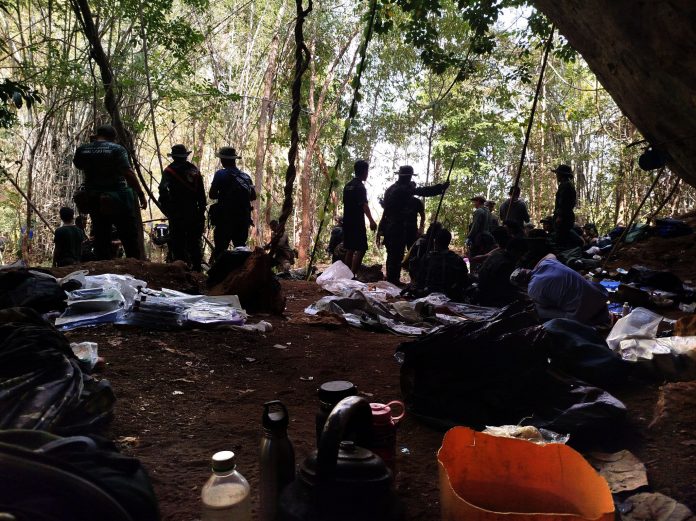
The Free Burma Rangers provide humanitarian assistance to injured resistance members in Hpasawng Township, Karenni State, on Jan. 23, 2024. (Credit: CJ)

International human rights organization Fortify Rights has formally called on Myanmar’s resistance forces to establish independent war crimes investigation units to hold combatants accountable for alleged violations committed by all sides since the Feb. 1, 2021 military coup.

The initiative aims to embed compliance with International Humanitarian Law (IHL) into the operational foundations of resistance forces, distinguishing opposition governance structures from the military regime’s systemic record of war crimes and atrocities.

A call for impartial accountability

The formal appeal follows a official letter sent on May 20 by Fortify Rights to the Interim Executive Council (IEC)—the provisional revolutionary government of Karenni State established in 2023—and the leadership of the Karenni Nationalities Defense Force (KNDF).

In a press release detailing the initiative, Fortify Rights highlighted that independent investigative mechanisms within resistance-controlled territories would significantly strengthen international justice efforts while establishing credible, law-based governance.

“We are committed to ensuring all parties to armed conflicts understand their obligations under the laws of war,” said Peter Bouckaert, Senior Director of Fortify Rights. “We observed a serious commitment among participants in Karenni State to understanding and applying these standards.”

Groundwork for federal justice in Karenni State

The call builds on a series of specialized IHL workshops and legal trainings conducted in November 2025 and March 2026. Organized directly by the IEC, the training sessions brought together commanders and personnel from key armed resistance branches operating in the state:

  • Karenni Nationalities Defense Force (KNDF)
  • Karenni Army (KA)
  • Karenni People’s Liberation Army (KPLA)

Leadership within the Karenni resistance welcomed the focus on international legal compliance, positioning the effort as central to their long-term democratic vision.

“Our struggle at its very core is about bringing about a new, federally democratic Myanmar where all nationalities can live in peace and with respect for their rights,” said Khun Bedu, Vice Chairperson of the IEC and Chairperson of the KNDF.

Ground realities: Conflict and mass displacement

The initiative comes against the backdrop of intense, ongoing territorial contention across Karenni State’s seven townships:

Karenni State Territorial & Humanitarian Profile
├── Total Townships: 7
├── Regime-Controlled Areas (Urban Centers): Loikaw (Capital), Demoso, Hpruso, Bawlakhe, Hpasawng
├── Resistance-Controlled Areas (Border Zone): Mese, Shadaw
└── Displaced Population: ~250,000 civilians in IEC-managed IDP camps

With an estimated 250,000 civilians forced from their homes due to regime air raids, artillery bombardments, and ground battles, the IEC currently manages an extensive network of camps for internally displaced persons (IDPs) despite severe resource constraints.

Building a blueprint for post-regime governance

Human rights advocates emphasize that establishing independent mechanisms to investigate offenses—including those potentially committed by resistance fighters—sets a critical precedent for Myanmar’s future legal framework.

“The Karenni IEC government is serious about building a future federal democratic Myanmar that reflects the aspirations of the people,” Bouckaert concluded, adding that impartial internal oversight is a crucial step toward securing international trust and formal recognition.
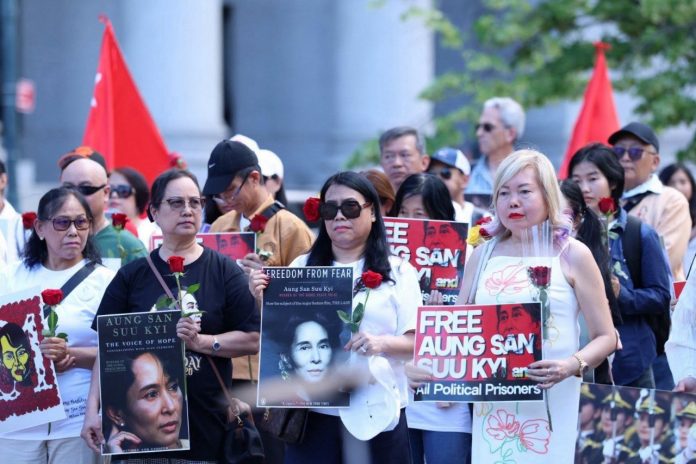
NLD wants Aung San Suu Kyi included in Myanmar peace talks; ASEAN Special Envoy denounces critics

0
Supporters of jailed State Counsellor Aung San Suu Kyi rally in New York City one day after her 81st birthday on June 20. (Credit: DVB)

NLD wants Aung San Suu Kyi included in Myanmar peace talks

The National League for Democracy (NLD) stated on Monday that jailed State Counsellor Aung San Suu Kyi must be included in any political process aimed at resolving Burma’s crisis since the military coup on Feb. 1, 2021 that ousted her NLD administration, which governed the country from 2016 up until the coup in 2021. It added that any peace process that excludes Aung San Suu Kyi would not be accepted.

“Aung San Suu Kyi—who enjoys the trust of the people and holds the legitimate democratic mandate conferred by them—is indispensable to resolving the political crisis that has arisen as a consequence of the military coup,” the NLD stated in a press release on July 20. The Association of Southeast Asian Nations (ASEAN) is facing a backlash over its choice to meet with regime Foreign Minister Tin Maung Swe.

The NLD welcomed efforts by the U.N. and others to support the ASEAN Five Point Consensus, a regional peace plan accepted by regime leader Min Aung Hlaing—who led the coup against Aung San Suu Kyi and the NLD—but not implemented upon his return to Burma in April 2021. It calls for an end to violence against civilians, the release of all political prisoners, and dialogue among all stakeholders to Burma’s crisis. 

ASEAN Special Envoy denounces critics of regime meeting

In a formal statement released from the Philippines’ Department of Foreign Affairs on Sunday, ASEAN 2026 Chair Special Envoy on Myanmar, Ma. Theresa P. Lazaro, called a recent public rebuke from the Special Advisory Council for Myanmar (SAC-M) “malicious and misleading” distortions of regional peace efforts.

The sudden escalation stems from an informal meeting convened on July 12 in Bangkok, Thailand, where ASEAN foreign ministers engaged directly with their “counterpart,” regime Foreign Affairs Minister Tin Maung Swe. The move for ASEAN to engage with a senior regime official from Naypyidaw triggered immediate outrage from SAC-M on July 18.

The advocacy group accused the ASEAN 2026 Chair, held by the Philippines, of “poor judgment,” timidity, and rewarding the military’s continuing internal atrocities. In her statement released on July 19, Lazaro categorically rejected the narrative that ASEAN is legitimizing the regime. Read more on our website

Residents in Karenni State connect to the internet, via satellite, on their mobile phones at an undisclosed location which advertises Starlink at 1,000 MMK ($0.23 USD) per hour in 2023. (Credit: Unknown)

SpaceX urged to halt Starlink satellite internet disruptions

A coalition of 255 Myanmar civil society organizations has issued an urgent appeal to SpaceX CEO Elon Musk, warning that recent disruptions to the company’s Starlink satellite internet network are threatening the lives and education of millions living under military-imposed communication blackouts.

In a joint letter released on July 17, the organizations urged Musk’s company to allow civilians and pro-democracy groups in Myanmar to continue utilizing its satellite internet, even though the service is not officially licensed to operate in the country. According to the civil society statement, recent Starlink cutoffs have affected over 13 million people inside Myanmar.

The disruptions are described as a “matter of life and death” for nearly 800,000 students who rely on the satellite connections to attend approximately 6,000 virtual schools operated by the National Unity Government (NUG)—the interim administration formed by elected lawmakers ousted in the 2021 military coup. Read more on our website

News by Region

ARAKAN—Five civilians were killed and at least 29 others, including children, were injured during airstrikes in Taungup, Thandwe and Ponnagyun townships carried out by the Burma Air Force on Sunday. Over 20 homes and one church were destroyed during the airstrikes, residents told DVB. 

A Thandwe resident, who spoke on the condition of anonymity, said that everyone is hiding inside their homes. The three townships, located 20-284 miles (32-457 km) northeast and south of the state capital Sittwe, were seized by the Arakan Army (AA) from March to November 2024. 

MANDALAY/SAGAING—Residents in Mahlaing Township, located 75 miles (120 km) south of the region’s capital Mandalay, told DVB that a 70-year-old man was killed during Unmanned Aerial Vehicle (UAV), or drone strikes, July 18-19. Residents claimed that all telecommunication services had been cut before the attacks.  

In neighbouring Sagaing Region’s Myaung and Chaung-U townships, residents told DVB that over 60 bombs were dropped on two villages by four fighter jets on July 19. No casualties were reported. The towns are located 16-36 miles (25-28 km) south of the region’s capital Monywa. Read more on our website

SHAN—The Ta’ang National Liberation Army (TNLA) met with the regime’s National Solidarity and Peacemaking Negotiation Committee (NSPNC) to discuss “cooperation in stability, development and healthcare” in Naypyidaw on July 19. It reportedly requested that the regime recognize territory under its control as a “Ta’ang State.” 

The TNLA has seized control of Namhsang and Manton townships, which are constitutionally recognized as the Palaung Self-Administered Zone (SAZ), as well as Namtu, Namhkam, Mongngawt, and Monglon townships in northern Shan State since “Operation 1027” was launched on Oct. 27, 2023. Read more on our website

(Exchange rate: $1 USD = 4,340 MMK) 

Read: A Q&A with Myanmar youth activist Nan Lin on the 2026 Democracy Award only on DVB English News. Follow us on X, Facebook, Bluesky, Instagram, TikTok & Threads.

ASEAN’s top diplomats meet in shadow of US-Iran conflict

0
US Secretary of State Marco Rubio speaks to reporters before departing from Joint Base Andrews in the US state of Maryland on July 19, 2026. Secretary Rubio is attending the 59th ASEAN Foreign Ministers' Meeting and related meetings in Manila, Philippines. (Credit: Reuters)

Tensions between the U.S. and Iran are ‌likely to cast a shadow over a diplomatic gathering in Southeast Asia this week, injecting additional uncertainty into a region grappling with maritime tensions with China and a faltering ​regional effort to end Myanmar’s civil war.

Foreign ministers from the 11-member ​Association of Southeast Asian Nations (ASEAN) and their major partners are gathering ⁠in Manila against a backdrop of instability beyond the region since the ​U.S. and Iran resumed open conflict, raising concerns about the flow of energy supplies ​through the Strait of Hormuz, as well as inflation and global growth.

The Middle East crisis is expected to feature prominently in discussions, said Dominic Xavier Imperial, a spokesperson for the Philippines, the 2026 chair of ASEAN and host of the meeting.

“We’re ​looking at several occasions where they can raise this very, very critical topic,” ​he said.

But Southeast Asia’s top diplomats, meeting in Manila, face no shortage of challenges ‌closer ⁠to home.

Myanmar’s conflict and tensions in the South China Sea, for which ASEAN and China are still trying to conclude a code of conduct, are expected to be key discussion points among ASEAN foreign ministers.

U.S.-China meeting potential

U.S. Secretary of State ​Marco Rubio and ​Chinese Foreign Minister ⁠Wang Yi will join in the days ahead and could meet on the sidelines.

Also set to attend the ASEAN-led meetings are India, Japan, ​Australia, South Korea, Russia, Britain and the European Union, ​among others.

Myanmar’s ⁠conflict is also expected to feature prominently as ASEAN’s peace initiative struggles to gain traction, five years after it was launched in the wake of a military ⁠coup ​that plunged the country into a civil war ​that has killed an estimated 100,000 people.

ASEAN foreign ministers will between them hold an informal consultation on ​Myanmar on July 22, Imperial said.

REUTERS

ASEAN ministers meet in Manila to discuss Myanmar and other regional conflicts

0
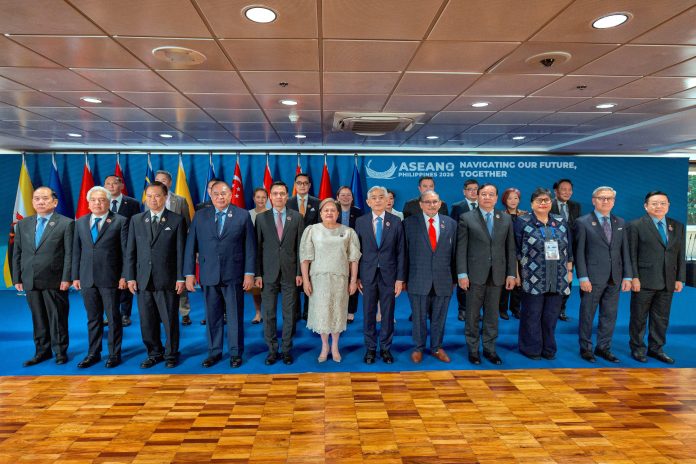
Myanmar's regime Permanent Secretary Hau Khan Sum, Malaysia Secretary-General of the Ministry of Foreign Affairs Amran Mohamed Zin, Thailand Deputy Prime Minister and Foreign Minister Sihasak Phuangketkeow, Timor-Leste Foreign Minister Bendito dos Santos Freitas, Vietnam Deputy Foreign Minister Dang Hoang Giang, Philippines Foreign Secretary Theresa Lazaro, Singapore Permanent Secretary of Foreign Affairs Albert Chua, Brunei Foreign Minister Erywan Yusof, Cambodia Deputy Prime Minister and Foreign Minister Prak Sokhonn, Indonesia Director General for ASEAN Cooperation Ina Hagniningtyas Krisnamurthi, Laos Foreign Minister Thongsavanh Phomvihane, and ASEAN Secretary-General Kao Kim Hourn pose for a photo with representatives from the ASEAN Intergovernmental Commission on Human Rights (AICHR) Representatives during the ASEAN Foreign Ministers' Meeting at the Philippine International Convention Center on July 20, 2026 in Pasay, Metro Manila, Philippines. (Credit: Reuters)

Top diplomats from member states of the Association of Southeast Asian Nations (ASEAN) will express alarm over renewed hostilities in the Middle East and call for the full reopening of the Strait of Hormuz when they gather in the Philippine capital Manila on Tuesday for talks with Western and Asian counterparts.

Iran and some of the world’s most intractable conflicts will be high in the agenda of the annual talks held by the 11-member ASEAN and hosted by its 2026 Chair the Philippines.

U.S. Secretary of State Marco Rubio, Chinese Foreign Minister Wang Yi and Russian Foreign Minister Sergey Lavrov are among the attendees. Ukraine’s top diplomat, Andrii Sybiha, has been invited to attend a Friday ceremony commemorating a 1976 nonaggression treaty of ASEAN, but will not be participating in the ASEAN meetings attended by Lavrov and Rubio.

Rubio and Lavrov have not announced any plans to meet each other or Sybiha while they are in Manila.

Iran war is among ASEAN’s top concerns

Southeast Asia, a bustling region of more than 680 million people, relies heavily on Middle East oil and gas and was severely hit by the global supply and price shocks sparked by the Iran war.

Philippine President Ferdinand Marcos Jr. declared a national energy emergency in March to ensure the availability of fuel, food and other basic goods and prevent hoarding and profiteering.

ASEAN foreign ministers will first meet among themselves on Tuesday to discuss the renewed hostilities between the United States and Iran and threats to shipping in the Strait of Hormuz, the waterway where roughly 20 per cent of global oil supplies transited before the war.

“We underscored the importance of maintaining regional peace, stability and prosperity, upholding international law … including the need for a complete and immediate cessation of hostilities across all fronts in the Middle East,” the ministers said in a draft statement of concern, which was seen by The Associated Press.

“We acknowledged the further implications of the continued tensions in the Middle East on regional trade, energy and food security, including energy markets and supply chains, agricultural production,” said the statement, which will be made public after their meeting.

The ministers “called for the restoration of the safe, unimpeded and continuous transit passage of vessels and aircraft in the Strait of Hormuz.”

Rubio meeting with ASEAN and Quad envoys

Rubio’s attendance in the ASEAN meetings was apparently aimed at dispelling concerns that the war in the Middle East would deter the U.S. from focusing on the Indo-Pacific, especially China’s actions in the disputed South China Sea and its pressure on Taiwan.

“The secretary’s visit advances a clear U.S. priority: a free and open Indo-Pacific that delivers safety, security and prosperity for the region and for the American people,” State Department spokesperson Thomas Pigott said in Washington.

Rubio is also expected to meet member of the Quad, which consists of the U.S., India, Japan and Australia, and is seen as a major component of the American strategy to counter China. It has been repeatedly criticized by Beijing as a U.S. scheme to contain its growing influence.

Myanmar’s civil war and the South China Sea are among regional disputes

The foreign ministers have been under growing pressure to do more to help resolve the conflicts in their own region, primarily the civil war in Myanmar and the disputes in the South China Sea.

Since Myanmar’s army wrested power from the democratically elected government of Aung San Suu Kyi in 2021, more than 8,100 people have been killed and nearly 22,500 remained in detention, according to the Assistance Association for Political Prisoners, a rights-monitoring group.

A five-point peace plan issued by ASEAN leaders in 2021 has failed to end the violence, mainly due to non-compliance by its military regime, which seized power during the coup. ASEAN has banned senior regime officials from attending its top-level meetings, including this week’s meetings in Manila.

In a bid to break the impasse, the foreign ministers, led by the Philippine’ Theresa Lazaro, met a representative of the Myanmar regime for the first time in five years this month in Bangkok, where they renewed calls for an end to the violence and renewed efforts to foster dialogue.

Rights groups criticized the meeting, saying it effectively abandoned the ASEAN ban on engaging the country’s senior regime officials and rewarded the generals without extracting any concession.

“It was not and should not be mischaracterized as an abandonment of the five-point consensus,” Lazaro said, referring to the peace plan. “The path to peace can only be obtained through resolute diplomacy with all parties to the conflict.”

The ministers will meet Wang Yi in Manila to discuss the status of negotiations between China and the regional bloc on a proposed pact called a “code of conduct,” which aims to prevent territorial disputes in the South China Sea from spiraling out of control.

The territorial standoffs involve China, Taiwan and ASEAN members Brunei, Malaysia, the Philippines and Vietnam, but confrontations in the disputed waters have particularly spiked between Chinese and Philippine coast guard and naval forces in recent years.

AP

Six civilians killed by airstrikes across Rakhine, Mandalay, and Sagaing; Arakan Army vows retaliation

0
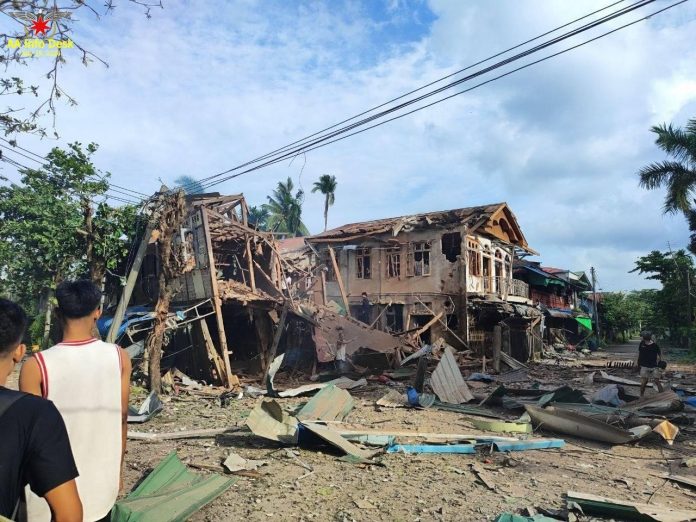
Residents in Thandwe Township, Arakan State, inspect the destruction caused by regime airstrikes on July 19. (Credit: AA)

At least six civilians were killed and more than 26 others—including children and Buddhist monks—were injured over the weekend as the Myanmar Air Force conducted a wave of airstrikes and drone attacks targeting liberated zones across Arakan State, Mandalay Region, and Sagaing Region.

The aerial bombardment destroyed over 25 residential homes and a local church, according to residents. The strikes triggered a swift warning from the Arakan Army (AA), which vowed to retaliate against every attack launched on territory under its administration.

Rakhine frontline: Strikes hit AA-controlled territory

The airstrikes heavily targeted three townships in Arakan State: Taungup, Thandwe, and Ponnagyun, located between 20-284 miles (32-457 km) northeast and south of the state capital, Sittwe.

All three townships were captured by the AA during its sweeping offensive between March and November 2024. The AA currently exercises administrative control over 14 out of Arakan’s 17 townships, alongside Paletwa Township in neighbouring Chin State.

A Thandwe resident told DVB on the condition of anonymity that everyone is hiding inside their homes because they don’t know when the next fighter jet is coming.

In an official statement issued on July 19, the AA strongly condemned the regime’s continued targeting of civilian areas and declared that its forces would “respond” to every military assault on AA-controlled territory.

Mandalay and Sagaing: Drone strikes and aerial bombardments

The military’s weekend air campaign extended deep into central Myanmar’s dry zone, utilizing a mix of fighter jets and unmanned aerial vehicles (UAVs):

  • Mahlaing Township (Mandalay Region): Located 75 miles (120 km) south of Mandalay city, the township was hit by a series of drone strikes July 18-19. A 70-year-old man was killed in the attack. Local residents reported that the military completely cut off all telecommunication and internet services prior to launching the strikes.
  • Myaung and Chaung-U townships (Sagaing Region): Situated 16-36 miles (25-58 km) south of Monywa, two villages were bombarded on July 19 by four fighter jets that dropped more than 60 bombs. While no casualties were reported, the heavy ordnance caused widespread structural damage.

A deadly paradox: Dialogue offers amid escalating airstrikes

The escalation comes amid a stark contradiction in the regime’s public diplomacy. On April 20—10 days after being inaugurated as president by a pro-military parliament—regime leader Min Aung Hlaing launched a “100-day plan” that included an invitation to all Ethnic Armed Organizations (EAOs), the People’s Defence Force (PDF), and the National Unity Government (NUG) to engage in peace talks in Naypyidaw before a July 31 deadline.

The offer has been widely dismissed by resistance forces as disingenuous, particularly given that the regime officially designated both the NUG and PDF as “terrorist organizations” in May 2021.

Data compiled by DVB indicates that far from de-escalating, the regime has intensified its air war since the dialogue invitation was announced:

Casualty Toll Since Min Aung Hlaing's "Peace Offer" (April 20 – July 19, 2026)
├── Verified Civilian Deaths from Airstrikes: 274
└── Verified Civilian Injuries from Airstrikes: 579

With the regime’s July 31 deadline approaching, resistance forces maintain that Naypyidaw’s call for dialogue is a tactical cover for its escalating air campaign against civilian populations across the country.

TNLA wants formal recognition of ‘Ta’ang State’ from regime in Naypyidaw

0
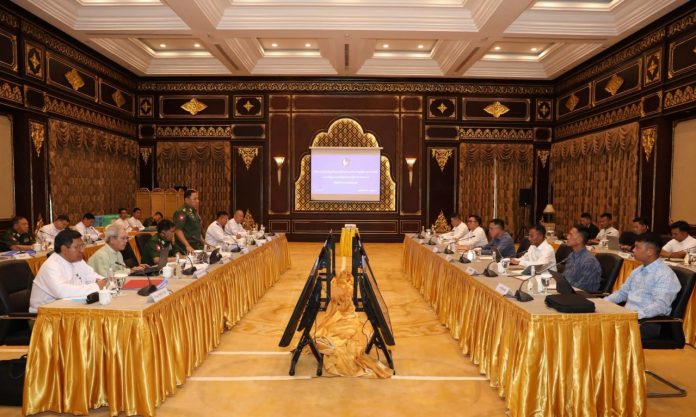
Representatives from the Ta’ang National Liberation Army met with the regime’s National Solidarity and Peacemaking Negotiation Committee in Naypyidaw on July 19. (Credit: Regime)

Representatives from the ethnic Palaung armed group, the Ta’ang National Liberation Army (TNLA), met with the regime’s National Solidarity and Peacemaking Negotiation Committee (NSPNC) in Naypyidaw on Sunday to negotiate terms on regional development, healthcare, and territorial stability.

The talks marked a significant diplomatic push by the TNLA, which formally requested that the regime recognize territory currently under its governance as an autonomous “Ta’ang State.”

In exchange, TNLA delegates assured regime negotiators that the proposed state would remain an integral part of the Union of Myanmar and would not attempt to secede. The group did not publicly detail the exact geographical boundaries it proposes for the new state.

Parallel consolidation: MNDAA establishes ‘civilian-led’ administrations

While the TNLA engaged in direct talks in the capital, its former alliance partner, the ethnic Kokang Myanmar National Democratic Alliance Army (MNDAA), executed a major administrative expansion.

The MNDAA officially announced the rollout of civilian-led administrative bodies across four newly designated districts within Special Region 1 in northern Shan State.

The move highlights a broader trend among major Ethnic Armed Organizations (EAOs) in northern Myanmar to institutionalize state-like governance over territories liberated or claimed during recent years of conflict.

A volatile territorial map: From offensive to ceasefire

The TNLA’s political demands follow nearly three years of dramatic territorial shifts across northern Shan State and Mandalay Region.

Northern Shan State & Mandalay Timeline
├── Oct 2023: Launch of 'Operation 1027' by Three Brotherhood Alliance (TNLA, MNDAA, AA)
├── 2024–2025: TNLA captures 12 townships across Shan State and Mandalay Region
├── Late 2025: Regime counteroffensives retake Kyaukme, Hsipaw, and Nawnghkio
├── Oct 28, 2025: TNLA signs China-brokered ceasefire with Naypyidaw
├── Nov 28, 2025: TNLA hands over Mogok and Momeik to regime per ceasefire terms
├── Mar 15, 2026: MNDAA takes full control of Kutkai from TNLA after territorial dispute
└── May 12, 2026: Regime orders TNLA to surrender Namhkam, Namtu, Mongngawt, and Monglon

The TNLA initially gained massive ground alongside the MNDAA and Arakan Army (AA) during Operation 1027, capturing the constitutionally recognized Palaung Self-Administered Zone (SAZ)—comprising Namhsan and Manton—alongside Namtu, Namhkam, Mongngawt, Monglon, Kutkai, Momeik, Kyaukme, Hsipaw, Nawnghkio, and Mogok in Mandalay Region.

However, maintaining control over this expansive footprint proved challenging:

Tactical realignments in northern Shan

The TNLA’s decision to negotiate in Naypyidaw reflects a pragmatic political pivot. Following Min Aung Hlaing’s inauguration as president by a pro-military parliament on April 10, the TNLA joined the ethnic Wa armed group, the United Wa State Army (UWSA), and the Mongla-based National Democratic Alliance Army (NDAA), in sending formal congratulations to Min Aung Hlaing following his inauguration as Myanmar’s president on April 10.

By seeking official recognition for a “Ta’ang State” while maintaining a China-backed ceasefire, the TNLA appears focused on consolidating its core administrative holdings in Namhsan and Manton, even as Naypyidaw continues to press for further territorial concessions along critical northern trade routes.

Contact