Thursday, July 23, 2026
Home Blog Page 66

Global calls to free Aung San Suu Kyi following transfer to house arrest

0
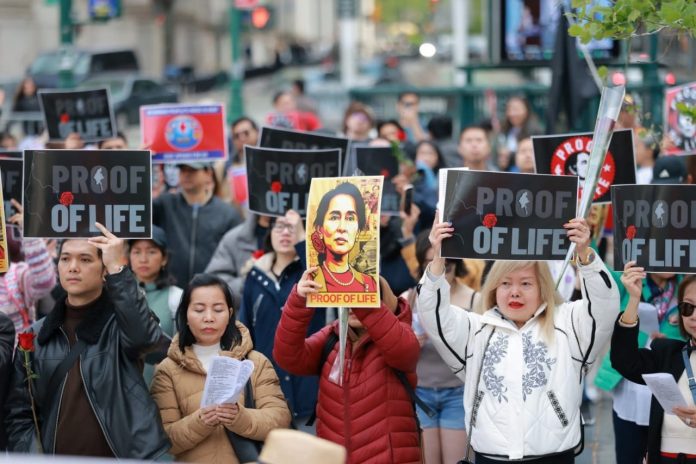
A ‘Proof of Life’ rally for Myanmar’s jailed leader Aung San Suu Kyi was held at Foley Square in New York City on May 2. (Credit: Kyaw Soe Latt, Sethu Win)

The European Union, the United Nations, the United States, and Japan have issued renewed calls for the immediate and unconditional release of ousted State Counsellor Aung San Suu Kyi and all political prisoners, following her recent transfer from Naypyidaw Prison to an undisclosed location under house arrest.

The detained leader, who has been held since the military seized power in a February 2021 coup, had her 22-year sentence reduced by one-sixth to 18 years as part of a general amnesty for 1,519 prisoners announced on April 30.

Despite the sentence reduction and transfer, the international community has made it clear that house arrest is not an acceptable resolution.

Calls to free Aung San Suu Kyi

“We continue to call for her immediate and unconditional release,” the U.S. State Department said in a May 1 statement. “We urge the regime to ensure Daw Aung San Suu Kyi has proper access to medical care given continued reports of her poor health.”

U.N. Secretary-General António Guterres echoed these demands, pressing for an immediate cessation of violence and a genuine commitment to inclusive dialogue.

Farhan Haq, the U.N. Secretary-General deputy spokesperson, told the press that Guterres “stresses the importance of continued dialogue between all relevant Myanmar stakeholders and his Special Envoy on how the United Nations and its partners, in particular ASEAN, can help support efforts towards a peaceful solution.”

Aris demands ‘Proof of Life’

Amid the heavy secrecy surrounding her new location and condition, Aung San Suu Kyi’s son, Kim Aris, publicly demanded “proof of life” from the military regime, asking for independent verification that his mother is alive and well.

Aung San Suu Kyi’s legal team reportedly planned to meet with her on May 3 following her transfer, which could provide a crucial update on her status.

Meanwhile, Beijing has struck a noticeably different tone regarding the crisis. During a press conference on April 30, China’s Foreign Ministry Spokesperson Lin Jian referred to the detained State Counsellor as an “old friend” of the Chinese government.

Reports indicate that China’s Foreign Minister Wang Yi may have met with Aung San Suu Kyi at her undisclosed location in Naypyidaw during his visit to the country on April 25, though these claims remain unverified by DVB.

Prison sentence reduced again

Aung San Suu Kyi’s transfer comes shortly after a similar move involving President Win Myint, who was also detained during the 2021 coup. Win Myint was released from Taungoo Prison in the Bago Region during the Myanmar New Year amnesty on April 17.

Their civilian administration, which governed the country from 2016 until the military takeover, was officially disbanded by Min Aung Hlaing’s regime in 2023 as part of an ongoing effort to permanently dismantle the National League for Democracy (NLD) party.

US Congress can apply the Iran sanctions model to Myanmar

0
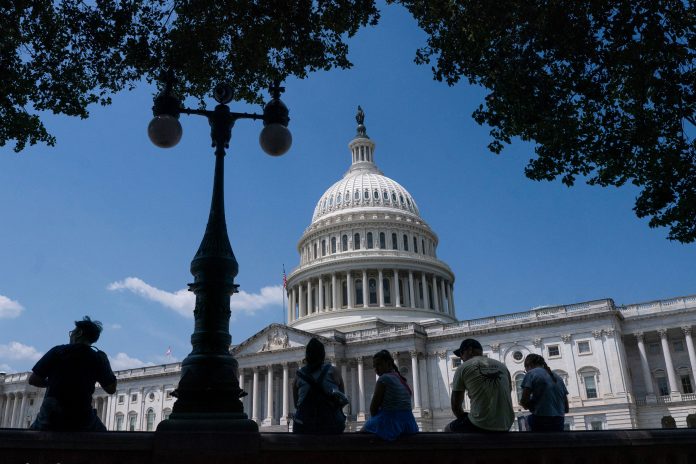
People sitting in the shade near the Capitol building on Capitol Hill in Washington, D.C., on June 25, 2025. (Credit: Reuters)

Guest contributor

James Shwe

On May 1, the U.S. State Department announced new sanctions targeting Iran’s oil trade with China as part of the “Economic Fury” campaign—a comprehensive financial warfare strategy that has cost Tehran an estimated $170 million USD daily while disrupting weapons networks, aviation fuel supplies, and shadow banking operations. 

This proven model offers Congress a powerful blueprint for addressing another regime that threatens American interests: Myanmar’s military junta, which operates billion-dollar scam compounds defrauding U.S. citizens while partnering with Iranian weapons suppliers.

Three bipartisan bills currently before Congress—each having passed one chamber—would strengthen U.S. policy toward Myanmar and transnational scam operations. 

With strategic enhancements drawing from the approach, these bills could close critical gaps that currently allow the junta to access American lobbyists, evade comprehensive financial pressure, and profit from criminal networks targeting Americans.

The Strategic Connection: Iran, Myanmar, and American Security

Investigative reporting has documented that Iran’s “shadow fleet” of sanctioned tankers supplies Myanmar’s military with aviation fuel and urea—a key explosive precursor—fueling the junta’s aerial bombardment campaigns. 

This connection means that U.S. sanctions disrupting Iranian networks create beneficial spillover effects, simultaneously cutting Myanmar’s military supply chains.

Moreover, secondary sanctions targeting Chinese companies handling Iranian oil are making Chinese firms more cautious about enabling Myanmar’s junta, as they face potential severance from the American financial system. 

This demonstrates how comprehensive economic pressure creates strategic synergies across multiple authoritarian regimes operating in the same illicit networks.

Bipartisan Congressional Leadership on Myanmar and Scam Operations

Congress has made extraordinary bipartisan progress on three bills that now require final passage:

The SCAM Act (S.2950), passed by the Senate on December 8, 2025, includes “Enabling Country” designation for governments that permit scam compound operations to continue. Americans lost $10 billion USD to Southeast Asia-based scams in 2024 alone. 

This provision would authorize presidential action against countries whose authorities enable transnational fraud operations. The bill awaits House approval.

The Dismantle Foreign Scam Syndicates Act (H.R. 5490), approved by the House Foreign Affairs Committee on December 2, 2025, explicitly identifies Myanmar’s military as a primary enabler of scam compounds where hundreds of thousands of trafficking victims are forced to conduct cybercrime operations against American citizens. 

The bill awaits a full House floor vote.

The BRAVE Burma Act (H.R. 3190), passed by the House on February 9 by unanimous consent, requires annual presidential determinations on whether Myanmar Economic Bank (MEB), Myanma Oil and Gas Enterprise (MOGE), and foreign entities in the aviation fuel sector meet sanctions criteria. 

The bill extends Myanmar sanctions through 2032 and mandates appointment of a Special Envoy for Burma with ambassadorial rank. It awaits Senate approval.

The unanimous House passage of the BRAVE Burma Act and strong bipartisan support for all three bills demonstrate sustained Congressional consensus that transcends partisan divisions—a remarkable achievement on foreign policy in the current political environment.

The Independent Voice: USCIRF’s Critical Recommendation

The U.S. Commission on International Religious Freedom (USCIRF), an independent federal commission, recommended in its 2026 Annual Report that Burma remain designated as a Country of Particular Concern (CPC)—a status it has held since 2022—for “systematic, ongoing, and egregious” violations of religious freedom. 

Myanmar is currently designated alongside China, Cuba, Eritrea, Iran, North Korea, Nicaragua, Pakistan, Russia, Saudi Arabia, Tajikistan, and Turkmenistan.

Critically, USCIRF urged Congress to introduce and pass legislation to ban the junta’s use of U.S.-based lobbying firms to dodge accountability for crimes including accusations of genocide by U.N. investigators. 

A 2018 U.N. Fact-Finding Mission concluded that Myanmar’s military should face investigation and prosecution for genocide, crimes against humanity, and war crimes, with particular focus on senior generals.

This recommendation addresses a gap that undermines U.S. policy coherence: current law permits lobbying for sanctioned regimes if agents comply with the Foreign Agents Registration Act (FARA). 

In July 2025, within days of the junta’s dissolution of the State Administration Council and rebranding, two Washington firms—DCI Group AZ, LLC and the McKeon Group—signed contracts worth $3 million USD annually for DCI with junta-controlled entities, as documented in public FARA filings.

While these firms operate within existing legal parameters, Congress has the authority to close this loophole through legislation.

A Strategic Framework: Economic Fury Meets Scam Center Enforcement

Congress should advance the three pending bills with targeted enhancements that apply lessons from the Iran model:

1. Pass all three bills and expand the scam center framework. The SCAM Act’s Enabling Country designation should be expanded to include “Enabler Groups”—armed factions and military regimes that protect scam operations. The Treasury Department has already sanctioned scam networks in Myanmar’s Shwe Kokko, which is protected by the pro-junta Karen State Border Guard Force (BGF), and the Justice Department’s Scam Center Strike Force charged Chinese nationals running Myanmar-Thailand border compounds in April 2026, confirming the junta’s role in this criminal ecosystem.

2. Enact USCIRF’s recommended lobbying prohibition. New legislation should prohibit provision of paid lobbying, public relations, or strategic communications services to Myanmar’s junta, dissolved junta entities, successor organizations, junta ministries, military-owned enterprises, and proxy entities. 

The prohibition must cover direct and indirect contracting through agents, law firms, shell companies, or front entities to prevent evasion through rebranding.

3. Prohibit lobbying by designated Enabler Countries/Groups and sanctioned entities. If a country or armed group is designated as an enabler of transnational crime or atrocity crimes, its de facto government should be automatically barred from hiring U.S. lobbyists. 

Similarly, any individual or entity already under U.S. sanctions should face the same prohibition.

4. Strengthen BRAVE Burma Act implementation. Congress should encourage:

  • Rapid presidential determinations on MEB and aviation fuel sector sanctions
  • Enhanced enforcement of existing MOGE restrictions through secondary sanctions on foreign buyers
  • Interagency coordination replicating the “Economic Fury” model’s comprehensive approach
  • Target sanctions on aviation fuel suppliers and refueling operations at regional airports serving junta aircraft
  • Disruption of cryptocurrency and shadow banking routes through Singapore, Bangkok, and Hong Kong
  • Sanctions on weapons component suppliers from China, India, and Russia
  • Expanded Scam Center Strike Force enforcement against junta-protected operations

Why Congressional Action Matters Now

The “Economic Fury” campaign in Iran demonstrates that comprehensive financial warfare combining energy revenue interdiction, aviation fuel blockades, weapons materials cutoffs, crypto freezes, and secondary sanctions can severely damage authoritarian regimes reliant on illicit networks. 

The model works—and Congress has the authority to apply it regardless of executive branch priorities.

The three pending bills represent years of bipartisan work and reflect broad consensus that Myanmar’s junta poses threats to American citizens (through scam operations), American values (through atrocity crimes including U.N.-documented genocide accusations), and American strategic interests (through partnership with Iranian and Chinese adversarial networks).

Myanmar’s Spring Revolution has fought for five years against a regime accused of genocide by U.N. investigators while operating billion-dollar fraud operations targeting American citizens. 

Congressional passage of these bills—with the enhancements outlined above—would demonstrate that American policy does not permit mass atrocity perpetrators to simultaneously hire Washington lobbyists and run criminal networks defrauding Americans.

The model exists. The bills have bipartisan support. Congressional leadership across both parties has demonstrated commitment. Final passage would close critical gaps and apply proven economic warfare strategies to a regime that threatens both American security and fundamental human rights.

The next move belongs to Congress.


James Shwe is a Myanmar American professional engineer and advocate for democracy in Myanmar, affiliated with the Los Angeles Myanmar Movement.

DVB publishes a diversity of opinions that does not reflect DVB editorial policy. We’d like to hear what you think about this or any of our stories: [email protected]

Thai and migrant workers march for reform in Chiang Mai

0

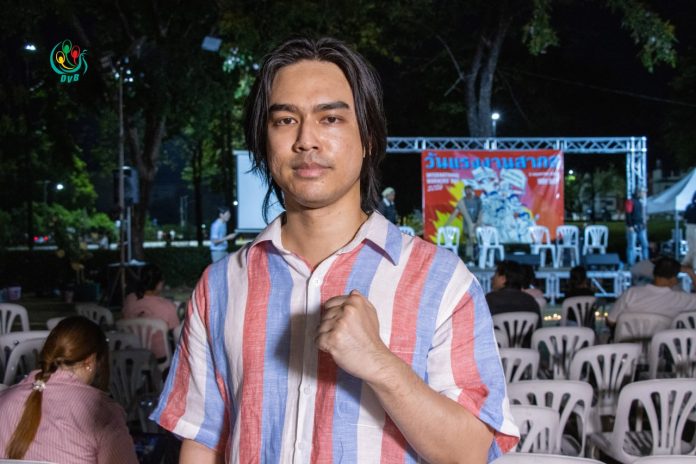
Workers, activists, and academics took to the streets of Chiang Mai, Thailand, on May 1 to mark National Labour Day, united behind an urgent call for structural reforms to the country’s social security system.

Marching under the core theme “No Social Security, No Security,” participants assembled in the city center before parading to Chiang Mai’s Railway Park.

Organized by the Northern Labour Network, the event distinguished itself from a traditional protest by blending direct advocacy with cultural activities, creating an inclusive space for both Thai citizens and marginalized migrant workers.

“We organize Labor Day parades every year. I think this makes the labor network Labor Day quite unique compared to the rest of the country,” said Sek Suphalak Bumroongkit, Secretary General of the Northern Labour Network.

“It’s a day that everyone, including the migrant workers, can gather together, have fun, and demand things that work for themselves… I’m trying to make this a platform for the people who want to see the world more equal and want to see the world better.”

A vulnerable safety net

Amidst the cultural displays, participants voiced deepening concerns over rising living costs, economic instability, and glaring weaknesses in Thailand’s social security system, which organizers described as the country’s last crucial safety net.

A significant contingent of the demonstrators included Burmese migrant worker groups, who marched to submit targeted demands regarding their systematic exclusion from healthcare and financial protections.

“Depending on the type of work migrant laborers do—for example, in agriculture, domestic work, or construction—we are advocating and demanding that they be included in the social security system,” explained Thong Kham, a representative from the MAP Foundation that works with Myanmar migrant communities living in Thailand.

Kham highlighted that many employers illegally fail to enroll their migrant staff in the Social Security Fund, leaving them severely exposed.

“Health is a critically important issue for our migrant workers,” Thong Kham added. “If health fails, medical costs are high and unaffordable for laborers. That is why we want everyone to be covered under Social Security.”

The May Day event on May 1 remained open to the public throughout the day, encouraging bystanders to join the procession, share their perspectives, and stand in broader solidarity with the global workforce.

Chiang Mai initiative shines light on unseen migrant workers in Thailand

0
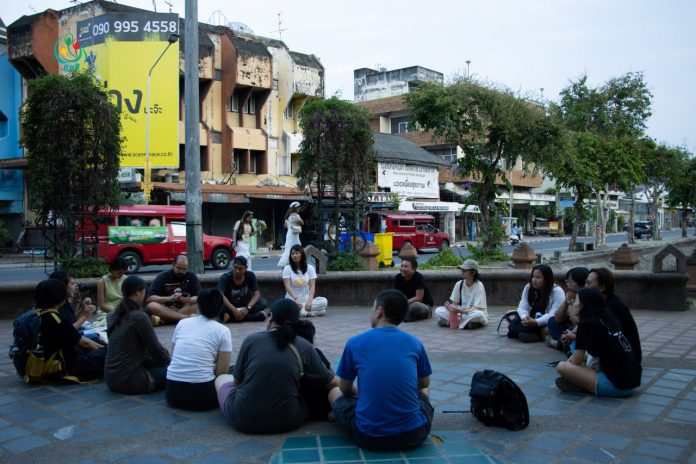
Volunteers on a nighttime field trip to foster respect for migrant workers, gather at the edge of the moat at Tha Phae Gate in Chiang Mai, Thailand on April 30. (Credit: DVB)

A unique nighttime volunteer activity in northern Thailand is drawing fresh attention to the vital, yet often invisible, role of Myanmar migrant garbage collectors who keep the city running after dark.

The event, affectionately titled “Night with Santa Claus,” took place on April 30 and brought around a dozen participants into the streets of Chiang Mai. Volunteers spent the evening exploring the city at night, which included riding tuk-tuks alongside Myanmar waste collectors as they carried out their regular shifts.

Organizers of the initiative say the goal is to challenge deeply ingrained social biases and highlight the essential contributions of migrant workers. Despite playing a foundational role in Chiang Mai’s daily operations and cleanliness, these workers are frequently marginalized and viewed as “outsiders” by the broader public.

“They are not ‘others.’ They are the ones cleaning the city. They are the ones moving to Chiang Mai,” said Kanokwan Meeprom, an organizer and manager of Serm Raeng Rian Chiang Mai.

The “Night with Santa Claus” program aims to break down prejudice through direct, humanizing experiences. For many volunteers, bridging the gap between residents and the migrant workforce proved to be a transformative experience.

“Going around with the trash collector [impacted] me a lot because I can hear their story, I feel empathy, and also, I feel proud of them,” said Thet, a volunteer participant. “I feel that they play an important role in environmental protection without knowing themselves or anything like that. They are also heroes of their family.”

To ensure the activity remains a positive experience for everyone involved, organizers established strict rules to protect the privacy and dignity of the waste collectors. The focus remains heavily on mutual respect rather than voyeurism.

“It’s a mutual respect. It’s like mutual exchange,” Meeprom added. “Maybe they have to improve, but at least this is the first time that [it opens] people’s minds to learn about this group of people.”

Relief, confusion, and the Myanmar military’s new political theatre

0
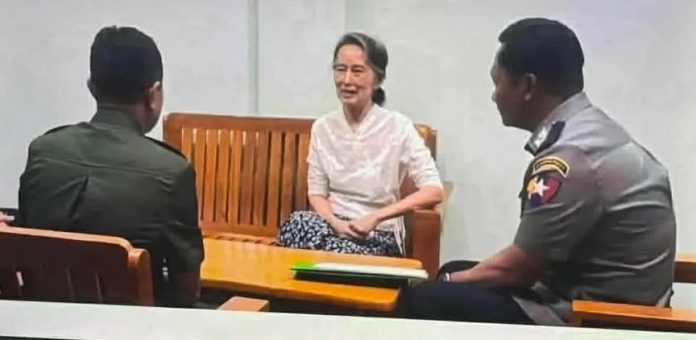
An image shared by regime media on April 30 purportedly showing jailed State Counsellor Aung San Suu Kyi, marking only the second time Naypyidaw has released an image of her since she was detained during the military coup on Feb. 1, 2021. No further details were provided. (Credit: Regime media)

Guest contributor

Mon Zin

President Win Myint is now free. Myanmar is not. 

The images of his release have brought a wave of relief. After five years of unjust detention, seeing him reunited with his family is undeniably human and deeply moving.

But relief, in Myanmar today, rarely arrives alone. It arrives with confusion.

Because while one prison door has opened, more than 22,000 others remain firmly shut. Among them is Aung San Suu Kyi, still under detention, still tightly controlled and still denied independence. 

The question is not simply what this release means. It is what it is meant to make people feel.

The answer lies less in the act itself than in its timing and framing.

The release of President Win Myint comes at a moment of carefully staged political theatre. 

The same military general that removed an elected government now sits in parliament under the title of “President,” and has proceeded to pardon the imprisonment of the very president it unlawfully detained.

It is a move that is as symbolic as it is strategic.

The jailer recast as arbiter of mercy. The usurper assumes the language of constitutional authority.

What appears humane is embedded within a structure that remains fundamentally illegitimate.

This is not simply a political contradiction. It is a constitutional one.

President Win Myint was the sitting head of state, elected by Parliament in 2018. His term was interrupted before a newly elected legislature could convene following the 2020 general election. 

No lawful transition took place. No successor was elected.

His detention was not the removal of a past officeholder, but the interruption of an ongoing presidency. His subsequent pardon is therefore not a routine exercise of authority, but a striking inversion of it.

This inversion is central to the military’s broader narrative manoeuvre.

Selective prisoner releases are not intended to resolve the crisis. They are designed to reshape its perception, to recast repression as reconciliation, and control as transition.

The latest developments make this strategy even clearer.

The military has announced that Aung San Suu Kyi will be moved to house arrest at an undisclosed “designated residence”, accompanied by the release of a carefully managed photograph, the first image of her in years.

Yet key questions remain unanswered.

Her location has not been disclosed. There is no independent access to her. Even the image itself has been questioned, with her own son indicating it may have been taken years ago.

This is not transparency. It is controlled visibility.

This recalibration is unfolding alongside regional pressure. Increased engagement between China and ethnic armed organisations along Myanmar’s eastern border, framed around stability, border security, and the protection of economic corridors, has coincided with the junta’s 100-day ultimatum for “peace talks.” 

This is not an open invitation. It is a managed timeline. One designed to create the appearance of dialogue without substance.

International response reflects an awareness of this dynamic.

Governments such as Australia and the United Kingdom have acknowledged the release, while avoiding language that would frame it as progress. 

Instead they reiterate calls for the release of all political prisoners, including Aung San Suu Kyi.

Even language has become contested terrain. 

The European Union and Canada continue to refer to Win Myint as President, reaffirming democratic legitimacy. 

The United States uses “former president”. Meanwhile, Australia and the United Kingdom adopt more neutral language, referring simply to Win Myint.

These are not stylistic differences. They reflect competing priorities; asserting legitimacy, preserving flexibility, and managing engagement.

At the core lies a familiar tension in international practice: the distinction between legitimacy and recognition.

Power may be exercised. It does not follow that it is lawful. The result is a carefully managed ambiguity.

This ambiguity now extends beyond diplomacy and increasingly visible in media framing as well.

In the aftermath of the release, some reporting has begun to describe Win Myint as a former president, while referring to Min Aung Hlaing as the country’s current head of state. 

This framing mirrors the very narrative the military seeks to establish, that a constitutional transition has taken place. 

It has not. 

In a context where constitutional order was violently interrupted, language does not merely describe reality. 

It shapes perception.

For many, the image of President Win Myint smiling again evokes memories of a political era that feels both distant and unfinished. It creates a sense, however fleeting, that something may be shifting.

But this is precisely where the danger lies. Because hope, when carefully engineered, can also disorient.

It can blur the distinction between symbolic gestures and structural change. It can soften the perception of a regime that continues to detain more than 22,000 political prisoners, restrict information and carry out violence against civilians. 

It can also fracture the resistance itself.

In this sense, the release of President Win Myint is not an endpoint. It is the beginning of a new psychological phase.

One in which the struggle is much about perception as it is about power.  Yet there is one point that remains beyond ambiguity. 

Aung San Suu Kyi remains under strict control, without independent access.

If the Myanmar military can present President Win Myint to the public, it can also provide proof that she is alive and well. 

Anything less raises legitimate concern.

And beyond her, more than 22,000 individuals remain behind bars, many young, many unnamed, many unseen, all part of the same unfinished story.

Their continued detention is not mitigated by the release of one man. It makes the contrast unavoidable.

The release of President Win Myint should be acknowledged. It should be welcomed on humanitarian grounds.

But it should not be mistaken for progress. Because the measure of change is not who has been freed. It is who remains.


Mon Zin is a Myanmar-born finance professional and community advocate in Australia focusing on geopolitical and humanitarian developments relating to Myanmar.

DVB publishes a diversity of opinions that does not reflect DVB editorial policy. We’d like to hear what you think about this or any of our stories: [email protected]

Military regains control of Sagaing Region’s Indaw in counteroffensive

0
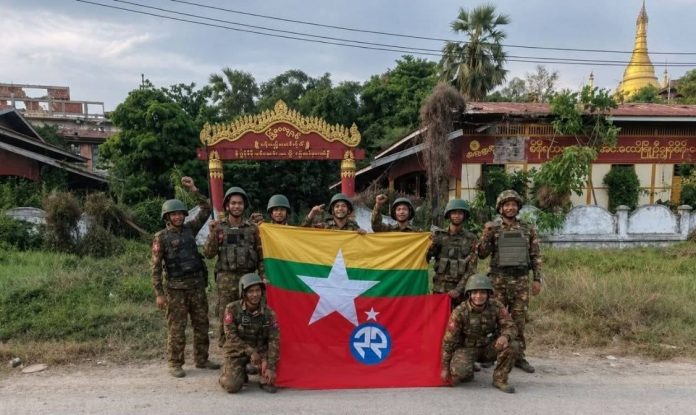
Regime troops after retaking control of Indaw Township, Sagaing Region, on April 30. (Credit: Regime)

The Myanmar military has regained control of Indaw Township, Sagaing Region, a critical logistics hub that connects to the regime’s northern strongholds in neighbouring Kachin State.

Regime forces re-entered the town on Thursday following a massive, seven-day counteroffensive that began on April 24.

Regime media reported that military columns recovered the bodies of 33 People’s Defense Force (PDF) members along with caches of weapons during the operation.

The recapture ends a year-long occupation by resistance forces. The Kachin Independence Army (KIA) and allied PDF fighters originally seized Indaw on April 7, 2025.

A ‘vital’ logistics artery

Indaw, located roughly 209 miles north of the Sagaing Region capital of Monywa, sits at a crucial road and rail junction.

Zin Yaw, a former soldier who joined the Civil Disobedience Movement (CDM) after the 2021 coup, told DVB that Indaw serves as a “vital” supply artery connecting to Kachin State towns like Mohnyin, Mogaung, and Myitkyina—the latter being the headquarters of the regime’s Northern Regional Military Command (RMC).

The push to retake Indaw appears to be part of a broader, coordinated effort by regime forces to secure its northern supply lines.

The military recently recaptured Tagaung in Mandalay Region’s Thabeikkyin Township on March 12, followed by Sagaing’s Tigyaing Township on March 26.

To retake Indaw, the regime launched three separate military columns originating from Tigyaing, Katha, and Tagaung.

On April 29, PDF sources confirmed to DVB that regime forces had already secured the main road leading into Indaw and captured Nabar village, just four miles east of the town.

Civilians flee amid conflicting claims

As the military moves to consolidate control, the humanitarian situation on the ground remains dire. An Indaw resident told DVB that locals are currently on the run, having fled the clashes between regime and resistance forces.

Meanwhile, a war of narratives has emerged over the town’s condition. Regime media reported that the military is currently conducting landmine clearance operations, accusing the PDF of displacing residents and constructing bunkers inside schools, hospitals, religious buildings, and administrative offices.

Pro-military outlets further claimed that resistance forces fled the town on April 30 without putting up a significant fight, accusing PDF members of looting civilian homes before their retreat.

Independent verification of casualty numbers and property damage remains difficult as residents have not yet returned to their homes.

Contact