

Guest contributor
James Shwe
On Myanmar New Year’s Day, after more than five years inside Taungoo Prison, President Win Myint was reunited with his family at their rental home in Naypyidaw’s Ottarathiri Township.
It was the first piece of unambiguous joy to come out of Myanmar in a very long time, and we should name it that way before we name anything else.
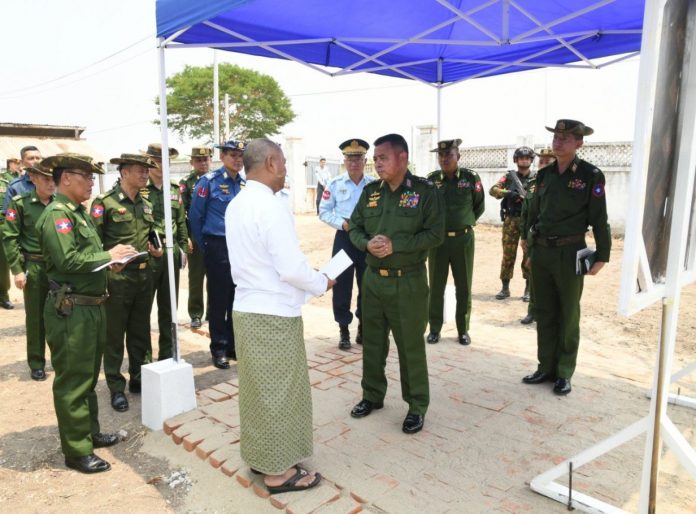
Within forty-eight hours, more than thirty soldiers and police had been posted outside the house, monitoring who came and went. That is the measure of the “freedom” the regime is selling.
The order that freed him was not mercy. Seven days earlier, Senior General Min Aung Hlaing had awarded himself the title “President,” and it was that newly-manufactured office that signed Order No. 42/2026 under Section 401(1) — a statute that keeps release revocable on the regime’s say-so.
Aung San Suu Kyi was not freed; her 27-year sentence was trimmed only by one-sixth. 22,131 political prisoners, by the count of the Assistance Association for Political Prisoners, remain in detention.
Airstrikes on civilian villages continued during Thingyan itself.
This was a cunning move, engineered in two capitals neither of which is Naypyidaw.
It was scripted in Beijing, which has spent two years openly backing the regime’s “credibility laundering” — arms, U.N. Security Council cover, and “technical assistance” for a three-phase vote held under martial law between late December 2025 and late January 2026, with major parties banned and no voting across roughly half the country.
And it was pitched in Washington: in July 2025 the junta signed a three-million-dollar-per-year contract with DCI Group AZ, LLC, a Republican Party-aligned public-affairs firm whose FARA filing names the mandate frankly — “rebuilding relations … with a focus on trade, natural resources, and humanitarian relief.”
The recent amnesty is the centerpiece those dollars were always meant to sell. The military-backed Union Solidarity and Development Party (USDP) was declared the “winner,” and a new administration is now being marketed abroad as a legitimate partner — but it is the same commanders, the same chain of command, and the same architecture of repression, wearing a civilian label, with Min Aung Hlaing, both Vice Presidents, and a substantial portion of the cabinet still under Western sanctions.
The timing is engineered too. On April 21, Min Aung Hlaing issued a 100-day ultimatum: ethnic armed organizations and the People’s Defense Force (PDF) must enter negotiations by 31 July under the regime’s “legal framework” — the one built on the sham election.
Key resistance organisations rejected it within hours. Beyond the 100 days sits the U.N. General Assembly Credentials Committee this autumn, which will choose between Ambassador Kyaw Moe Tun — the legitimate voice of Myanmar at the U.N. — and an envoy sent by the regime.
Win Myint’s release is the down-payment on both.
In diplomacy, whoever speaks matters as much as what is said. Ranked by seniority, the Western picture sharpens.
Canada spoke at the top — Foreign Minister Anita Anand herself — calling for “the unconditional release of all political prisoners, including State Counsellor Aung San Suu Kyi.”
The European Union followed through Anitta Hipper, the lead spokesperson for HR/VP Kaja Kallas, demanding “the unconditional release of all arbitrarily detained persons, including Daw Aung San Suu Kyi”; Brussels had already rejected the junta’s election as neither free nor fair.
The United Kingdom used Chargé d’Affaires Andrew Jackson in Yangon, repeating the call for “all those who are unjustly detained, including Daw Aung San Suu Kyi.”
Australia spoke at embassy level and named the “Myanmar military”— a careful refusal to recognize Min Aung Hlaing’s new title.
The United Nations pitched at the highest rank available: Secretary-General António Guterres “took note” and reframed the moment around those still detained; High Commissioner Volker Türk demanded the unconditional release of every political prisoner. The Philippines called the release a “constructive step” while echoing the same demand.
The United States spoke through Assistant Secretary Riley Barnes: “We welcome reports of the release of political prisoners … including U Win Myint and Shin Daewe. The United States will continue to advocate for the release of all political prisoners and support a path to peace and stability in Burma.”
The DCI Group’s campaign is designed to shape exactly this kind of statement — to shift vocabulary toward “peace and stability” and away from names and conditions.
That the Assistant Secretary for Democracy, Human Rights, and Labor still insisted on “the release of all political prisoners” is a line held against heavy lobbying pressure. The American position has not collapsed; it is being contested. Our job as diaspora advocates is to reinforce it, not tear it down.
That is where the Burmese American community now has its most consequential work — and has already begun.
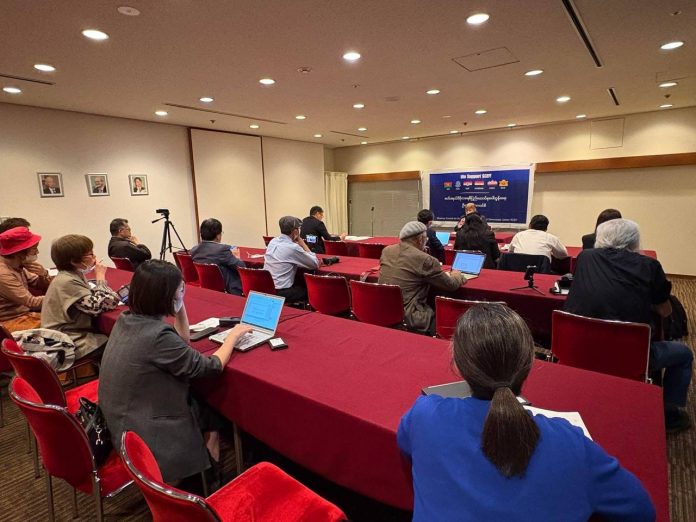
A coalition of organizations wrote a collective letter to the Congressional Burma Caucus and to the leadership of the House Foreign Affairs and Senate Foreign Relations Committees, naming four converging developments: Russian oil reshaping ASEAN’s incentives; the manufactured “new government”; early signals in Washington of expanded engagement; and the 100-day ultimatum.
The letter is not a demand for new funding. It is an invitation to Congress to use the voice and oversight it already has — four asks, in the community’s own words:
Please hold the line against premature recognition or upgraded engagement with the post-”election” government — no invitations, no upgraded contacts, no quiet “reset” — until there is real, systemic change on the ground, and do not let the July 31 “peace deadline” become a pretext for normalization.
Please ask the administration to set clear benchmarks before any expansion of engagement: a verifiable end to airstrikes on civilians, release of political prisoners, unhindered humanitarian access, genuine inclusion of the National Unity Government (NUG) and ethnic resistance organizations, and credible accountability for atrocities.
Please make clear that Russia and China are not neutral brokers. Moscow armed and legitimised this junta. Beijing hedges across all sides for its own leverage but wants the military to retain power.
Please keep the bipartisan lines Congress has already drawn visible — the BURMA Act, BRAVE Burma, and the No New Burma Funds Act — so they are not quietly eroded by executive-level engagement that bypasses them.
These demands complement the State Department’s April 21 position; they do not contradict it. A Burma Caucus, Senate Foreign Relations, or House Foreign Affairs leadership statement that welcomes Win Myint’s release, names Aung San Suu Kyi, and reaffirms bipartisan moral support for the people of Myanmar would give the administration the congressional backing it needs against a well-funded lobbying campaign working the opposite way.
The ask for every Burmese American this week is simple: call or write to your member of Congress. Over 96,000 people have died in this conflict; more than 3.6 million are displaced.
Burmese of every ethnicity and faith — Bamar, Karen, Kachin, Chin, Shan, Karenni, Rakhine, Rohingya, Mon and others — have sacrificed for a genuine transition to democratic governance, not a cosmetic civilian facade.
Our Canadian, British, Australian, Japanese and European diaspora allies have parallel work: ask Ottawa to keep using Minister Anand’s voice, London to move from Chargé- to Foreign-Secretary-level, Canberra to match the EU at ministerial rank, Tokyo to speak at any rank, and Brussels to hold the line through the autumn U.N. votes.
Against the Western chorus stands the predictable set of capitals that underwrote the junta before the amnesty was ever drafted.
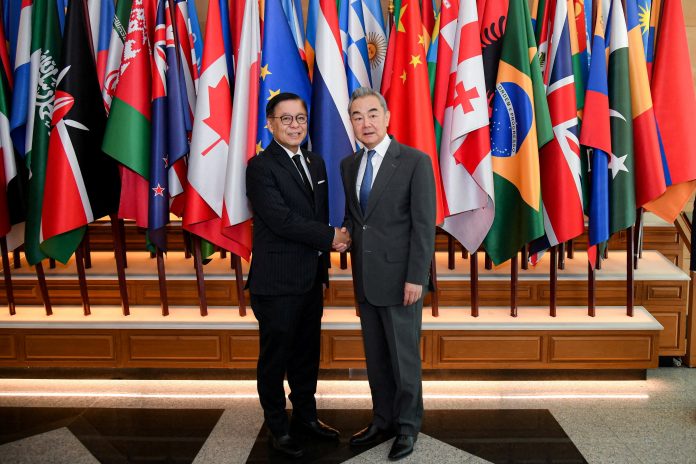
China was the first to acknowledge Min Aung Hlaing’s self-elevation: Ambassador Ma Jia called on him on April 6, Xi Jinping sent early congratulations, and Xi’s Special Envoy Jiang Xinzhi attended the 10 April inauguration in person, pledging a “China–Myanmar community with a shared future.”
Russia’s Vladimir Putin and Belarus’s Aleksandr Lukashenko were among the first heads of state to congratulate Min Aung Hlaing on his “election”; Nicaragua’s Daniel Ortega and Murillo followed. And India — the world’s largest democracy — recognized Min Aung Hlaing as President when Minister of State Kirti Vardhan Singh travelled to Naypyidaw to hand-deliver Prime Minister Modi’s letter of felicitations.
Thailand then spoke at full foreign-ministry level and embraced every piece of regime framing — welcoming “the Order of the President of Myanmar,” calling the amnesty “a positive step by the Myanmar Government,” and using the Beijing-scripted vocabulary of “national reconciliation.”
On April 22, Thai Foreign Minister Sihasak Phuangketkeow pledged to lead Myanmar’s return to ASEAN; Cambodia fell behind.
And while Bangkok was welcoming “the Order of the President of Myanmar,” the U.S. Department of Justice (DOJ) was reminding everyone what that “Myanmar Government” actually runs.
On April 22, the U.S. Scam Center Strike Force unsealed criminal charges against two Chinese managers of the Shunda scam compound in Min Let Pan, Myawaddy Township of Karen State — a compound that DOJ said used trafficked workers “held under threat of violence and torture.”
The same announcement seized another Tai Chang–linked domain operating out of Karen State and paired it with a State Department reward of up to $10 million USD for information on Tai Chang proceeds.
It follows November 2025 Treasury sanctions against senior Democratic Karen Benevolent Army (DKBA) leaders and Trans Asia affiliates.
The contradiction is impossible to miss: the same capitals now congratulating Min Aung Hlaing on his “election” are the capitals whose citizens are being trafficked into compounds run on his border under his military’s protection.
“Stability” is not what that looks like.
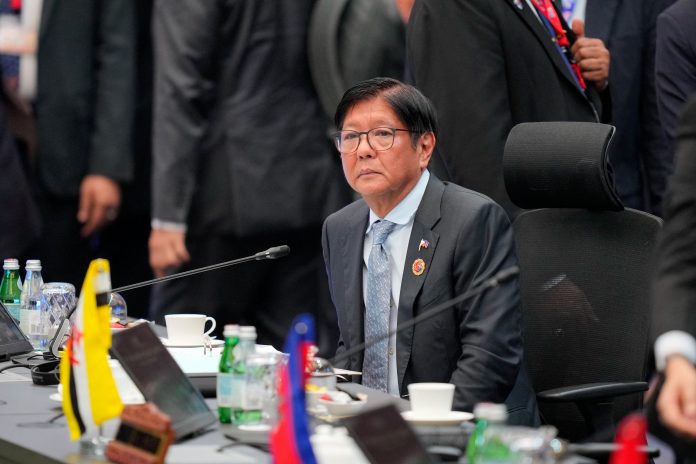
But the pro-junta bloc is narrower than it looks. The Thai government does not speak for the Thai people. India’s recognition is contested at home by parliamentarians, civil society, and the country’s independent press. And the rest of ASEAN has not followed Bangkok: 2026 Chair Philippines, with Indonesia and Malaysia, has pointedly refused to congratulate Min Aung Hlaing.
ASEAN is split our way — though the Russian-oil arithmetic of the past five weeks, with Indonesia, Malaysia, the Philippines and Vietnam all opening or expanding energy arrangements with Moscow, is a reminder the balance can shift.
The fourth voice is ours. On April 18, the NUG Ministry of Foreign Affairs called Win Myint’s release “a key step driven by people’s resistance and sustained international pressure.”
On April 22, the Steering Council for the Emergence of a Federal Democratic Union formally welcomed him home.
And three days before the amnesty, the International Criminal Court (ICC) spokesperson Oriane Maillet reminded the world that Min Aung Hlaing’s new civilian title changes nothing about the arrest warrant pending against him since November 2024: “The Rome Statute applies equally to all persons without any distinction based on official capacity.”
No pardon, no election, no costume change lifts an ICC warrant.
What is being asked of us in these 100 days? Celebrate the man, not the moment: Win Myint coming home is our joy; the fiction of a “President of Myanmar” signing the order is not something we are obliged to authenticate.
Use the language of Ottawa, Brussels, London, Canberra, the U.N. and the NUG — not Bangkok. Say “released after five years of unjust detention”; never “pardoned by the President of Myanmar.”
Say “Win Myint”; never “former president.” Every time we invoke his freedom, invoke her detention — say her name, Aung San Suu Kyi, in the same sentence, every time.
Keep her and the other 22,131 political prisoners at the center of every statement; the number is a discipline. Press Congress with the four asks from the April 26 letter — strengthen the American position, do not pull against it.
And refuse tiered bargaining. The next move in the Beijing-scripted, DCI-pitched sequence — once the 100-day “peace deadline” has softened the ground — will almost certainly be an offer to commute Aung San Suu Kyi’s sentence to house arrest in exchange for resistance acceptance of the 2008 Constitution or the sham election.
Our answer is prepared in advance: no dialogue without a nationwide cessation of airstrikes; no dialogue without the verified unconditional release of every political detainee; no dialogue without acceptance of a federal democratic framework. These are not opening positions. They are the floor.
Win Myint did not bow for five years inside Taungoo. He walked out at age 74 with his dignity intact and the elected presidency still attached to his name.
Canada at ministerial rank, the E.U., the U.K., Australia, the U.N., the Philippines, the ICC, and the civil-society movements that have not gone quiet since February 2021 have rejected the regime’s script.
The ICC warrant stands. The NUG and SCEF own the meaning of this moment. Only Bangkok has accepted Min Aung Hlaing’s self-awarded title.
And Washington — under lobbying pressure, at a rank lower than we would wish — still said “all political prisoners.”
That clause is a door left open. It is on us, and on our friends in Congress, to walk through it together in the 100 days ahead.
One man is home. 22,131 political prisoners remain. We will say her name until the day she too walks free.
The revolution will win.
James Shwe is a Myanmar American professional engineer and advocate for democracy in Myanmar, affiliated with the Los Angeles Myanmar Movement.
DVB publishes a diversity of opinions that does not reflect DVB editorial policy. We’d like to hear what you think about this or any of our stories: [email protected]