Thursday, July 23, 2026
Home Blog Page 71

Cambodia readies new conscription law for men aged 18-25

0
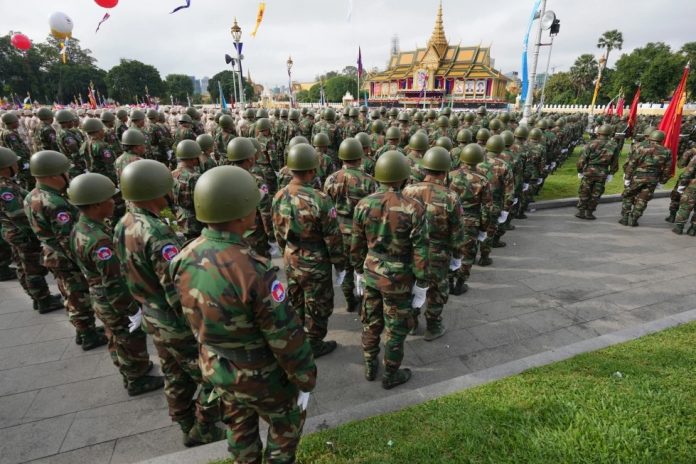
Cambodian military members participate together with government civil servants in the country’s 70th Independence Day, in Phnom Penh, Cambodia, on Nov. 9, 2023. (Credit: AP)

A law requiring Cambodian males aged 18 to 25 to serve in the military for two years has gained Cabinet approval following two spates of deadly combat last year with neighboring Thailand.

The new draft law on conscription will replace an existing law dating from 2006 that was never implemented and no longer addresses current and future needs, a government spokesperson said Friday.

The existing law specified 30 as the maximum call-up age. Women will be allowed to serve on a voluntary basis.

Spokesperson Pen Bona said the draft law, with eight chapters and 20 articles, was adopted by the Cabinet at its meeting on Thursday.

Fighting between Cambodia and Thailand flared twice last year over contending claims to territory along their shared border.

Hundreds of thousands of people in both countries were displaced and about 100 Cambodian soldiers and civilians lost their lives. There has been no new fighting since a December ceasefire, though tensions remain high.

A government statement described military service as an essential duty and a great honor allowing the Cambodian people to contribute to national development and defend the motherland.

Prime Minister Hun Manet said in July last year when relations with Thailand were deteriorating that Cambodia would implement conscription this year. He said that soldiers joining through conscription are more effective and professional than a voluntary force, and that conscription will be used to fill shortages and upgrade military capabilities.

The legislation will be sent to the National Assembly and the Senate for approval, and become law once King Norodom Sihamoni signs it.

AP

Military regains control of Chin State’s Falam town from resistance forces

0
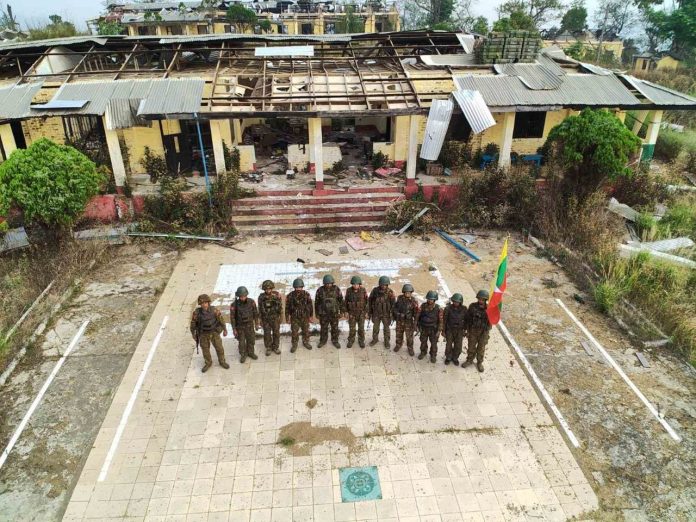
Regime forces in front of a destroyed building in Chin State’s Falam after regaining control of the town from Chin resistance forces on April 25. (Credit: Regime)

The military regained control of Falam, the second largest town in Chin State after the capital Hakha, from the Chin resistance on Saturday. 

Salai Timmy Htut, the Chin Brotherhood spokesperson, declined to speak to DVB, citing “military confidentiality.” 

The Chin National Defence Force (CNDF), a member of the Chin Brotherhood, told DVB on the condition of anonymity that fighting over control of Falam is ongoing.

Chin World, the local news agency, reported that both Falam and its Surbung Airport were recaptured by regime forces on April 25. Falam, located 41 miles (66 km) north of Hakha, was seized by the Chin Brotherhood in April 2025.

Regime media reported that 19 “terrorists” were killed by regime troops, which is how Naypyidaw refers to Chin resistance force members. The military doesn’t disclose its fatalities. It launched a counteroffensive to retake Falam in October 2025. 

Residents in Chin State told DVB that regime forces recaptured Taingen, a strategic village that sits at the junction connecting northern to southern Chin, on Nov. 9. Taingen is located 91 miles (146 km) north of Hakha.

The Chin Brotherhood seized control of southern Chin’s Kanpetlet, Mindat, and Matupi townships in June and December 2024.

Tonzang township, located 65 miles (105 km) north of Hakha, and parts of Thantlang Township, located 22 miles (35 km) west of Hakha, were seized in August 2023 and May 2024 by Chinland Council forces, which includes the Chin National Army (CNA) and the Chinland Defence Force (CDF).

The CNA and the CDF seized the India-Myanmar border town of Rikhawdar in Falam district in November 2023.

The Interim Chin National Consultative Council (ICNCC)—the political wing of the Chin Brotherhood—and the Chinland Council have engaged in unification talks, but no formal progress has been announced publicly since Feb. 26, 2025.

Paletwa Township in southern Chin State, located 199 miles (321 km) south of Hakha, was seized by the Arakan Army (AA) in January 2024 after it launched its Arakan State offensive on Nov. 13, 2023. Besides Paletwa, the AA has seized control of 14 out of 17 townships in Arakan.

The regime controls Hakha, and partially controls Thantlang and Tedim, 117 miles (188 km) north of Hakha.

China’s top diplomat visits Myanmar to meet with Min Aung Hlaing

0
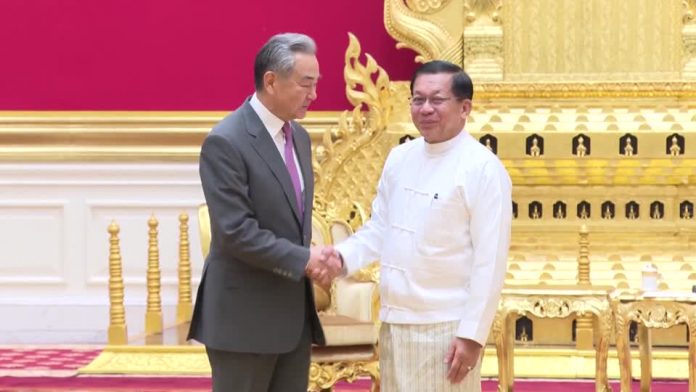
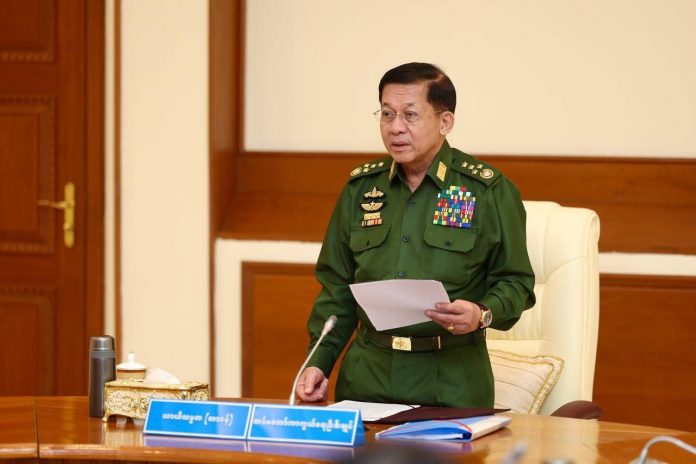
Chinese Foreign Minister Wang Yi meets Min Aung Hlaing, on the last leg of his regional tour, in Naypyidaw on April 25. (Credit: Reuters)

China’s top diplomat on Saturday visited Myanmar’s capital and met with the leader of its military-backed administration as part of a regional tour aimed at strengthening Beijing’s political, security and strategic ties in Southeast Asia.

Regime media reported that Chinese Foreign Minister Wang Yi and Min Aung Hlaing discussed enhancing Myanmar’s international relations and cooperation within the Association of Southeast Asian Nations (ASEAN).

Wang’s visit to Naypyidaw comes after Min Aung Hlaing was sworn in as president on April 10 following an election that critics say was neither free nor fair and was designed to maintain the military’s grip on power five years after it ousted Aung San Suu Kyi’s civilian government.

The report said Min Aung Hlaing told Wang he was pleased that the Chinese President Xi Jinping sent his congratulatory message within hours of his election.

China, which has major geopolitical and economic interests in Myanmar, is the country’s biggest trading partner and a longstanding ally.

Beijing has invested billions of dollars in Myanmar’s mines, oil and gas pipelines and other infrastructure and is a major arms supplier along with Russia.

China is one of a small number of countries that have openly supported recent elections and sent congratulatory messages to Min Aung Hlaing after he became president.

ASEAN, whose 11 members include Myanmar, was among the outside groups that did not recognize Myanmar’s elections after most opposition groups were excluded and dissent was tightly restricted.

Voting also could not take place in some areas due to Myanmar’s ongoing civil war.

Myanmar’s leaders were barred from attending ASEAN’s previous meetings after failing to implement a peace plan agreed to by the bloc in April 2021, which called for an immediate end to violence, dialogue among all parties and humanitarian aid.

Myanmar’s previous military regime led by Min Aung Hlaing allowed limited humanitarian aid on its own restrictive terms and did not comply with other terms of the plan.

In his April 10 inauguration speech, Min Aung Hlaing said restoring normal relations with ASEAN was among his top priorities.

Saturday’s report said the two sides also exchanged views on border stability, trading, cooperation in eliminating cybercrime and Myanmar’s internal peace efforts.

China also maintains ties with the ethnic armed groups operating near its border, including the powerful “Three Brotherhood Alliance” that has been fighting for decades for greater autonomy from Myanmar’s central government.

The alliance captured large swaths of territory near Chinese border and western Myanmar between late 2023 and 2024, inspiring resistance forces opposed to military rule to expand their operations across the country.

However, a series of China-brokered ceasefires last year slowed their advance, allowing the army to retake key territories and regain the upper hand since mid-2025.

AP

Aung San Suu Kyi’s son demands ‘proof of life’

0
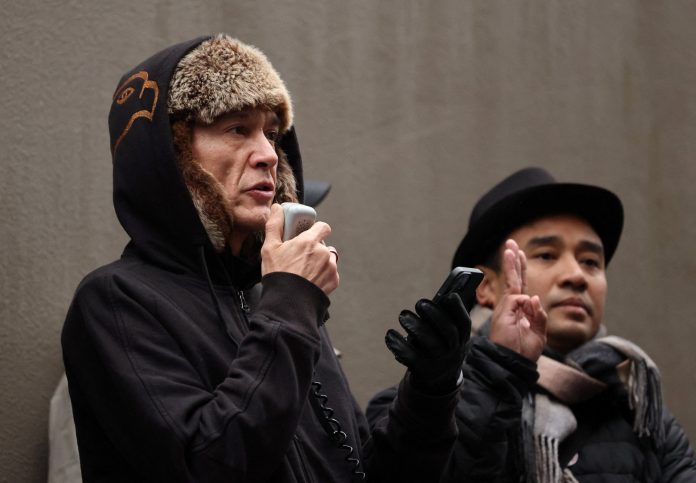
Aung San Suu Kyi’s son Kim Aris speaks at a protest outside of the Myanmar embassy in Tokyo, Japan, on Dec. 14. (Credit: Reuters)

Kim Aris, the youngest son of Myanmar’s jailed civilian leader Aung San Suu Kyi, has issued an urgent plea to the regime in Naypyidaw to provide “proof of life” for his 80-year-old mother on Monday. Aris has had no direct communication with Aung San Suu Kyi since the military seized power in a military coup on Feb. 1, 2021 and detained her. Read more.

Myanmar’s military-backed administration imposes martial law in 60 townships

0
Min Aung Hlaing announces the extension of the state of emergency - first imposed during the military coup on Feb. 1, 2021 - at a meeting in Naypyidaw on July 31, 2024. (Credit: Regime media)

Myanmar’s regime leader Min Aung Hlaing, who was inaugurated president by Myanmar’s pro-military parliament on April 10, has issued new emergency ordinances to impose military control in 60 townships, a move ​aimed at tightening security in regions still mired in ‌conflict despite the transition to civilian rule.

  • The ordinances cover 60 townships across Kachin, Karenni, Karen, Chin, Shan and Arakan States as well as Saging, ​Magway and Mandalay regions – areas where the military had ​imposed restrictions and curfews following the 2021 coup.
  • The ⁠official announcement cites the need to “end armed terrorism” and restore “the ​rule of law” as the main justifications for the 90-day ​emergency period, according to a notification published by regime media on Friday.
  • All executive and judicial authority in these areas is transferred to Myanmar’s new military ​chief Ye Win Oo for a period of 90 ​days, according to a second notification published in regime media.
  • The ordinances mark the first major move by Min Aung Hlaing to solidify control over war-ravaged territories since being appointed president by a pro-military parliament in early April after a widely criticised election won by a military-backed party.
  • Myanmar ​was plunged into ​conflict in ⁠2021 after the military ousted an elected government led by Nobel laureate Aung San Suu ​Kyi, sparking widespread protests that morphed into a ​nationwide ⁠armed resistance against the coup.
  • Following its 2021 takeover, the Min Aung Hlaing-led regime imposed a state of emergency across the country, which ⁠it ​extended multiple times before it was ​able to conduct elections in December and January that critics said were neither ​free nor fair.

REUTERS

US launches sweeping crackdown on Southeast Asia cyberscams and sanctions Cambodian senator

0
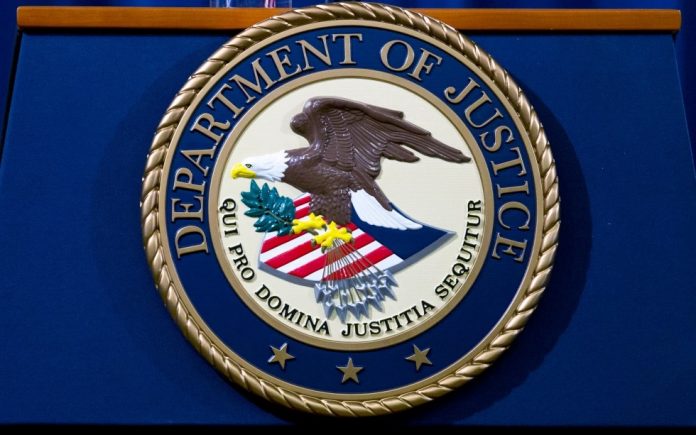
The Department of Justice seal is seen in Washington on Nov. 28, 2018. (AP Photo/Jose Luis Magana, File)

U.S. officials have announced a sweeping crackdown on Southeast Asian cyberscam operations as part of what U.S. Attorney Jeanine Pirro characterized Friday as a “new theater of war” launched by the Trump administration against Chinese transnational organized crime.

The crackdown, led by a U.S. government Scam Center Strike Force, includes the Treasury Department’s sanctioning of a prominent lawmaker and 28 other people and companies accused of operating from Cambodia.

Criminal charges also were filed against two Chinese nationals involved in a similar operation in Myanmar.

The initiative includes a warrant to seize and shut down a major online recruitment channel on the Telegram messaging app and freezing hundreds of millions of dollars in illicit assets, Pirro said in a virtual press conference connecting her from Washington to journalists in Asia.

Cybercrime has flourished in Southeast Asia in recent years, particularly in Cambodia and Myanmar, with illegal operations making mammoth profits from victims around the world, according to United Nations experts and other analysts.

Americans lost nearly $21 billion USD to cyber-enabled crimes and online scams in 2025 alone, according to the Federal Bureau of Investigation.

The illicit industry is closely involved in human trafficking, with foreign nationals employed to run romance and cryptocurrency scams, often after being recruited with false offers of legitimate jobs and then forced to work in conditions of near-slavery.

The Scam Center Strike Force comprises Pirro’s U.S. Attorney’s Office for the District of Columbia, the Department of Justice’s Criminal Division, the FBI and the U.S. Secret Service.

The most prominent target of the crackdown is Kok An, a Cambodian senator and prominent businessman described by the Treasury Department as a “scam center kingpin.”

The department’s Office of Foreign Assets Control announced sanctions against Kok An and associates for their roles in a network that has allegedly defrauded U.S. citizens of millions of dollars.

They include blocking Kok An’s assets in the United States and prohibiting U.S. entities from doing business with him. The Associated Press was unable to contact Kok An or any of his representatives for comment.

“His Excellency Kok An is a Cambodian Senator and he was elected by elections, and as a senator he has parliamentary immunity,” said Chea Thyrith, a Cambodian Senate spokesperson, who added that only the U.S. side could speak clearly about the sanctions.

Kok An is at least the second Cambodian senator to be sanctioned by the U.S. In 2024, Washington acted against another top tycoon, Ly Yong Phat, who also was accused of being connected with forced labor, human trafficking and lucrative online scams.

Pirro said the latest crackdown was set in motion in November when FBI agents sent to Thailand accessed copious evidence seized from an abandoned scam center in Myanmar, including more than 8,000 phones and 1,500 computers.

That led to charges of wire fraud conspiracy against two Chinese nationals, Huang Xing Shan and Jiang Wen Jie, who were managers of the compound before seeking to reestablish their operations in Cambodia.

They are being held by Thai authorities for immigration violations and the U.S. is seeking their extradition, Pirro said.

Cambodian lawmakers unanimously adopted a new law in March targeting online scam operations with up to life in prison, following a government pledge to shut down the centers by the end of April.

In January, Cambodia extradited to China another alleged scam kingpin, Chen Zhi, the founder of business and banking conglomerate Prince Holding Group, even though U.S. authorities had sought custody after indicting him last year for allegedly running a huge scam operation.

AP

Contact