
Thursday, July 23, 2026
Home Blog Page 85

Myanmar factory owners complain about new power supply rate as price of rice rises amid fuel shortage

0
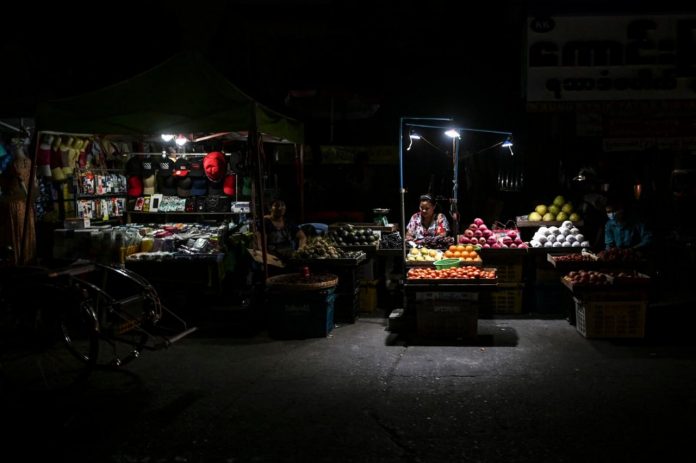
Street vendors at a market in Yangon Region wait for customers during a power outage on March 3, 2022. (Credit: AFP)

Yangon factory owners complain about new power supply rate

Factory owners in Yangon Region told DVB that the regime’s Ministry of Electric Power’s new option for a non-stop “24-hour” power supply at a rate of 900 MMK ($0.21 USD) per unit, which was introduced on Feb. 1, is “not cost-effective.” Under the regular electricity tariff, factory owners pay between 150-500 MMK ($0.03-0.11 USD) per unit but have experienced “frequent” power outages.

“We can’t use generators due to fuel shortages when the power is out. So, we have no choice but to pay the new rate,” an owner of a factory located in Hlaingthaya Township’s Industrial Zone told DVB on the condition of anonymity. He added that the regular electricity supply coming from the Yangon Electricity Supply Corporation provides power to industrial zones for 18 hours per day—from midnight to 5 p.m. the following day. 

The ministry introduced nationwide “planned load shedding,” or rolling power cuts, starting March 18 until June. Pro-regime media reported that electricity will be distributed in two groups on a rotating four-hour schedule between 9 a.m. and 9 p.m. in Yangon Region. Burma consumes 4,664 megawatts of electricity per day but can generate only 3,600 MW—about 77 per cent of demand—according to the ministry.

Price of rice rises amid fuel shortage

Rice traders told DVB that the retail prices of one bag, approximately 50 kg, of premium rice increased from 160,000-190,000 MMK ($38-45 USD) and lower-grade rice varieties from 60,000-90,000 MMK ($14-21 USD) since the third week of March. They attributed the price hike to rising transportation and operation fees due to fuel shortages triggered by the war against Iran since Feb. 28.

Farmers told DVB that gasoline costs 10,000-15,000 MMK ($2.30-3.50 USD) on the black market to run harvesters as they can’t purchase enough fuel at the stations. Rice millers told DVB that mills operate on diesel with prices rising 5,450-5,680 MMK ($1.29-1.35 USD) per liter for regular and 6,085-6,805 MMK ($1.44-1.62 USD) for premium April 2-8, according to the regime-controlled Petroleum Products Regulatory Department.

It set prices for one litre of 92-octane gasoline at 4,625 MMK ($1.10 USD) and 95-octane gasoline at 4,780 MMK ($1.13 USD) on April 8. Edible oil traders also told DVB that palm oil cost as high as 17,000 MMK ($4 USD) in the retail market on March 31 although the regime-controlled Supervisory Committee on Edible Oil Import and Distribution under the Ministry of Commerce set the reference rate at 6,600 MMK ($1.5 USD) last month.

Zaw Min Tun outside of a polling station in the capital Naypyidaw after casting his ballot during the regime’s 2025-26 elections on Dec. 28. (Credit: Regime)

Zaw Min Tun faces corruption charges

Sources close to the regime in Naypyidaw told DVB that its former spokesperson Zaw Min Tun is being tried by court martial for “abuse of power and corruption” since March 25. He was dismissed from his position – held since the military coup on Feb. 1, 2021 – as the director of the regime’s Public Relations and Psychological Warfare Directorate on March 25 and replaced by his deputy Ye Yint Aung.

A regime source told DVB on the condition of anonymity that Zaw Min Tun holds no position in either the regime or its new Union Solidarity and Development Party (USDP)-led administration, which won the most seats in the regime’s 2025-26 elections held Dec. 28, 2025 to Jan. 28. Another regime source told DVB that he was dismissed over an “unnecessary” disclosure regarding Min Aung Hlaing’s spinal surgery on March 23.

Zaw Min Tun has been absent from public view since March 25. The source added that he has also been replaced by Ye Yint Aung as chief of the military’s True News Information Team. The position as the regime’s deputy information minister remains vacant, as Min Aung Hlaing has yet to name a replacement for Zaw Min Tun, who is a graduate of the 37th batch of the Defence Services Academy (DSA).

News by Region

MAGWAY—Residents in Saw Township told DVB that a National Unity Government (NUG) court handed a verdict of the death penalty on April 2 to a man who was convicted of the rape and murder a 13-year-old girl. Saw, located 163 miles (263 km) northwest of the region’s capital Magway, is partially under People’s Defence Force (PDF) control. 

A resident told DVB on the condition of anonymity that the convict, Min Min Soe, declined to post bail despite the court allowing him to do so. He was arrested one month after the crime was committed on Oct. 21. The victim’s family members held a vigil calling on the NUG to issue the death penalty on Oct. 26.

SAGAING—The People’s Administration Team (PAT) under the NUG in Depayin Township warned residents on April 4 to be alert for airstrikes by the Burma Air Force during the Thingyan festival April 13–16. Depayin, located 40 miles (64 km) north of the region’s capital Monywa, is partially under PDF control.

A PDF member in Depayin told DVB that they have a network to alert residents of incoming jets once they take off from neighboring Mandalay Region’s Tada-U and Meiktila Air Force bases. At least 29 civilians were killed in 51 regime airstrikes and artillery attacks nationwide during Thingyan in 2025.

SHAN—At least 160 people were either killed or injured during an explosion at a gunpowder production facility in Pangsang Township on Tuesday. Pangsang is located in the Wa Self-Administered Division and is headquarters of the United Wa State Army (UWSA) on the Burma-China border in northern Shan. 

A Pangsang resident told the Shwe Phee Myay News Agency that the number of casualties is still being counted at the Chinese-owned gunpowder production facility and that a petrol station was located nearby, which may have added to the explosion. The UWSA is still investigating the cause. 

(Exchange rate: $1 USD = 4,200 MMK)

Watch our latest DVB English News interview with Rohingya genocide survivor Yasmin Ullah, who filed a genocide case against Min Aung Hlaing in Indonesia.
Telenor faces lawsuit over claims it exposed Myanmar customers’ data

0
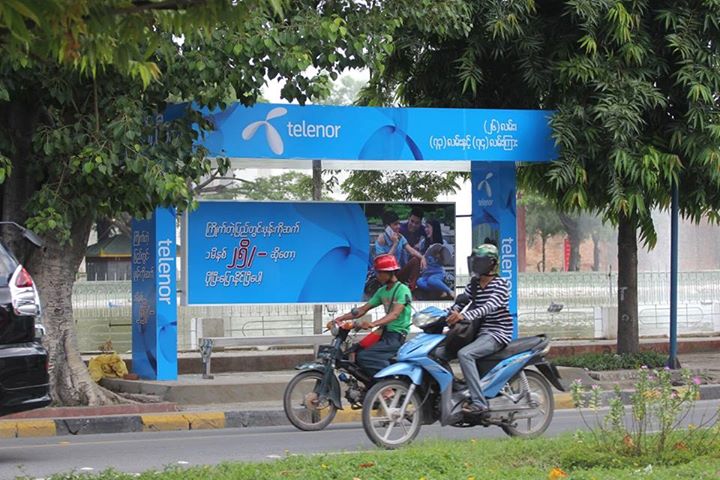
Two motorcycle drivers in Mandalay pass a bus stop with a Telenor Myanmar advertisement after SIM cards first went on sale on Sept. 26, 2014. (Credit: DVB)

A Swedish non-profit filed a class action lawsuit against Telenor on Tuesday on behalf of over 1,200 people whose phone data it says ​the Norwegian telecom’s Myanmar subsidiary shared with the country’s military junta following a 2021 coup.

Telenor, which has since exited Myanmar, said ‌it believed there was nothing in the lawsuit that the company had not already addressed and “in our view it is unlikely that such a claim will succeed”.

The lawsuit, filed in Norway by the Justice and Accountability Initiative, alleges Telenor Myanmar shared the call logs and location data of suspected political opponents of the junta, exposing them to repression and leading ​to the execution of at least one prominent activist and the prosecution of another.

The lawsuit claims Telenor is liable for 9,000 euros ($10,524 USD) per ​customer whose data was shared.

“If successful, this case would be the first ever to hold a telecoms company to account ⁠for not sufficiently protecting user data from access by an authoritarian regime,” said Beini Ye, legal counsel at the Open Society Justice Initiative, which is ​supporting the case.

‘Terrible’ if data was misused by junta, Telenor says

Telenor, which is 54 per cent owned by the Norwegian state, was informed of plans to file the suit ​in a pre-action letter in October and said at the time it had been “legally required to provide traffic data to the authorities”.

“Telenor Myanmar was operating on the ground in a war zone,” the company said in an email to Reuters on Wednesday, adding that refusing the military authorities’ requests could have led to “imprisonment, torture or the death penalty” for local ​employees.

“Telenor Myanmar had no real options. We could not play Russian roulette with the lives of our employees,” it said. “It is terrible if data from ​Telenor has been misused by the authorities.”

However, it said Myanmar’s military authorities had sole responsibility for how they treat their citizens and “neither Telenor nor any other civilian organisation has ‌that responsibility.”

Victims of repression hope lawsuit will bring justice

Telenor sold its business in Myanmar following the coup, which unseated an elected government, to avoid European Union sanctions amid pressure from the junta to activate intercept surveillance technology and exited the country in March 2022.

Before leaving, however, Telenor Myanmar shared data from least 1,253 phone numbers with the military, the lawsuit alleges, with Telenor’s Norwegian headquarters recommending its team in ​the country comply with junta requests.

Aung ​Thu, a civil society activist arrested ⁠in September 2021, told Reuters his information was among data that was allegedly shared.

Originally charged with incitement after leading anti-coup protests, he had been due to be released under an amnesty but was instead re-arrested at the prison gate ​and given an additional five-year sentence.

He said data handed over to the junta by Telenor formed the basis ​for his re-arrest and ⁠came up during his interrogation and trial.

“I am hoping for justice, not just for myself, but for all the people of Myanmar,” he told Reuters, in reference to the lawsuit.

Phoe Zeya Thaw – a popular hip hop artist, who was a lawmaker under the ousted civilian government – was hanged in 2022 along with three other activists ⁠accused of ​helping carry out “terror acts” in a case that prompted international outcry.

Telenor had shared his phone ​data a few weeks earlier, the lawsuit alleges.

“It is not just a wife losing her husband,” his wife Thazin Nyunt Aung said in a statement. “It is also a loss to democracy.”

The lawsuit seeks additional ​damages for financial losses for Aung Thu and Zeya Thaw.

($1 = 0.8552 euros)

REUTERS

Myanmar’s women caught between war, disaster and blocked aid

0
A building inside a monastery compound in Katha Township, Sagaing Region, after being hit by regime airstrikes on March 20. (Credit: PDF)

A monastery sheltering about 100 people in northern Myanmar has been bombed by the military, killing monks and civilians in what rights groups say is part of a broader pattern of attacks on religious sites.

The air strike on March 20 hit the monastery in Katha, in Sagaing region — a town where author George Orwell once lived and which inspired his novel Burmese Days.

A year ago, a devastating 7.7-magnitude earthquake centred in Sagaing Region killed thousands of people and destroyed homes and infrastructure across six regions and states.

The effects are still being felt, with attempts to rebuild hindered by the junta’s continued attacks on civilian infrastructure — including religious buildings.

“Monasteries are where people come together to eat, to pray, to survive,” said Thinzar Shunlei Yi, a pro-democracy activist who founded the NGO Sisters 2 Sisters, which provides aid to women.

“The military is now attacking the heart of our faith: the Buddhist monkhood and our religious spaces,” she told the ABC.

She said the military appeared to be targeting areas it believed were linked to resistance forces, including monasteries, treating those sheltering there as enemies.

“They are indiscriminately attacking all civilians … even religious sites supporting community members as a shelter,” Thinzar Shunlei Yi explained, after speaking to survivors.

She added that the attacks appear aimed at instilling fear and tightening control as junta leader Min Aung Hlaing was elected as president in an election widely seen by Western governments as a “sham”.

The strike in Katha was not an isolated incident.

A day later, a monastery and school in Kani Township, east of Mandalay, were bombed, according to local news reports.

This week in Karen State, along the border with Thailand, another monastery was reportedly attacked.

Since the military seized power from Aung San Suu Kyi’s elected government in February 2021 in a coup, peaceful demonstrations were put down with lethal force, and many opponents of the military rule took up arms.

Thinzar Shunlei Yi said these recent attacks in Sagaing Region, which is a stronghold of armed resistance against the military, showed there was nowhere safe for civilians.

“Once they bomb monasteries — places that support the community — it’s an attack on people’s mindset, the mindset of resistance,” she said.

The military did not reply to a request for comment.

Rights groups, including Karen Human Rights Group (KHRG), have documented the Myanmar military’s attacks on religious buildings as part of its widespread, post-coup campaign against civilians.

Aid blocked — including menstrual pads

Aid groups say blockades in Sagaing Region are ongoing, with the Myanmar military continuing to restrict the flow of basic supplies into areas hit by conflict and the earthquake.

“They intentionally put in a policy to block the delivery of menstrual products,” said Thinzar Shunlei Yi.

Grassroots groups, including Sisters 2 Sisters, are still trying to raise funds and deliver gender-specific aid — sanitary pads and medical supplies — to women in affected areas.

Their volunteers were recently blocked from distributing aid in Pale and Yin Mar Pin townships located in Sagaing Region.

“The main reason the military has given for blocking this aid is they suspect these products will be used by the PDF,” said Thinzar Shunlei Yi, referring to the opposition People’s Defence Force (PDF).

“[The military says that] people will use it [pads] to cover their wounds.”

She described the restriction as “a direct attack on women’s bodies”.

International humanitarian groups have also struggled to access conflict-affected regions.

“We’re trying to support farming communities in Sagaing, where their livelihoods were interrupted both by the earthquake … [and] the conflict that’s happening on all sides of them,” said Ross Farmery, head of the International Committee of the Red Cross (ICRC) delegation in Mandalay.

He said landmines and unexploded ordnance were also an issue for those returning to their homes.

“They’re displaced, then coming back, but there’s weapons contamination,” he said. “So there’s all these things on top of the earthquake.”

Fragile rebuilding

About 8,300 religious monuments and temples were damaged or destroyed by the earthquake, according to the U.N. Education Science and Cultural Organization (UNESCO).

Among the sites damaged was the Kuthodaw Pagoda, home to a collection of Buddhist scripture tablets inscribed in UNESCO’s Memory of the World Register.

“When these places are harmed, communities lose anchors of memory and belonging,” said a UNESCO spokesperson.

Repair of historical buildings is slow, but in cities like Mandalay, shops have reopened and on the surface, daily life appears to be resuming.

Even during fuel shortages, people improvise — setting up stalls beside long petrol queues to sell drinks and snacks.

But aid agencies warn the effects of the Middle East conflict on fuel, food and fertiliser are pushing more families closer to hunger.

“Disruptions to transportation, fuel rationing, and rising black-market prices are pushing up the cost of moving food,” said Michael Dunford, the U.N. World Food Programme (WFP) country director in Myanmar.

“This new wave of global instability is hitting Myanmar at the worst possible moment,” Dunford told the ABC.

An estimated 12.4 million people — about one in four — are struggling to find enough to eat. Fuel remains tightly controlled by the military regime.

Private cars can only operate on alternate days based on licence plates, yet shortages persist, and queues stretch for hours. Last week, a man collapsed while waiting in the heat.

“People who survived the earthquake have barely begun to stand again, and now another blow is knocking them back down,” Dunford added.

Community support can’t keep up

Many monasteries have become emergency shelters for people fleeing armed conflict near their homes and affected by the earthquake.

“Almost every monastery was already hosting displaced people,” said Aye Sandar Tun, who was pregnant when the quake struck in Mandalay.

“Finding food is the main challenge for people, so even on weekends, when I am not working, I would drive around and help hard-to-reach areas,” she said.

But as costs rise and donations fall, many are struggling to cope. Many are trying to get by alone.

Myint Myint, a street vendor, set up a samosa stall days after losing her home, but rising prices have kept her reliant on aid.

“It’s a daily cycle of borrowing and scraping by,” she said. Her debts have reached 1.5 million kyats (about $1,030 USD). Despite this, she says others are worse off.

Zin Mar Wai, a displaced mother of three, wants to return to her home in Saigaing’s Wetlet Township, now a conflict zone.

“I just want to go home,” she said. “I had a small grocery shop. I would work twice as hard — but everything has become so much more difficult.

“For now, I just hope food assistance doesn’t stop. There are people hiding in the jungle whose situations are much worse than ours,” she added.

ABC

Inside a cyber scam compound on the Thailand-Cambodia border

0
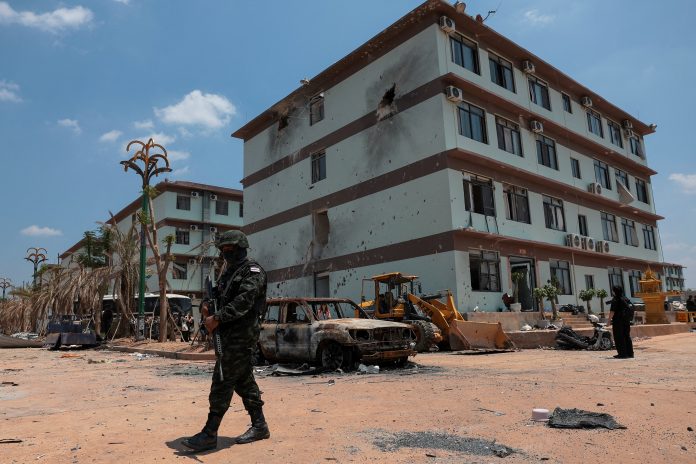
A Thai soldier stands guard near scam compounds, which the Thai military said were used for scam operations in the O’Smach area at the Chong Chom–O’Smach border crossing, after clashes between Thailand and Cambodia along a disputed border area, in Samraong, Oddar Meanchey province, Cambodia, on April 7. (Credit: Reuters)

By HUIZHONG WU

O’SMACH, Cambodia (AP)—I have often used the word industrial-scale in my own writing to describe the scam compounds that dot this region in Southeast Asia.

But the weight of that phrase truly sunk in at the O’Smach Resort complex that we visited on Tuesday. Thailand’s military, which conducted a tour for the media, said that the whole area encompasses around 197 acres (80 hectares), equivalent to 150 American football fields.

It wasn’t my first time at a scam center, but its scale dwarfed anything I had seen before.

From my base in the region, I have followed this issue for the past few years, watching its scale only grow larger and larger.

Scam compounds have mushroomed across Southeast Asia since the pandemic. Inside these industrial-scale complexes, workers attempt to lure unsuspecting targets from countries all across the world in sophisticated online-based scams.

The latest estimates from the U.N. office on Human Rights are that around 300,000 workers are caught up in the industry regionally.

Thailand’s military invited journalists back to the huge scam complex it seized in December during its border conflict with Cambodia. The military said it took the area in response to the Cambodian side using it as a base of operations for launching attacks.

The complex was called the O’Smach Resort, owned by Cambodian politician Ly Yong Phat, who faces U.S. sanctions for rights abuses in the very same complex. It’s unclear, however, whether the new construction also belongs to Ly.

Throughout the massive grounds of the self-contained town, there were signs of construction. Piles of bricks and construction cranes sat waiting for workers to finish the job.

The military also took us to the premises where workers likely scammed Americans. FBI data released on Tuesday shows that Americans lost near $21 billion USD to scams in 2025 alone.

On the desks inside a four-story office building were still snacks from the previous users, as well as scripts and notes in Chinese on each aspect of the scam. American SIM cards were scattered about as well.

There was an elaborate backstory to target the Americans. One of the scripts on the desk was 24 pages of an in-depth character sketch of a woman named Mila who had earned a lot of money on the gold options trading market.

But the script went further. Mila had lost her husband to leukemia when their daughter was just a baby. It constructed memories of her childhood, such as her getting bullied by other girls, and then her parents sending her to South Africa to live with her uncle in order to be in a healthier environment.

There are 157 buildings, 29 of which housed the scam companies and their offices. The rest included massive dorm complexes, and more luxurious accommodations that included apartments and three-story villas.

The military officials said they estimated that at least 10,000 people were living there.

There was also a variety of Chinese restaurants, catering to people who wanted spicy Hunan cuisine, or southern Shaxian cuisine, or hot and sour rice noodles, a Sichuanese classic.

While Thailand and Cambodia have vowed to tackle the scamming problem, its scale is far more global.

“Every country of the world has to join together to solve this problem, (we) cannot do it alone with Cambodia and Thailand,” said Air Chief Marshal Prapas Sornchaidee, who was one of the Thai officials leading the tour.

AP

A poem on the Myanmar diaspora experience

0
Ko Ko Aung, a Sydney-based immigration lawyer and writer, at the New South Wales Young Lawyers Annual Assembly Dinner in Sydney, Australia, on Nov. 10, 2023. (Credit: KKA)

Guest contributor

Ko Ko Aung

Two Places

for those who cannot return

In Sydney

the trains run on time,

coffee stays hot,

and my phone fills with emails about visas.

In Myanmar

someone’s house is burning.

I spend my days

translating fear into legal language,

writing sentences that say

he will be arrested,

she cannot return,

the risk is real.

The law asks for evidence.

Myanmar is full of it.

Mass graves.
Airstrikes.
Students who disappeared.

Sometimes it feels strange
living this quiet life
while my people learn
the sound of drones in the sky.

But distance
does not mean safety.

Every message from home
arrives like a small explosion.

Ko Ko, they took him.
Ko Ko, the village is gone.

And still
the world moves normally.

In the morning
I button my shirt,
open my laptop,
and try again

to build a bridge of words
between the country I live in
and the country
that refuses to let me go.


Ko Ko Aung is a Myanmar born immigration lawyer currently serving as a Special Counsel at Albert Arthur Lawyers in Sydney, Australia.

Min Aung Hlaing selects 30 ministers; First batch of conscripts complete two-years of military service

0
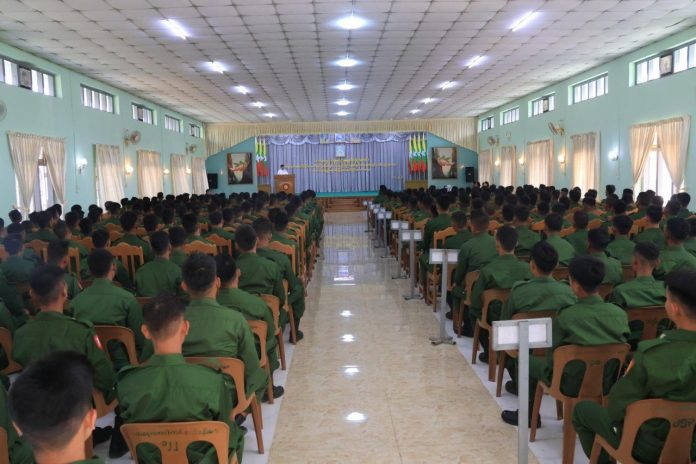
Conscripts from the first batch drafted into military service in 2024 at a ceremony marking the completion of their two-years of service in Loikaw, Karenni State, on April 3. (Credit: Regime media)

First batch of conscripts complete two-years of military service

A ceremony was held in the Karenni State capital Loikaw on April 3 for the first 385 male conscripts, aged 18 to 35, drafted into military service upon the completion of their mandated two-years under the conscription law, which was enforced on Feb. 10, 2024. Training for the first batch of military conscripts began across Burma on April 8, 2024, according to the regime. 

Zin Yaw, a former captain in the Burma Army who defected to join the Civil Disobedience Movement (CDM) following the 2021 military coup, told DVB that the military may release some conscripts while attempting to retain others as full-time soldiers. “We need to monitor their releases,” he said. The ceremony on April 3 is the first reported instance of conscripts completing their two-years of military service. 

Nationwide conscription has now reached its 23rd round with the 21st round of conscripts reported to have completed military training earlier this month, according to the regime. A source in Yangon who assists conscripts to evade military service told DVB that none of the males conscripted into the military over the last two years have returned to their family homes. Read more

Min Aung Hlaing selects 30 ministers for 31 ministries

Min Aung Hlaing, voted by pro-military lawmakers as president on April 3, presented the names of the 30 ministers to lead the proposed 31 ministries at a session of the Pyidaungsu Hluttaw, Burma’s bicameral parliament, in Naypyidaw on Tuesday. His written message was announced by the Pyidaungsu Hluttaw speaker Aung Lin Dwe as Min Aung Hlaing did not attend the April 7 parliamentary session.

Tun Aung, the Burma Air Force chief, was nominated Minister of Defence. Nyunt Win Swe, the commander of the Yangon Regional Military Command (RMC) from 2020-23, was nominated Home Affairs minister. Tin Maung Swe, Burma’s ambassador to China from 2022-25, was nominated as Foreign Affairs minister. Under the 2008 constitution, all three posts are entitled to seats on the 11-member National Defence and Security Council (NDSC).

A total of 12 new ministerial nominees were announced with the other 18 being incumbent regime ministers. The Pyidaungsu Hluttaw approved Min Aung Hlaing’s proposal to form 31 ministries on April 7 after he proposed six new ministries: Women Affairs, Youth Affairs, President’s Office, Industry and Small and Medium Enterprise Development, Digital Development and Communications, and Hotels, Tourism and Culture.

Shockat Adam, the British MP for Leicester South, speaks in the UK House of Commons earlier this year. (Credit: Reuters)

British MPs urge ICC arrest warrant for Min Aung Hlaing

Eleven British members of parliament have signed the “Early Day Motion (EDM) 526,” which is a formal parliamentary proposal supporting the International Criminal Court (ICC) request for an arrest warrant for Min Aung Hlaing. The motion adds to growing international efforts to hold Min Aung Hlaing accountable for alleged crimes committed by the military before and after the 2021 coup.

“What is done through the U.K. Parliament is important for us,” Tun Khin, the president of the Burmese Rohingya Organisation UK (BROUK), told DVB. “We are still waiting for the ICC to issue an arrest warrant.” The EDM 526, titled “ICC arrest warrant for General Min Aung Hlaing,” was introduced by Shockat Adam, an independent MP for Leicester South, on Dec. 9, 2024, along with six other British MPs. 

ICC Chief Prosecutor Karim Khan requested an arrest warrant to be filed against Min Aung Hlaing on Nov. 27, 2024. The charges include crimes against humanity for his military’s “security clearance” operations in 2016-17 against the Rohingya. The U.S. declared the 2017 Myanmar military operations in Rakhine State, which led to over 700,000 Rohingya to flee into Bangladesh, as genocide. Read more

News by Region

KACHIN—The Kachin Independence Army (KIA) rejected an April 5 regime media report on Monday as “fabricated.” It reported that eight KIA and People’s Defense Force (PDF) members gave up “armed opposition” and attended a “handover ceremony” in the state capital Myitkyina on April 4. 

“There was no such defection,” Naw Bu, the KIA spokesperson, told DVB. Fighting over control of Hpakant Township between the KIA and regime forces resumed on Sunday. Hpakant is located 94-158 miles (151-254 km) west and northwest of the state capital Myitkyina and the KIA headquarters of Laiza.    

NAYPYIDAW—The regime’s Ministry of Energy claimed on Monday that it has 40 days of gasoline and 50 days of diesel in reserve, adding that 36 shiploads of fuel will be imported in April. It reported that the daily fuel consumption dropped from 3.54 million gallons to 2.5 million gallons, saving $6 million USD in its fuel rationing measures from Feb. 20 to April 6

One litre of 92-octane gasoline increased 4,450-4,625 MMK ($1.05-1.10 USD) but 95-octane gasoline decreased 4,975-4,780 MMK ($1.18-1.13 USD) April 2-7, according to the regime-controlled Petroleum Products Regulatory Department. The price of diesel and premium diesel is up 5,450-5,680 MMK ($1.29-1.35 USD) and 6,085-6,805 MMK ($1.44-1.62 USD).

SAGAING—Residents of Shwebo Township told DVB that a Buddhist monk and one woman were killed by airstrikes carried out by the Burma Air Force on Monday. An unknown number were injured. Shwebo is located 57 miles (91 km) northeast of the region’s capital Monywa. 

A PDF member told DVB that two fighter jets dropped seven bombs on a monastery in Sinin village after taking off from neighbouring Mandalay Region’s Meiktila and Tada-U Air Force bases. Residents displaced from their homes in Shwebo have been sheltering at the monastery.

(Exchange rate: $1 USD = 4,200 MMK) 

Stay up-to-date with the latest on #WhatsHappeninginMyanmar by subscribing for free to the DVB English News Daily Briefing newsletter.

Contact