
Thursday, July 23, 2026
Home Blog Page 84

Australia now has a blueprint on Myanmar: Will it act?

0
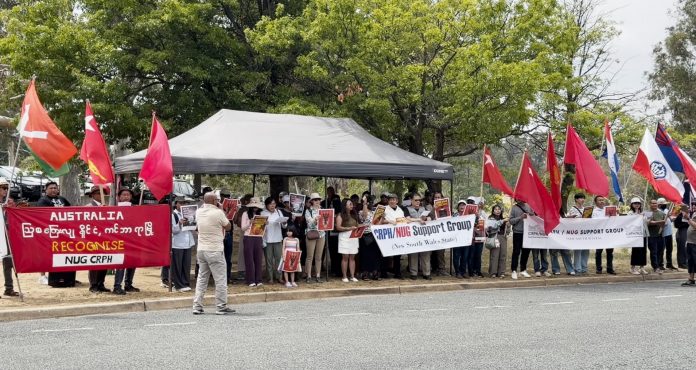
A protest against elections in Burma was held on the same day as the second round of voting on Jan. 11, in Canberra, Australia. Officials from the National Unity Government, an interim administration representing lawmakers elected in the 2020 elections but ousted in the 2021 military coup, participated in the protest. (Credit: DVB)

Guest contributor

Mon Zin 

For years, Canberra has responded to Myanmar with statements of concern while the crisis deepened on the ground. This time, the Australian Senate’s March 2026 report does more than describe the problem. It identifies the regime’s pressure points with unusual clarity.

It recognises that air power, fuel supply chains and financial networks,  with the Central Bank of Myanmar (CBM) at its core, are not abstract issues, but the machinery sustaining violence. 

It also signals a shift: Myanmar is no longer just a humanitarian crisis, but a strategic challenge with regional consequences. The policy path is now visible. What remains uncertain is whether Australia is prepared to follow it.

Events on the ground reinforce this trajectory. Min Aung Hlaing, the architect of the post-coup order, has recast himself as its civilian head, through an election in form, but not in substance. 

This was not competition, but a manufactured mandate; a pre-engineered outcome masquerading as democracy, with uniforms traded for civilian dress while military power remained intact. Parallel structures only reinforce the point: this is entrenchment, not transition.

The National League for Democracy (NLD), once the country’s dominant political force, has been dismantled and removed from the field. 

Its leadership remained detained, with Aung San Suu Kyi held incommunicado, absent not by choice, but by design, and cut off even from her own family. Without its primary democratic actor, this was never a contest; the field was cleared before it began.

The Senate report matters because it cuts through that illusion. It aligns Australia with a growing international view: this process lacks credibility and must not be treated as a pathway to legitimacy. 

For too long, ambiguity has worked in the junta’s favour, allowing it to move between condemnation and quiet engagement while tightening its grip on power. But clarity alone is not a strategy. Australia now faces a clearer risk: normalising what it claims to reject.

Not through recognition, but through habit; language, engagement and quiet accommodation. Australia’s Department of Foreign Affairs and Trade (DFAT) must draw a clear line. 

Engaging Myanmar as a state is necessary; legitimising Min Aung Hlaing is not. Anything less risks turning stated policy into quiet accommodation.

Because normalisation does not arrive as a policy decision. It arrives incrementally and by the time it is visible, it is already embedded. Avoiding that outcome requires more than restraint; it requires targeted pressure.

The report points clearly to where these pressures should be applied. Airstrikes have become the junta’s primary instrument of control, sustained by aviation fuel flows enabled through transnational supply chains.

Disrupting these flows is not symbolic. It is operational.

But beneath this sits a deeper lever; finance. Recent interventions by the CBM, injecting foreign currency to stabilise imports and manage exchange volatility, reveals its role as a gatekeeper of foreign exchange, shaping access to critical financial flows. 

This is precisely what makes it a sensitive but strategic pressure point.

The CBM is not peripheral, it sits at the centre of the junta’s financial system, enabling access to foreign exchange, facilitating procurement, and sustaining its operational capacity.

That no major government has yet sanctioned the CBM reflects not its irrelevance, but its centrality and why targeting it would matter. 

The Senate’s recommendation to sanction the CBM marks a potential inflection point, a move beyond incremental pressure towards targeting the regime at its core. Australia has chosen caution where the situation demands escalation.

Sanctions have been applied incrementally, signalling disapproval without fully leveraging the tools available. The Senate report implicitly acknowledges this gap. The question is whether the government is willing to close it.

At the same time, pressure must be matched with a recalibration of support. 

Cross-border and locally led delivery mechanisms reflect a reality long understood by those working on the ground: assistance routed through regime-controlled channels will not reach those most in need. 

A more flexible approach is not just more effective, it is essential in a fragmented and contested environment.

Equally important is the report’s recognition of the Myanmar diaspora. This is not symbolic. It is a strategic asset. Diaspora communities possess networks, knowledge and access that governments often lack. 

If Australia is serious about a more informed and adaptive response, it must treat diaspora actors as partners, not observers.

Myanmar now sits at the intersection of humanitarian crisis and strategic risk. The consolidation of military power under a civilian façade, the continued detention of democratically-elected leaders, and the expansion of transnational crime all point to a conflict that is deepening, not resolving. 

For a country like Australia, this is not a distant issue. It is a test of whether middle powers can respond to complex crises with coherence and resolve.

Australia’s history shows that when parliamentary findings align with international momentum, policy shifts follow, from sanctions against apartheid South Africa to pressure during the East Timor (Timor-Leste) crisis. 

The current Senate report meets that threshold. What remains is whether Australia will act in step with that precedent, or fall short of it.

It has done the difficult work of diagnosis. It has mapped the terrain, identified the leverage points and articulated a direction of travel. What comes next is less comfortable.

It requires moving beyond calibrated concern to coordinated action, sustaining pressure where it matters, and resisting the quiet drift toward normalisation.

Recent amendments to Australia’s sanctions framework, introduced in the context of Iran, have expanded the government’s ability to target state-owned entities.

In Senate estimates, DFAT confirmed that existing settings already allow for the designation of entities owned or controlled by Myanmar’s military.

The constraint, then, is no longer legal. It is a question of application. This distinction matters. The junta’s resilience is not built on individuals alone, but on state-linked enterprises and financial channels that sustain its foreign revenue.

While partners such as the European Union (EU) have moved to target these structures, Australia’s approach remains comparatively narrow.

Failure to act does not preserve neutrality. It allows the junta to operate under manageable pressure while Australia risks falling out of step with partners and weakening its regional credibility.

It also leaves space for external actors to shape outcomes in ways that may not align with Australia’s long-term strategic interests.

Australia does not lack the tools. It now has the blueprint. The question is whether it has the will to use it.


Mon Zin is a Myanmar-born finance professional and community advocate in Australia focusing on geopolitical and humanitarian developments relating to Myanmar. 

DVB publishes a diversity of opinions that does not reflect DVB editorial policy. We’d like to hear what you think about this or any of our stories: [email protected]
Myanmar’s parliament approves cabinet mostly of former generals

0
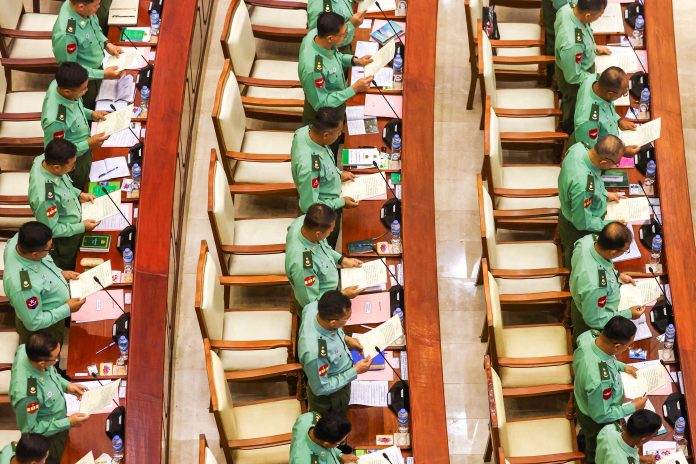
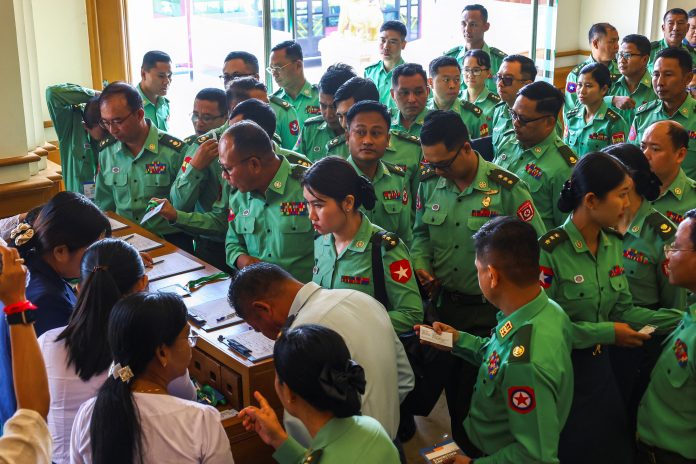
Military-appointed lawmakers arrive for a session of the Pyithu Hluttaw, or lower house of parliament, following a phased election dominated by the army-backed Union Solidarity and Development Party, in Naypyidaw on March 16. (Credit: Reuters)

Myanmar’s parliament approved a cabinet Thursday that largely includes former generals and holdovers from the past military regime under Min Aung Hlaing.

Despite the formation of a new government following controversial elections in December and January, there’s little signs of a return to civilian governance five years after he led the 2021 army takeover.

Min Aung Hlaing will be sworn into office as president Friday, along with two vice presidents and cabinet members.

Parliament Speaker Aung Lin Dwe said the appointments of 30 ministers were approved with no objections.

According to the official list, 24 are current or former generals and military officers or are lawmakers from the military-backed Union Solidarity and Development Party (USDP).

Eighteen of the ministers were cabinet members of the previous military government, while four others were military and government officials under the same administration.

Several have also been sanctioned by foreign governments that accused them of supporting and serving in the regime or violating human rights.

Parliament also reappointed the chairman of the constitutional tribunal, attorney general, and judges of the Supreme Court.

The Association of Southeast Asian Nations (ASEAN) was among the outside groups that did not recognize Myanmar’s elections after most opposition groups were excluded and dissent was tightly restricted.

Voting also could not take place in some areas due to Myanmar’s ongoing civil war.

AP

‘Agree to disagree’ DVB Debate returns to TV screens in Myanmar

0
Four panelists join DVB Debate host Sai Khit Nway on stage to discuss the multifaceted impacts of Artificial Intelligence during the relaunch of the program at Payap University in Chiang Mai, Thailand, on April 4. (Credit: DVB)

The Democratic Voice of Burma relaunched its DVB Debate program tackling the subject “Is AI an opportunity or a threat?” in Chiang Mai, Thailand, on April 6. The show was put on hiatus following the military coup on Feb. 1, 2021. It was recorded live at Payap University on April 4.

“In a polarized world, DVB Debate stands for something simple but powerful, the right to disagree without division,” said Aye Chan Naing, the DVB Chief Editor. 

DVB host Sai Khit Nway moderated the debate featuring Ma Han, a former university lecturer who joined the Civil Disobedience Movement (CDM) in opposition to the 2021 military coup, who is currently working on educational projects for Myanmar students, which includes the use of Artificial Intelligence (AI). 

“Reviving DVB Debate is about creating a space where difficult issues can be discussed openly, thoughtfully, and respectfully,” said Sai Khit Nway.

“At a time when public conversation is often shaped by fear, division, and misinformation, we believe debate remains essential to [Myanmar’s] democratic culture,” he added.

Padaythar, an AI trainer and founder of the Padaythar Pin YouTube channel, creates educational and entertainment content to support the anti-coup movement in Myanmar. He was one of the four panelists.

The other two were Aung Ye Kyaw, a 3D artist and AR/VR interactive technology developer, as well as Myanmar heavy metal musician Novem Htoo, also joined the debate.

“Our motto, agree to disagree, is not just a phrase…it’s a commitment to real conversation,” Aye Chan Nating added.

The live DVB Debate recording at Payap University was attended by at least 50 participants, including media workers, technology professionals, and Myanmar students studying at universities in Chiang Mai. 

DVB Debate is now airing on DVB TV News’ satellite channel and on-demand on YouTube on Mondays at 10:30 p.m., Wednesdays at 7 a.m., Thursdays at 11 a.m., Fridays at 4:30 p.m., Saturdays at 10:30 p.m., and Sundays at 4:30 p.m.

Originally launched in August 2013, DVB Debate aimed to foster civic discourse and promote an “agree to disagree” culture in Myanmar. The program adopted a town hall-style format, bringing together stakeholders from across the political spectrum—including government officials, ethnic leaders, and civil society actors—to debate contentious issues.

Past discussions have addressed topics such as military accountability, conflict-related sexual violence, and environmental exploitation. 

DVB Debate focuses on ongoing issues, including crisis management, resistance movements, and the societal impact of emerging technologies such as AI.

On March 8, 2021 – following the 2021 coup – the regime revoked the publication licenses of five media outlets, including DVB, which was subsequently forced into exile, halting most of its programming except for its daily news.

DVB Debate is inviting audience participation for its second episode. You can find the public survey on DVB TV News Facebook with two options: Myanmar migrants in Thailand, or social media addiction. The topic receiving the most votes will be selected and recorded in early May, but the exact date has not yet been announced.

Three civilians killed by airstrikes in Sagaing Region this month

0
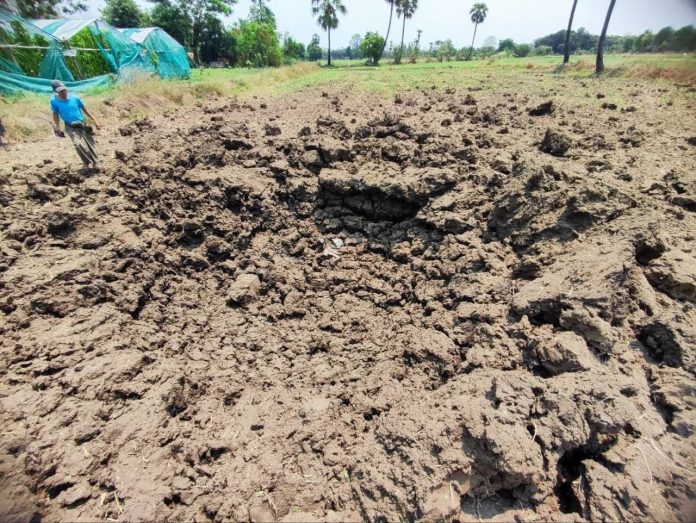
A resident of Shwebo Township inspects the destruction caused by regime airstrikes in Sinin village, Sagaing Region, on April 6. (Credit: People’s Defence Comrades)

A 38-year-old Buddhist monk and two 60-year-old women were killed by airstrikes carried out by the Myanmar Air Force on Shwebo Township’s Sinin village, Sagaing Region, April 3-8. 

Eight civilians, including two girls, were injured at the Sinin village monastery. Residents told DVB that two pagodas, 10 homes, a school, and an unknown number of shelters inside the monastery compound were destroyed. Shwebo is located 57 miles (91 km) northeast of the Sagaing Region capital Monywa. 

“Innocent civilians, monasteries, clinics, hospitals and schools are not military targets. It is a war crime to bomb and attack civilians and non-military targets,” a People’s Defence Force (PDF) member in Sagaing Region told DVB, adding that five fighter jets from neighbouring Mandalay Region’s Tada-U and Meiktila Air Force bases dropped a total of 14 bombs on Shwebo April 3-8. 

No casualties were reported in the airstrikes on April 8. A monk, who was also a teacher at the monastery, was killed while taking children to an air raid shelter on April 3. An elderly woman died from a heart attack. Another woman was killed from excessive bleeding during the airstrike on April 6.

A resident told DVB on the condition of anonymity that more than 300 residents displaced from their homes in Mandalay Region are temporarily sheltering in Shwebo’s Sinin village and need urgent healthcare, medicine and food. 

A map showing Sinin village, Shwebo Township, in Sagaing Region. (Credit: DVB)

Sinin village has a population of over 1,500 households. Most of the village was destroyed by arson attacks carried out by regime forces in November 2022. The military abandoned the village in June 2024 following a PDF offensive.  

The PDF has warned Shwebo residents to avoid large gatherings as the military counteroffensive continues across Sagaing Region, especially during the Thingyan festival next week, April 13-16. 

The National Unity Government (NUG), an interim administration representing lawmakers ousted in the 2021 coup, stated that more than 2,320 civilians were killed and over 4,140 were injured by airstrikes carried out by the Myanmar Air Force across the country in 2025. 

It added that more than 3,570 homes, over 100 educational infrastructures, over 30 healthcare facilities and 190 religious buildings were destroyed during those airstrikes.    

At least 2,181 people have been killed in 2,788 aerial attacks across the country since March 28, according to DVB data. Out of those 2,788 aerial attacks, 618 occurred in Sagaing Region.

Myanmar’s Min Aung Hlaing appoints new cabinet, military still dominates

0
Military-appointed lawmakers attend a session of the Pyithu Hluttaw, or lower house of parliament, following a phased election dominated by the army-backed Union Solidarity and Development Party, in Naypyidaw on March 16. (Credit: DVB)

Myanmar’s parliament approved a list of 30 ministers to serve in the cabinet of regime leader Min Aung Hlaing on Thursday following his appointment as president last week, with ​the military still holding a dominant role.

The move follows a widely disputed victory ‌by the military-backed Union Solidarity and Development Party (USDP) in an election that was supposed to mark Myanmar’s transition to civilian rule, but was dismissed as a sham by the United Nations and many Western countries.

The ​cabinet list approved on Thursday signals a business as usual approach by ​Min Aung Hlaing, with most of his appointees consisting of retired military ⁠officers and holdovers from the previous administration.

Regime Defence Minister Maung Maung Aye has retired, ​to be replaced by Tun Aung, former air commander-in-chief. Regime Minister of Broder Affairs Yar Pyae ​has also stepped down to be replaced by Hpone Myat, formerly the home affairs minister.

Former ambassador to China Tin Maung Swe will take up the role of ​foreign affairs minister. He has also served previously as a military attache in Britain.

A ​number of former defence ministers who have served the regime since it took power in a ‌2021 military coup ⁠were also reappointed to the new cabinet, including retired generals Mya Tun Oo and Tin Aung San.

The regime leader, voted president by a pro-military parliament on April 3, also nominated former officials to head another 14 ministries, extending the dominance of ex-military generals and former police chiefs across the legislative, executive and ​judicial branches.

Analysts said that ​the appointments suggest ⁠that significant structural change is unlikely, with many of the old guard changing uniforms but retaining their previous influence.

“Min Aung Hlaing has ​established a political system where military officers wear traditional civilian attire ​to govern ⁠in a civilian capacity, while he continues to maintain centralised control,” said independent analyst Aung Kyaw Soe.

He added that under such a system, there is no reason to expect genuine ⁠progress ​in Myanmar.

Myanmar has been gripped by violence since the ​2021 coup, when the military unseated a democratically elected government led by ​Nobel Peace Prize winner Aung San Suu Kyi.

REUTERS

Who is Myanmar’s former spymaster Commander-in-Chief Ye Win Oo?

0
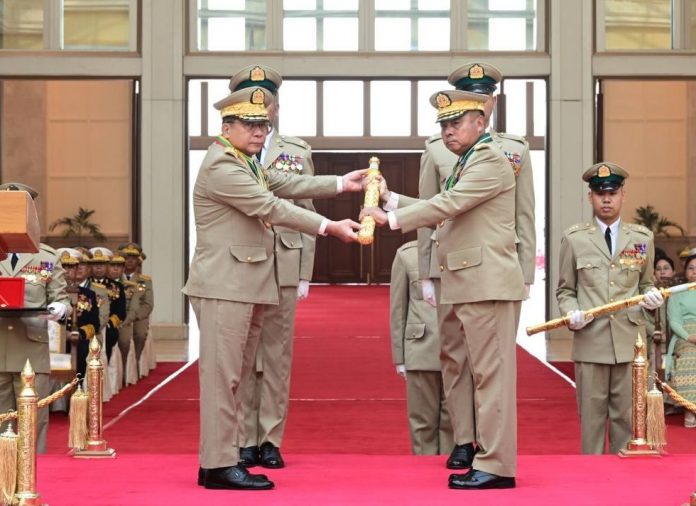
Min Aung Hlaing hands the ceremonial saber to Ye Win Oo, his replacement as the ninth commander-in-chief of the Myanmar military, at a ceremony in Naypyidaw on March 30. (Credit: Regime)

The Myanmar Defense & Security Institute (MDSI) told DVB that the elevation of Ye Win Oo, from intelligence chief to become Myanmar’s new commander-in-chief, marks the first time in the country’s history that a “spymaster” and graduate of the Officers Training School (OTS), instead of an alumni of the Defense Services Academy (DSA), has risen to the top post in the military.

This is a testament to his role as a deeply trusted ally of Min Aung Hlaing, who was voted president by a pro-military parliament on April 3.

“We saw him use various methods to dismantle opposition groups in order to consolidate and strengthen the political power of the regime. For example, he carried out suppressions against urban [underground] groups, tortured [members of] resistance groups, and violated human rights [at military interrogation centers],” Naung Yoe, the MDSI research officer, told DVB.

He added that Ye Win Oo oversaw the arrests of State Counsellor Aung San Suu Kyi and President Win Myint during the military coup on Feb. 1, 2021.

Despite his lack of battlefield experience in the military, Ye Win Oo became the “eyes and ears” of Min Aung Hlaing’s regime following the 2021 coup.

He’s become the chief of the Military Security Affairs Corps and the chief executive officer of the regime’s National Defence and Security Council (NDSC), which is the decision-making body led by Min Aung Hlaing.

Ye Win Oo was appointed Chief of the Myanmar Army on March 2 and has held various military posts prior to the 2021 coup.

MDSI is a group of former military personnel who defected to join the Civil Disobedience Movement (CDM) in opposition to the 2021 coup.

Contact