


The crises refugees face in Malaysia are compounding – from unannounced raids, to indefinite detention and collapsing support systems.
Guest contributors
Isabelle Chong & Emily Ou Yong
The queue started forming before dawn. By 7 a.m. on a grey Tuesday in November, nearly 200 people lined the pavement outside the United Nations High Commissioner for Refugees (UNHCR) office in Kuala Lumpur, Malaysia, a river of brightly coloured headscarves and worn jackets pressed shoulder to shoulder beneath a thicket of umbrellas.
Some stood alone, others came as entire families. The gates will not open for another hour, but positioning mattered: being closer to the front could mean speaking to an officer that day to obtain a UNHCR card – the only document standing between them and arrest, detention, or deportation – and going home empty-handed and returning tomorrow.
“Even if you have a document, you can’t come in illegally,” an officer steps outside to address the crowd.
Among them was *Mohamad Assar, a 19-year-old Rohingya refugee who arrived in Malaysia in April 2025. Without an appointment, he hoped someone might help expedite his application.
After nine months, he is still waiting – one among tens of thousands of refugees whose application can take years, even a decade, to process.
But even securing a UNHCR card offers limited protection. Those with UNHCR cards remain legally undocumented under Malaysian law, which does not formally recognise refugee status.
“The situation is the worst it has ever been,” said Mohamad.
Refugees from Myanmar are now navigating a shrinking humanitarian safety net alongside heightened enforcement pressure. With a new government-led registration system, deep cuts to international funding, and intensified immigration raids, daily life has grown increasingly precarious, marked by fear and shrinking avenues for help.
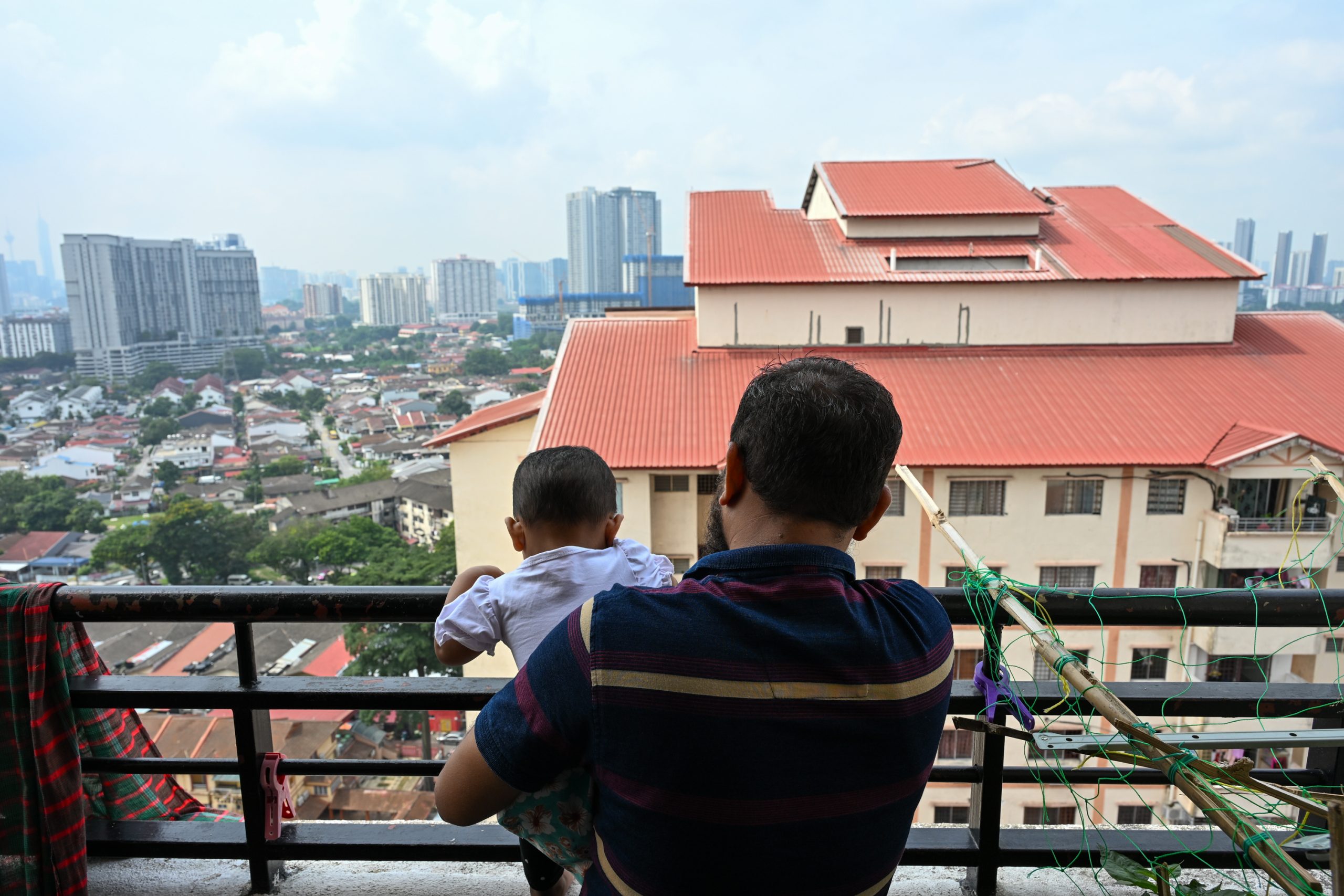
Many refugees do not intend to remain in Malaysia long-term. In low-cost government flats in Setapak, families share cramped two-bedroom units designed for far fewer occupants. Mattresses line bare floors. Furniture is scarce.
“They are ready to be resettled,” said James Lim, acting principal and administrator at the Children Training Centre (CTC), a refugee school in Danau Kota, which located is 11 km (six miles) north of Kuala Lumpur.
“That’s why they live very minimally.”
CTC serves just over 300 students, mostly from Myanmar. Almost all walk to class, partly out of convenience but also out of fear. Using public transport increases the risk of being stopped and asked for documents.
Refugee children are particularly vulnerable to racial profiling, according to Cassie Seow, head of communications at El Shaddai refugee school. A darker skin alone can draw attention, she said, making even routine travel risky.
New system, new uncertainty
On Jan. 1, Malaysia launched the Refugee Registration Document (DPP) programme in an official attempt to manage refugees independently of UNHCR. The initiative promised biometric databases, official identification documents, and potential pathways to work permits.
Immigration Department director-general Datuk Zakaria Shaaban said the initiative was aimed at addressing data gaps.
“Based on our observations, the real figure may be higher than what UNHCR has reported to us,” he told the New Straits Times in late 2025 and highlighted concerns about fake UNHCR cards that were detected during checks.
UNHCR has welcomed the move, saying that proper registration is key to refugees’ access to basic services such as healthcare.
“These efforts reflect an important step towards a structured, predictable, and nationally owned approach to protecting people forced to flee their country,” the U.N. refugee agency wrote in a statement on their website.
But for the more than 211,000 refugees and asylum seekers registered with UNHCR – around 190,000 of them from Myanmar – the news sparked cautious hope mixed with anxiety.
“It added another layer of uncertainty,” said Seow.
“How would this be rolled out? Who would have access to this status? How would this data be used? Can the government be trusted to handle all this data? Do they have any other agenda to have access to this data?”
James Bawi Thang Bik, the chairperson of the Alliance of Chin Refugees (ACR), shared similar sentiments.
“The lack of clear coordination between the Home Ministry and UNHCR has created concerns over protection standards and refugee rights,” he wrote in an op-ed published in DVB. Registration could mean surveillance, making it easier for authorities to detain and deport.
Detentions and raids
At the same time, immigration raids have surged in and around Kuala Lumpur.
“At least once a week, immigration raids happen in the community,” said Magdalene Lahpai, community outreach manager of human rights nonprofit Asylum Access Malaysia (AAM), adding that these incidents had intensified sharply over the past year.
Raids now sweep through residential areas, schools, and workplaces. Between January and May 2025, immigration authorities have arrested above 34,000 individuals, according to Malaysia’s Ministry of Home Affairs.
At CTC, four students were detained and later deported in 2025 despite repeated appeals by Lim, who personally visited immigration offices to plead their cases. The teenagers were caught during a raid on a neighbouring condominium, after residents complained about the presence of foreigners.
Their families were required to pay RM750 ($184 USD) each for airfare.
“If not, they will continue to be stuck in that horrible detention centre,” said Lim.
Conditions inside detention centres are dire, said former UNHCR interpreter Anis Ullah. He described the overcrowding, limited medical care and drinking water drawn from toilet flush tanks because taps run brown with iron and arsenic.
While such raids instil fear among refugees, they have also forced refugees to rely on collective vigilance.
“The community set up WhatsApp groups. They take pictures to tell each other immigration is here,” said Lim.
In theory, detainees with valid UNHCR documentation can be released after verification interviews. In practice, staff shortages following budget cuts have created severe backlogs.
For those deported, the risks are far greater.
Aid collapse
U.S. aid cuts have meant fewer services for refugees in Malaysia, shorter operating hours, and painful decisions over who to help.
For the International Catholic Migration Commission (ICMC) in Malaysia, however, the impact was terminal. Fully reliant on U.S. funding, the organisation shut down its operations in January 2025, ending specialised support for refugee survivors of gender-based violence.
The closure affected 30 staff members, including refugee community workers, and halted support for hundreds of vulnerable refugees. Even after the organisation announced its closure, calls for emergency help continued to come in.
“This time, we really couldn’t help. That was very painful,” said *Wendy Loh, a senior staff member at ICMC.
Before the freeze, ICMC handled around 250 cases annually and reached about 1,500 refugees annually through outreach programmes.
“Reliance on a single funding source has always been a time bomb. What happened here shows how quickly essential services can disappear,” Loh added.
ICMC’s closure also sent ripple effects through an already strained network of refugee-support organisations, forcing remaining organisations to take on cases they had neither planned nor been equipped to handle.
AAM, already grappling with its own funding cuts, laid off four out of its 10 staff members and reduced its monthly caseload from 15 cases to just seven. Yet requests for help have continued to rise, including health-related and emergency cases outside its core legal mandate.
“We feel extra burdened for now. Other service providers have shut down and we don’t know where to direct them,” said Lahpai at AAM.
Mental health services provider Health Equity Initiatives (HEI) lost 95 per cent of its budget, funding it had relied on for 15 years. Two-thirds of its 30 staff were laid off and around 40 patients with less severe conditions were discharged and referred to public hospitals.
“Some of us don’t take a salary to allow this organisation to continue to provide the services needed by the refugees and asylum seekers,” said executive director Alice Tan.
Unable to afford rent, HEI vacated its Brickfields office in January and now operates with a skeletal team, surviving month to month on donations.
Healthcare group ACTS, or A Call to Serve, lost RM2 million ($493,000 USD) – about 90 per cent of its funding – forcing its clinic to reduce operations from five days a week to three. Its two convalescent homes for seriously ill refugees remain open, costing up to RM90,000 ($22,189 USD) a month.
“Running the only refugee convalescent home, we cannot reduce any costs,” said 78-year-old founder Rosemary Chong.
Despite the strain, ACTS has not retrenched staff.
“Everyone goes on as usual. There are no complaints,” she said. “As long as we can still serve, we will continue.”
*Name changed to protect identity


This article is part of a package produced by a team of final-year undergraduates from Nanyang Technological University’s Wee Kim Wee School of Communication and Information, as part of their thesis project. Since September 2025, the team has been reporting from Malaysia, where they met migrants and refugees displaced by decades of conflict in Myanmar as they rebuild their lives there.