


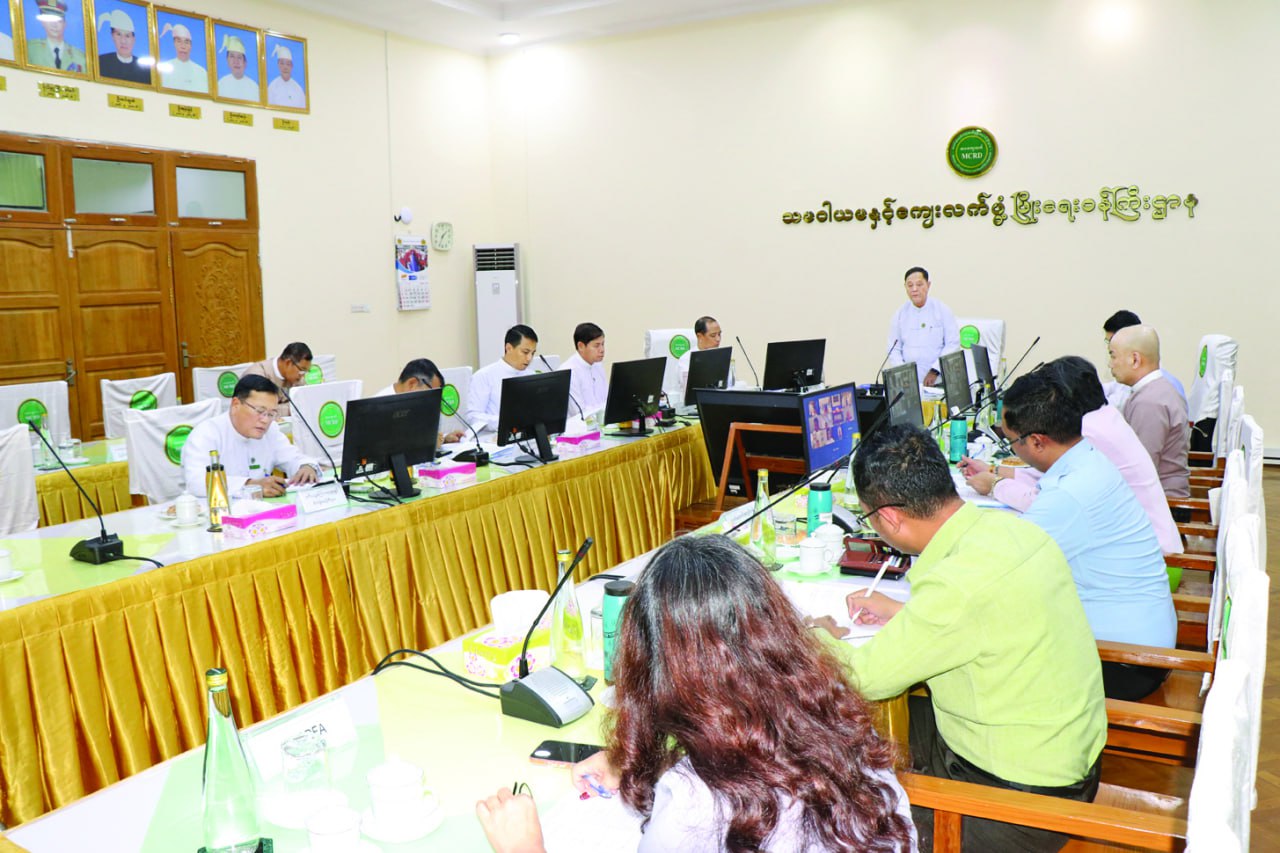
Price of fertilizer up since war in Middle East began
The regime’s Minister for Cooperatives and Rural Development Hla Moe told a meeting in Naypyidaw on March 13 that war in the Middle East, since the U.S. and Israel launched its attacks on Iran on Feb. 28, is affecting chemical fertilizer prices. Hla Moe called for inspections to prevent price speculation by merchants, adding that the regime has over 300,000 tons of fertilizer and that 1.1 million tons have been imported up to Feb. 2.
Richard Horsey, the senior advisor on Burma at the International Crisis Group, told DVB that the regime in Naypyidaw imports urea—which can be used to produce fertilizer and explosives—from Iran and that an increase in urea prices could impact the price of fertilizer. The regime set the wholesale price for a 50-kg bag of urea at 94,000 MMK ($23 USD). But sources told DVB that the market rate can be as high as 130,000 MMK ($33 USD) per bag.
On March 7, the regime’s National Defence and Security Council (NDSC) tripled the fine for importing fertilizers without a licence and for selling substandard fertilizers to three million MMK ($750 USD) and for using fertilizers for non-agricultural purposes to 1.5 million MMK ($375 USD). The regime’s Ministry of Agriculture, Livestock and Irrigation stated in December that 7,946 firms have been licensed to import and distribute fertilizers.
Over 70,000 displaced in Myanmar since January?
The U.N. Office for the Coordination of Humanitarian Affairs (OCHA) reported on March 9 that 73,350 civilians have been displaced from their homes due to conflict in Burma over the first two months of the year. It estimates that over 3.6 million people are displaced from their homes nationwide and listed as Internally Displaced Persons (IDPs) by the U.N.
Gwyn Lewis, the U.N. resident and humanitarian coordinator, visited IDP camps in the Arakan State capital Sittwe on Jan. 27. “It was really important for me to come to Rakhine State because the conflict here has been going on for so long, and because the impact on both the Rakhine and the Rohingya community has been enormous,” she wrote.
The U.N. reported that its humanitarian partners were able to deliver life-saving assistance to 6.3 million people, despite access challenges, shrinking funding, and insecurity. It added that 2.6 million people in Burma with the most urgent needs are the focus of humanitarian assistance in 2026. The Humanitarian Needs and Response Plan calls on donors for $890 million USD to reach 4.9 million people this year.

Vital Myanmar-China trade route under MNDAA control?
A source in the Kachin Independence Army (KIA) told DVB that the Myanmar National Democratic Alliance Army (MNDAA) asked KIA forces to relocate from checkpoints in northern Shan State to a distance of five miles (8 km) from the Lashio–Muse road so that the MNDAA can control the entire 108-mile (174 km) Burma-China trade route.
The KIA source added that the MNDAA, an ethnic armed group representing the Kokang Chinese in Burma, is acting at the behest of China’s government in Beijing. It allegedly seeks to clear the vital Burma–China trade route from the border town of Ruili all the way to Mandalay, Burma’s second-largest city, of all other armed groups.
Naw Bu, the spokesperson for the ethnic Kachin KIA, denied that the MNDAA ordered its forces to retreat from the Lashio-Muse road in an interview with DVB on March 17. The KIA seized Namhpatkar village in Kutkai Township, 27 miles (43 km) north of Kutkai town, in January 2024. Read more
News by Region
KARENNI—A source close to the Karenni Nationalities Defense Force (KNDF) told DVB on Monday that a portion of the main highway from the state capital Loikaw to Hpasawng Township is now under regime control. The source added that a counteroffensive launched in September has regained control of Demoso and Hpasawng townships.
The source said that “retaking the key highway” could allow regime troops to expand their control over the surrounding areas. On Feb. 17, resistance forces claimed that it prevented advancing regime troops from reaching Mese, which is under resistance control, by destroying a bridge over the Thanlwin River.
MAGWAY—A resident of Gangaw Township told DVB that two civilians were killed inside a nursing home during airstrikes carried out by the Burma Air Force on a Buddhist monastery compound on Monday. Gangaw is located 222 miles (357 km) northwest of the region’s capital Magway.
A People’s Defence Force (PDF) member in Gangaw told DVB that four jets carried out the strikes from Tada-U Air Base in Tada-U Township and Shan Te Air Base in Meiktila Township of Mandalay Region. The two towns are located about 205 miles (330 km) east and southeast of Gangaw, which is partially controlled by the PDF.
SHAN—The ethnic Palaung Ta’ang National Liberation Army (TNLA) told DVB that it met with the MNDAA in the Kokang Self-Administered Zone (SAZ) capital of Laukkai on Tuesday. But no further details were shared. Laukkai is located 117 miles (188 km) northeast of the regional capital Lashio.
Lway Yay Oo, the TNLA spokesperson, told DVB that the two ethnic armed groups met to discuss the conflict over Kutkai. A TNLA member told DVB that fighting between the two ended on March 17. The MNDAA seized control of Kutkai, 47 miles (75 km) north of Lashio, from the TNLA on March 15.
(Exchange rate: $1 USD = 4,050 MMK)

Stay up-to-date with the latest on #WhatsHappeninginMyanmar by subscribing for free to the DVB English News Daily Briefing newsletter.