


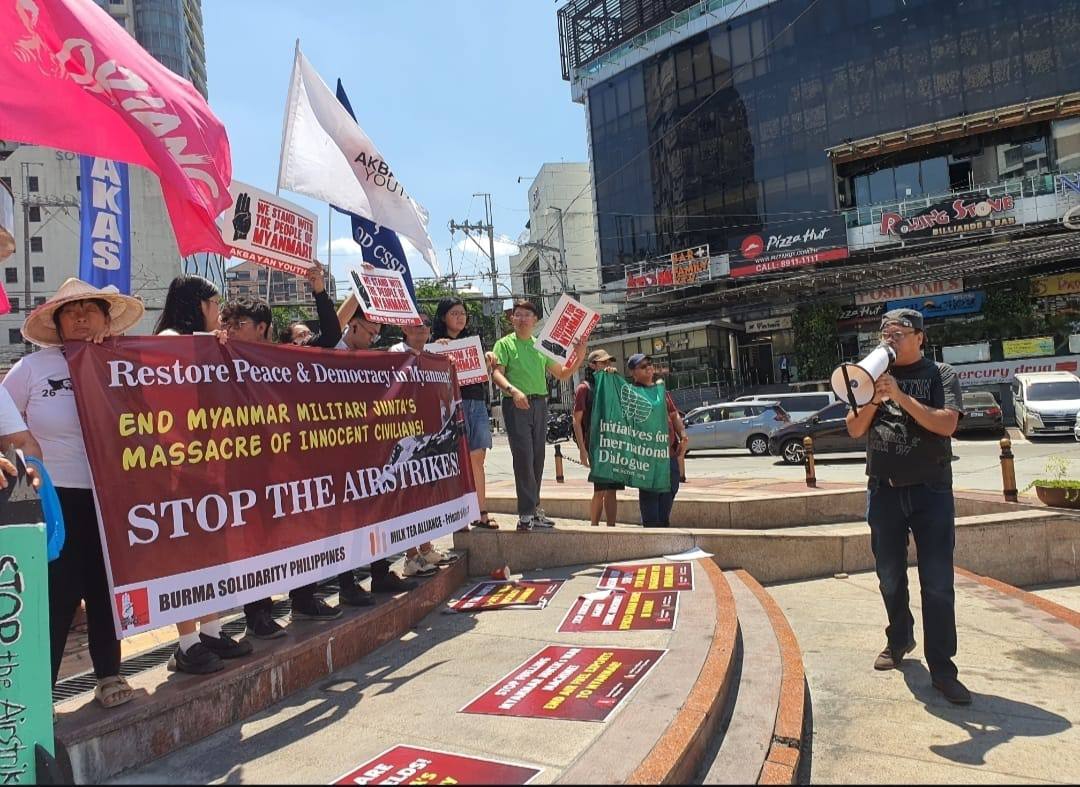
Human rights advocate and long-time regional campaigner Gani Abunda is issuing an urgent call to Southeast Asian leaders to abandon “dribbling” diplomatic tactics and confront the military regime in Myanmar directly.
Abunda, the Program Coordinator for the Initiatives for International Dialogue (IID) and co-chair of the upcoming ASEAN People’s Forum (APF), warned that the Association of Southeast Asian Nations (ASEAN) reliance on its Five-Point Consensus peace plan has failed to protect civilians or halt military atrocities in Myanmar.
Speaking to DVB in an exclusive interview in Manila, Abunda outlined plans for radical civil society mobilization across the Philippines and Southeast Asia ahead of the official ASEAN Summit in Manila, urging regional governments to recognize the civilian-led National Unity Government (NUG) and the Committee Representing Pyidaungsu Hluttaw (CRPH) as Myanmar’s elected leaders, ousted in the 2021 military coup, rather than the military regime led by Min Aung Hlaing.
Critique of Philippine policy and regional engagement
Abunda expressed sharp concern over vague foreign policy signals from the Philippine government, particularly following recent diplomatic outreach that included meetings with regime officials in Naypyidaw and its Foreign Minister Tin Maung Swe in Bangkok on July 12.
“We do not want the Philippine government to invite Min Aung Hlaing, but instead recognize the NUG. They represent the genuine representatives of the people who won the election,” Abunda told DVB.
As co-chair of the 21st ASEAN Civil Society Conference / ASEAN People’s Forum (ACSC/APF), scheduled to take place in Manila in October ahead of the official 49th ASEAN Summit in November, Abunda promised a departure from traditional, closed-door civil society convenings.
Under the banner “Resist Business as Usual: Disrupt, Reclaim, Rebuild,” the regional coalition plans to take its advocacy directly to community sites, public spaces, and the streets of Manila.
“Don’t expect the ACSC/APF to be held within the confines of hotels or comfortable closed-door meetings. It is time to up the ante a bit and engage the real issues that ASEAN has been ignoring for decades,” Abunda told DVB.
Abunda’s IID is a part of the Burma Solidarity Philippines (BSP), a regional coalition partnering with the Commission on Human Rights of the Philippines (CHR) to host public dialogues, photo exhibits, and documentary screenings highlighting the impact of the ongoing conflict on civilians in Myanmar.
Abunda’s involvement with Myanmar was ignited after reading License to Rape, a landmark report published by the Shan Women’s Action Network (SWAN) and the Women’s League of Burma (WLB) that documented the military’s systematic use of sexual violence as a weapon of war.
- Early Coalition Building: In 1995, IID helped form the Free Burma Coalition Philippines (FBCP), coordinating regional actions across Thailand, South Korea, and Southeast Asia.
- Post-Coup Reconstitution: Two months after the 2021 military coup, Abunda and fellow advocates re-established the network as Burma Solidarity Philippines (BSP).
- Diverse Alliances: BSP works directly with the Civil Disobedience Movement (CDM), trade union federations, youth strike committees, and women’s organizations, organizing public rallies, legislative briefings, and international advocacy campaigns.
Rejection of the Five-Point Consensus and ‘sham’ elections
Reflecting on the historical trajectory of military rule—from the 2007 Saffron Revolution and the military-drafted 2008 Constitution to the short-lived political transition 2015-21—Abunda emphasized that civil society must remain vigilant against military propaganda.
He described ASEAN’s Five-Point Consensus as little more than a recycled version of the military’s former “Seven-Step Roadmap to Democracy,” designed to stall for time while the military attempts to consolidate territorial control through violence and fraudulent electoral exercises.
“We are not members of a cheering squad for Myanmar; we are part of it. We get offended every time our fellow human beings have their rights violated. Empathizing is not a requirement—it should be innate…
If ASEAN comes to a point where they just recognize whoever is sitting in Naypyidaw, that would be horrible and detrimental to the whole revolution. Solidarity movements, the NUG, and all resistance fronts must continue complementing each other’s work until genuine democracy and social justice are restored,” Abunda told DVB.