


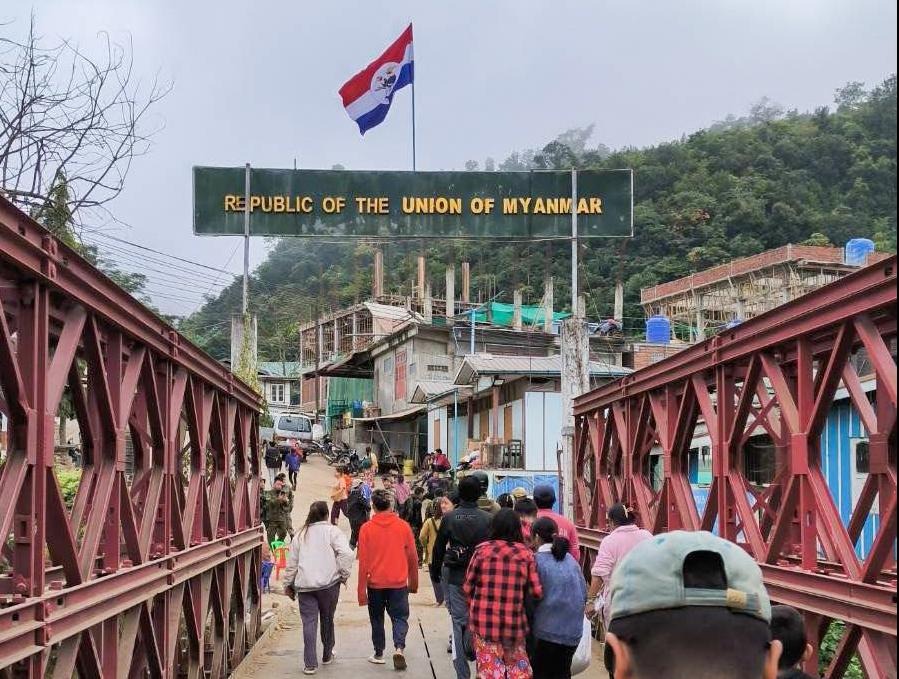
The split within the Chin resistance in Myanmar’s Chinland (Chin State) has led to severe consequences for those displaced from their homes, over the last four years of conflict with the military following its 2021 coup, and staying temporarily at Internally Displaced Person (IDP) and refugee camps along the Myanmar-India border.
A leader at the Lawngtlai camp for Chin refugees in India’s Mizoram State said the split between the two Chinland resistance factions has impacted the availability of humanitarian aid for displaced people in late 2024.
“The situation was stable. We regularly received both educational and humanitarian aid from organizations. Since the split, the aid has completely stopped,” he said, referring to the split in the Chin resistance when the Chinland Council (CC) was formed by the Chin National Front (CNF) in February 2024, breaking off with the Interim Chin National Consultative Council (ICNCC) founded to represent all Chin people after the 2021 coup.
A study conducted by Exile Hub, an organization researching humanitarian aid for refugees from Myanmar in India, states that aid has become increasingly politicized.
Both refugees and IDPs are increasingly being categorized based on their birthplace within Chinland, which in turn suggests proximity or affiliation with either the ICNCC or the CC.
This alignment is often shaped by ethnic ties, historical allegiances, and political learnings. As a result, the aid distribution process itself has become highly politicized.
This has led to a two-tiered aid system on the ground. Those identified as being affiliated with the ICNCC are facing a complete cessation of aid deliveries, the Exile Hub found.
The difficulties in securing aid have prompted some IDPs and refugees to consider returning to areas controlled by the Chin resistance. However, this is being thwarted by conflict between the CC armed wing, the Chin National Army (CNA) and the ICNCC armed wing, the Chin Brotherhood.
A middle-school teacher who refused to work under the military after the 2021 coup and joined the Civil Disobedience Movement (CDM) in Matupi Township said that fighting between Chin resistance forces makes it difficult for his family to return home. Matupi, which was seized by the Chin Brotherhood, is located 280 miles (173 km) south of the state capital Hakha.
“I promised my wife and children that we would return by the end of this year. But now, even though the military isn’t in Matupi, we can’t go back because of the internal conflict,” said the CDM teacher.
Chin refugees at the Lawngtlai camp, with a population of approximately 400 people, have received only one 30 kg bag of rice in the last four months.
Around 100 students from IDP and refugee camps affiliated with the Chin Brotherhood have been denied enrollment in schools established by the CC, Exile Hub found.
Human rights, health and educational crisis
The access to humanitarian aid is now heavily dependent on the power dynamics and influence of the Chin resistance factions, who often set their own criteria for who receives support. Humanitarian organizations based locally must now operate with extreme caution within this complex and restrictive environment.
The Exile Hub study indicates that this increasing factionalism in Chinland not only interferes with the work of frontline aid workers but also creates a vicious cycle of marginalization among the IDPs and refugees.
The Mizoram State government shared data stating that approximately 35,000 people have sought refuge in India from Myanmar. Funding from the Indian government and international NGOs has decreased significantly since the beginning of 2025.
The suspension of USAID funding in January 2025 further intensified the crisis, leading to a general reduction in aid and focus only on the most essential services, Exile Hub found.
“The remaining bags of rice are from the Indian government, but this is the last of it. We received some from Zoram Entu Pawl before, but it wasn’t enough,” said Soe Lin, a leader in the Canaan Refugee camp located on the India-Myanmar border.
The financial constraints, scarcity of services, and unequal aid distribution are also severely limiting healthcare access for refugees from Chinland staying temporarily in Mizoram.
Most refugee families struggle with daily livelihood and cannot afford even basic healthcare due to the high costs of living along the border.
Some refugees expressed constant fear of bias, discrimination and neglect in medical treatment. As a result, some refugees are reportedly avoiding local clinics run by the CDM doctors affiliated with the CC.
Medical care for the wounded, especially those arriving from conflict zones, remains a critical and life-saving necessity. Civil society organizations play a vital role in coordinating care for these and other long-term patients.
While some receive initial emergency treatment from organizations like Doctors Without Borders, or Medecins Sans Frontieres, those requiring more complex care are referred to hospitals in the Mizoram State capital Aizawl.
For highly specialized treatments unavailable in Mizoram, patients must be transferred to inland cities like Kolkata and New Delhi. This cross-border referral process is complicated by the need for legal documentation, creating significant difficulties for many undocumented refugees.
“In 2022 and 2023, MSF provided free medical treatment for everyone in the camp. But they are not providing it anymore now,” added Soe Lin.
The Exile Hub report highlights that the loss of USAID support has resulted in a degradation of existing services, particularly impacting women, the elderly, and those with chronic diseases who no longer receive adequate medical care.
“We have resources, and everything is run on donations. So, how long can we keep going? The people are exhausted. We have spent so much to fight the military. Now, this is impacting everything from individual family kitchen to education and health services,” said a CDM doctor.
While health workers involved in the CDM continue to provide services on the ground, the split among the Chin resistance, compounded by aid shortages, is a major obstacle to providing consistent care.
“This internal rift is affecting the healthcare we provide on the ground. We know that this split is detrimental, but we are simply trying to withstand it and continue our work,” said another CDM doctor.
The CDM Medical Network-Chin issued a statement on July 14, appealing to Chin resistance groups to avoid obstructing health, education, and public services during their operations. The statement urged the groups to refrain from conflict and to resolve disputes through dialogue.
“Regardless of affiliation, the basic needs of the [refugees] are the same. This obstruction of aid delivery, even in basic needs, should not be happening,” said a CDM doctor.
Schools for refugees and IDPs are also struggling with insufficient funding and rely solely on volunteers. Teachers are paid a meager honorarium of around 200-300 Indian Rupees ($2.28-3.42 USD).
A CDM healthcare worker said that 33 refugee schools were established in Mizoram with 600 CDM teachers in 2022, providing education to about 4,000 students. However, most have been forced to close, with only five expected to remain operational by November 2025.
A teacher said that the refugee camp schools continue to operate under the command of the National Unity Government (NUG) and issue high school completion certificates, relying on local donations.
These schools lack clear policy direction and suffer from a severe shortage of funds and resources. Although attending Mizoram government schools is an option, language and transportation difficulties force refugee families to rely on the under-resourced NUG school.
The psychological toll and the need for unity
A teacher from a self-help school in a village of Chinland’s Thantlang Township emphasized the need to prevent the conflict among resistance groups from breeding internal discrimination among students.
“Whether as a university student or now as a teacher, I have always lived by the motto, ‘We are one in Chin.’ We cannot operate as separate entities. I do not want the younger generation to inherit the ripples of this internal conflict. Even if I fail in my tenure as a teacher, I want to pass on this message.”
A journalist covering the conflict in Chinland and refugee issues highlighted that the fundraising tactics of international donor groups are also contributing to the issues felt on the ground.
“This worsening situation is due to fundraising groups for the revolution attacking and antagonizing each other when soliciting donations from their respective audiences. The severe situation is intensifying. What used to be a single entity is now engaging in back-and-forth attacks. This has a very negative impact,” said the journalist.
A Chin civil society leader claimed that “mutual respect” is the sole solution for the current conflict among factions of the resistance in Chinland.
“I do not want to see political maneuvers used to backstab one another,” he said.
An ethnic Chin working at an embassy said that the current state of affairs, concerning aid and the internal conflict, has led to a sense of loss of a common ground among the Chin community.
“I feel that the common thread for all our suffering is being lost. We must approach every issue from the unifying perspective that we are all members of the Chin ethnicity,” he said.
Exile Hub warned that without systemic change regarding the resistance to the 2021 coup in Chinland, the IDPs and refugees staying along the Myanmar-India border will remain in a precarious state caught between inadequate cross-border protection and the fragmentation of local aid networks.
BNI