


Guest contributor
Alan Clements
There are moments when truth pierces history’s distortions like lightning through fog—sudden, irreversible, illuminating everything.
At the request of Kim Aris—son of Aung San Suu Kyi—Fergus Harlow’s Letter to Religions for Peace Italy and its accompanying 15-minute video were created as acts of service and solidarity. They are acts of conscience in an age of moral sleepwalking—unfiltered, unafraid, unforgettable.
I urge every journalist, faith leader, and citizen of conscience to take those 15 minutes and watch. It may alter how you see not only Aung San Suu Kyi, but the very idea of moral courage itself.
Fergus Harlow—a forensic journalist, scholar, and moral historian—is my long-time colleague, co-author, and friend. His life’s work is devoted to Myanmar’s struggle for freedom and democracy. Together, we co-created Burma’s Voices of Freedom, a four-volume oral history documenting the conscience of a nation under siege.
His recent letter and film culminate that work—the flowering of years of devotion distilled into one unflinching act of truth-telling. They restore integrity to one of the most misrepresented figures of our time and expose the global complicity that allowed her vilification to eclipse understanding.
Let us be clear: Aung San Suu Kyi was never silent. Not on the Rohingya crisis. Not on her people’s suffering. Not on the imperatives of peace and reconciliation. Her speeches and policies were documented, verified—not rumor, but record.
Yet global media, unable or unwilling to hold complexity, chose caricature over conscience. It was easier to condemn her than comprehend her; easier to flatten a human into an abstraction than face the world’s own failure.
Harlow’s work restores that depth. It gives us back the woman behind the myth—not an icon, but a human who embodied freedom under tyranny and now endures her fifth year of solitary confinement, reportedly gravely ill and needing urgent cardiac care.
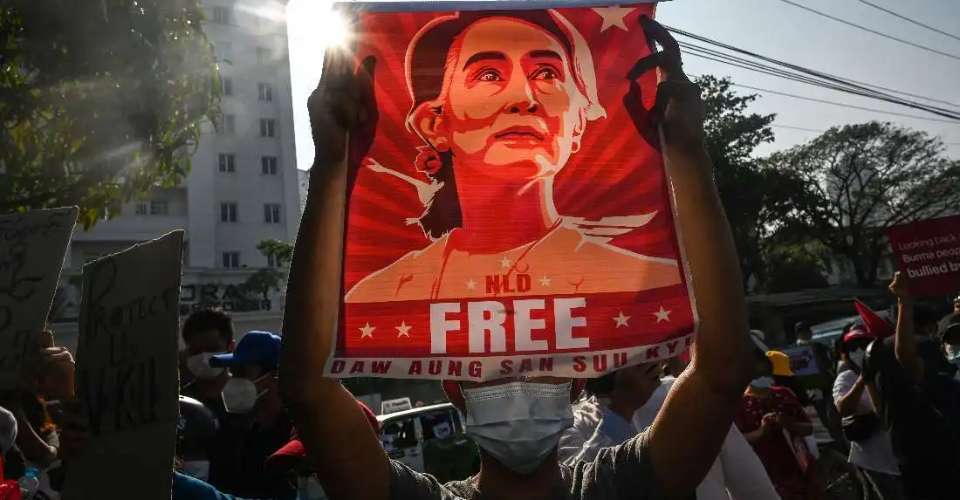
Aung San Suu Kyi’s crime was not complicity. It was conscience. She awakened moral intelligence in a culture addicted to obedience, revealing tyranny’s real battleground: the mind. For this, she has been silenced and imprisoned—along with over 22,000 political prisoners in Myanmar. Yet her captors cannot imprison her moral clarity.
Her revolution remains a spiritual one—rooted in forgiveness, courage, and the radical belief that love can disarm hate.
As part of the Use Your Freedom campaign, Kim Aris hand-delivered The Voice of Hope: Aung San Suu Kyi from Prison – and a Letter to a Dictator – a book Fergus Harlow and I co-created—to Religions for Peace Italy. It was no symbolic act but an invocation: a call to faith communities to defend truth where governments fail.
Burma’s revolution is not a distant tragedy. It is a mirror—reflecting our moral choices: to be silent or speak; to look away or see; to comply or awaken.
For years, commentators claimed Suu Kyi was “silent” during the Rohingya crisis. The record shows otherwise. She spoke to the BBC, VOA, and CNN-IBN; called for investigations; denounced violence; urged equal rights; and described the Rakhine tragedy as a “huge international calamity.”
She labeled discriminatory laws “criminal” and “in breach of human rights.” She collaborated with the Annan Foundation on reconciliation and redevelopment, using the term “Rakhine Muslim” to reduce incendiary rhetoric that extremists exploited for more killing.
While condemned for nuance, the real genocide perpetrators—Senior General Min Aung Hlaing and his military cabal—remain free, unrepentant, signing repatriation agreements for refugees they created. The irony is grotesque: a Nobel Peace laureate imprisoned by mass murderers, while the world repeats her jailers’ propaganda.
This is not mere political failure but moral collapse—a global poverty of imagination. Western media, missing the spiritual-political dimensions of Burma’s revolution, reduced decades of sacrifice to headlines of betrayal. What they overlooked—and what Fergus refuses to let die—is reconciliation’s heartbeat.
For Aung San Suu Kyi, reconciliation was sacred practice—forgiveness as statecraft, compassion as realism, dialogue as defiance. To misread that as weakness misunderstands nonviolence’s architecture.
She sought transformation, not vengeance. “Hatred can only be overcome by love,” she said, echoing the Buddha. Her politics extended her meditation: seeing through illusion to restore humanity, even in enemies.
This is why Fergus’s letter matters. It restores moral clarity to a narrative hijacked by cynicism. It demands those who vilified her to confront their complicity. But I call not for apologies—for action. Use your freedom to demand hers.
It is time for the immediate, unconditional release of Aung San Suu Kyi, President U Win Myint, U Win Htein, and all prisoners of conscience in Myanmar’s prisons. Time to restore dignity to discourse and truth to the record.
Fergus Harlow’s work is revelation—a moral autopsy of propaganda and power. His voice invites us beyond cynicism into empathy, recovering courage to care in a world numbed by algorithms and spectacle.
Fifteen minutes. That’s all it takes to listen. Fifteen minutes to undo years of distortion. The video is testimony, restoring what propaganda erased: moral clarity’s sound.
To leaders of nations who speak of freedom yet stay silent before tyranny: use your freedom. Speak her name. Demand her release. Governments trading with the junta while professing democracy stain their credibility. Journalists recycling false narratives become accomplices in censorship. Citizens who shrug risk forfeiting the conscience defining humanity.
Aung San Suu Kyi remains unjustly imprisoned. But her spirit—and those fighting for her—is unbroken. Fergus Harlow’s letter, like her life, is fierce love: a reminder that truth, spoken with precision and compassion, can move mountains.
In doing so, you restore not just a woman’s truth, but a nation’s dignity—and perhaps the world’s conscience.
Alan Clements is an author, investigative journalist and former Buddhist monk ordained in Myanmar, where he lived for years immersed in the country’s spiritual and political landscapes. He is the author of Burma: The Next Killing Fields? and The Voice of Hope, co-authored with Aung San Suu Kyi, Conversation with a Dictator: A Challenge to the Authoritarian Assault, as well as Aung San Suu Kyi From Prison and a Letter to a Dictator.
DVB publishes a diversity of opinions that does not reflect DVB editorial policy. We’d like to hear what you think about this or any of our stories: [email protected]