


Guest contributor
Jaivet Ealom
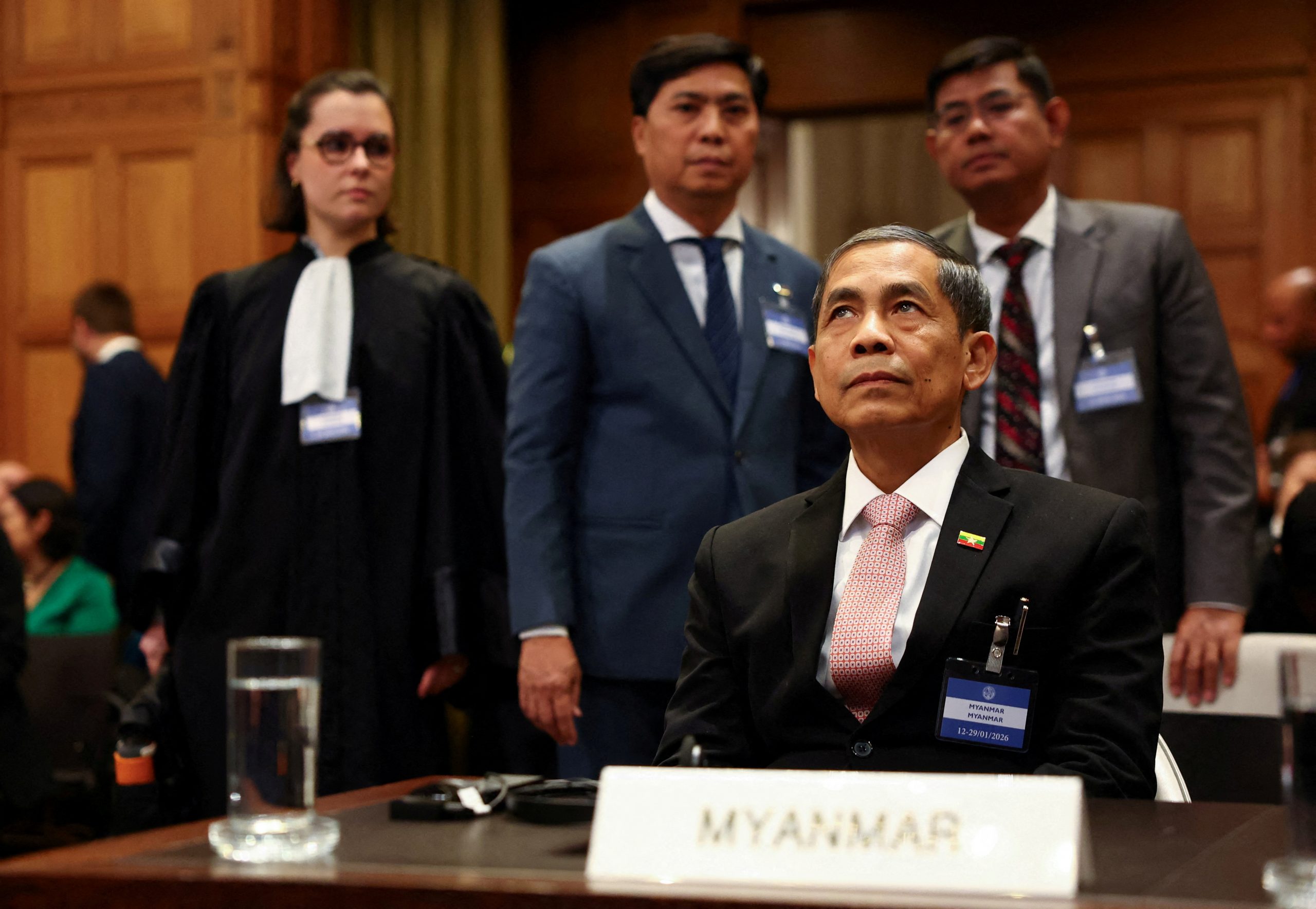
The dust has settled with the pause of courtroom drama at The Hague. Hashtags have faded, livestream commentaries have quietened, and media attention has quickly moved on to other pressing international issues. But the reckoning has only begun.
The case against Myanmar at the International Court of Justice (ICJ) moves at the snail’s pace of international law. There may or may not be a final decision later this year, and it may be technical, restrained, and difficult to enforce.
But one thing is clear: after holding sham elections to gain a bit of international legitimacy, the military now has to face the fire for allegations of genocide on the international stage.
For an institution built on impunity, this setback is unprecedented. The case should not be understood only as a legal process. It is also one of the fronts in Myanmar’s broader struggle against military rule.
For the first time in Myanmar’s history, the military, long shielded by its monopoly over violence, nationalism, and oppression, has finally been compelled to stand before the International Court of Justice to answer for its crimes against humanity.
This moment did not arrive because the military suddenly lost its grip on power. Nor because a revolutionary force toppled the regime. Nor because a foreign army marched on Naypyidaw.
It happened because Rohingya blood crossed borders and brought the Myanmar military before the world’s highest court. What the military tried to bury in burned villages in Rakhine State resurfaced in courtrooms thousands of miles away.
For decades, the Rohingya were denied their dignity, their identity, and their citizenship. They were portrayed as outsiders in Myanmar, erased from textbooks, and finally driven from their homes.
The military believed it could carry out atrocities to exterminate the Rohingya in Rakhine with total impunity, as it had done in other parts of the country for generations.
Villages were burned until little remained but ash and memory. Survivors fled across rivers and borders carrying stories that many hoped would simply disappear with them.
Instead, those stories were told in refugee camps, translated into legal records, and carried across continents – testimony that eventually became evidence before the world’s highest court.
Many revolutionary actors have fought the military on battlefields, in parliaments, in jungles and in exile.
The Rohingya, though wounded and displaced, were the first ones to bring this fight to The Hague. They fought on a different battlefield – international law. A battlefield the generals never expected.
This is not a competition about who has suffered more or resisted more in Myanmar. Every community in Myanmar carries its own wounds from decades of military rule.
The details of suffering may not be identical, but the system that produced it and the impunity it expects are the same.
The Rohingya do not command battalions or territories like many other revolutionary actors, and they could not defend themselves, let alone participate in armed struggle, in the same way.
But revolutions are not fought on a single battlefield. Some wield the sword; others wield the law.
From the margins, the Rohingya have delivered a historic blow to the Myanmar military’s once-thought-impenetrable shield: its impunity on the international stage.
The very people the military tried to erase have brought those who sought to destroy them before the highest court of international law.
This is a shield that has never been pierced before. Not by the United States. Not by the United Nations. Not by China. Not by the Association of Southeast Asian Nations (ASEAN).
No sanction, condemnation, or numbered-point consensus has ever put the military in a place where it had to face the fire of its own atrocities in Myanmar.
This progress is part of the revolution.
Accountability is not separate from resistance. It is resistance.
At a time when Rohingya-phobia and hate speech are rising again in Myanmar, particularly on social media, it is worth asking why.
For decades, the military encouraged the idea that Rohingya were outsiders and enemies.
Those narratives do not disappear overnight. Yet it is striking that the very community that helped bring the military before the world’s highest court is still met with suspicion by many.
Perhaps this discomfort reflects something deeper: acknowledging the Rohingya experience also means confronting the full extent of the military’s violence.
If the revolution is about dismantling the military’s system, it must also dismantle the propaganda, segregation, and legal exclusions that sustained it.
The military not only persecuted the Rohingya, but systematically portrayed them to the rest of the country as outsiders and enemies. Propaganda, exclusion, and violence hardened this divide.
At the same time, the isolation imposed on Rohingya communities meant many grew up seeing other ethnic groups in Myanmar as hostile and dangerous. Fear grew on all sides.
Rohingya were denied the chance to see others as compatriots, just as others were taught not to see Rohingya as their own. These divisions did not arise naturally. They were engineered — and they served the military well.
The revolution now requires undoing those divisions as much as confronting the military itself. The task ahead is to rebuild the trust the military worked so hard to break, and to pursue the justice that makes such trust possible.
The ICJ case should be understood as a Rohingya contribution to Myanmar’s broader struggle for a federal democratic future. The Rohingya did not act against the revolution. They are part of the revolution.
Myanmar’s future will not be built on selective memory. It cannot rest on partial justice or conditional solidarity. If the revolution is to succeed, it must hold space for all the ways people resist: armed, political, cultural, and legal.
Recognizing the Rohingya contribution does not diminish the struggles of others. It acknowledges that the fight against the military has taken many forms.
The Rohingya resisted through survival, testimony, and now through international law. And at an immense cost.
Justice may move slowly, and it may arrive imperfectly. But even the act of forcing the generals to answer before the world has altered the political landscape.
Whatever the ICJ ultimately decides, one fact cannot be reversed: the era of absolute impunity has been fractured.
The military has been named. It has been scrutinized. It has been brought before the world to answer for genocide – the gravest crime in international law.
That, too, is part of Myanmar’s revolution.
Jaivet Ealom is a fellow at MyPACK Hub, at the University of Toronto’s Asian Institute and currently serves as the Secretary-General of Rohingya Consultative Council.
DVB publishes a diversity of opinions that does not reflect DVB editorial policy. We’d like to hear what you think about this or any of our stories: [email protected]