


Guest contributor
Mayyu Ali
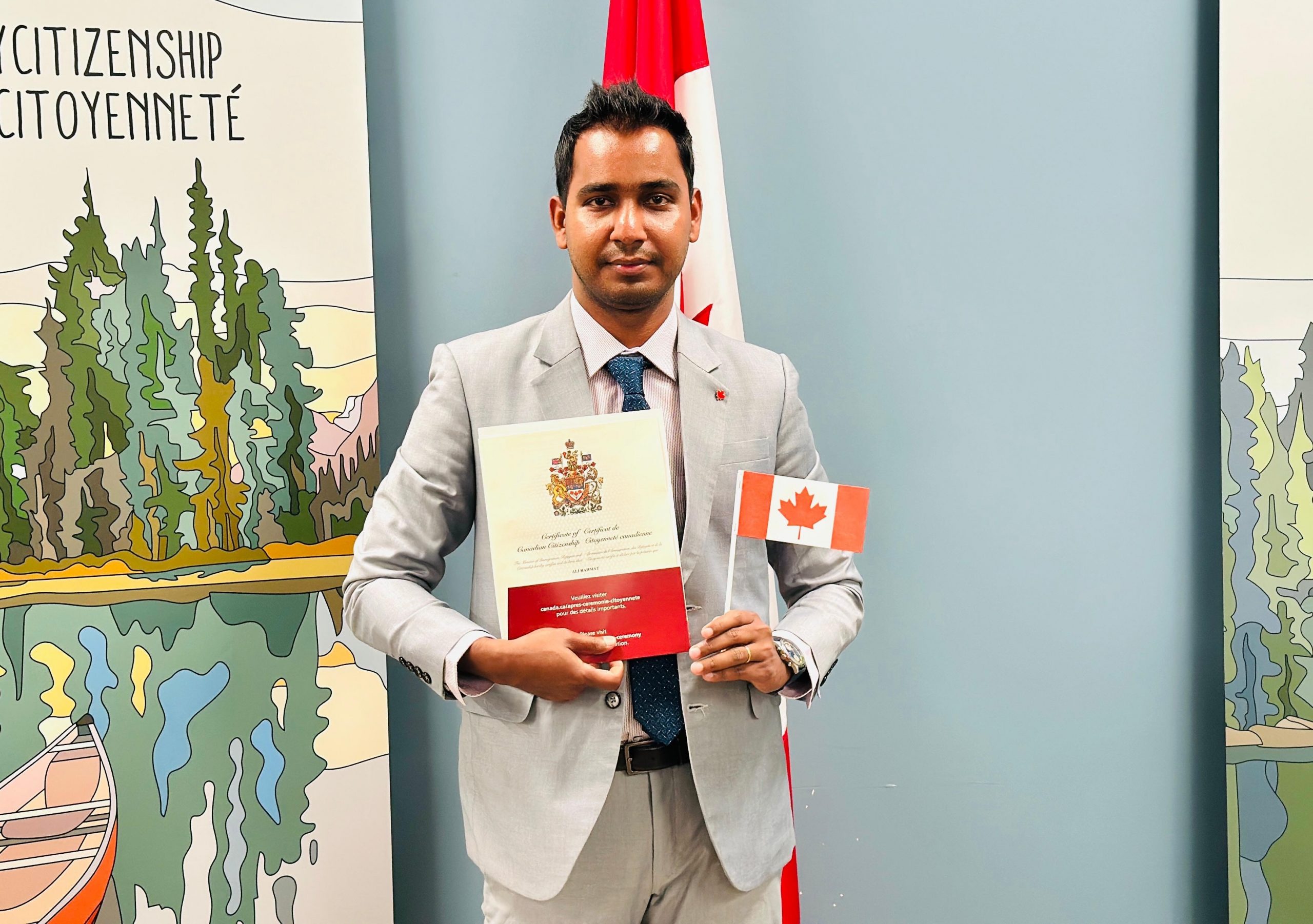
I am a Rohingya, a survivor of genocide in Myanmar. On August 29, I took the oath of citizenship and officially became a Canadian citizen.
As I walked toward the stage to receive my certificate of citizenship, my mind was inundated with flashbacks of the persecution and discriminatory policies that have deprived my community, my parents, and myself of citizenship in Myanmar for decades.
At 34-years-old, I have become a citizen for the first time in my life. This citizenship represents more than a mere privilege; it is a profound acknowledgment of my existence, a sense of belonging to Canada, and a realization of the freedoms, rights, safety, and opportunities that were absent in my country of birth.
For the thousands of my fellow community members in Canada, the path to acquiring citizenship presents significant challenges and barriers.
Rohingya citizenship deprivation in Myanmar
In Myanmar, our country of origin, we have faced a profound identity crisis, having been systematically deprived of citizenship, education, and political participation.
The enactment of the Citizenship Law in 1982 by the Myanmar government effectively denied the Rohingya citizenship and excluded them from the enumeration of recognized ethnic groups within the nation.
Myanmar’s Citizenship Law delineates three classes of citizens: full, associate, and naturalized, all of which the Rohingya are categorically denied.
As a consequence of this citizenship deprivation, the Rohingya have been subjected to numerous forms of state-sponsored operations and violence, compelling at least 1.3 million to flee their homeland in search of refuge in neighboring countries.
In their displacement across Southeast Asia, Rohingya refugees continue to be denied formal education and employment opportunities. This prolonged deprivation of fundamental rights has resulted in a high illiteracy rate within the Rohingya community, posing significant barriers to political participation for those resettled in Europe and North America, including Canada.
Many members of the Rohingya community in Canada are adults facing substantial challenges in acquiring Canadian citizenship, not only due to the long-standing deprivation of education and citizenship in their homeland but also because of the inadequacy of citizenship education programs provided by the Government of Canada for newcomers seeking to secure their citizenship.
Process and requirements of Canadian citizenship
Participatory democracy expects citizens to take part in decision-making of the nation, and a basic requirement for effective participation is citizenship education.
There are specific processes and requirements for newcomers to apply for citizenship in Canada. Newcomers between the ages of 18 and 54 must have adequate knowledge of English or French to become Canadian citizens.
They must also have knowledge of voting procedures, Canada’s history, symbols, democratic institutions, geography, and the rights and responsibilities of citizenship.
Applicants need to pass a citizenship test, providing a proof of document to meet the language requirement for the citizenship process. The document must be either of the Immigration, Refugees and Citizenship Canada (IRCC)-approved third-party test, government-funded language training programs and completion of secondary or post-secondary education in English or French, in Canada or abroad.
Challenges of Rohingya to citizenship
Currently, it is estimated that there are between 3,000 to 4,000 members of the Rohingya community in Canada, making it their new home. Since 2006, they were resettled to Canada from displacement in the South and Southeast Asian countries, including Bangladesh and Malaysia.
They live in Ottawa, Quebec City, Surrey, Calgary, Vancouver, Toronto, and London. Kitchener has the largest population in Canada. The Rohingya community in Canada is diligently working to adapt to life within Canadian society while enhancing their understanding of Canadian history and the rule of law.
The Government of Canada provides citizenship education for newcomers through the government-sponsored programs including ESL (English as a Second Language) and the Language Instruction for Newcomers to Canada (LINC). There are more than 40 different organizations that provide citizenship programs in Canada.
Ninety-five percent of programs provide classes specifically for preparation for the citizenship test, and five percent offer language proficiency courses with a heavy emphasis on citizenship perspectives in the length of instruction between 1 to 41 weeks, with a national average of 12 weeks.
Understandably, the citizenship education classes are offered in bilingual languages: 61 percent in Chinese, 13 percent in Punjabi, 9 percent in Vietnamese and also in Hindi, Bengali, Portuguese, and Korean.
All these programs have bilingual instructors who teach students in their mother language. Some specific challenges faced by members of the Rohingya community in their efforts to acquire citizenship include the absence of documentation pertaining to language proficiency, the lack of citizenship education provided in the Rohingya mother tongue in Canada, the necessity to withdraw from citizenship classes due to employment obligations or limited incomes required to support their families, and a general lack of understanding regarding the significance of citizenship.
As a result, Rohingya men and women in Canada are encountering significant challenges, including language barriers that impede their ability to obtain citizenship, despite having resided in the country for several years. Only a small number of them have successfully acquired Canadian citizenship, enabling them to vote for the first time in their lives.
A call to action
The acquisition of citizenship for the Rohingya community in Canada is both socially and politically essential, as they are effectively stateless in their country of birth and remain displaced across South and Southeast Asia.
Consequently, the establishment of a targeted citizenship education program for adults within the Rohingya community in Canada is crucial, as it would provide an invaluable opportunity for Rohingya men and women to attain citizenship and exercise their right to vote for the first time in their lives.
To implement this program effectively, Prime Minister Mark Carney’s government should consider the following recommendations:
First, Canada must immediately appoint a replacement for U.N. Ambassador Bob Rae as special envoy. The Rohingya genocide continues in Myanmar, and international action, including Canada’s, has diminished.
A new envoy could spark global attention and action, leading to concrete proposals for investigating ongoing crimes by the Myanmar military and recent crimes by the Arakan Army against the Rohingya.
Canada should also refer the Arakan Army’s crimes to the International Criminal Court (ICC) as part of its investigation into the Myanmar military’s actions against the Rohingya. Additionally, the envoy would assess and address the challenges and concerns faced by the Rohingya community in Canada.
Second, to enhance coordination, Canada should establish a “Rohingya Working Group” across government, as recommended by Rae in his final report seven years ago.
Advancing effective policies and programs to address this crisis should involve government officials from diplomatic, humanitarian, and refugee protection sectors, as well as economic, security, and military aspects.
A mechanism is necessary to ensure a coherent agenda is developed and implemented across these departments.
Finally, Canada should establish a dedicated program for “Rohingya Citizenship Assistance” aimed at supporting Rohingya newcomers until they attain the necessary level of citizenship literacy.
This program must be bilingual, incorporating the Rohingya mother language, facilitated and instructed by individuals with expertise in Rohingya culture and language.
It should be designed in a methodical and evidence-based manner to maximize the opportunities for the Canadian Rohingya community to attain citizenship.
Additionally, the program must receive federal funding and support and be implemented in collaboration with the “Rohingya Working Group.”
The Rohingya population has been nearly expelled from their homeland in Myanmar. This genocide continues to escalate, now exacerbated by the actions of the Arakan Army.
If Canada were to support the education and empowerment of young Rohingya individuals in Canada, they could emerge as leaders and peacemakers, embodying the values for which Canada is globally recognized, while effectively contributing to the Rohingya cause.
Mayyu Ali has a master’s degree in global governance from the University of Waterloo. He is a Rohingya poet and author of Exodus, L’effacement and The White Elephant. In 2021, he was resettled in Canada. Twitter @AliMayyu
DVB publishes a diversity of opinions that does not reflect DVB editorial policy. We’d like to hear what you think about this or any of our stories: [email protected]