


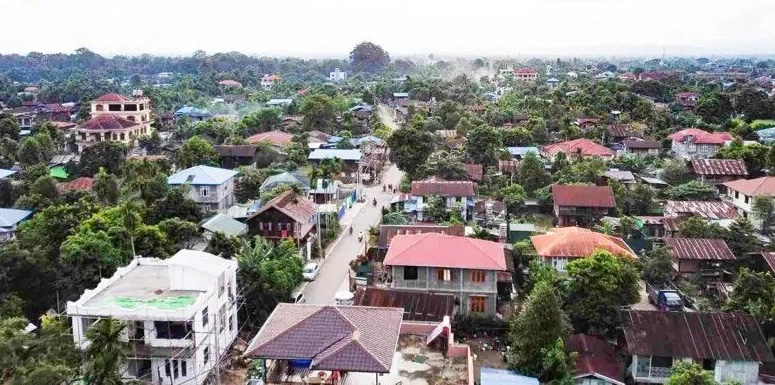
Residents and civil society groups across Kachin State are voicing growing concern over potential shutoffs to their Starlink satellite internet access, following a wave of terminal deactivations across Karenni and Arakan states, as well as Sagaing and Mandalay regions that began on July 2.
While local Starlink terminals in Kachin State remained operational as of Aug. 1, communities fear that expanding geolocation restrictions and account suspensions could soon sever their primary communication link amid ongoing military-imposed digital blackouts.
“We rely on Starlink for mobile banking and to read news about airstrikes and fighting. What other alternative can we use if Starlink goes offline?” a resident in the Kachin State capital Myitkyina asked.
Military blackouts and unreliable operators
Reliance on unlicensed satellite internet deepened after the military regime imposed a statewide telecommunications blackout across Kachin State on July 21, 2024, attempting to disrupt a major offensive launched by the Kachin Independence Army (KIA).
Since the offensive began, the KIA has seized key administrative centers, including Sumprabum, Injangyang, the rare-earth mining hubs of Chipwi and Tsawlaw, and Mabein in neighboring Shan State.
While military-linked Mytel (partly owned by Vietnam’s Ministry of National Defence) alongside MPT, U9 (formerly Ooredoo), and Atom (formerly Telenor) have partially restored cellular coverage in Myitkyina and nearby towns, connectivity remains erratic, slow, and heavily monitored.
Kachin State Telecommunications & Conflict Context
├── Statewide Blackout Imposed: July 21, 2024 (following KIA offensive)
├── Territorial Gains: KIA controls Sumprabum, Injangyang, Chipwi, Tsawlaw, & Mabein
├── Active Frontlines: Escalating battles in Bhamo, Shwegu, & Hpakant
└── Human Rights Impact: Blackouts impede monitoring of military abuses (KHRW)
The Kachin Human Rights Watch (KHRW) noted that persistent telecommunications disruptions severely hinder efforts to document alleged military atrocities against civilians as fighting continues around Bhamo, Shwegu, and Hpakant.
Civil society coalition appeals to SpaceX
Resistance actors estimate that more than 20 percent of Starlink terminals operating in non-state-controlled areas of Myanmar have gone offline since early July as SpaceX enforces stricter geolocation controls and account verification rules.
- Mass CSO Appeal: A coalition of 255 Myanmar civil society organizations issued an urgent open letter to SpaceX CEO Elon Musk, warning that Starlink cutoffs endanger over 13 million people living under military internet blackouts. The coalition highlighted that the satellite network serves as a critical lifeline for nearly 800,000 students attending virtual schools operated by the parallel National Unity Government (NUG).
- Registration Hurdles: Banyar Aung, second secretary of the Karenni State Interim Executive Council (IEC), noted that Starlink has begun requiring user identification verification that is impossible for civilians in conflict zones to fulfill.
- Scam Compound Crackdown: The disruptions follow recent meetings in Japan between U.S. officials and regime representatives regarding cyber-fraud rings along the Thailand–Myanmar border. SpaceX Vice President of Business Operations Lauren Dreyer confirmed that Starlink disabled over 2,500 terminals operating in the vicinity of illicit scam compounds.
Human rights defenders emphasize that while disabling devices used by criminal syndicates is necessary, broad or untargeted service cutoffs risk isolating pro-democracy networks, frontline emergency medical workers, and vulnerable displaced populations across Myanmar’s borderlands.