


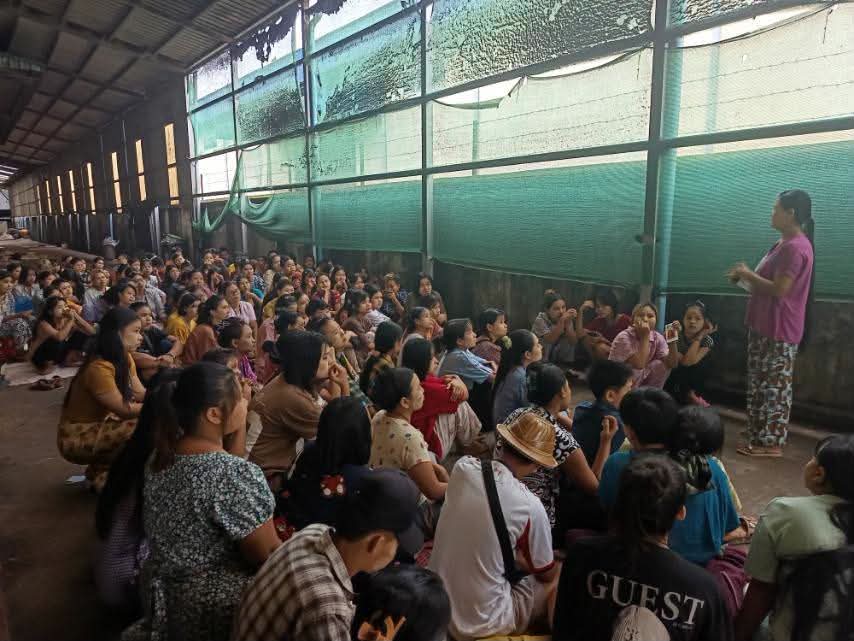
Workers at the Spring Moon Garment Manufacturing Co-Ltd in Yangon’s Hlaingtharyar Township Industrial Zone 4 are demanding a direct meeting with the factory owner on Aug. 10, to negotiate daily wage increases, overtime rates, and attendance bonuses.
The Chinese-owned facility employs over 200 workers under the Cut-Make-Pack (CMP) system, producing apparel for Japanese and Italian clothing brands, including SUIRAN and Makku.
Negotiation breakdown & timeline
The strike was launched on July 8 by 177 employees following months of rising commodity costs and steep inflation across urban industrial zones since the 2021 military coup.
Spring Moon Garment Factory Negotiation Breakdown
├── Daily Wage Rate:
│   ├── Pre-Strike Base: ~10,000 MMK
│   ├── Worker Demand: 13,000 MMK (~$3.00 USD)
│   └── Management Offer (July 24): 11,000 MMK (~$2.50 USD)
├── Overtime Rate (per hour):
│   ├── Worker Demand: 2,500 MMK (~$0.50 USD)
│   └── Management Offer (July 24): 2,200 MMK (~$0.45 USD)
└── Monthly Attendance Bonus:
    ├── Worker Demand: 50,000 MMK (~$11.60 USD)
    └── Management Offer: Unresolved
- July 8: 177 workers walk off the job, submitting demands for higher daily wages, overtime pay, and attendance bonuses.
- July 24: Factory management offers a partial increase (11,000 MMK daily wage and 2,200 MMK overtime).
- July 31: Workers reject the lower counteroffer and resume striking.
- August 10: Striking employees schedule a formal demand for direct negotiations with the factory owner.
Third-party mediation & threats against striking workers
The labor dispute is occurring alongside growing friction between striking employees and local officials.
The Solidarity of Trade Union Myanmar (STUM)—a Yangon-based labor rights group—stated it is assisting worker representatives in negotiations despite having officially terminated its trade union activities this month due to severe financial difficulties.
“We respect the workers’ rights and provide our services in the negotiation process,” an STUM member, told DVB on the condition of anonymity.
In recent statements, STUM warned that factory management and local labor officials have pressured striking workers, threatening legal action under claims that absent personnel had taken jobs at other facilities during the strike—allegations denied by worker representatives.
The standoff underscores ongoing economic instability across Myanmar’s export garment sector, where factory workers continue to push for living wages to keep pace with severe domestic price increases.