


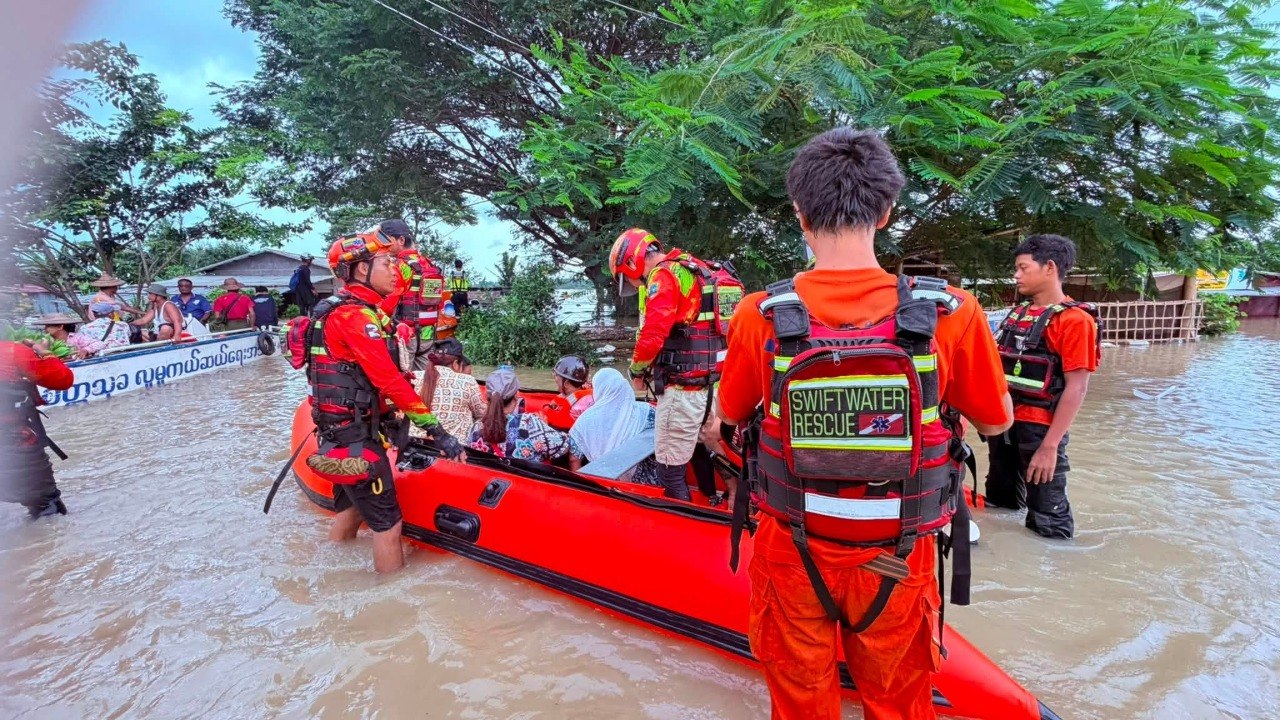
Two flood-related deaths have been confirmed in Ayeyarwady Region’s Lemyethna Township as an expanding embankment breach inundates more than 100 villages, affecting an estimated 40,000 residents across the lower river basin.
Local relief networks confirmed on Wednesday, that a volunteer aid worker drowned on Aug. 4 after being swept away by strong flood currents while returning from a food distribution mission to an isolated village.
Separately, the body of a local woman who went missing in floodwaters was recovered in Lemyethna town on the same day. Six additional rescue volunteers sustained injuries when their emergency vehicle overturned during a relief deployment.
Widening embankment breach spreads to neighboring areas
The breach has widened significantly over the past week, sending uncontrolled torrents into surrounding residential wards and low-lying agricultural zones.
Ayeyarwady Region Flood Impact Assessment
├── Affected Townships: Lemyethna, Hinthada, Kyonpyaw, & Myanaung
├── Total Inundated Area: 5 urban wards & 106 villages in Lemyethna Township
├── Structural Damage: 7,734 homes flooded; telecom/power towers disabled
└── Casualty Summary: 2 Deaths | 6 Rescue Volunteers Injured | 3 Missing
Floodwaters have overflowed beyond Lemyethna into three adjacent townships located north and northeast of the regional capital, Pathein:
- Hinthada Township: 17 miles (27 km) east of Lemyethna
- Kyonpyaw Township: 20 miles (32 km) south of Lemyethna
- Myanaung Township: 50 miles (80 km) north of Lemyethna
Humanitarian impact and discrepancies in figures
Regime administrative bodies in Ayeyarwady Region reported that floodwaters have inundated 7,734 homes across five urban wards and 106 villages, officially impacting 32,607 individuals from 7,858 households.
However, independent aid organizations and community leaders estimate that the true number of affected residents is closer to 40,000, noting that severe damage to cellular towers and electrical infrastructure has cut off communication with remote rural settlements.
“Many communities continue to rely primarily on volunteer rescue teams, charity groups, and social welfare organizations for evacuation and relief assistance,” a Lemyethna resident told DVB on the condition of anonymity.
Relief efforts and emergency response
State media reported that regional administrative personnel are attempting to stabilize the breach using Geo Bags—large geotextile containers packed with sand or soil designed to reinforce weakened riverbanks and reduce water velocity during flood emergencies.
Despite engineering interventions, local volunteer groups report that food rations, clean drinking water, medical kits, and temporary shelter materials remain urgently needed as floodwaters continue to expand into low-lying monsoon paddy fields throughout the delta region.