


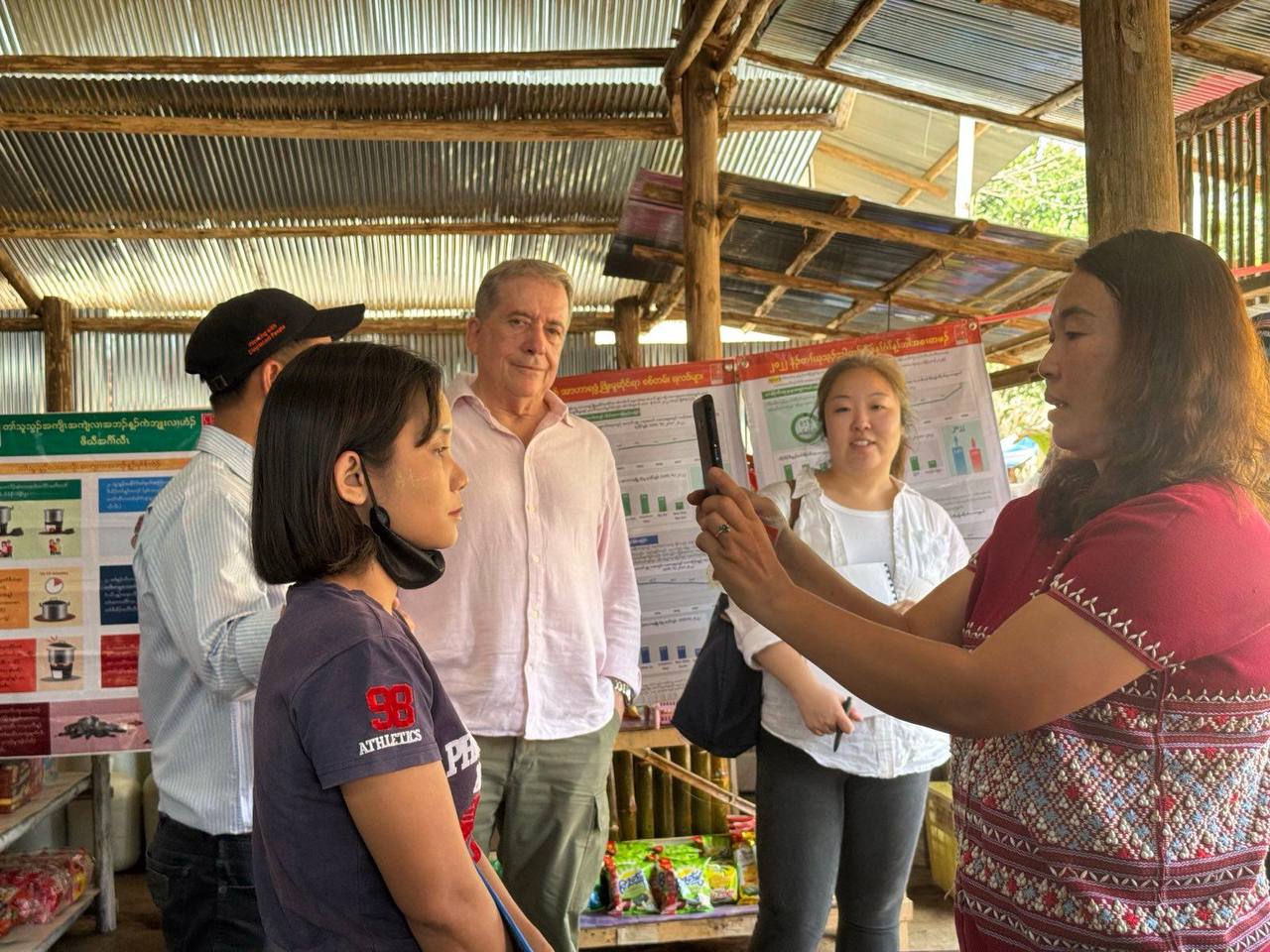
The Border Consortium (TBC) is a Thailand-based humanitarian organization providing food aid, shelter, and other forms of support to at least 107,000 refugees living in nine camps along the Myanmar border for over 30 years.
In this Q&A, TBC Executive Director Leon de Riedmatten discusses the significance of Thailand’s policy shift toward long-term Myanmar refugees by granting legal work permits to 80,000 of them on Aug. 26.
DVB: What do you think led Thailand to shift its policy toward refugees from Myanmar living in the camps after so many years?
LR: It’s really great news. After 41 years that these temporary shelters have existed, the Thai authorities have finally decided to let people work outside of them.
Maybe the motivation was related to the fact that there was no more resettlement [to a third country], especially to the United States. So, it was certainly one factor.
And the second one was the financial support for food and cooking fuel, was not going to continue as it was in the past and the Thai authorities didn’t have the means to replace the previous donor.
So thinking about this, what they could do, letting people working outside was certainly part of the solution.I don’t say the solution, but part of the solution.
It could also happen that the tension and what happened at the Cambodian border and having so many Cambodians going back home, There was a lack of manpower.
For plenty of activities also there, so maybe for some of these authorities they thought, maybe why not the Myanmar refugees could partly replace the Cambodian [migrant workers]. So this may have had a positive influence on the decision.
I think it was a very pragmatic decision that there was almost no alternative because there were no other donors.
This is the first time that for the refugees, there is a hope that a new life can start if it’s not by going to a third country, at least where they are in Thailand, a new life can start. Because going back, it’s certainly not a solution in the prevailing circumstances in Myanmar.
DVB: How do you assess the potential impact of this new policy and the recent healthcare budget for refugees?
LR: The impact will be positive. I am also pleased that the modalities will not be too difficult or won’t be too long. Refugees can really have activity outside the camp, and employers in agriculture, hospitality, and factories are interested. What matters is ensuring it’s voluntary and properly monitored, so people aren’t abandoned once they leave camps.
Still, only 77,000 people are officially registered with the [Thai] Ministry of the Interior, while the real camp population is closer to 107,000. So we must also create income-generating opportunities inside the camps for those left out.
And at the first stage, they will consider the ones who are among the 77,000. In the second stage, they could integrate the others.
DVB: What about the skills refugees have and challenges they may face?
LR: Many already have skills in agriculture, mechanics, or small businesses. I’m not afraid about the skills. Language could be a barrier, depending on where they work.
Many of them are already working inside the camps. They engage in small activities such as agriculture, mechanics, vending, and other small business activities. So I am not worried about their skills. The main challenge could be a language barrier, depending on where they go to work. But otherwise, I believe they will manage fine.
Then comes the question of families. If people go to work far from the camp, will their families follow them? And if families move, what about the children? They must be able to go to school. At the moment, for example, the Ministry of Education has a rule that refugee children in the camps can only study inside the camps. This rule needs to be reviewed and changed.
In addition, there should now be opportunities to teach the Thai language inside the camps, to help prepare people for integration. All of this is a process—step by step. What is important is to follow this process closely, and to maintain constant contact and discussion with the authorities concerned.
DVB: Will refugees who arrived after the 2021 military coup also be included?
LR: The initial phase covers 77,000 officially registered [by the U.N. Refugee Agency] residents. But the process is evolving, and we expect others will be included later, possibly in a second phase from early next year. Authorities know the real situation. I’m confident that we will not let them be forgotten.
DVB: When will the implementation of this new work program start?
LR: The authorities plan to start on October 1. At the district level, work permits will be provided relatively simply, with medical checks and insurance requirements. It’s a straightforward process handled locally.
DVB: Will having work permits affect refugees’ chances of resettlement?
LR: No. I was reassured that eligibility for resettlement remains unchanged. Refugees can work in Thailand without losing the possibility of being resettled to a third country if such opportunities reopen.
DVB: How realistic is resettlement now, given declining opportunities?
LR: That is a question I cannot really answer. We see that there are some countries—Japan, South Korea, New Zealand, Australia, Canada—that remain willing to take a small number of refugees. But the numbers are very, very limited. The main destination for resettlement has always been the U.S.
For the U.S., I have not seen any change since the time of President Trump. That means, in the next three years, there might be no progress. And who knows who will be in charge next, or what the future policy will be.
People should keep some hope that resettlement can still happen, but at the same time, they need to take this new opportunity to work, to earn their own income, and to become more independent and self-reliant. That is good for them, good for their families, and it marks the beginning of an integration process that is certainly very positive.
And importantly, this does not close the door to resettlement. Nor does it close the door to returning home, if the situation improves inside Myanmar. So, in that sense, it is really positive—three options remain open.
DVB: What kinds of challenges do you face when discussing this work policy with Thai government authorities, and what challenges do you think Thailand itself faces in implementing it?
LR: It’s too early to come to a conclusion or make a real comment.
It’s so new, but as I have already said, they have chosen a very pragmatic, practical way to make this process moving. It’s through the experience that we will see where maybe the weaknesses and what has to be readadjusted, corrected.
For the authorities, they have to be also a little bit worried about some nationalist movement or things like this who believe that why are you not giving favor to those foreign migrants or whatever they will call them.
They have to take this into account.
But talking at the provincial level like in a Tak Province and so on, I was really surprised how the authorities were committed, how they were ready to do something and, in and asking also the population to contribute.
I’m really positive about this and I think that there will be really useful and fruitful outcomes.
DVB: Can you update us on the situation faced by Internally Displaced People inside Myanmar?
LR: Yes, the IDP situation is certainly a big concern. At TBC, for instance, we are also providing broader support to IDPs on the other side of the border, especially in Karen and Mon states.
What really concerns me is the situation inside Myanmar more generally—not only in the southeast. The U.N. has said that more than 20 million people are now living under the poverty line. With the recent cuts in assistance from the U.S., life for those people has become much more difficult.
If you add to this the earthquake and its consequences, plus the regime’s focus on preparing for elections, there is a real risk. The authorities may try to retake territories they lost in recent years, especially populated areas, in order to hold elections.
When you put all these factors together, we can foresee more IDPs emerging soon. And since they may not be able to get sufficient support where they are inside Myanmar, many could also move toward the borders. We have to be prepared for a potential influx of IDPs before the end of the year.
DVB: How have you seen the Thai and Myanmar governments’ approaches change over the years?
LR: There have been different periods of time. Especially from around 2011–12 up to 2021, there was progress.
We saw bilateral ceasefire agreements, and then the Nationwide Ceasefire Agreement in 2015. During that period, many refugees really thought about going back home. Since there was less conflict, almost informally, around 20,000 people from the camps returned to Myanmar.
They believed they could restart a normal life. But later, many of them had to come back to this side again.
After the coup, everything totally changed. We cannot expect any positive gestures from the Myanmar regime, because most refugees and IDPs are considered to be part of the opposition movement. So there is no way the authorities inside Myanmar would see these people as deserving support.
On the Thai side, I would say that despite the fact Thailand has not signed the 1951 Refugee Convention—so legally speaking, refugees are regarded as temporary illegal migrants—they have been treated quite well in the camps for the past 40 years. The main problem was that they were isolated and not allowed to go outside.
Now, with this new policy, we should thank the Thai authorities. They have treated this population in a way of respect, and in many ways, their attitude toward the refugees has been really positive.
DVB: Thank you for your time.