


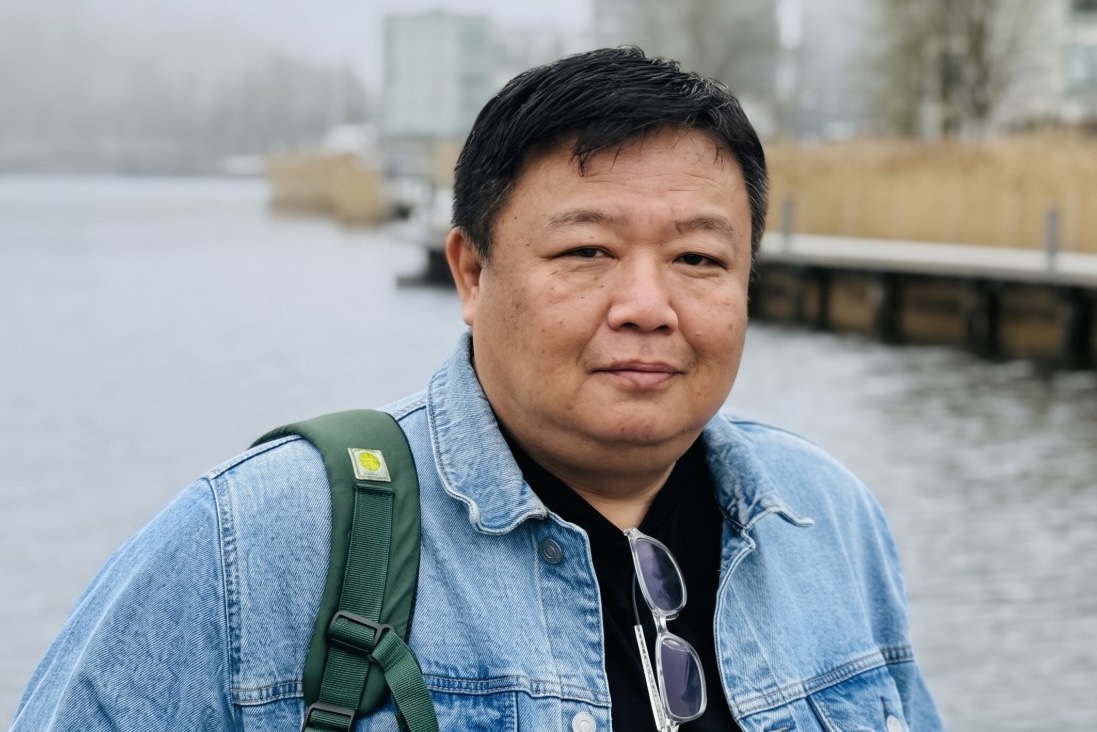
Myanmar human rights campaigner Ye Lin Myint, founding chair of Sweden-based Justice and Accountability Initiative (JAI), received the 2026 Magnitsky Human Rights Award for “outstanding legal contribution to human rights” in London for his human rights work, including spearheading legal action in Norway to hold Norwegian telecommunications firm Telenor accountable after it withdrew its operations from Myanmar and allegedly handed over millions of citizens’ user data to the regime.
Established in the U.K. in 2015 in honour of Russian tax lawyer Sergei Magnitsky—who died in a Moscow prison in 2009 after exposing state corruption—the annual prize recognizes individuals and organizations advancing human rights and fighting impunity.
DVB: First of all, how do you feel about receiving the 2026 Magnitsky Human Rights Award, and what does this award mean for your human rights work?
YLM: We are deeply honored and delighted by this recognition. Receiving this award serves as a strong source of motivation, while also carrying a great sense of responsibility. Moving forward, there is much work to be done building on this recognition, and I hope this award will help make our efforts stronger and more effective.
DVB: Next, when taking legal action against a major international telecommunications company like Telenor, what were the biggest challenges you faced?
YLM : There were many challenges and difficulties. Taking on a massive multinational corporation—one of the wealthiest companies in the world—is no easy task for us.
Coming from Myanmar to prepare a lawsuit like this, we needed immense support at every stage of the process. We had to collaborate with many organizations and individuals. Preparing the legal groundwork and working with lawyers involved extensive effort and numerous obstacles.
DVB: In December 2025, the Norwegian [Organization for Economic Cooperation and Development] National Contact Point found that Telenor had failed to conduct adequate human rights due diligence. How significant is that finding in holding Telenor accountable?
YLM : Yes, it’s called the National Contact Point in English. The OECD establishes international guidelines on human rights and responsible business conduct that companies—particularly in European member states and several Asian countries—are expected to follow.
When a company fails to comply with those human rights guidelines, complaints can be filed through the respective country’s National Contact Point.
We filed our complaint back in 2021, mobilizing over 400 organizations—474 groups in total—alleging that Telenor failed to fulfill its human rights obligations during its exit from Myanmar.
Following the complaint, we entered mediation processes from 2022, 2023, to 2024, which ultimately failed to reach an agreement. As a result, the National Contact Point investigated the matter further and issued its final report and recommendations in December 2025.
The key finding was that Telenor failed to act in accordance with OECD guidelines, and the NCP endorsed our demands for what Telenor should do to remedy this.
It is true that the OECD National Contact Point is an independent, non-judicial body whose rulings are not legally binding; it cannot impose legal penalties for non-compliance.
However, because the Norwegian government is Telenor’s majority shareholder, Telenor cannot simply ignore the findings without consequence—non-compliance carries serious reputational damage.
That was really where the story began. Even though the NCP decision is non-binding, our work isn’t finished; the NCP is scheduled to conduct a follow-up review in 2026 to assess whether Telenor has complied with its December 2025 recommendations.
Meanwhile, we established the Justice and Accountability Initiative in late 2024 to pursue legal action.
In April 2026, we formally filed a lawsuit in court, and in September, the court granted us permission to proceed as a class-action lawsuit.
However, Telenor has appealed that decision, so there is still a lot of back-and-forth ahead of us—we still have a long road to go.
DVB: Because Telenor handed over user data to the military regime, how severely were users on the ground affected? Could you share some examples?
YLM: Telenor itself has already acknowledged that it handed over user data requested by the military, which we were already aware of.
We firmly believe that based on this data, many people suffered arbitrary arrests, detention, torture, killings, and other severe abuses—which is precisely why we initiated this lawsuit.
Furthermore, in a separate criminal complaint filed by International Commission of Jurists Norway and Justice for Myanmar, a statement released by the Norwegian police clearly noted that Telenor also handed over surveillance equipment and technology—specifically a “lawful intercept gateway” used to intercept and monitor users’ communications.
This means the harm caused is vast. With that technology, authorities could monitor what phone and internet users were doing, what they were saying, who they were communicating with, and where they were located.
We believe the resulting consequences were immense. As for the details, once the lawsuit and the investigations they are currently conducting are concluded, the specifics of what happened and how things unfolded during that period will be revealed.
DVB: What was the main driving force behind founding JAI in Sweden, and what are JAI’s goals moving forward?
YLM : To be candid, we established JAI as an institutional entity to sue Telenor. For people coming from afar, filing a lawsuit in a country like Norway against an extraordinarily wealthy corporation is extremely difficult.
If we had filed individually, we would have faced massive financial hurdles, such as having to put down millions of dollars in security deposits. On the advice of our legal counsel, we established JAI as an institutional entity so we could meet those procedural requirements and bring the case forward.
As for the future, we will see how things unfold. Since we have spent our lives working to ensure international corporations abide by laws, regulations, and human rights standards, we certainly intend to continue pursuing similar accountability efforts moving forward.
DVB: What kind of justice do you hope this lawsuit will achieve for the victims?
YLM: Right now, there are three parallel tracks happening regarding Telenor. First is the OECD NCP complaint that we led, which produced recommendations in 2025 and will undergo a compliance review in 2026—that is a non-judicial, non-binding mechanism.
Second is the criminal complaint filed by Justice for Myanmar and ICJ Norway, which is a separate initiative from ours. Third is our current civil lawsuit seeking financial compensation for damages suffered. All three are moving forward simultaneously.
When we talk about “justice,” the concept is very broad. Some of the harm caused by Telenor can never truly be made right, regardless of how much money or compensation is awarded. Many things cannot be measured in financial terms—for instance, if someone lost their life or a loved one, nothing can ever replace that.
Therefore, our effort is largely about establishing symbolic accountability: proving that Telenor committed these acts, declaring that what they did was wrong, and holding them to account, alongside securing some financial compensation for victims if we win.
While true justice for individual suffering is hard to define, our goal is to fight for every measure of accountability available within the bounds of the law.
DVB: There is a distinction between the Magnitsky Human Rights Award and Magnitsky sanctions laws. How do Magnitsky laws hold human rights abusers and corrupt actors accountable?
YLM: The two are closely connected. Sergei Magnitsky was a lawyer in Russia who exposed major corruption and human rights abuses, and he was subsequently arrested and killed in custody.
Following his death, his colleagues and supporting organizations campaigned tirelessly, leading to the passage of Magnitsky laws in the EU, the US, the UK, Australia, and other countries. These laws are used to impose targeted sanctions on individuals and companies responsible for human rights violations and corruption.
The Magnitsky Human Rights Award was established in 2015 in his honor. From Myanmar, our comrade and sister Thinzar Shunlei Yi previously received this award in 2022, and now it has been awarded to me.
However, none of this work could have been accomplished by me alone—it is the result of collective effort by numerous organizations, legal scholars, telecommunications experts, and local and international groups. While the award bears my name, it is truly a recognition of everyone’s hard work.
DVB: At the upcoming award ceremony in London, what is the main message you hope to deliver to the international community in your acceptance speech?
YLM: My primary message will focus on the ongoing injustices, lawlessness, and destruction of democracy in Myanmar, and the daily suffering our people endure as a result.
Countless people are risking everything and overcoming immense hardship to fight for democracy, peace, and justice. In the current global political landscape, Myanmar has largely been forgotten and is rarely spoken about.
I intend to use this award as a platform to bring international attention back to Myanmar and speak as forcefully as I can about the people of Myanmar’s struggle.
DVB: What message of encouragement would you like to share with the people of Myanmar and activists suffering under military rule regarding the pursuit of legal justice?
YLM: I want to encourage all of our brothers and sisters who are fighting for justice, freedom, and democracy through every possible avenue. We are doing what we can within our capacity and expertise, and because everyone is contributing according to their own circumstances and opportunities, I believe we will eventually succeed. Nothing we are striving for comes easily, so if we all keep pushing together, we will reach our goal one day.
To be honest, I am never fully satisfied with my own efforts, because compared to those risking their lives on the ground, what we do is nothing—it cannot even be compared. We are simply doing the best we can with what we know. I want to tell those risking everything on the front lines that we deeply respect, recognize, and take pride in them, and that we are doing everything in our power to support the struggle.
DVB: Is there anything else you would like to add that my questions may not have covered?
YLM: Just one small point: the award being given to me is purely an honorary recognition—it does not come with any prize money or financial grant whatsoever.
I just wanted to clarify that it is strictly an award of recognition, with no monetary component attached.
DVB: Thank you so much for taking the time out of your busy schedule to speak with us.