


Guest contributor
Linn Thant
Myanmar’s military regime is confronting multiple crises at once. On the battlefield, resistance forces continue to challenge its authority and control over territory.
Economically, the country faces mounting financial pressures, disrupted livelihoods and shortages of essential services.
Politically, the military’s claim to legitimacy remains deeply contested, while its international isolation has limited its room for manoeuvre.
Yet the regime is not simply waiting for its position to deteriorate. It is also searching for external partners, financial resources and technical assistance that could help it sustain its rule.
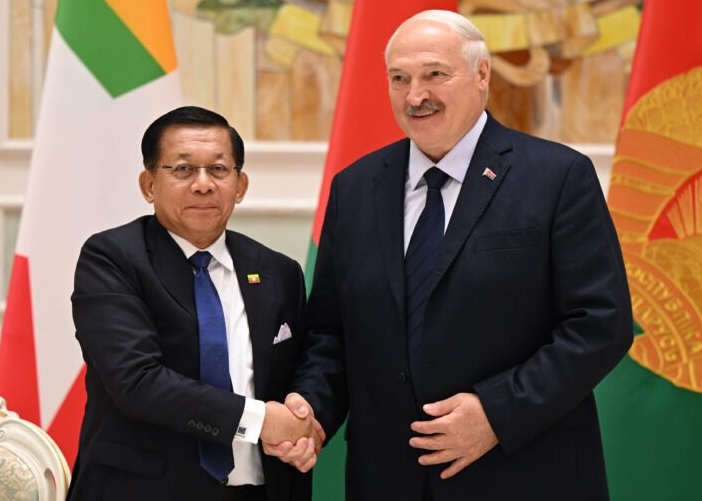
Belarus has emerged as an important partner in this effort, with cooperation extending across defence-related affairs, state institutions, finance, energy and technical training.
This relationship raises a fundamental question: is international cooperation helping Myanmar recover from its profound crisis, or is it strengthening the institutions through which the military maintains its power?
A partnership built around mutual survival
The growing relationship between Belarus and Myanmar should be understood in the context of two governments facing international criticism and seeking greater room to operate beyond Western influence.
A BELPOL report published on October 29, titled An Alliance of Dictators: How Lukashenko’s Supporters and Myanmar Are Building a System of Mutual Survival, describes a broad framework for cooperation between Belarusian actors and Myanmar’s military authorities.
The report examines a 2026–2028 cooperation roadmap signed in Naypyidaw on November 28, 2025 and outlines proposed collaboration involving military-related optics, police training, defence-linked education, state-bank lending, commodity exchanges and media or propaganda activities.
These reported arrangements suggest that the relationship extends beyond conventional diplomatic engagement. It potentially connects financial support, technical cooperation and institutional capacity-building in ways that could strengthen the regime’s ability to withstand pressure.
It is important, however, to distinguish between agreements, proposed cooperation and activities that have actually been implemented. The existence of a roadmap does not by itself establish that every proposed project has been completed or that every financing arrangement has been disbursed.
Nevertheless, the breadth of the reported agenda deserves scrutiny, particularly when cooperation involves security institutions and state-controlled economic structures.
For Myanmar’s military rulers, such partnerships could provide alternatives when access to other sources of finance, technology and diplomatic support becomes more difficult.
For Belarus, closer engagement offers an opportunity to expand its influence and cultivate a partner with overlapping interests.
The result is a relationship whose political significance cannot be measured solely by the number of agreements signed.
Financial pressure and the cost of keeping the regime afloat
Myanmar’s financial crisis is an essential part of this story.
The military authorities must finance a costly war while confronting economic disruption, pressure on public revenues and growing demands for basic services.
The loss of territorial control in parts of the country, the damage inflicted by conflict and the erosion of public confidence complicate the regime’s efforts to govern and generate revenue.
In such circumstances, external credit can become politically significant.
Loans may help finance state projects and meet immediate expenditure needs, but they also create future repayment obligations.
Their real value depends on the interest rate, repayment period, currency risks, conditions attached and whether the funded projects generate benefits sufficient to justify their costs.
Myanmar parliamentary and government reporting has discussed foreign-currency export-credit arrangements involving Belarusian financial institutions, including the Belarus Development Bank and Belinvestbank.
Reported interest rates range from 2.25 to 9.33 per cent, with loan terms of up to five years.
Those figures should not be interpreted as proof that every Belarus-linked loan carries the highest rate, or that all proposed financing has been disbursed.
They do, however, highlight the importance of examining the terms of individual agreements rather than treating the announcement of a loan as an unqualified economic success.
For a country experiencing severe economic difficulties, borrowing at commercially or politically unfavourable terms can shift costs into the future.
Foreign-currency obligations may be especially burdensome when export earnings, foreign-exchange availability and public finances are under pressure.
The central issue is therefore not simply whether the regime can obtain money. It is what the money will finance, who will benefit from it and who will ultimately bear the cost.
If credit primarily sustains the institutions responsible for repression and warfare, it may strengthen the regime in the short term without addressing the economic foundations of Myanmar’s crisis.
The public could then face the consequences through reduced spending on essential services, higher future debt-service costs or further economic instability.
Under the investment laws of the National Unity Government of Myanmar, as amended and approved by the Committee Representing Pyidaungsu Hluttaw (CRPH)—composed of representatives duly elected by the people in the 2020 multi-party general election—international governments should take seriously the fact that high-interest loans taken out by the military junta are not guaranteed to be recognized or honoured by a future legitimate government of Myanmar.
Belarus and Myanmar’s electricity crisis
The energy sector provides a particularly revealing example of this relationship.
On October 27, Myanmar’s so-called Minister of Electricity and Energy, Ko Ko Lwin, signed a bilateral cooperation roadmap with Belarus concerning the electricity and energy sectors.
According to Myanmar’s state media, the proposed cooperation includes upgrading electricity transmission infrastructure, reducing transmission and distribution losses, developing smart generation and grid systems, and sending Myanmar personnel to Belarus for technical training.
During the 30th Energy and Ecology Forum in Minsk, Myanmar’s so-called minister also invited foreign investors to participate in the country’s energy sector.
On the surface, these initiatives address genuine and urgent needs. Myanmar’s electricity system has suffered from inadequate supply, infrastructure problems and persistent interruptions.
Households and businesses have endured rolling blackouts and electricity rationing, while manufacturers and small enterprises struggle to maintain normal operations.
Reporting by Myanmar Now in October described electricity rationing amid severe shortages, with rotating supply arrangements expected to continue.
Myanmar’s own official reporting has also acknowledged that electricity generation has been insufficient to meet demand.
Improving transmission infrastructure and reducing losses could contribute to a more reliable electricity supply. Technical training may also help strengthen local expertise.
Myanmar needs investment in power generation, transmission, distribution and maintenance, and international cooperation can play a legitimate role in meeting these needs.
But signing a roadmap is not the same as restoring electricity to households.
The publicly reported details of the Belarus–Myanmar energy roadmap do not, by themselves, establish the total financing committed, the specific infrastructure projects selected, the procurement arrangements, the implementation timetable or the measurable reduction in transmission losses expected.
Without those details, it is impossible to determine whether the agreement will deliver substantial improvements or remain largely an announcement of intent.
The distinction matters because Myanmar’s electricity crisis is not merely a technical problem. It is also an economic and governance challenge.
A country can sign agreements and invite investors while its citizens continue to experience shortages, businesses lose productive hours and public confidence deteriorates.
The question is whether the proposed cooperation will deliver measurable improvements in electricity access and reliability—or whether it will primarily provide another diplomatic and economic lifeline to the authorities controlling the state.
Energy security in a country dependent on imported fuel
Myanmar’s energy difficulties cannot be separated from its wider economic vulnerability.
The World Bank has reported that Myanmar imports more than 90 per cent of its fuel.
This dependence exposes the economy to international price movements, supply disruptions and foreign-exchange pressures.
When fuel becomes more expensive or difficult to obtain, the consequences spread through transport, electricity generation, manufacturing and household expenditure.
For a government already under financial pressure, these challenges create a difficult cycle: inadequate and unreliable energy constrains economic activity; weaker economic activity undermines livelihoods and revenue; and limited resources make it harder to improve the infrastructure needed for recovery.
International investment could help break that cycle—but only if projects are financially sustainable, transparently awarded and designed to serve the public interest.
A credible energy partnership should therefore disclose its financing structure, procurement process, implementation schedule and expected public benefits.
It should also clarify who will own and operate the upgraded infrastructure, how costs will be recovered, and whether electricity improvements will reach communities that have endured prolonged shortages.
These are not unreasonable political conditions. They are basic requirements for responsible public investment.
Technical cooperation must not become a substitute for accountability
Supporters of the Belarus–Myanmar relationship may argue that energy projects, training and credit should be assessed on their practical merits rather than their political context.
There is a legitimate principle here: ordinary people should not be denied essential infrastructure improvements merely because their country is experiencing political conflict.
But that argument cannot justify ignoring the institutions receiving the assistance or the purposes to which resources may be put.
When cooperation extends across energy, finance, security-related training and state institutions, its cumulative effect deserves examination.
Assistance that strengthens a government’s administrative or technical capacity may have benefits for the public, but it may also increase the capacity of an authoritarian state to maintain control.
The relevant question is not whether every Belarusian project is inherently harmful.
It is whether the arrangements include safeguards to ensure that public benefits are real, transparent and distinguishable from support that enables repression or prolongs conflict.
For energy projects, such safeguards should include transparent contracts, independent financial scrutiny, clear procurement procedures, measurable delivery targets and public reporting.
For lending, they should include disclosure of interest rates, repayment obligations, guarantees and the intended use of funds.
For security-related cooperation, the risks of strengthening institutions implicated in abuses must be considered directly.
Without such safeguards, the language of technical assistance can obscure the political consequences of cooperation.
Diplomatic engagement is not democratic legitimacy
The Belarus–Myanmar relationship also illustrates a wider distinction in international affairs: diplomatic recognition, economic transactions and official meetings do not automatically confer democratic legitimacy.
Governments may maintain relations with military authorities for a variety of reasons, including trade, regional stability and access to resources. Such engagement does not, by itself, settle the question of who has a legitimate mandate to govern Myanmar.
Nor does the signing of an agreement demonstrate that the agreement will resolve the problems confronting the country.
The military regime’s ability to remain in office depends not only on the availability of weapons, money, fuel and technical expertise, but also on its ability to sustain the institutions of government amid continuing resistance and public opposition.
External partnerships may help it manage immediate pressures, yet they cannot independently resolve the underlying political conflict or restore public trust.
A durable settlement requires a political future in which Myanmar’s people can determine their own government and the structure of their state.
It requires credible accountability, inclusive political participation and a framework that addresses the country’s longstanding demand for a federal democratic system.
No energy roadmap, loan agreement or technical-training programme can substitute for that political transformation.
The real test is what happens to the people of Myanmar
Myanmar’s crisis is not simply a contest between a struggling military regime and its foreign partners.
It is a question of whether the country’s resources, institutions and international relationships will serve the public—or primarily sustain those who exercise coercive power.
Belarusian cooperation could, in principle, contribute to useful technical improvements.
If grid upgrades reduce transmission losses, if investment increases reliable electricity supply, and if training strengthens local capacity, Myanmar’s people should benefit.
These outcomes should be welcomed and measured honestly.
But the same cooperation must be assessed against the wider context of financial pressure, armed conflict and authoritarian rule.
Credit can postpone a financial reckoning without resolving it. Diplomatic agreements can create the appearance of momentum without delivering results.
Technical assistance can strengthen public services, but it can also strengthen state institutions whose conduct demands scrutiny.
The appropriate response is neither to assume that every agreement will fail nor to accept official announcements as proof of success.
It is to demand evidence: transparent financing, accountable implementation, measurable improvements in public services and safeguards against the diversion of resources toward repression and continued warfare.
The international community should examine not only what Belarus and Myanmar have agreed to do, but also what has actually been delivered, who benefits and what obligations are being created for the future.
The measure of international cooperation should not be the number of agreements signed, the number of officials exchanged or the scale of credit extended.
It should be whether the people of Myanmar become safer, more prosperous and better able to determine their own political future.
Linn Thant is the Prague-based Representative of the National Unity Government (NUG) of Myanmar and a former democracy activist. He writes on Myanmar affairs, geopolitics, democracy and international relations.
DVB publishes a diversity of opinions that does not reflect DVB editorial policy. We’d like to hear what you think about this or any of our stories: [email protected]