


Guest contributor
Khin Ohmar
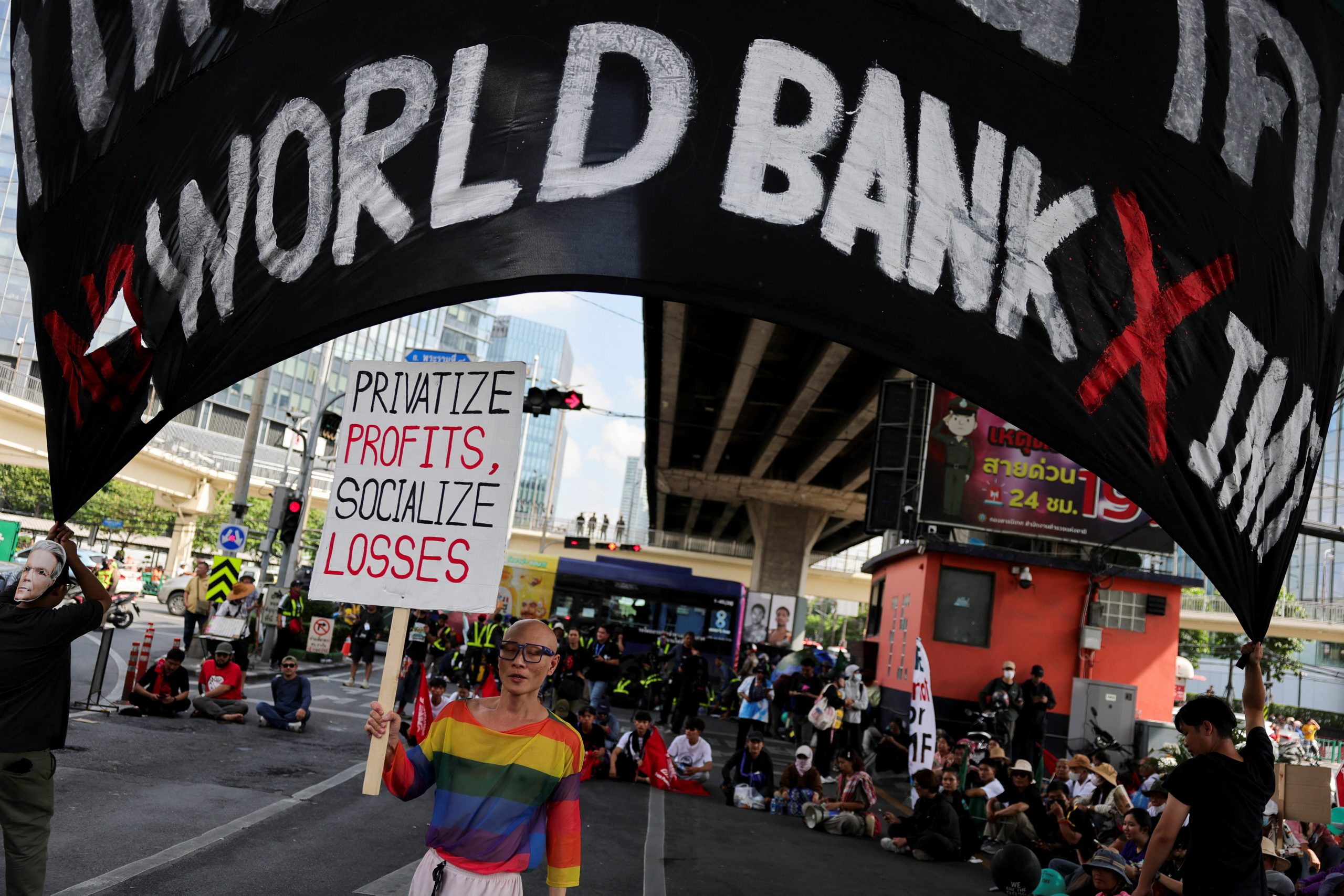
During the IMF-World Bank Annual Meetings in Bangkok in October, I took part in a Myanmar civil society delegation that engaged senior officials from the World Bank, raising our concerns and setting out our calls.
This included an intervention delivered to World Bank President Ajay Banga and Managing Director of Operations Anna Bjerde at the civil society town hall, bilateral meetings with the offices of numerous Executive Directors, and a press statement that we published.
Specifically, we asked the bank to open formal dialogue with Myanmar civil society and democratic governance institutions outside junta control; we called for an end to funding through junta-controlled systems; and we demanded that the bank resist any attempt by the junta to gain legitimacy.
We raised the same concerns with the Asian Development Bank (ADB) in a separate online meeting following Bangkok.
We did not ask for a favor. We asked the banks to do their own work properly.
A history of failed accountability
Myanmar’s communities remember what happened the last time the banks worked at scale in our country, in the years before 2021, when they partnered with the authorities in Naypyidaw.
If the banks want to understand why Myanmar civil society insists on being at the table, they should start with this record.
The World Bank’s first project on its return to Myanmar in 2012 was the National Community Driven Development Project (CDD): an $80 million USD grant, later joined by a $400 million USD credit, channeled through the Department of Rural Development to thousands of villages. The very name of the project promised community control.
Years of monitoring by IFI Watch Myanmar, which I helped founded, documented what communities actually experienced: opaque contracts, discrepancies between budgets and payments, corruption and mishandled funds, villagers threatened with arrest if grants were not used as directed, and project timelines that excluded the people the project claimed to be helping.
The monitors warned that, left unaddressed, the project would reinforce the corruption and elite capture it was supposed to change.
There was also the Asian Highway through Karen State. The ADB’s Greater Mekong Subregion program championed the road as part of the East-West Economic Corridor, but it cut through a war zone.
Thailand financed the Myawaddy–Kawkareik road, opened in 2015, while the ADB lent $100 million USD for the Eindu–Kawkareik section.
Karen organizations documented the result in a report whose title says everything: “Beautiful Words, Ugly Actions.” Villagers were not notified or consulted, and at least 17 households were forcibly dispossessed of their land.
Those who demanded fair compensation were threatened with seizure and forced to accept far less. No conflict impact assessment was conducted, despite five armed actors competing for control of the road.
When fighting broke out in July 2015, more than 1,000 villagers fled, and two were reportedly shot dead by the army. Homes in Tha Nay Moo village were later burned as fighting followed the road.
On the ADB-funded section, some 500 people were affected by resettlement plans that Karen organizations said were inadequate and violated the bank’s own safeguards on involuntary resettlement.
Then there was Dawei, on the Tanintharyi coast, where Thailand built its deep-sea port and special economic zone, the flagship of the same development model the ADB championed across the Mekong region.
The Dawei Development Association identified 32,279 people in 19 villages in the project’s path, along with 21 schools and 23 pagodas.
Construction and land clearing began in 2010 without prior information or consent. Farmland was cleared without fair compensation, and many families refused to move into resettlement housing.
In November 2015, Thailand’s National Human Rights Commission found that the project had violated the human rights of the people of Dawei.
And when communities tried to use the banks’ own accountability systems, they learned how weak that protection was. In Hmawbi, outside Yangon, the International Finance Corporation lent $10 million USD in 2016 to the Myanma Awba Group’s agrochemical complex.
In 2017, villagers complained to the IFC’s Compliance Advisor Ombudsman about toxic wastewater, dangerous groundwater contamination, air pollution, blocked access to a village road, and a complete lack of consultation.
In September 2023, the CAO found the IFC materially noncompliant with its own sustainability framework.
The IFC had failed to assess the plants’ impacts, identify affected communities, or adequately supervise the project. The management action plan approved in 2024 contained no project-level remedy for the community.
In June 2017, the IFC approved $35 million USD in loans and equity for Shwe Taung Cement in Mandalay Region despite an open letter from 174 Myanmar civil society organizations urging it to refuse.
Villagers described farmland bulldozed without notice, compensation paid only after the fact, and consultation meetings reduced to a formality.
Different projects, different banks, but always the same pattern. No meaningful free, prior, and informed consent. Consultations held after decisions were already made, or skipped entirely.
Safeguards that existed on paper and failed on the ground. Communities treated as obstacles to be managed, not as people with rights to be heard.
We raised these failures directly with the banks in October. The meetings are done, but the questions we raised are unaddressed.
A better approach, but not a complete solution
That history is why the post-coup break mattered, and why we defend it.
Since the February 2021 illegal coup attempt by the Myanmar military, the World Bank has channeled about $207 million USD through third parties, including the Myanmar Community Support Project, the Myanmar Community Livelihood Assistance Project, the Myanmar Strengthening Community Resilience Project, and the Myanmar Health Assistance and Nutrition Support Project.
The ADB, after its April 1, 2025 emergency grant of $3 million USD, approved a $100 million USD grant package on June 17, 2025, its largest grant for the people of Myanmar, plus $1.5 million USD reallocated for earthquake response.
Across the two banks, six humanitarian and resilience projects have been approved since the coup attempt, all implemented by third parties such as U.N. agencies and the International Committee of the Red Cross (ICRC).
Third-party delivery was the right break from the old model, because it claims to stop money flowing through junta-controlled systems.
But it is also a fact that third parties such as the ICRC have to rely solely on junta-controlled mechanisms such as the Myanmar Red Cross Society, a body historically serving the military as its security apparatus.
Routing money through a third party is a mechanism, not a safeguard. That is the gap the banks left open in our engagement with them, and it is the gap this article is about.
Returning to the old model would legitimize the criminal junta
Now hear this warning plainly, because it is the heart of what we reached out to the banks to say: Myanmar today is not the Myanmar of 2015.
The illegal, criminal military junta is waging a nonstop campaign of terror against the people of Myanmar.
As of September 2026, more than 4 million people are internally displaced, and the true figure is likely higher given the junta’s information blackouts and travel restrictions.
In a country in active conflict, a return to the old model—designing projects with the only interlocutors the junta permits, consulting inside boundaries the junta draws, treating normalization as development—would not be a neutral act.
It would repeat the pre-2020 pattern under far worse conditions. It would hand the junta resources and, above all, legitimacy, which is precisely what it is bombing villages, clinics, schools, and churches to obtain.
The banks should not pretend to be confused about this. On October 30, 2026, the Financial Action Task Force, the global watchdog on money laundering, kept Myanmar on its list of high-risk jurisdictions subject to a call for action.
It maintained enhanced due diligence on transactions connected to Myanmar, and it warned that if no further progress is made by February 2027, it will consider countermeasures.
Myanmar has sat on that list since October 2022 for one reason: under the junta, its financial system cannot be trusted to police dirty money.
If the world’s financial watchdog requires the highest level of scrutiny for money connected to the junta, the World Bank and the ADB cannot apply a lower standard.
There is no version of sound banking in which the FATF’s warning and a drift back to normalization with the junta are both right.
What the banks must do now
So what we brought before the bank stand. They are the direct answer to the banks’ own record in Myanmar.
First, the banks must engage local and regional democratic governance actors and institutions outside junta control, and independent civil society groups who operate outside junta control.
These are the people who already run clinics, schools, and relief in the areas the banks say they want to reach.
Second, the banks must open dialogue with Myanmar civil society.
Progressive Voice and partner Myanmar CSOs wrote to the World Bank in April 2026 and have asked repeatedly for a meeting and a formal dialogue under the World Bank’s Fragility, Conflict and Violence Strategy. That letter is still unanswered.
We do not say the gaps in the bank’s approach are insurmountable. We say the bank must begin open, transparent, constructive, and safe consultations without further delay.
A strategy that claims to put people at the center cannot be written without the participation of the people it claims to serve.
Third, there must be no bank funds through junta-controlled systems. There must be independent Myanmar CSOs as delivery partners and third-party monitoring.
Partner is a specific word. It does not mean a U.N. agency subcontracts a local group to distribute goods at the last mile and then reports the result upward with rigidity that serves the purpose of the junta’s intelligence gathering.
It means Myanmar CSOs get involved in designing the program, sit at the table when delivery is planned, and are funded fairly and efficiently.
Monitoring must be independent, not a self-assessment by the same chain that delivered the aid.
If aid can be diverted, taxed, or claimed by the junta, the banks need to know before the next tranche, not after.
Fourth, the banks must hold the line against junta legitimacy bids.
Every meeting, every program document, and every public statement is read in Naypyidaw as a signal.
Engagement with the people of Myanmar is not the same as engagement with the junta, who are the perpetrators of Myanmar’s multifaceted crisis, and the banks must keep that distinction visible in everything they do.
None of this is an argument against helping people in Myanmar. It is an argument for helping them effectively and properly.
The people who need life-saving emergency food, health care, shelter, and learning support are not waiting for a perfect system.
They are waiting for aid that reaches them without strengthening the forces that bombed them, torched their villages, and displaced them.
Khin Ohmar is a Myanmar human rights activist who was involved in organizing the ‘8888’ nationwide pro-democracy uprising. She is also the founder and chairperson of Progressive Voice, a Myanmar human rights organization. She developed the Women Peacebuilding Program for Women’s League of Burma and served as program coordinator from 2000 to 2006.
DVB publishes a diversity of opinions that does not reflect DVB editorial policy. We’d like to hear what you think about this or any of our stories: [email protected]