


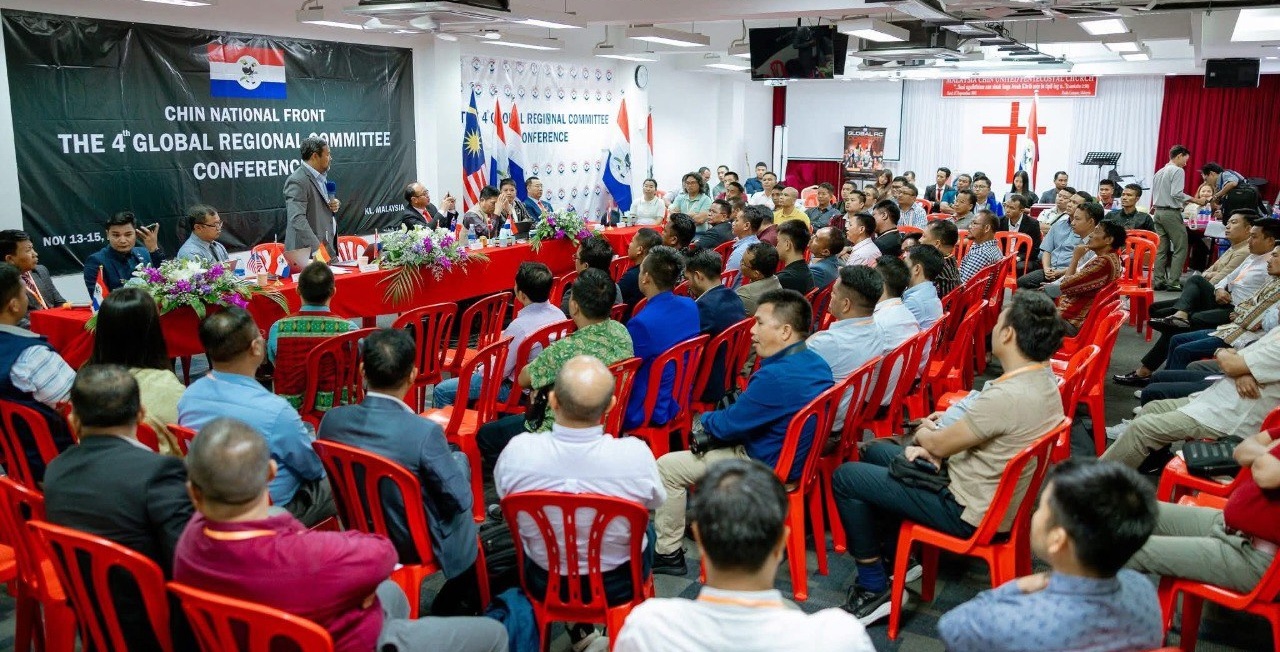
The Chin National Front (CNF) called for stronger support from Chin communities worldwide this week after holding its 4th Global Regional Committees Conference which brought together 67 representatives from 13 countries to Kuala Lumpur, Malaysia, Nov. 13-15.
“We discussed how we will mobilize and seek funding for the revolution to succeed, and the issue of Chin refugees in Malaysia,” Salai Van, a CNF member who organized the conference in Kuala Lumpur, told DVB on Wednesday. He added that humanitarian aid deliveries for Chin refugees in Malaysia, India and other countries was also discussed.
Malaysia hosts the vast majority of an estimated 32,800 Chin refugees among 189,760 Myanmar nationals registered with the U.N. High Commissioner for Refugees (UNHCR). This includes 124,123 Rohingya and 32,827 from other ethnic nationalities from Myanmar.
The CNF stated that its conference delegates reviewed and assessed the crisis in Myanmar’s Chinland, and laid out future action plans for the Chin resistance, on Nov. 18.
During the conference, CNF leaders requested Chin people living abroad to increase financial support through its diaspora activities to fund “nation-building and revolutionary activities” in Chinland.
The CNF also expressed appreciation to Malaysia for assisting Chin refugees and for efforts to seek a political solution to Myanmar’s crisis as the chair of the Association of Southeast Asian Nations (ASEAN) in 2025.
It urged ASEAN members—and future chairs—to provide more effective support for establishing “a federal democratic” Chinland, along with other states and regions in Myanmar.
The Philippines will take over from Malaysia as ASEAN chair on Jan. 1, 202, since the alphabetical order will bypass Myanmar.
President Ferdinand Marcos Jr. has stated that he will not engage directly with the regime and will continue excluding it from high level summits since Min Aung Hlaing has refused to implement the ASEAN Five Point Consensus peace plan he agreed to in April 2021.
Comprising nine townships, Chinland is one of Myanmar’s least developed regions even before the 2021 military coup, according to the U.N. Development Programme (UNDP).
The armed uprising to the coup has since worsened the humanitarian situation in Chinland as 101,300 residents—around 20 percent of Chinland’s total population—have been displaced from their homes, according to the U.N.
The Institute of Chin Affairs (ICA), a diaspora group monitoring human rights violations since the coup, reported that at least 135 civilians and 115 resistance force members have been killed.
Another 835 civilians have been injured in 252 airstrikes carried out by the Myanmar Air Force in Chinland since 2021.
More than 1,100 homes, 81 religious buildings, and over 90 government and administrative buildings were also destroyed or damaged by the attacks, the ICA added in a report published on Nov. 14.
Residents of Falam Township and resistance groups told DVB that at least 20,000 people, including more than 3,000 children, have fled their homes due to a regime offensive ahead of its 2025-26 elections set to begin on Dec. 28 and continue into January 2026. Falam, located 68 miles (109 km) north of the Hakha, was seized by the Chin Brotherhood in April.
The regime’s Union Election Commission (UEC) stated that it will hold polls on Dec. 28 in Tedim and the state capital Hakha. Tedim, located 117 miles (188 km) north of Hakha, is contested between regime and resistance forces.
CNF spokesperson Salai Htet Ni told DVB that the military only controls the urban areas of Hakha and Thantlang, located 22 miles (35 km) west of Hakha.
Resistance forces, including the Arakan Army (AA) in neighbouring Arakan State, have seized control of six out of the state’s nine townships. This includes Tonzang, Paletwa, Mindat, Matupi, Kanpetlet, and Falam.
Kanpetlet, Mindat, and Matupi were seized between June and December 2024 by the Chin Brotherhood, an armed group representing the Interim Chin National Consultative Council (ICNCC).
The ICNCC was established in April 2021—in response to the coup–as a political coordination body for resistance groups in Chinland. It is supported by the National Unity Government (NUG), the democratic interim administration led by elected lawmakers ousted in the coup.
Paletwa Township was seized in January 2024 by the AA, an ethnic armed group allied with the Chin Brotherhood. Paletwa is located 199 miles (321 km) south of Hakha. Tonzang Township is under the control of the CNF and its allied resistance forces. Tonzang is located 144 miles (231 km) north of Hakha.
The CNF and its armed wing, the Chin National Army (CNA), were founded in 1988 to seek autonomy for the Chin ethnic nationality. The group signed the 2015 Nationwide Ceasefire Agreement (NCA) but withdrew and returned to armed resistance following the 2021 coup.
The CNF was a founding member of the ICNCC but disagreements over leadership and decisionmaking led to a split in the Chin resistance. This resulted in the CNF establishing the Chinland Council, excluding the ICNCC, in December 2023.
Earlier this year, the Chinland Council and the ICNCC agreed to merge during talks in India’s Mizoram State and begin unifying their armed factions — the Chin National Army and the Chin Brotherhood — into a single Chin resistance force.