


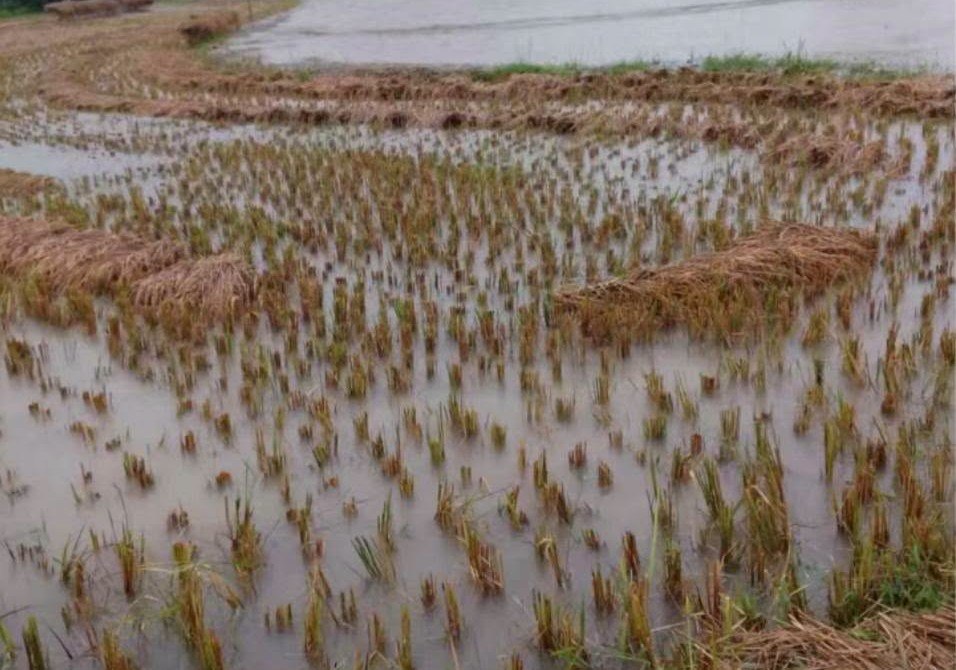
Floodwaters receded across southern Shan State’s Mongnai, Laihka, and Nyaungshwe townships on Sunday, leaving widespread agricultural destruction and temporary civilian displacement in their wake, though no fatalities were reported.
Located between 18-97 miles (28-156 km) south and east of the Shan State capital Taunggyi, the three townships bore the brunt of unseasonal torrential rains that battered the region over the past week.
In Mongnai Township, Sai Pan Pha, secretary of the Mongnai Township Farmers Association, told DVB that flooding between Nov. 10-12 completely destroyed 1,869 out of 2,714 acres of paddy fields belonging to 544 local farmers.
He added that the association has formally appealed for emergency relief from the military regime’s Ministry of Social Welfare, Relief and Resettlement as well as the Shan State administration, but has yet to receive any response.
In neighboring Laihka Township, the pro-regime Shan State Progress Party (SSPP) reported that 204 acres of paddy fields across five villages under its administration were submerged between Nov. 8-12.
Meanwhile, in Nyaungshwe Township, local residents told DVB that rising waters around Inle Lake from Nov. 8-14 temporarily displaced more than 700 people and wiped out an undetermined acreage of floating and lakeside tomato plantations.
The deluge followed historic precipitation across the Shan plateau.
According to the regime’s Department of Meteorology and Hydrology (DMH), Taunggyi Township recorded its highest single-day rainfall in 52 years on Nov. 11, receiving 4.05 inches (103 mm) of rain within 24 hours.
Between Nov. 8-12, heavy rains triggered flooding and landslides across seven southern Shan municipalities—Taunggyi, Aungban, Kalaw, Hopong, Nyaungshwe, Laihka, and Kholam, situated 13-106 miles (20-170 km) east and west of the state capital—without any reported loss of life.
Local residents noted that communities across southern Shan have now endured at least four separate episodes of severe flooding and landslides so far in 2026, compounding economic hardship for rural farming households.