


Guest contributor
Shalini Perumal
The global transition toward green technologies and electric mobility has triggered an unprecedented rush for critical minerals.
This situation has fundamentally reshaped the geopolitics of the Indo-Pacific, turning remote frontier regions into arenas for competition.
For a rapidly growing economy like India, breaking a near-total dependency on Chinese rare earth supply chains is an understandable economic and security objective.
Yet, New Delhi’s expanding diplomatic and commercial outreach to secure rare earth deposits in Myanmar reveals an unsettling continuity with historic patterns of resource extraction.
In the pursuit of industrial self-reliance and technological autonomy, external powers are actively engaging with a fractured, war-torn autocratic state, bypassing the sovereignty of Myanmar’s ethnic communities, fueling internal conflicts, and externalising severe ecological destruction onto vulnerable indigenous lands.
This pursuit has gained visible momentum. At a recent mining forum in Mandalay, India’s Ambassador to Myanmar, Abhay Thakur, outlined expanding bilateral cooperation in the critical minerals sector, pointing to successive delegations involving state-owned enterprises like IREL (India) Limited and private firms such as Midwest Advanced Materials.
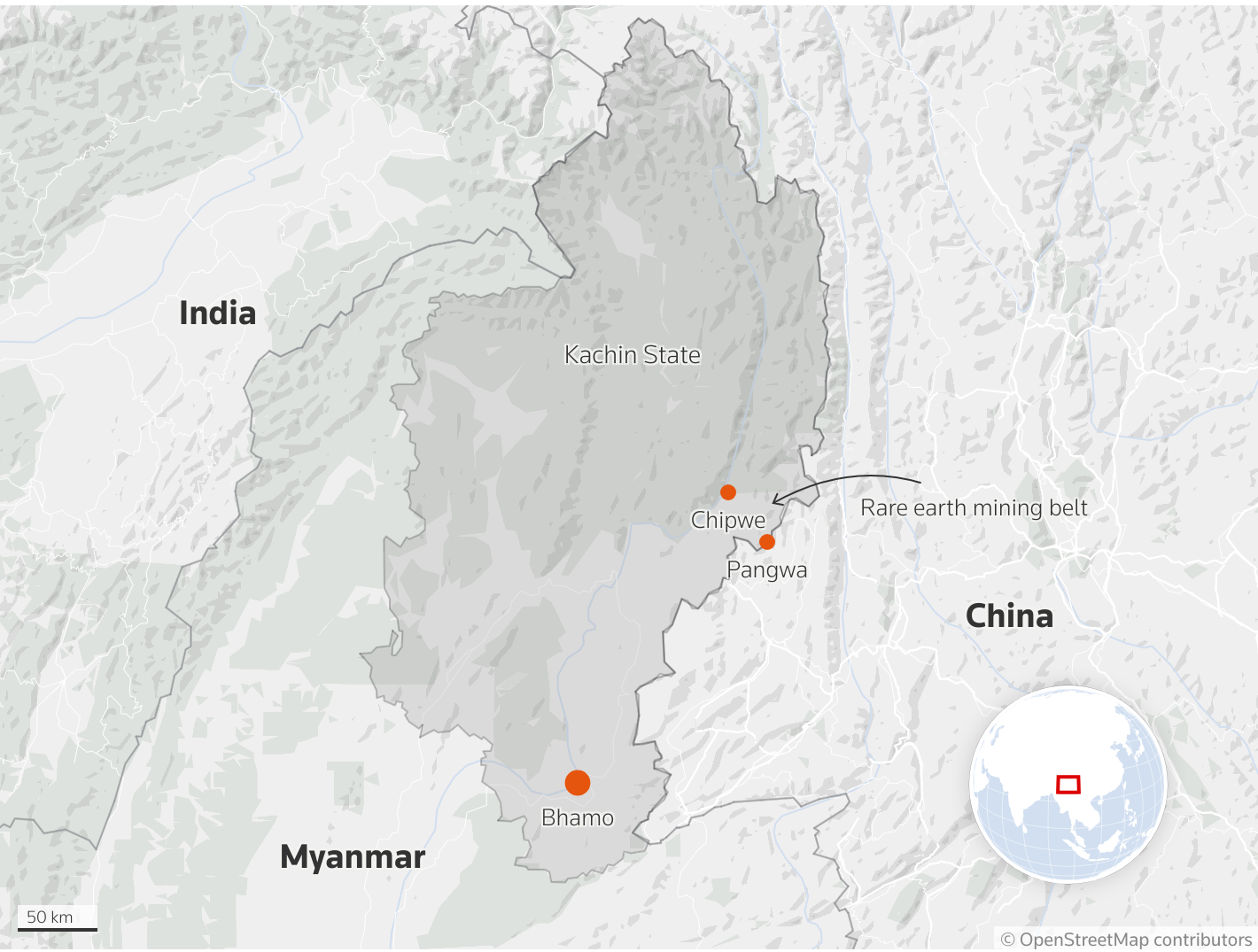
These diplomatic maneuvers run parallel to earlier disclosures that New Delhi has explored procuring rare earth samples through the Kachin Independence Army (KIA), an ethnic armed organisation controlling vital mining hubs near the Chinese border.
Framed through the sanitised technical language of supply chain diversification and economic partnership, this strategy is frequently presented as a pragmatic counterweight to Beijing’s dominance.
Yet, examined through a necessary human rights and environmental lens, India’s change in strategy exposes a systemic form of resource-driven neo-colonialism that treats marginalised indigenous territories as mere geopolitical extraction zones.
Myanmar has been engulfed in a catastrophic civil war since the military junta’s illegal 2021 coup.
The regime in Naypyidaw has systematically targeted civilian populations, committing widespread atrocities, launching indiscriminate airstrikes, and displacing millions of people.
Despite this, external powers seeking strategic advantage have routinely demonstrated a willingness to normalise relations with the military junta or deal opportunistically with non-state armed factions that control specific resource-rich tracts.
India’s dual-track approach—engaging the internationally isolated junta leadership, including high-level interactions with Senior General Min Aung Hlaing, while simultaneously exploring arrangements with ethnic armed groups like the KIA—illustrates a classic realpolitik calculus.
In this framework, human rights considerations and democratic norms are deliberately subordinated to strategic competition with Beijing.
By negotiating access to raw materials across contested boundaries, external actors provide financial and political oxygen to factions engaged in a brutal civil conflict.
For the ethnic minority populations inhabiting these border regions, this external interest brings little benefit. Instead, it entrenches a war economy where valuable natural assets become prizes to be captured, traded, or heavily taxed by competing armed actors.
Decisions regarding ancestral lands, community forests, and local futures are made in distant foreign capitals and corporate boardrooms, reducing indigenous populations to silent bystanders in a contest over resources they neither consented to extract nor control.
This dynamic strips ethnic communities of their agency, weaponising their geography against them.
The reality on the ground in northern Myanmar’s Kachin State—which accounts for nearly half of the world’s supply of heavy rare earths like dysprosium and terbium—is defined by immense environmental degradation.
Unlike traditional hard-rock mining, rare earth extraction in this remote region relies heavily on a rudimentary and destructive technique known as “in-situ leaching.”
Operators drill deep into mountainsides and inject massive quantities of ammonium sulfate, sulfuric acid, and other chemical solutions to strip the valuable elements from the surrounding soil, collecting the resulting toxic runoff in open, unlined air pools.
This unregulated industrial expansion has transformed parts of Kachin State into an ecological sacrifice zone.
Chemical runoffs and heavy metals systematically leach into local groundwater networks and river systems, including vital tributaries of the Irrawaddy River, poisoning the primary water sources for downstream communities and destroying aquatic life.
Additionally, thousands of acid-leach collection pools scar the landscape, accompanied by extensive clear-cutting of old-growth forests and widespread soil erosion that dramatically heightens the frequency of fatal landslides during the monsoon season.
Furthermore, local residents, indigenous villagers, and low-paid labourers face acute and chronic health hazards, including severe skin ailments, respiratory illnesses, liver damage, and kidney failure linked to prolonged exposure to hazardous processing chemicals.
The expansion of this industry mirrors the dark mechanics of ecological dumping. Just as strict environmental regulations within China prompted Beijing to shift heavy extraction to weakly regulated areas across its border, external consumer nations risk perpetuating a system where the environmental burdens of the clean-energy transition are offloaded onto politically disenfranchised populations.
Purchasing minerals extracted under such conditions creates an ethical paradox: the green technologies of the industrialised world are built directly upon the silent destruction of ecosystems and human lives elsewhere.
The structural dynamics governing Myanmar’s rare earth trade bear all the hallmarks of modern resource imperialism.
Indigenous ethnic communities, who have long fought for self-determination, autonomy, and cultural survival against Bamar domination and marginalisation, find their ancestral lands subjected to external commercial appetites.
Whether resources are funneled through networks aligned with the central military junta or through arrangements with ethnic armed organisations seeking immediate revenue for military survival, the structural outcome for inhabitants remains largely the same: violent displacement, loss of traditional livelihoods, and irreversible ecological ruin.
Both the Myanmar military junta and various ethnic armed factions treat land and natural wealth as disposable commodities to secure short-term financial liquidity and external diplomatic backing. Concurrently, major external powers like China and India treat the region as a peripheral warehouse of raw inputs, devoid of community-based agency, labour rights, or environmental protections.
India’s ambition to transform its domestic industrial base— through advanced semiconductor and defense manufacturing by securing external mineral supplies—risks replicating the exact extractive inequalities that characterize traditional colonial economics.
Sourcing raw materials from a conflict zone without robust, transparent, and enforceable human rights safeguards means that economic security is being pursued at the direct expense of human dignity.
Beyond the severe ethical and environmental concerns, this strategy rests on fragile practical foundations.
Sourcing raw rare earth concentrates from remote, conflict-ridden terrain in Kachin State involves monumental logistical hurdles.
Transport infrastructure is precarious, subject to sudden shifts in territorial control, militia blockades, and ongoing military skirmishes.
Furthermore, even if raw materials successfully cross borders into India, the country faces a significant technological and industrial gap: it currently lacks the large-scale separation, refining, and magnet-manufacturing capacity required to independently process heavy rare earths into market-ready components without relying heavily on established Chinese supply chains.
Chasing raw ore in a war-torn foreign state without a mature domestic processing ecosystem merely shifts supply chain vulnerabilities while externalising environmental devastation.
It represents an inefficient and high-risk shortcut that fails to address the structural dependencies plaguing modern industrial policy.
Ultimately, a foreign policy framework that treats human rights, indigenous sovereignty, and ecological protection as secondary externalities is fundamentally unsustainable.
If major so-called democracies like India wish to secure long-term industrial resilience, they cannot do so by mimicking the predatory extractive models they seek to counter.
True strategic security cannot be built upon the exploitation of indigenous lands, the poisoning of shared waterways, and the financial sustenance of war economies.
A genuinely forward-looking approach requires decoupling technological advancement from human exploitation.
Without a radical commitment to transparency, environmental accountability, and the self-determination of ethnic and indigenous communities, the scramble for Myanmar’s rare earths will remain a dark chapter in the history of the global energy transition.
Shalini Perumal is a creative international development professional who has worked previously in Mae Sot, Thailand at Mae Tao Clinic, consulted for Finnish Refugee Council Myanmar, and served as a Writer/Researcher at Insight Myanmar Podcast. She is currently a freelance journalist working on a novel.
DVB publishes a diversity of opinions that does not reflect DVB editorial policy. We’d like to hear what you think about this or any of our stories: [email protected]