


Guest contributor
Shalini Perumal
The chilling reports emerging from the Andaman Sea in May painted a stark picture of escalating hostility towards Rohingya refugees from the government of India.
Forty Rohingya, including women, children, and the elderly, were allegedly thrown into international waters by Indian officials near Myanmar’s maritime border, and were forced to swim for their lives with only life jackets provided.
This inhumane act, reportedly occurring on May 8, brazenly contradicted the Solicitor General’s assurance to the Indian Supreme Court just the day before that any deportations would strictly adhere to legal procedures.
Numerous eye-witness accounts and evidence have verified this incident. It was first reported by Maktoob Media. an independent Indian media outlet founded in 2014, with a core focus on human rights.
This incident is not an isolated aberration but a horrifying symptom of a systemic, deeply ingrained anti-Rohingya sentiment that has been deliberately cultivated and weaponized in India for years, creating a climate ripe for such egregious human rights violations.
Calculated cruelty: The Andaman Sea incident
The details of the alleged deportation are harrowing. These 40 Rohingya refugees, all registered with the U.N. High Commissioner for Refugees (UNHCR) India, had been detained by Delhi Police officials under the deceptive pretext of collecting their biometric data.
What followed was an ordeal of unimaginable terror. Maktoob Media reported that David Nazir, a Rohingya Christian representative, recounted how his parents were flown from Delhi to Port Blair, in the Andaman and Nicobar Islands.
They were then “forcibly put on naval ships with their hands tied and their eyes blindfolded.” They remained in this vulnerable condition throughout the journey.
A petition prepared for the Supreme Court detailed the horrific abandonment: “Children as young as 15, female minors as young as 16, senior citizens up to 66 years old, and people suffering from cancer and other ailments were among those abandoned into the sea without regard for their lives or safety.”
The detainees reportedly pleaded not to be sent to Myanmar, fearing for their lives, and asked instead to be taken to nearby Indonesia.
However, officials allegedly deceived them, binding their hands and feet and abandoning them in international waters under the false assurance that they would be escorted to Indonesian waters. Only upon washing ashore did they realize they had reached Myanmar.
Even more disturbingly, the writ petition claims that one female detainee, who managed to contact relatives in India, reported being subjected to sexual assault and groping by officials before being thrown into the water.
In other cases, “children have been forcibly separated from their mothers. A 16-year-old girl who was separated from her family before abandoning her into the international waters near the Myanmar coast.”
This systematic abuse and deception indicates a deep disregard for human dignity and international law.
A resistance group calling itself the Ba Htoo Army told DVB that it had detained 40 Rohingya after a boat they were traveling in landed on a beach in Launglon Township on May 9.
“They were detained under conditions that adhere to human rights. We are currently in contact with individuals and organizations who can provide assistance to them,” Khant Myat, the Ba Htoo Army’s information officer, told DVB.
The legal and moral quagmire of India’s stance
India’s actions stand in stark contradiction to fundamental principles of international law, even if it is not a signatory to the 1951 Refugee Convention or its 1967 Protocol.
Fazal Abdali is an advocate for the Supreme Court specializing in rights-based litigation and part of the petition team against the deportation of the Rohingya.
“In the absence of a dedicated refugee protection framework, Indian authorities have increasingly invoked provisions of the Foreigners Act, 1946, to justify the arbitrary detention and deportation of stateless refugees. This has created a situation wherein international refugee law standards remain unincorporated, leaving such populations in a legal vacuum,” he said.
India is, however, a signatory to the Convention against Torture and Other Cruel, Inhuman or Degrading Treatment or Punishment. Article 3 of this treaty unequivocally states that “no person shall be expelled to a place where there is a threat to their life.”
In the preliminary hearing to an ongoing case at the International Court of Justice, the ICJ declared Rohingyas to be a protected group, and they remain extremely vulnerable in Myanmar, a nation still plagued by ongoing conflict and a military junta responsible for their persecution.
Thomas Andrews, the U.N. Special Rapporteur on the situation of human rights in Myanmar, initiated an inquiry into the deportations, condemning them as “unconscionable, unacceptable acts.”
He called on India to refrain from such “inhumane and life-threatening treatment.”
The principle of non-refoulement, a cornerstone of international law, prohibits states from returning individuals to a territory where they face threats to their lives or freedom, which India is obligated to.
The U.N. Committee on the Elimination of Racial Discrimination (CERD) has explicitly called on India to cease arbitrary detention and forcible deportation of Rohingyas to Myanmar, where they face serious human rights violations.
“I am deeply concerned by what appears to be a blatant disregard for the lives and safety of those who require international protection. Such cruel actions would be an affront to human decency and represent a serious violation of the principle of non-refoulement, a fundamental tenet of international law that prohibits states from returning individuals to a territory where they face threats to their lives or freedom,” Andrews said.
Despite widespread media coverage and the Andrews’ condemnation, the Supreme Court of India declined to issue any interim orders to halt the deportations, citing a lack of “material evidence” and an oral observation that there existed “a serious dispute” on whether the Rohingya were refugees or not. It cited them as “illegal immigrants”.
The Supreme Court will be making an official statement of the investigation on July 31. This judicial stance, coupled with the government’s actions, signals a worrying retreat from humanitarian principles.
The perilous destination: Myanmar’s conflict zones
The area where the 40 Rohingya were abandoned, Tanintharyi Region, the southern tip of Myanmar, is far from safe. This region has witnessed heavy shelling, aerial bombing, and frequent gunfights involving junta forces and various resistance groups, including the People’s Defence Force (PDF).
Angshuman Choudhury is a doctoral scholar at the National University of Singapore, specializing in conflict in Myanmar and statelessness issues across its western and eastern borders and northeast India, drawing on nine years of dedicated research in the region.
“The current situation in the Tanintharyi Region is very concerning. Clashes between the junta and various resistance groups, including People’s Defence Forces, are becoming more frequent. So are deadly airstrikes by the junta on resistance-dominated areas. This makes Tanintharyi dangerous for the Rohingya,” he said.
Furthermore, as Choudhury notes, this region is unfamiliar territory for most Rohingya who originate from northern Rakhine State.
Because the Rohingya belong to northern Rakhine State, Tanintharyi is largely unfamiliar territory for them. They don’t have community-based support networks there, which makes them even more vulnerable to hostilities. If the junta apprehends them, they might be jailed, assaulted or forcibly conscripted into the military,” Choudhury told Maktoob Media.
The fear of forced conscription into the military, potentially as human shields, is a grave concern.
Yasmin Ullah serves as the Executive Director of the Rohingya Maìyafuìnor Collaborative Network (RMCN), a women-led, Rohingya-led, and refugee-led organization dedicated to addressing Rohingya human rights issues.
She laments the disillusionment with international bodies and the ongoing impunity.
“As long as you keep the military junta in power, Rohingya will flee genocide. If the resistance don’t win, the military will keep using Rohingya as human shields and terrorise the entire country, and push more to further leave the country, making perilous journeys to other parts of the region to find some kind of safety,” she said.
The military generals who orchestrated the 2017 genocide against the Rohingya, leading to the deaths of at least 10,000 people and the forced displacement of over 700,000, are now the very authorities in control of Myanmar.
In February 2021, these same generals staged a coup, detaining elected civilian leaders. An international arrest warrant for Senior General Min Aung Hlaing, the commander-in-chief of Myanmar’s military and current junta leader, has been issued by a federal court in Argentina for his role in the 2017 genocide.
Human Rights Watch estimates that about 600,000 Rohingya remain in Myanmar, effectively detained under a system of apartheid. At the same time, it is estimated that over 100,000 Rohingyas fled last year from Rakhine State into Bangladesh, fleeing conflict. Returning them to such conditions is an act of extreme cruelty.
The undercurrent of hate: Fuelling the deportations
The inhumane treatment and deportations of Rohingya refugees in India are not isolated policy decisions but are deeply rooted in a pervasive and systematically manufactured anti-Rohingya sentiment that has permeated public discourse and governmental actions over the years.
This sentiment has transformed Rohingya from persecuted victims into convenient scapegoats, stripped of their humanity and rights.
“If you look at Instagram, the majority of the comments that are anti-Rohingya are by Indian or Bangladeshi nationalists. The issue is the retaliation against the community is filled with hate speech, which is manufactured. They were very strategically created online sentiments, it is not organic,” said Ullah.
This strategic creation of anti-Rohingya narratives is evident in the demonization campaign. The Rohingya are routinely profiled as “infiltrators,” “invaders,” or “terrorists.”
Angshuman Choudhury notes, the Indian government’s actions, such as “Operation Sindoor,” contribute to a broader message that “we are protecting our frontiers,” often at the expense of Bengali Muslims and Rohingya, who are receiving the short end of the stick just for fleeing genocide and looking for safety.
Mainstream media in India has often amplified these discriminatory narratives. During the COVID-19 pandemic, some media outlets shockingly branded the Rohingya as “corona bombs,” scapegoating them for the spread of the virus.
This blatant Islamophobia further fueled public animosity. This kind of reporting dehumanizes the community and makes them targets for violence and discrimination, rather than objects of empathy and protection.
The targeting of Rohingya has been politically convenient for various actors. As early as 2017, when the Rohingya genocide occured in Myanmar, the Indian Ministry of Home Affairs (MHA) issued a directive to state governments to identify “illegal immigrants” for deportation.
This directive paved the way for widespread detentions, and is questionably opportune considering that India provides funding for weapons and arms manufacture to the military junta to carry out airstrikes and genocide,
The arbitrary detention of Rohingya has become a disturbing norm. Approximately 700 Rohingya refugees currently face indefinite detention in India.
In 2018, the Supreme Court of India rejected a plea to halt deportations, and a 2021 apex court judgment further facilitated more deportations, seemingly validating the government’s stance despite international outcry.
“The use of executive power to deport stateless refugees without due process stands at odds with constitutional protections and established norms of international human rights law, warranting close legal scrutiny,” said Fazal Abdali.
He also notes a shift in India’s international image over the past few years, suggesting a decreased caution regarding human rights criticism.
The political rhetoric has also taken a sinister turn against Rohingya women.
“This idea that ‘Rohingya bogeyman needs to be quelled’ is widespread. Women are the target to all of this – the kind of sentiments used always target women’s reproductive rights and women’s reproductive health access. They ask why do Rohingya always breed, with the high birth rate among the community, but don’t consider the high mortality rate. Rohingya’s have inadequate access to education and reproductive healthcare. It is well known that as women become more educated, they have less kids. That idea, though, was never part of the conversation. Policing Rohingya women’s bodies takes center stage,” said Ullah
This demonstrates how anti-Rohingya sentiment intersects with misogyny and anti-Muslim prejudice, creating a compounded layer of vulnerability for Rohingya women.
The targeting of Rohingya refugees gained particular prominence in regions like Jammu. In 2017, a petition by a member of President Narendra Modi’s political party, alleging demographic change, instigated widespread anti-Rohingya statements.
Before January 2017, a larger chunk of Rohingyas were residing in Jammu, but that changed after this petition. The Rohingyas residing in Jammu lost employment, there were burning of their settlements, and they fled from there to other cities like Delhi.
The Chamber of Commerce even issued a statement to deport Rohingyas after Jammu traders threatened to identify, catch and kill Rohingyas, abetting such hate.
The pattern of violence and threats continued: in 2019, Rohingyas were associated with the anti-Citizenship Amendment Act movements, leading to further burning of settlements.
In 2021, even the Aam Aadmi Party (AAP) issued statements blaming Rohingyas for Delhi’s problems. This consistent demonization from various political factions highlights a deeply systemic issue.
As Yasmin Ullah says, “how can a disadvantaged community of around 40,000 in a country of a billion cause so many problems for you, and ruin the country? We do not have that kind of power.”
The individual story of Mohammad Arafat, a Rohingya human rights defender, tragically encapsulates the systemic persecution faced by the community in India.
After more than four years of arbitrary detention in Assam, India. According to a report by Maktoob Media, Arafat was forcibly deported to Bangladesh on May 6, along with two other Bangladeshi migrants.
His release came after the U.N. Human Rights Council Working Group on Arbitrary Detention urged India to end his detention, recommending his immediate and unconditional release and coordination with UNHCR for protection or resettlement in a third country.
Arafat’s life has been a relentless cycle of violence and displacement. Born in 1993, he lost his father, a community leader, allegedly to Myanmar forces. Despite systemic discrimination, he was among the few Rohingyas who could pursue education. However, violence in Rakhine State forced him to flee to Bangladesh in 2012, and later to India’s Jammu region.
In India, Arfat worked as a translator and community mobilizer with the Development and Justice Initiative, an NGO partnered with UNHCR. However, after leaving the organization in 2018, he struggled to find work amidst escalating anti-Rohingya sentiment in Jammu.
Driven by a desire to help his family, Arfat returned to Bangladesh in 2017 to assist relatives fleeing Myanmar’s brutal military crackdown. While working in Bangladeshi refugee camps, he became vocal about the human trafficking crisis, which attracted threats from militant groups. These threats compelled him to seek safety in India once more in December 2020, where some of his family still lived.
Upon re-entering India, Arfat was arrested by Assam police while attempting to advocate for other detained Rohingya. Despite presenting his UNHCR refugee card and explaining his fear for his life in Bangladesh, he was detained, interrogated, and reportedly physically assaulted.
His subsequent detention in various prisons for over 500 days, often in inhumane conditions, exemplifies the arbitrary and cruel nature of India’s detention policy. He faced harassment from inmates due to his Rohingya identity.
The psychological toll on Arfat has been immense. During his detention, his wife was pressured to remarry, and his family lost their shelter. His children, aged seven and nine, are not enrolled in school—a profound burden for Arfat, who deeply valued education.
Arfat’s story is a stark illustration of refoulement, where individuals are returned to places where their lives or freedom are threatened, despite India’s international obligations.
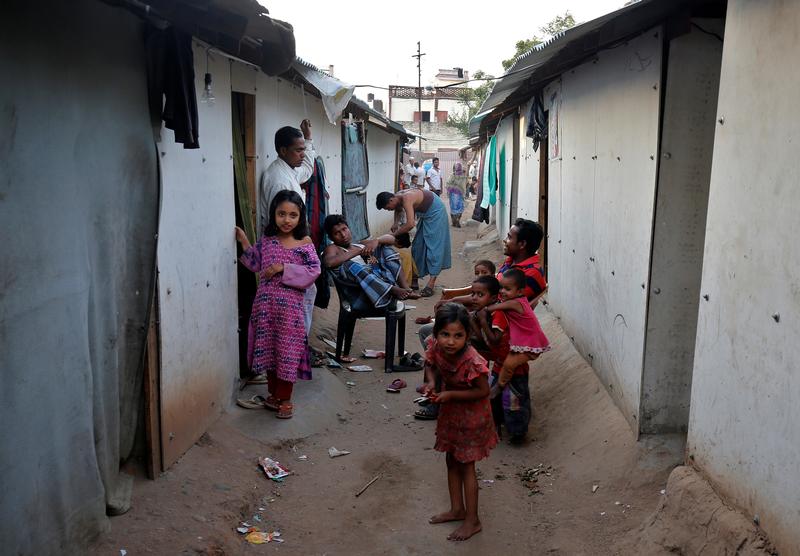
The numbers tell a story of immense vulnerability and persecution. An estimated 40,000 Rohingya sought asylum in India, with approximately 18,000 registered with UNHCR India. These individuals often live in precarious settlements on the outskirts of north Indian cities, engaging in menial labor and lacking access to any state welfare schemes.
The recent wave of detentions has been aggressive. Since early May, India has reportedly expelled nearly 600 undocumented individuals deemed illegal migrants.
While most were deported at land borders with Bangladesh, the incident of 40 UNHCR-registered Rohingya being allegedly pushed into the Andaman Sea near the Myanmar border stands out for its extreme inhumanity.
This brings the total of recently detained Rohingyas in India to nearly 700. In addition to the 40 allegedly abandoned at sea, Maktoob Media confirmed that at least eight more Rohingyas were rounded up and detained by Delhi Police, and another report indicates 10 Rohingyas are being detained in Uttar Pradesh.
The incident in the Andaman Sea, while shocking, is perceived by Rohingya activists and human rights advocates as part of a larger, worrying trend of regional impunity.
“Every case we’ve encountered ends up in some sort of tragedy. Oftentimes we are the ones swooping in and finding the funds to ensure people who survived this ordeal are provided with their needs. It’s such a loss that all these countries that are aiming towards deportation of Rohingya, are actually doing the complete opposite of the international covenants that India is a party to. There is a public sentiment supporting it,” said Ullah.
She observes a troubling comparison between India and Indonesia, both with “nationalist militaristic backgrounds,” where similar anti-refugee rhetoric flourishes: “Rohingya refugees having too many kids, lazy, dirty, uncivilized… coming to steal jobs.” This anti-Muslim sentiment, coupled with xenophobia, creates a potent cocktail of manufactured hate.
“The root cause is not talked about enough. It becomes this door to regional impunity. At one point Rohingya were cherished, and now look at what happened to them? Indian citizens are not immune to government crackdowns, it could be them next,” added Ullah.
This “cyclical butterfly effect” of disinformation, judicial decisions, and state actions creates an environment where atrocities can occur with seemingly little accountability.
“I don’t think there is any accountability with the government. If the Supreme Court does anything, I will be surprised. Regarding international law, my hopes are even lower. There will be a report, but then what? How will the government be held accountable, taken to ICJ, or ICC? Some countries have to take India to the ICJ. India is also not an ICC member,” added Choudhury.
The lack of accountability for human rights violations against the Rohingya in Myanmar, coupled with the unwillingness of regional states to uphold their international obligations, fosters a dangerous environment where basic human dignity is continually eroded.
The tragedy in the Andaman Sea is a stark reminder of this failure, a direct consequence of decades of persecution, manufactured hate, and a global reluctance to decisively protect a stateless people facing genocide.
Shalini Perumal is a creative international development professional who has worked previously in Mae Sot, Thailand at Mae Tao Clinic, and consulted for Finnish Refugee Council Myanmar. She is currently a freelance journalist as well as Writer/Researcher at Insight Myanmar Podcast.
DVB publishes a diversity of opinions that does not reflect DVB editorial policy. We’d like to hear what you think about this or any of our stories: [email protected]