


Guest contributor
Thit Lwin
In 2020, a university student in Myanmar could still imagine a fairly ordinary future: complete a degree, graduate, find a job, become financially independent, and gradually support a family.
The students were studying different subjects and dreaming about different careers, but the basic direction was similar. Education was expected to lead to employment, and employment was expected to lead to a more stable adult life.
COVID-19 had already interrupted university education. But at that time, the interruption still looked temporary. Students could imagine returning to university when the pandemic improved and continuing along the same path.
Then came the military coup on February 1, 2021.
Five years later, many young people who were university students were nowhere near the futures they had expected in 2021.
Among eight young people whose lives were traced from their university years in 2020 to their situations in 2026, some had become international students in Thailand, some were migrant workers abroad, some remained inside Myanmar with redirected careers, and others had moved into alternative education, community or political pathways.
The important point is not simply that their education was delayed. Their entire path from university to adulthood was reshaped.
A degree was supposed to lead somewhere
Before the coup, university education was more than a period of study. It was expected to be a bridge between youth and adulthood.
The expected sequence was simple: study, graduate, find professional work, become financially independent, and take on greater family responsibility.
That path did not disappear because young people suddenly changed their ambitions. It was disrupted by political events beyond their control.
The coup was also different from COVID-19. The pandemic interrupted university attendance. The coup changed the political and institutional conditions surrounding education itself.
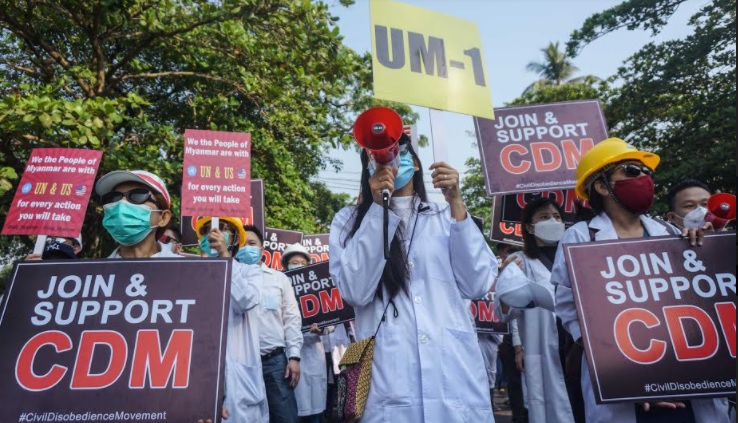
For young people connected with the Civil Disobedience Movement, continuing in military-controlled institutions could also become a political decision.
Education was no longer separated from questions of resistance, legitimacy and personal security.
As a result, some degrees remained unfinished. Some students entered alternative education. Some changed fields. Others eventually moved abroad and restarted university.
By 2026, a young person who had expected to already be working in a profession could instead still be completing a new bachelor’s degree.
Another could be working abroad without the qualification originally expected to open the door to a professional career.
Another could remain inside Myanmar but work in a field completely different from what was planned in 2020.
These are not simply educational delays. They are interrupted life paths.
Six years later, are they living their dreams?
This is the question that matters most to me.
If these students had been asked in 2020 where they expected to be by 2026, how many would have imagined restarting university in another country?
How many would have expected to become migrant workers before completing their degrees?
How many would have imagined that decisions about education, employment and migration would be shaped by military rule and conscription?
The answer is probably very few. That does not mean their lives have failed. It means the future they originally chose became much harder to reach.
This distinction matters. Young people can build new futures while still losing the futures they had already invested years in preparing for.
Becoming responsible without becoming secure
Perhaps the most important change is that adult responsibility did not wait for education and careers to recover.
While graduation and professional employment were delayed, other parts of adulthood moved much faster.
Young people had to earn money, support themselves, contribute to family expenses, migrate, manage life independently in another country, or take on political and social responsibilities.
In other words, responsibility moved forward while stability remained behind.
Before the coup, adulthood might have followed graduation and employment.
After the coup, some young people had to become responsible adults without first receiving the qualifications, income, or career opportunities that usually make adult independence possible.
This is why it is not enough to say that Myanmar youth simply “grew up faster.” Growing up faster sounds almost positive. It can suggest maturity and progress.
But being forced to carry adult responsibilities while education, employment and financial security remain uncertain is something different.
The post-coup crisis disconnected these stages of life. Education and professional development could stall while economic, family, migration and political responsibilities increased.
Conscription added another break
The activation of military conscription in 2024 created another turning point.
But it did not create this generation’s insecurity from the beginning. By then, young people had already experienced three years of disrupted education, unstable work, and political uncertainty.
Conscription arrived on top of those existing problems.
For some, it became an important reason to migrate. For others, migration plans already existed but had to be carried out sooner.
For young people already abroad, returning to Myanmar became more uncertain.
For those remaining inside the country, planning education, work and family life became even more difficult.
The effect was therefore not the same for everyone. Conscription redirected some lives, accelerated others and deepened uncertainty for many.
One generation, different destinations
The young people who shared a similar position as university students in 2020 had reached very different situations by 2026. This difference matters.
Political crises do not affect everyone equally. A young person with access to scholarships, financial support, or international networks may be able to restart education abroad.
Another may have to enter low-paid work. Someone else may remain inside Myanmar because of family responsibilities or limited mobility.
Family resources, education opportunities, networks, political commitments, location, and the possibility of migration all influence what kind of future remains possible.
So, this is not one simple story of an entire generation moving in the same direction.
It is a story of young people who began from a similar point and were scattered into very different life paths by the same political crisis.
Lost, or interrupted?
It is understandable to call them a “lost generation.”
Years of education have been lost. Careers have been postponed. Financial independence has been delayed.
Some young people are still searching for the stability they expected to have reached years ago.
But “lost” can also sound too final. Young people are still studying, working, migrating, supporting families, learning new skills and rebuilding plans. Some have found opportunities that they never imagined in 2020.
That does not erase the losses. Resilience should never become an excuse for ignoring the political conditions that forced young people to rebuild their lives in the first place.
This is why “Generation Interrupted” may be a better description. The generation is not finished.
Its future has not disappeared. But the connection between education, career, independence, and adulthood was broken.
And that may be the clearest way to understand Myanmar’s 2020 university generation in 2026: not a generation without dreams, but a generation still trying to rebuild futures they once expected to have already reached.
Thit Lwin is a student specializing in Politics and Social Sciences at Chiang Mai University, Thailand.
DVB publishes a diversity of opinions that does not reflect DVB editorial policy. We’d like to hear what you think about this or any of our stories: [email protected]