


Guest contributor
Alan Clements
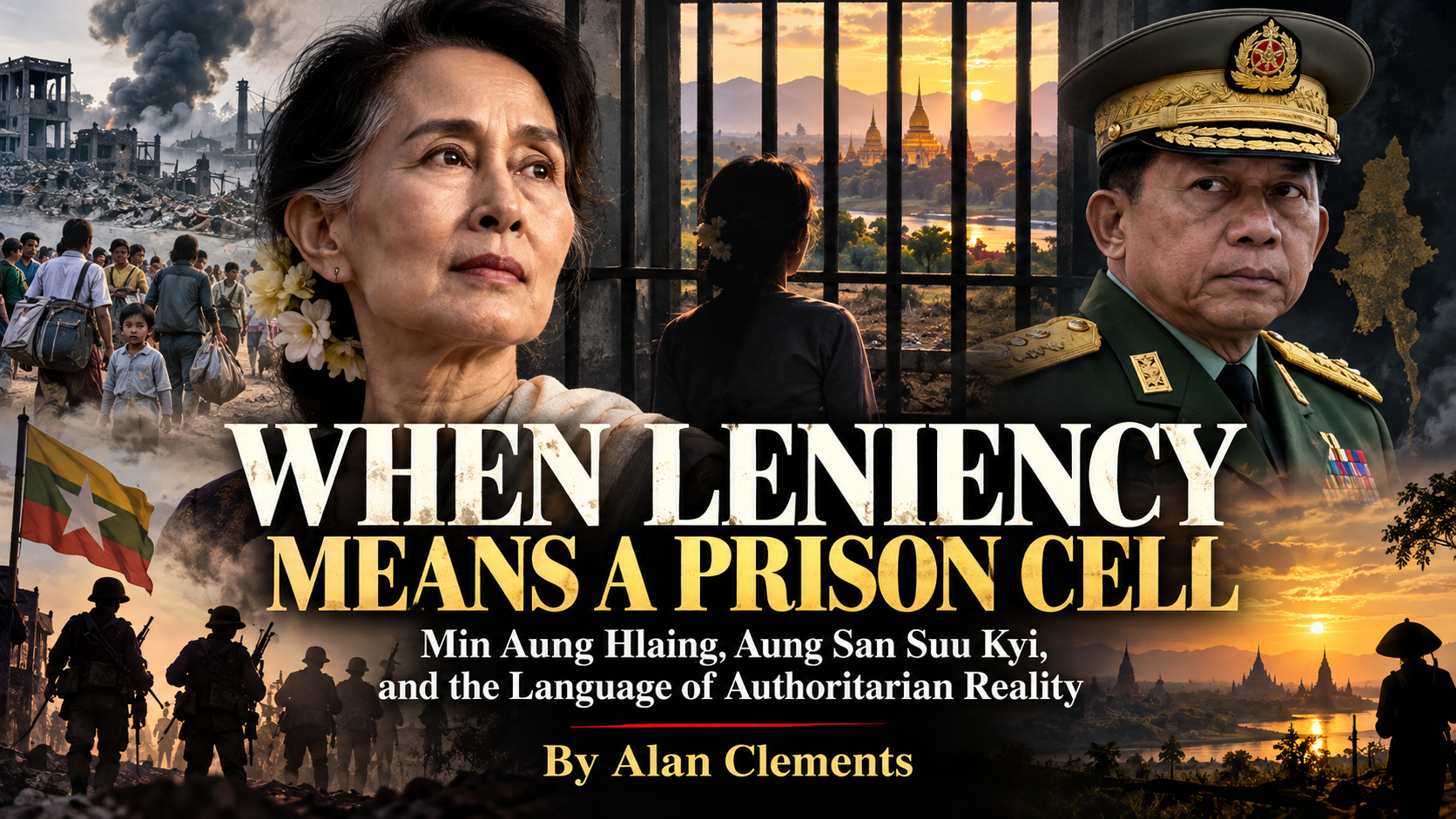
“Extremely lenient.” Those are the words Min Aung Hlaing uses to describe his treatment of Aung San Suu Kyi, the elected civilian leader his military arrested when it seized power on February 1, 2021.
There are moments when a phrase contains an entire political system within it, when language becomes so radically detached from observable reality that answering it requires something more than disagreement. It requires the recovery of language itself.
In his new interview with TIME, Myanmar’s military commander turned president continues to defend that seizure of power through allegations of electoral fraud, suggests that any future amnesty for Suu Kyi “depends on her,” and argues that democracy assumes different forms in different civilizations.
What he promises is a democracy appropriate to Myanmar’s “culture, customs, and traditions.”
There is an almost unbearable inversion contained in those words. A man whose military imprisoned the leader chosen overwhelmingly by Myanmar’s electorate now describes her continued captivity as evidence of his restraint.
The jailer invokes mercy. The institution that nullified an election invokes democracy. Power first creates the prison and then asks to be admired for the conditions under which it might someday open the door.
I have spent more than four decades living with Burma, studying its culture, knowing its people, witnessing its dictatorships, interviewing dissidents and political prisoners, and trying to understand what prolonged authoritarianism does not only to institutions but to consciousness itself.
I first entered the country in 1979 as a Buddhist monk. I have watched fear become administrative procedure, censorship become ordinary speech, imprisonment become political vocabulary, and propaganda gradually acquire the peculiar texture of reality for those required to inhabit it.
Yet I resist reducing Min Aung Hlaing to a monster existing outside history. That would be emotionally satisfying and intellectually inadequate.
Dictatorships do not descend from another planet. They emerge from history, institutions, inherited fears, collective wounds, ideologies and human beings.
To understand those conditions is not to excuse what people subsequently do with power. It is to understand how power becomes capable of excusing itself.
Burma has endured profound historical violence. British expansion began with the first Anglo-Burmese War in 1824; annexation proceeded until the monarchy was destroyed and Upper Burma incorporated into the British Empire in 1886.
Colonial rule reordered institutions, economies and identities. Japanese occupation followed during the Second World War. Independence finally arrived in 1948.
Colonial domination leaves more than political borders behind. It can leave a wounded imagination of sovereignty: the conviction that national survival depends upon vigilance, unity, obedience and protection against forces forever threatening to dismember the country.
None of this mechanically produces dictatorship. But it helps us understand the historical soil in which Burma’s military developed its extraordinary conception of itself.
Since General Ne Win’s 1962 coup, generations of soldiers have been educated within an institution that repeatedly represented itself not merely as one participant in the nation but as the indispensable guardian of the nation.
Under such conditions, domination can gradually rename itself duty. Violence becomes security. Dissent becomes terrorism. Obedience becomes patriotism.
Eventually the institution defending its power may cease to distinguish between protecting itself and protecting the country.
Understanding that history matters. Turning history into absolution would be another form of dishonesty.
This is why Min Aung Hlaing’s word “lenient” deserves such scrutiny.
Aung San Suu Kyi was not seized after losing an election.
Her National League for Democracy overwhelmingly won the November 2020 election. Independent observers identified structural deficiencies in Myanmar’s electoral system, but the Carter Center reported that voters were able to express their will freely and found no major irregularities on election day capable of sustaining the military’s extraordinary justification for overturning the political order.
And to understand the historical circumstance in which Aung San Suu Kyi attempted to govern Myanmar, one must remember what she was confronting: a military retaining immense constitutional and coercive power, a nation fractured by generations of armed conflict, and an authoritarian inheritance that had imprisoned her for years and repeatedly crushed democratic dissent.
Against that inheritance, her defining political wager was dialogue. It was reconciliation rather than retribution, negotiation rather than the annihilation of one’s adversaries.
Her government placed national reconciliation at the center of its ambitions and convened the 21st Century Panglong peace process in an attempt to bring ethnic nationalities, armed organizations, political actors and the military itself into a shared conversation about a democratic federal future.
There was something radical in that choice. In a political culture so long dominated by the grammar of command, weaponry, hierarchy and force, Aung San Suu Kyi attempted, against almost impossible constraints, to introduce another conception of power: patience instead of retaliation, listening instead of domination, reconciliation instead of revenge.
I think of this as a feminine principle in political life, but I do not mean that women inherently possess these qualities or that men do not.
Nor do I mean femininity as biology, sentimentality, passivity or weakness.
I mean a human capacity available to women and men alike: the capacity to remain receptive without surrendering strength, to hold apparently irreconcilable realities without immediately converting difference into enmity, to privilege relationship over domination, and to recognize that the deepest exercise of power may sometimes lie not in defeating an adversary but in creating conditions in which neither side must destroy the other in order to survive.
That experiment was fragile and unfinished, unfolding inside a political structure in which the military had never truly relinquished its power.
But it cannot honestly be collapsed into the fiction that she represented a threat to democracy requiring military intervention. She represented another proposition: that Myanmar’s seemingly irreconcilable forces might learn to negotiate a common future without perpetually reaching for the gun.
Then came the coup.
What does “leniency” mean when the authority claiming to extend it helped destroy the political order from which the prisoner derived her democratic mandate?
What does mercy mean when the jailer determines whether the prisoner has behaved sufficiently well to deserve freedom? What remains of an election when those who dislike its result possess the weapons to annul it?
What remains of language when imprisonment can be renamed compassion?
These are not semantic curiosities. They reveal the way authoritarian power rearranges reality.
The catastrophe following the coup cannot credibly be narrated merely as a response to disorder. As of September 22, the Assistance Association for Political Prisoners reported 31,959 people arrested since the coup, with 14,842 confirmed still detained and thousands of additional detention cases awaiting verification.
AAPP reported 8,418 people killed by the military and pro-military groups and cautions that actual totals are probably higher.
Behind every statistic is the danger of abstraction. Thirty-one thousand arrests become merely a number until we remember what an arrest means: a door opened at night, a mother who does not know where her son has been taken, a prisoner waiting for footsteps outside a cell, a family learning to speak quietly inside its own home.
Millions displaced become a humanitarian category until we remember that displacement means leaving the place where your children slept because remaining there may kill them.
Human-rights organizations have documented military airstrikes against civilian communities and attacks affecting schools, hospitals, religious sites and camps sheltering displaced people.
Abusive recruitment practices have also been documented following activation of the conscription law.
None of this means every allegation against the military is automatically true. Nor does suffering inflicted by the military exempt armed resistance organizations from international humanitarian law. Truth cannot become selective merely because the cause feels righteous.
But no credible account of contemporary Myanmar can separate the military’s claim to political guardianship from the immense human suffering occurring under that claim.
And here lies the deeper problem with the TIME interview.
Min Aung Hlaing wants the international community to reconsider Myanmar’s isolation. That proposition should not simply be dismissed.
Diplomacy eventually requires speaking with people whose actions one profoundly opposes. Dialogue is not surrender. Engagement is not endorsement.
I have spent much of my life arguing for reconciliation rather than vengeance. Myanmar cannot bomb, imprison or assassinate its way into durable peace.
Nor can the resistance ultimately build a free society merely by reversing the identity of those possessing coercive power. Eventually people who have learned to regard one another as enemies will have to inhabit the same country.
But reconciliation without truth becomes amnesia administered in the language of peace.
If Min Aung Hlaing genuinely wants a new relationship with the world, the beginning cannot be cosmetic civilianization, diplomatic choreography or semantic reinvention.
It must begin with reality. Aung San Suu Kyi did not voluntarily surrender her freedom. Political detainees did not voluntarily enter prison.
Displaced families did not voluntarily abandon their homes. Democracy does not become democratic because those holding power place the word “Myanmar” in front of it.
There is something profoundly poignant about this because Burma possesses within its own spiritual traditions a vocabulary capable of penetrating precisely this condition.
In the Buddhist culture that has shaped so much of the country are the qualities of hiri and ottappa: moral conscience and moral concern regarding the consequences of harmful action.
These are not Western imports. They are not sanctions. They are not colonialism disguised as human rights. They belong to Burma’s own civilizational inheritance.
The question is therefore not whether Min Aung Hlaing can become Western enough to satisfy Washington, Brussels or London. Burma has endured enough outsiders imagining civilization must be imported.
The question is whether power can become truthful enough to encounter the suffering occurring beneath it.
I do not know what Min Aung Hlaing believes when the cameras disappear. None of us possesses privileged access to another human being’s interior world. But we can examine words against evidence.
We can compare claims with documented events. We can ask whether calling imprisonment “leniency” illuminates reality or conceals it.
We can refuse hatred without surrendering judgment. We can refuse vengeance without abandoning accountability. And we can refuse the lie without surrendering the humanity of the person speaking it.
After 47 years of involvement with Burma, I no longer believe another cycle of demonization will heal a country saturated with historical trauma.
The task is more demanding: to oppose authoritarianism without reproducing its psychology; to insist upon accountability without surrendering to vengeance; to defend human dignity even when speaking about those responsible for denying it to others.
There is a road toward another Myanmar, but language alone cannot build it.
Release political prisoners. Permit independent humanitarian access. End attacks upon civilians. Allow political opponents to speak without fearing imprisonment. Permit independent journalists to report.
Create conditions in which elections are not ceremonies validating power already possessed but genuine occasions on which power can be lost. Allow Myanmar’s people—not its military, not China, Russia, America or anyone else—to determine their political future.
And allow Aung San Suu Kyi, now 81 years old, to live whatever remains of her life as a human being rather than as an instrument of political leverage.
None of this can undo the dead. It cannot restore childhoods spent in displacement, return years taken inside prisons, rebuild every village, reconcile every ethnicity, or erase generations of fear. History does not offer such mercy.
But Myanmar can still decide what it does with the history it has inherited.
Perhaps that is where genuine leniency begins: not when those possessing the guns congratulate themselves for sparing those they have imprisoned, and not when power offers freedom as a favor to people from whom it was taken, but when power finally relinquishes the fiction that the nation belongs to it.
Myanmar does not belong to its generals, its armies, its political parties, its resistance movements, or the foreign powers competing for influence over its future.
It belongs to its people, in all their astonishing ethnic, religious, political and human plurality. The deepest act of reconciliation now would therefore be the simplest and most difficult: to return to the people what was always theirs—the freedom to determine how they will live together.
Only then might the word “leniency” give way to something infinitely more courageous than mercy bestowed from above: the restoration of dignity, truth, and the sovereignty of a people over their own lives.
Alan Clements is an author, investigative journalist, former Buddhist monk ordained in Burma, performing artist, and longtime advocate for human rights and freedom of conscience. His engagement with Burma began in 1979 and has continued for more than four decades through dictatorship, democratic uprising, political transition, imprisonment, war, and resistance. He is the co-author with Aung San Suu Kyi of The Voice of Hope, based upon their extended conversations in Yangon following her first years of house arrest.
His books include Burma: The Next Killing Fields?, Burma’s Revolution of the Spirit, the four-volume Burma’s Voices of Freedom, co-authored with his colleague Fergus Harlow, Conversation with a Dictator, Unsilenced: Aung San Suu Kyi—Conversations from a Myanmar Prison, and Politics of the Heart: Nonviolence in an Age of Atrocity. His work explores authoritarianism, conscience, contemplative inquiry, nonviolence, democracy, and the human struggle to remain free without becoming what we oppose.
DVB publishes a diversity of opinions that does not reflect DVB editorial policy. We’d like to hear what you think about this or any of our stories: [email protected]