


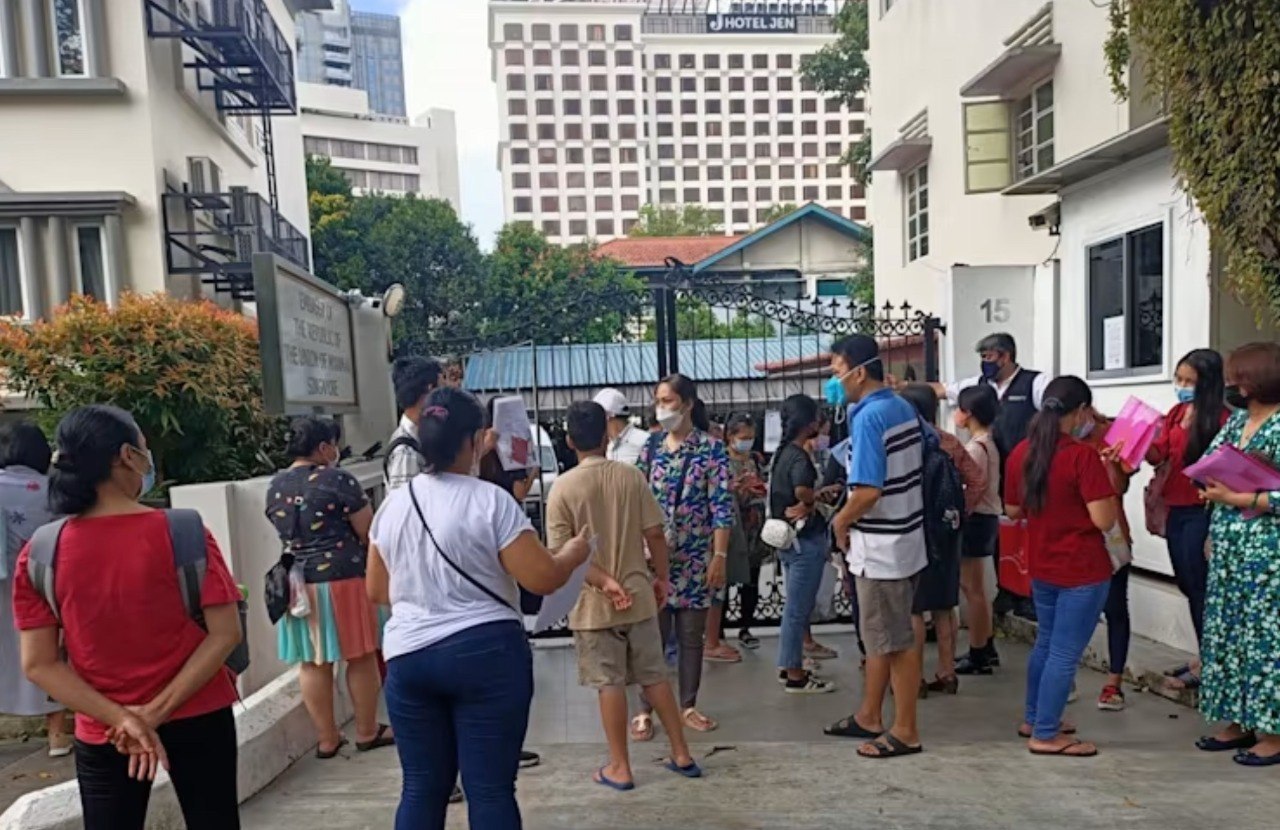
Myanmar embassies in Singapore and the Philippines announced this week that holders of Passports for Job (PJ), which are issued to nationals working abroad, must now provide receipts when renewing their passports showing that they have transferred 25 per cent of their salaries to families in Myanmar through regime-approved banks over the previous three months along with proof of income tax payments.
“The regime clearly needs money and is squeezing migrant workers through different methods. As long as we hold Myanmar passports, we have no choice [but to pay],” a Myanmar migrant worker in Singapore told DVB on condition of anonymity. Myanmar issues nine passport categories, including PJ, Passport for Visit (PV) for tourism, and Passport for Education (PE) for studying abroad.
The regime’s Ministry of Labour introduced a remittance requirement in September 2023 followed by the enforcement of a two per cent overseas income tax in December 2023. This requires Myanmar migrants to transfer at least 25 per cent of their total earnings through authorised financial channels, either monthly or once every three months.
The latest regime announcement, via its embassies, requires PJ passport applicants to provide documentary proof of compliance with the remittance and income tax requirements when renewing their passports.
“This creates an even greater financial burden on migrant workers,” the Myanmar migrant in Singapore told DVB.
The regime warns that migrant workers who fail to comply could face restrictions on passport renewals and Overseas Worker Identification Cards (OWICs), which are required for Myanmar nationals formally employed outside of the country.
The regime warned applicants against submitting falsified documents and that it would verify information provided about remittance recipients in Myanmar.
The Myanmar embassy in the Philippines also introduced restrictions that Myanmar nationals whose passports have expired for more than two years must pay a $15 USD penalty fee, while those whose passports have expired for over five years must return to Myanmar to renew them.
The Myanmar Embassy in Japan introduced a similar five-year passport expiry rule on Aug. 12.
In August, Myanmar embassies in several countries, including Singapore, Thailand, Japan, Australia and New Zealand, introduced required approval from authorities in Naypyidaw for some passport category changes, including PV-to-PJ conversions.
Category changes are commonly sought by Myanmar nationals who initially travelled abroad on Passport for Visit (PV) documents, which they may have found easier or quicker to obtain in Myanmar.
But some who secured jobs overseas during their travels must switch to a PJ passport to register their employment status with Myanmar authorities to access related consular services.
Since the 2021 military coup, political instability, armed conflict and economic hardship have driven more people to leave Myanmar, according to the World Bank.
World Bank figures tracking cross-border movements from 2021 through early 2024 indicate that Thailand served as the top destination, accounting for roughly 56 per cent of recorded migrants from Myanmar, followed by Malaysia at 21 per cent.
Other top destinations for Myanmar migrants include Singapore, Japan, South Korea, and China, alongside India, the Philippines, and some countries in the Middle East.
The World Bank noted that the exact number of Myanmar nationals who have left the country remains difficult to establish as many migrated “through irregular or undocumented routes.”