


The regime’s Ministry of Foreign Affairs rejected the U.N. Independent Investigative Mechanism for Myanmar (IIMM) on Wednesday after its lead investigator Nicholas Koumjian addressed the 63rd Session of the U.N. Human Rights Council in Geneva, Switzerland, Sept. 7-9.
The regime responded on Sept. 9 to the IIMM 2026 Annual Report published on Aug. 11, calling it “one-sided allegations against the Myanmar military from opposition groups,” adding that Myanmar has never recognized IIMM since its inception in 2018.
It accused the U.N. High Commissioner for Human Rights (OHCHR) of establishing the IIMM without Naypyidaw’s consent to “exert political pressure on a sovereign state.”
The IIMM was given the mandate to collect and preserve evidence of serious international crimes committed in Myanmar since 2011.
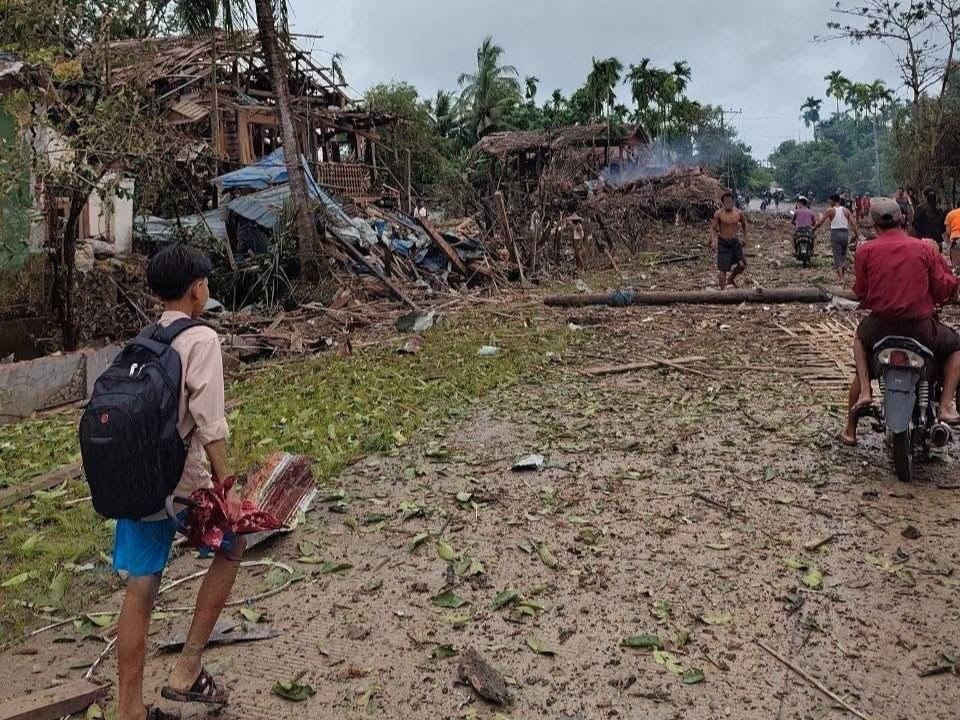
The regime’s Ministry of Foreign Affairs claimed that airstrikes were conducted solely against “military targets” in response to seizures of towns and villages by “terrorist groups,” which is how it refers to resistance forces.
It accused the IIMM’s report of contributing to violence and instability in Myanmar while hindering peacemaking efforts by the “government” in Naypyidaw.
Koumjian told DVB in an exclusive interview last month that it’s difficult to prove that regime airstrikes have targeted civilians. But he added that civilians are suffering from airstrikes in “much higher proportions than combatants.”
The IIMM has documented an increase in regime airstrikes in areas where voting was scheduled to take place, as well as the arrest of civilians for criticizing the regime’s polls.
DVB has documented at least 1,684 fatalities and 3,650 injuries in 2,272 aerial attacks, including airstrikes, drone, paramotor and gyrocopter attacks since the Myanmar earthquake on March 28, 2025 up to Jan. 31.
At least 18 people have been jailed, 84 have been arrested, and 269 have been charged under the Election Protection Law since its inception on July 29, 2025, according to DVB data.
The IIMM told that its evidence repository now contains over 1,600 sources and 750 witness accounts, which continue to be shared with universal jurisdiction cases and international tribunals—including the International Criminal Court (ICC) and International Court of Justice (ICJ)—to support future criminal prosecutions against the Myanmar military.