


Guest contributor
James Shwe
Myanmar is one of four countries, alongside Afghanistan, Bolivia and Colombia, that Washington has designated as having “failed demonstrably” to make substantial counternarcotics efforts in its fiscal-year 2027 determination.
Yet the same document declares that providing U.S. assistance to Myanmar remains “vital to the national interests of the United States.”
That combination requires careful interpretation. It preserves a legal option for assistance, not a promise of support for Myanmar’s revolution or an agreement to rehabilitate military rule.
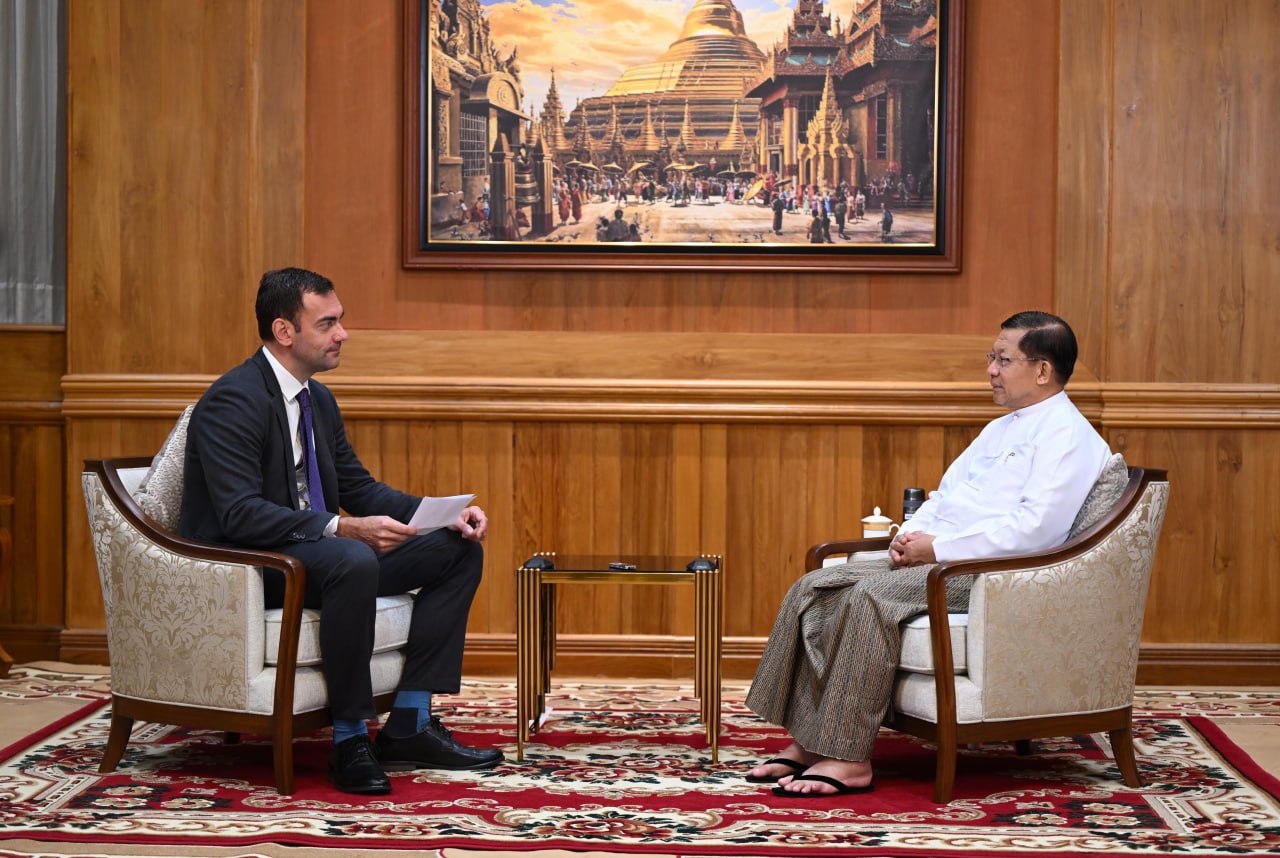
The political stakes are clearer following Charlie Campbell’s September 23 TIME magazine interview, “Exclusive: Myanmar’s Dictator Wants to Rebuild Ties With the West,” in which Min Aung Hlaing seeks American cooperation and sanctions review.
The junta subsequently condemned the magazine’s presentation of the interview. That adds a revealing tension: seeking international engagement while objecting to independent scrutiny.
For Myanmar’s democratic movement, the task is neither to reject every practical contact nor to assume that legal restrictions make normalization impossible. It is to distinguish assistance that helps people, cooperation that reduces harm, and concessions that entrench military power.
What Washington’s decision actually does
The national-interest exception, commonly called a waiver, removes a particular statutory obstacle to covered assistance; it does not allocate money, identify recipients or guarantee delivery.
Permission to provide assistance is not a commitment to provide it.
Nor does every humanitarian program depend on this exception: the statutory definition excludes disaster relief, assistance involving food or medicine, refugee assistance and specified counternarcotics assistance.
Certain democracy, anti-trafficking and global-health assistance falls within the definition, however, so preserving the exception can matter.
The determination neither repeals separate sanctions nor establishes a bilateral drug-control partnership or recognizes the junta’s legitimacy.
“Assistance to Myanmar” should therefore be read as neither a grant to the military nor an award to the resistance.
This is also continuity rather than a new opening: Myanmar received both the failure designation and the assistance exception in the preceding fiscal year.
Any claim of a new American commitment, whether to democratic forces or military authorities, requires evidence beyond the annual waiver.
What TIME adds to the normalization question
Min Aung Hlaing tells TIME magazine that American cooperation would help foster “peace, stability, and development,” and urges Washington to review sanctions “objectively.”
These are requests from a prospective beneficiary, not evidence that the United States has accepted his terms.
TIME places those overtures within a possible transactional approach involving transnational crime, economic interests and competition with China, and reports that a U.S. policy review appears likely to favor revived ties.
That is reporting and assessment, not a published U.S. decision to normalize relations.
The article also quotes former U.S. ambassador to Myanmar Scot Marciel warning that engagement will not change the military’s behaviour, while acknowledging that “isolation has limited value as well.”
The implication deserves consideration: neither access nor isolation should be mistaken for a strategy that automatically delivers results.
The drug determination supplies an important test of the junta’s pitch. Washington itself says the military regime has made “little discernible effort to crack down on its drug economy.”
If policymakers now consider working more closely with it, they should explain what would make future cooperation effective and independently verifiable.
The central question is not simply whether the military will talk. It is whether it can deliver sustained results without using cooperation to protect favored networks, obtain broader concessions or strengthen its coercive capacity.
The junta’s response is a warning about scrutiny
According to September 23 reporting on its statement, the junta condemned TIME and Campbell for publishing an article rather than a question-and-answer transcript and including other voices and commentary.
It alleged misrepresentation and said the full exchange would be released separately.
Those complaints must be separated from proof. A reported feature that incorporates an interview is not inherently unethical because it also includes context, criticism or other interviewees.
Whether TIME breached a specific agreement or misrepresented an answer requires examination of the actual agreement and interview record; the junta’s accusation alone cannot establish either.
The political significance is narrower but important. The response suggests an expectation that access should produce a preferred presentation.
A government considering cooperation should ask whether similarly unwelcome scrutiny of arrests, seizures, recipients or civilian harm would be tolerated.
The dispute does not prove that every future arrangement would fail. It strengthens the case for verification that does not depend on the military’s willingness to approve the findings.
Benefits are possible; political concessions require a separate test
For the revolution, the waiver’s direct benefit remains modest: it preserves eligibility for covered assistance. Its practical value depends on funding, implementing partners, safeguards and delivery.
Well-designed cooperation against criminal networks could also benefit civilians.
Tracing illicit finances, restricting precursor chemicals or protecting trafficking victims may reduce harm without conferring political legitimacy.
Humanitarian relief should remain needs-based, not be presented as support for a political movement simply because recipients live in resistance-held areas.
The danger is incremental political acceptance.
Technical meetings could become routine high-level access; selected arrests could be offered as grounds for broader sanctions relief; military-appointed officials could become the default partners through whom outsiders approach Myanmar.
That process would not require a single dramatic announcement. Democratic actors could lose access and influence gradually if foreign governments began treating the military as indispensable while marginalizing alternative institutions.
The opposite error would be to dismiss any useful contact as betrayal. An arrangement that reduces identifiable harm, preserves independent delivery channels and grants no unrelated concessions should be assessed on those terms.
My assessment is therefore a limited legal benefit alongside a credible, potentially serious normalization risk.
Neither the waiver nor the TIME interview establishes that normalization has occurred; together, they make scrutiny of subsequent decisions more important than reassurance based on legal barriers alone.
What the democratic movement should demand
The National Unity Government, ethnic resistance organizations and civil society should seek specific answers from Washington: which programs will receive support, through which partners, on what timetable, and with what protection for sensitive information?
Public explanations should distinguish assistance legally permitted from money committed and money delivered.
They should also press for clear boundaries around any security cooperation.
Its purpose, duration, participants and review conditions should be defined, with safeguards against intelligence or equipment being used for political repression.
Public accountability should not expose vulnerable personnel, beneficiaries or delivery routes.
Results should be judged by sustained disruption of criminal networks and their protectors, not seizure photographs alone.
Diplomatic upgrades, broader sanctions relief and political concessions should each require a separate justification rather than follow automatically from a limited operation.
Democratic and ethnic administrations must offer credible alternatives within their authority and capacity.
That means enforceable rules against official involvement in trafficking, investigation of credible allegations regardless of affiliation, and protection for communities dependent on fragile livelihoods.
Responsibility should be assessed actor by actor, not presumed from geography or political identity.
The TIME interview makes the junta’s desire for Western acceptance explicit; the reported backlash shows its resistance to the way that appeal was scrutinized.
Neither proves that Washington will grant the acceptance being sought.
Myanmar’s democratic movement should judge American policy by assistance delivered, people protected, institutions strengthened and concessions made.
Cooperation against crime can be justified by results; political rehabilitation cannot be justified by an interview, a meeting or a promise.
James Shwe is a Myanmar-American engineer and pro-democracy advocate who works with diaspora coalitions supporting federal democracy in Myanmar.
DVB publishes a diversity of opinions that does not reflect DVB editorial policy. We’d like to hear what you think about this or any of our stories: [email protected]