


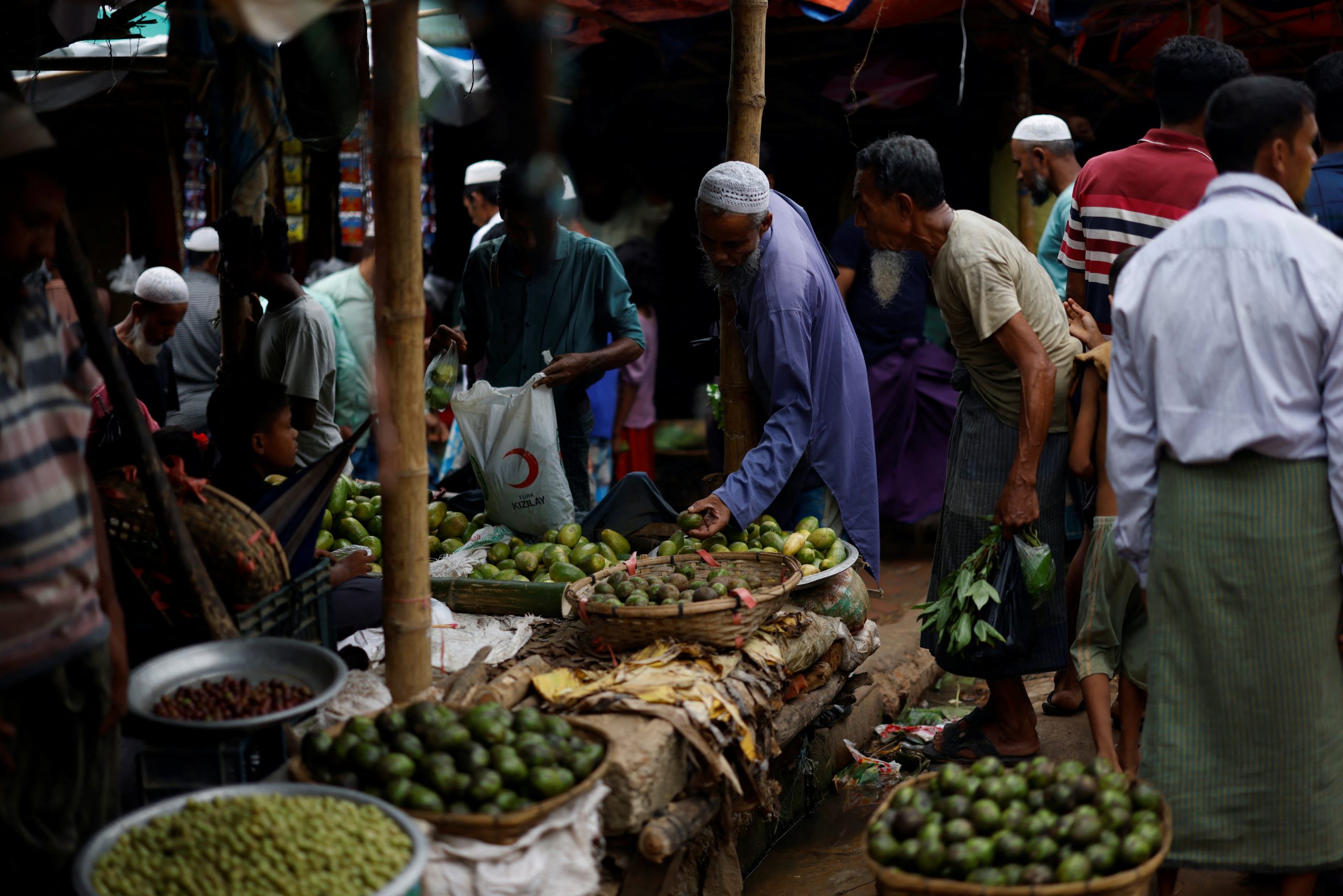
After Ajib Bahar’s six-month-old son fell sick last year in Myanmar’s Arakan (Rakhine) State, the 38-year-old Rohingya mother said she had no medicine or food to give him. The boy died in her arms.
“My children cried all night from hunger. I boiled grass and gave it to them just to keep them quiet,” Bahar said from a refugee camp in Bangladesh’s Cox’s Bazar, where she and her family sought safety after fleeing violence and starvation in Myanmar.
Arakan, a western coastal region that has suffered years of conflict and ethnic violence mostly targeting the Rohingya Muslim minority, is now facing an “alarming” hunger crisis due to a “deadly combination of conflict, blockades, and funding cuts,” according to the U.N. World Food Programme (WFP).
At a high-level U.N. conference in New York on Myanmar’s minority groups on Tuesday, the U.S. and Britain announced that they would provide $96 million USD in further assistance to support the Bangladesh refugee camps that house over a million Rohingya who fled Arakan.
Surviving on leaves
Myanmar has been in crisis since the military seized power in 2021 and brutally cracked down on protests, prompting a nationwide armed uprising and re-igniting a simmering conflict in Arakan, opens new tab between the regime and the Arakan Army (AA).
Five Rohingya, including Ajib Bahar and her husband, told Reuters they had survived on leaves, roots and grass in Arakan before escaping to Bangladesh in the last six months.
More than 100,000 children in Rakhine are suffering from acute malnutrition, with less than 2 percent able to access treatment, according to previously unreported data provided by aid workers.
They declined to be identified for fear of retribution. Myanmar’s regime has suppressed information about the crisis by pressuring researchers not to collect data about hunger and aid workers not to publish it, Reuters reported last year.
Security fears and restrictions by the regime and the AA mean the U.N. is unable to move food beyond Sittwe, the regime-controlled state capital, into the central and northern parts of the state, said Michael Dunford, the acting U.N. head in Myanmar.
“This is obviously contributing to the spike in hunger that we are seeing,” said Dunford, who is also the country representative for WFP.
“We’re desperately frustrated because we know that there are populations that require our support.”
Khaing Thukha, the AA spokesperson, said that the regime was blocking the flow of aid, including food and medicine, and that the group was cooperating with the U.N. and aid agencies.
Their data suggested one in four children are malnourished but it had not reached famine levels, he said, blaming the military blockade.
He said the conflict made it difficult to provide medical treatment but the AA was trying to keep the prices of necessities as low as possible and reduce taxes.
A regime spokesman did not respond to a request for comment.
Aid blocked
A combination of conflict, near-empty markets, a stalled economy and blockades is squeezing Arakan’s civilian population like never before, aid workers say.
The situation is particularly dire in camps for tens of thousands of internally displaced people in the state, many of them Rohingya who fled their homes during previous waves of violence and face severe restrictions on their movement.
The data provided by aid workers showed acute malnutrition was widespread in the camps, with parents skipping meals to feed their children. It shows the number of people living in these conditions increased nearly tenfold between September 2023 to August this year.
Dunford said he spoke to residents at a Rohingya camp outside Sittwe earlier this year. The agency had supported them before funding cuts forced them to limit food supplies.
“I had one gentleman, in tears, tell me that, ‘If WFP can’t feed us and the authorities won’t support us, then please drop a bomb on us. Put us out of our misery,'” he said.
‘Severe wasting’
Rohingya are arriving in Bangladesh in much poorer health than previous waves of refugees, with high rates of malnutrition particularly among children under five and pregnant and lactating women, the International Rescue Committee (IRC), a nonprofit working in the refugee camps, said last month.
The increase in new arrivals coincided with a critical aid funding shortfall worldwide and overstretched health and nutrition services, the IRC said.
“There was hardly any food to eat. Most days we had only one meal,” said Mohammed Idris, Bahar’s husband, a farmer from Arakan’s Buthidaung Township, adding that he gave his food to the children and ate their leftovers.
Food prices surged and sometimes there was nothing to buy, he said.
“I can’t remember the last time we ate an egg or meat.”
Bahar is now eight months pregnant. Although the family is grateful to be living in peace, conditions in the camp are difficult, she said.
“I wonder – will this child be born hungry too?”
REUTERS