
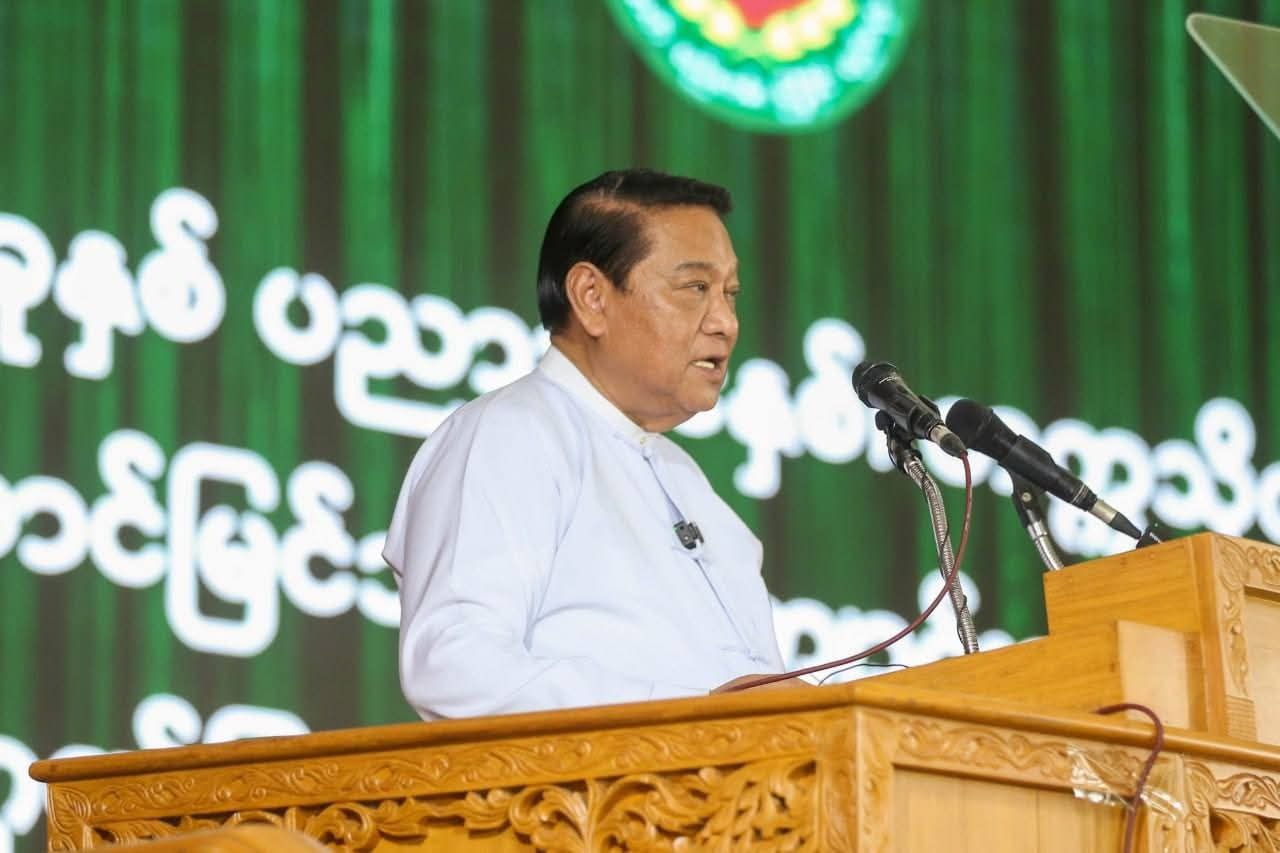
The pro-military Union Solidarity and Development Party (USDP) Chairperson Khin Yi launched his campaign, via USDP social media channels, on Sunday.
“People in Myanmar have been experiencing violence and terror caused by selfish politicians,” Khin Yi said in a video posted to USDP social media on Sept. 28. “We are ready to make impactful plans and results instead of just reciting slogans. We have fully qualified individuals to implement these plans.”
Following this video, Khin Yi is being accused of violating the election law, which stipulates that campaign activities can only be conducted within 60 days prior to an election. The regime elections are scheduled to begin on Dec. 28.
“This is a question to raise whether what he is doing now is legal or against the law,” an unnamed spokesperson of a political party told DVB on the condition of anonymity.
The regime Union Election Commission (UEC) stated that political party rallies and politicians’ speeches can only be aired on regime media from Oct. 28 to Dec. 26, or face suspension or dissolution of their parties. It instructed party leaders to submit their campaign speeches by Oct. 15.
The UEC announced on Sept. 23 that 4,963 parliamentary candidates from 57 registered political parties will compete in the regime elections, which will take place in 102 out of Myanmar’s 330 total townships during the first phase. It will continue with final polls in January 2026.
The USDP has the highest numbers of candidates with 1,018, followed by the National Unity Party (NUP) with 694, the People’s Pioneer Party (PPP) with 672 candidates, the Myanmar Farmers Development Party (MFDP) with 428, the Shan & Nationalities Democratic Party (White Tiger Party) with 584, and the People’s Party with 512.
“I see this junta’s election plan as sham by design,” an independent election analyst told DVB on the condition of anonymity. “[It] will have significant and serious impacts on democratic institutions and processes of the country,” he added.
There are a total of 960 candidates from 51 political parties competing at the regional and state level, according to the UEC. It also announced that 95 independent candidates, who are not associated with any political parties, registered with the UEC from Sept. 8-22 to run in the elections.
The National Democratic Force (NDF), the Democratic Party of National Politics (DNP), the Women’s Party, and the Union Farmer-Labour Force Party were dissolved by the UEC on Sept. 9 for failing to meet its criteria.
The regime enacted the Election Protection Law on July 29, which carries a minimum sentence of three years in prison and a maximum sentence of death for anyone “opposing or disrupting the elections.”
On its 37th anniversary, the National League for Democracy (NLD) party, stated that it does not accept, recognize, nor will it cooperate with any regime “sham” elections.
The NLD governed Myanmar from 2016 up until the coup on Feb. 1, 2021 when State Counsellor Aung San Suu Kyi and President Win Myint were detained and their government was ousted and replaced by the regime which still clings to power in Naypyidaw.
The NLD vowed to work with pro-democracy groups in Myanmar to oppose the regime election. It was dissolved by the UEC in March 2023 for failing to re-register.
The interim National Unity Government (NUG), a body of elected lawmakers ousted in the 2021 military coup, as well as ethnic armed groups the Karen National Union (KNU) and the Arakan Army (AA) have called for a boycott of the regime elections.
A total of 61 political parties registered with the UEC. But only six, including the USDP, will compete nationwide. The USDP governed Myanmar from 2011-16 but lost the 2015 and 2020 general elections to NLD landslide victories, both considered “free and fair” by international observers.