


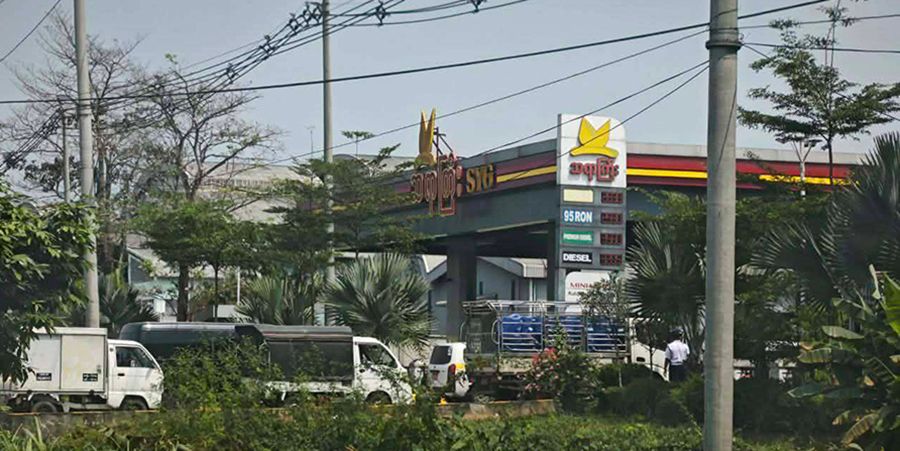
Vehicle owners in Yangon, Mandalay, Naypyidaw and the Shan State capital Taunggyi told DVB that the regime’s Ministry of Energy quick response (QR) code for drivers to purchase petrol, which took effect on March 12, has turned many to the black market to make fuel purchases.
A car dealership in Yangon Region told DVB on the condition of anonymity that owners of unlicensed vehicles, like those being sold, can’t refuel since they lack official documents required to register for the regime’s QR code. The new fuel rationing measures stipulate that all registered vehicles may refuel once every 24 hours.
Drivers told DVB that one liter of 92-octane gasoline is sold at around 2,800 MMK ($0.70 USD) at petrol stations but can cost as high as 10,000 MMK ($2.50 USD) on the black market as of March 18. But this price may increase rapidly.
Motorists must present their vehicle registration tax documents—locally known as the wheel tax—issued by the regime’s Road Transport Administration Department to petrol station staff.
After checking these documents, staff generate a QR code through a ministry-issued application to authorize the sale of fuel.
Drivers are required to retain the QR code for future purchases. The code stores the vehicle’s details and prevents drivers from attempting to purchase fuel at any petrol station for the next 24 hours.
Under the new measures, motorcycles are limited to two liters of gasoline per day, three-wheelers to four liters, and private cars to 12 liters. For diesel, private cars and light trucks are capped at 20 liters per day, while passenger and cargo vehicles are allowed up to 50 liters.
Private car owners told DVB that the system allows them to refuel once every 100 miles if they’re travelling on the highway. A delivery service operator told DVB on the condition of anonymity that he has to rely on black market fuel as he travels only within Yangon.
Bus operators at Yangon’s Aung Mingalar Highway Terminal told DVB that they still haven’t sold advance tickets for April 11-19 for those who want to return to their hometowns to celebrate the Thingyan Myanmar New Year holidays with their families.
“Some travel companies accept advance registration. They’re not setting prices yet because ticket prices may change,” a ticketing agent told DVB on the condition of anonymity.
Fares on the Yangon–Naypyidaw route increased from 21,000 to 45,000 MMK ($5-11 USD), while fares for the Yangon–Mandalay route also rose from 23,000 to 50,000 MMK ($5.70-12 USD) over the last week, according to Yangon residents.
Petrol station owners told DVB that prices for one liter of 92-octane gasoline rose from 2,534 to 2,830 MMK ($0.60-0.7 USD), 95-octane gasoline from 2,595 to 2,930 MMK ($0.60-0.70 USD), and diesel from 2,610 to 3,205 MMK ($0.60-0.80 USD) over the last week.
The regime announced on March 4 that Myanmar has a 40-day fuel reserve and will not face shortages despite disruptions to the global energy supply chain caused by the war in the Middle East, which began on Feb. 28.
Regime media reported that the Central Bank of Myanmar (CBM) announced on March 11 that it would sell $30 million USD to fuel oil businesses in an attempt to stabilize prices.