
Thursday, July 23, 2026
Home Blog Page 6

How a 2,300-mile Walk for Peace thrust a Texas monk and his rescue dog into the spotlight

0
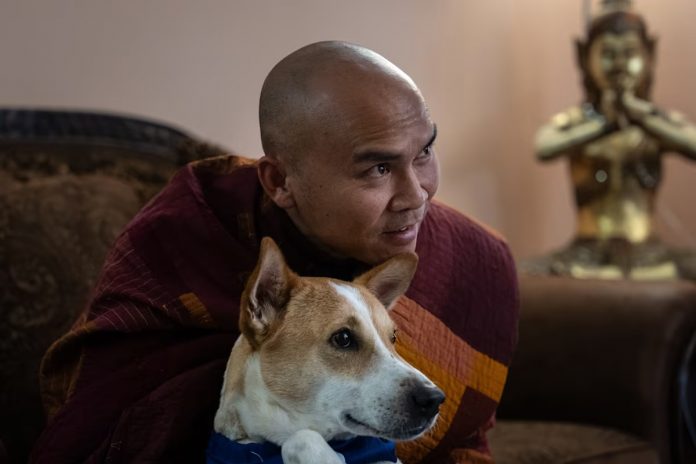
Bhikkhu Pannakara, a Buddhist monk who led a Walk for Peace from Fort Worth, Texas, to Washington, D.C., sits with his dog, Aloka, before an event at Wat Thai of Los Angeles in the North Hollywood section of Los Angeles, on July 13, 2026. (Credit: AP)

Chien Le first met the Venerable Bhikkhu Pannakara in 2005, a few years before Pannakara became a novice monk at the Texas Buddhist temple where he is now the deputy abbot.

What struck Le then, and amazes him still, is Pannakara’s iron-clad determination.

“When he decides to do something, he goes all the way,” said Le, secretary of the temple — the Huong Dao Vipassana Bhavana Center in Fort Worth. “He’s never been afraid of obstacles. He always finds a way through them.”

That indomitable will was in full display during the meditative Walk for Peace that Pannakara led earlier this year with an international group of monks and his rescue dog, Aloka, who has become a mascot for the movement.

The 2,300-mile (3,700-km) journey started in Fort Worth on Oct. 26 and ended in Washington, D.C., on Feb. 14.

An ascetic walks into the spotlight

Pannakara’s discourses on mindfulness and kindness in churchyards, town squares and in front of the Lincoln Memorial drew large, diverse crowds. Millions worldwide followed along online.

Within weeks, the Walk for Peace had propelled this obscure monk into the spotlight as a leading voice for inner peace and unity in an increasingly divided nation.

His popularity continues to soar, with some drawing comparisons with the Dalai Lama, the Reverand Martin Luther King Jr. and the late Thich Nhat Hanh, a revered Zen master and peace activist who shared Pannakara’s Vietnamese roots.

Pannakara, who traveled to Southern California last weekend with Aloka for several speaking engagements, said he doesn’t care for all the attention.

“There is no fame for monks,” he said. “I made a vow to walk to raise awareness of peace, loving kindness and compassion. That’s what it’s about.”

As part of his Theravada Buddhist practice, he follows “Vinaya” — a strict code of monastic rules. That means no social media accounts, personal possessions or handling money, and the practice of celibacy and modesty.

He doesn’t eat after noon and, according to Le, sleeps sitting up, which is not mandatory for Theravada monks, but adopted by some as an ascetic practice to deepen mindfulness.

The pivot from engineer to monk

Pannakara was born in Dak Lak, Vietnam, in 1981, the youngest of 10 children. He says his family was Buddhist in “name only.” He immigrated to the U.S. in 1997 and graduated with a degree in information technology from the University of Texas at Arlington.

He said his first exposure to Buddhism was in the U.S. through temple summer camps and youth leadership.

Pannakara stepped away from his engineering career to become a novice monk and became fully ordained in 2010 by his teacher, the Venerable Ratanaguna, who he has often cited as his source of inspiration.

There was not one life-changing event that prompted his decision, he said, but the cumulative effect of seeing his loved ones suffer and people trying to step on each other to move up.

“To me everything just seemed fake,” he said.

Le recalls that Pannakara’s parents were inconsolable.

“Even on the day he was ordained, his mother came, and she cried a lot,” he said, adding that they eventually accepted it.

Le said Pannakara was a quick learner, completing several projects on their campus including landscaping, a new kitchen, homes for the monastics and a memorial hall for deceased members.

At his teacher’s direction, Pannakara traveled to Myanmar between 2018 and 2020 to study and practice Vipassana meditation, an ancient technique taught by the Buddha himself as core for attaining enlightenment.

When COVID hit, he returned to Fort Worth and organized food drives, said Amanda Phan, a temple member.

“[Pannakara] is a rare human being,” she said. “He is an embodiment of kindness, compassion, wisdom — a bodhisattva — a being whose purpose is to relieve others from their suffering.”

Transformative journey tracing the Buddha’s steps

In late 2022, Pannakara joined about 100 monks in a 2,100-mile (3,380-km), 112-day pilgrimage tracing the footsteps of the Buddha — from his birthplace in Lumbini, Nepal, to Bodh Gaya where he attained enlightenment; Sarnath, the site of the first sermon; and Kushinagar, where he died.

The monks emulated Buddha’s journey — walking barefoot, eating one meal a day, and sleeping under the stars.

“I had learned the Buddha’s teachings from the Tipitaka (Buddhist canon),” Pannakara said. “But with this walk, I experienced it.”

He also learned about himself — about his strength to bear adversity and pain.

“I learned that we can do much more than we think we’re capable of,” he said.

That journey also brought Aloka into his life. Aloka means light in Pali.

“Even when he faced challenges and almost died he walked with us,” Pannakara said of his dog.

It was on a previous trip to Bodh Gaya — under the Bodhi tree where the Buddha attained enlightenment — that Pannakara said he had a vision to build stone stupas to preserve the sacred teachings for generations to come.

Seven years later, he told Ratanaguna about his desire. With his teacher’s blessing, the plan for the $200-million USD Dhammacetiya project was born — 840 stupas bearing Buddha’s teachings in 10 languages, built to last 4,000 years.

Pannakara knelt before an assembly of monastics and visitors during the temple’s 2022 International Vesak Ceremony and vowed that if he is unable to complete the project in this lifetime, he would “be reborn to continue this project until its completion.”

This project and the peace walks — which he plans to do more of — together uphold his vow to promote peace and preserve the Buddha’s teachings, he said.

Ajahn Nisabho, a Seattle-based Theravada Buddhist monk, said he was moved by Pannakara’s authenticity and commitment.

“The story of his quilted robe that he stitched it together from pieces of cloth he picked up during the walk in India — he was honoring that past and that ethos,” Nisabho said. “As a fellow monk, it was inspiring for me to see floods of people walking behind him during the peace walk.”

A conscious decision to steer clear of politics

Bhikkhu Bodhi, a senior Theravada monk who spoke at the conclusion of the Walk for Peace in Washington, said Pannakara was wise to remain silent on politics during his walk. But Bodhi, 81, hopes he does speak up on critical social issues like poverty, hunger, housing and the climate.

“I just hope that as [Pannakara] becomes more established and gets accustomed to publicity, he’ll consider taking a stand on these issues that have deep moral and spiritual significance,” he said.

Nisabho believes Pannakara made the right decision to steer clear of politics and activism.

He said there are not many spaces today that are able to welcome the kind of diversity the peace walk attracted — with the exception of Dolly Parton “who brings truckers and drag queens together.”

“The vision of a monastic is the one chance someone has, to be inspired toward awakening and find an escape from suffering,” Nisabho said. “If you bring politics into that, you cause damage by alienating half the country.”

AP
Myanmar military declares ‘full’ control over Chin State’s Thantlang

0
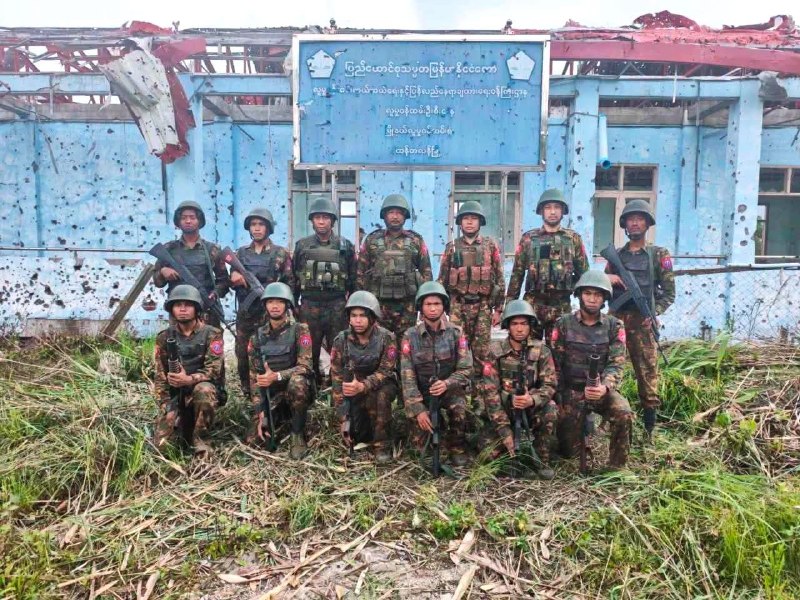
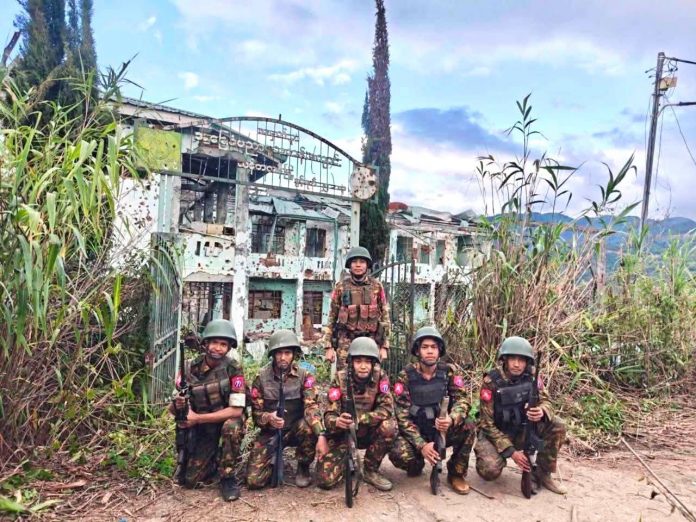
Regime troops in front of a school destroyed during fighting in Thantlang Township, Chin State, after the military claimed it had regained control on July 16. (Credit: Regime)

Myanmar’s military has declared it now has complete control over the embattled town of Thantlang and its surrounding areas, following what regime media described as a months-long “counter-terrorism operation.”

The recapture of Thantlang, located 22 miles (35 km) west of the Chin State capital Hakha, marks a significant development in a protracted and highly destructive conflict.

The town has been a fiercely contested battleground between regime and resistance forces since September 2021, when intense aerial bombardments forced the entire civilian population to flee.

Both sides have launched repeated offensives to secure the area over the past five years.

The regime counteroffensive

The regime’s successful push to retake Thantlang began in June. According to military reports, troops steadily advanced through the town, capturing critical infrastructure—including the local police station, a school, the hospital, and the fire station—in late June.

The military officially declared full control of the town on July 16.

The operation is part of a broader, massive military mobilization in the region. In mid-June, the Chin National Army (CNA) reported to DVB that the regime had deployed approximately 6,000 troops across the state in a sweeping counteroffensive designed to recapture territory lost to resistance groups.

A critical turning point in the campaign occurred on June 10, when the military, backed by intense artillery and aerial bombardments, regained control of the Hakha–Thantlang road.

This strategic trade artery links the state capital to the Myanmar-India border and had been under CNA control since 2023, following the resistance’s capture of the border towns of Rihkhawdar and Cikha (Zikhaw).

A shifting battlefield

Despite the loss of Thantlang, Chin resistance forces and allied ethnic armed organizations maintain control over significant portions of the state:

The shifting battlefield dynamics have also driven political consolidation among the resistance. The CNA, which left the ICNCC in April 2023 to establish its own Chinland Council in February 2024, recently moved to unify the fractured political landscape.

On February 26, 2025, the ICNCC and the Chinland Council officially agreed to merge, forming a singular governing body known as the Chin National Council to streamline administration and military coordination across liberated areas.

But no further progress to unify the two Chin resistance factions has been announced since then.

Regime troops in front of the Thantlang Township Social Welfare office destroyed during fighting in Chin State on July 16. (Credit: Regime)

Myanmar military escalates attacks in Magway Region to reinforce Chin State frontline

0
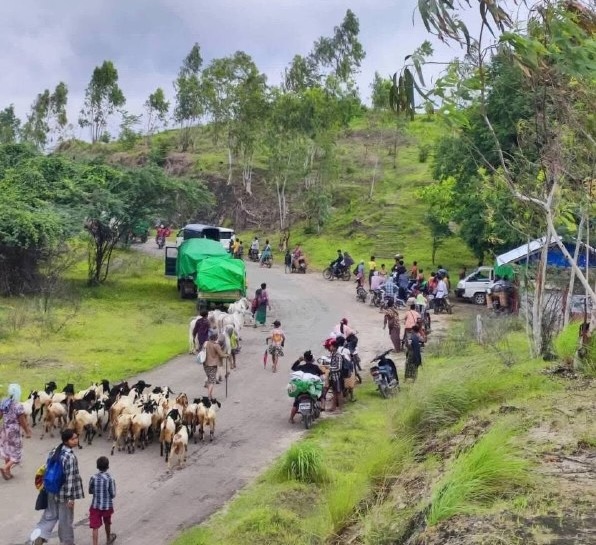
Residents from Magway Region’s Myaing Township flee their homes due to the regime counteroffensive that began in the second week of July. (Credit: Anyarmyay Group-Myaing)

A violent military counteroffensive in Magway Region’s Pauk and Myaing townships has left four civilians dead and at least 50 homes destroyed across six villages between July 13 and 15.

Civilians targeted in arson attacks

According to an aid worker based in Myaing Township, who spoke on the condition of anonymity, the four victims were between 50 and 60 years old. They were already internally displaced persons who had been temporarily sheltering with relatives in Pauk’s Kannat, Myinkothit, and Kaingtawma villages when they were killed.

The People’s Defense Force (PDF), which partially controls the two townships located 130 miles (209 km) north of the region’s capital Magway, stated that a regime column comprising about 600 military personnel was responsible for killing the four civiilans and related arson.

The PDF emphasized that the troops set fire to the homes despite there being no active clashes with resistance forces in the immediate area at the time.

Following the attacks, regime forces have reportedly maintained a presence in the area and have been deployed in Myaing’s Wayinchaing and Ima villages since July 16.

Escalating airstrikes and troop movements

The ground assaults were accompanied by aerial bombardments as the regime escalated its counteroffensive against the PDF in Myaing last week. On July 15, the Myanmar Air Force conducted airstrikes that destroyed an unknown number of homes in the eastern part of the township.

Meanwhile, the military is also shifting significant resources to neighbouring battlefronts.

On July 13, approximately 1,000 regime troops based at the Directorate of Defence Industry (DDI) facilities 24 and 25—located in Magway’s Pauk and Saw townships—were dispatched to reinforce an ongoing military counteroffensive in southern Chin State’s Mindat and Kanpelet townships.

Deepening humanitarian crisis

The recent violence compounds an already severe humanitarian emergency in the region.

Aid workers operating in Magway and Chin states report that relentless retaliatory airstrikes and ground clearance operations have displaced tens of thousands of residents from their homes since May 12.

The displaced populations are reportedly in dire need of urgent humanitarian assistance, including food, shelter, and medical supplies.

UK halves aid to Myanmar despite escalating humanitarian crisis

0
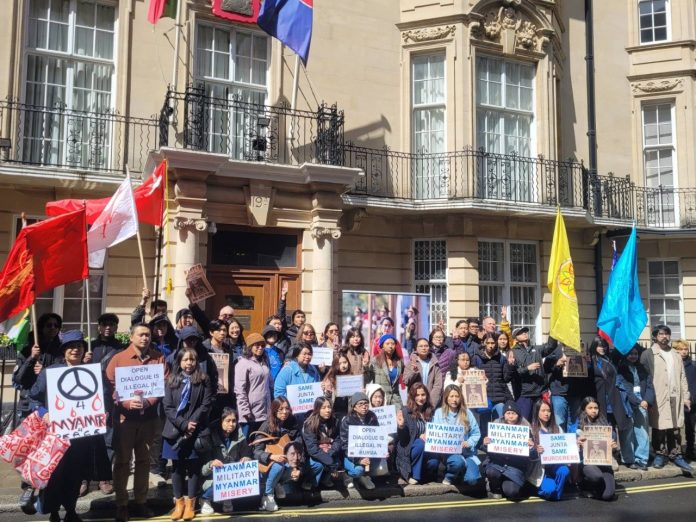
Demonstrators gathered outside the Myanmar Embassy in London, UK, to denounce a “propaganda offensive" by the regime in Naypyidaw. The protest was organized by Burma Campaign UK, the Myanmar Accountability Project, and Stars of Myanmar Friendship, which coordinated a boycott of the “Open Dialogue” event planned to be held at the embassy on May 14, 2026. (Credit: Burma Campaign UK)

The British government is facing severe backlash after quietly reducing its humanitarian aid to Myanmar, a move that rights advocates warn will cost lives and directly benefit the regime which seized power during a military coup on Feb. 1, 2021.

The cuts were detailed in the Foreign, Commonwealth & Development Office (FCDO) annual report, which was published on July 16 without an accompanying press release or public announcement.

The figures, buried in the appendixes of the 264-page document, reveal that U.K. aid to Myanmar will fall to £55.3 million ($74 million USD) for the current financial year, down from a core allocation of roughly £66 million ($88 million USD).

According to the report, the reduced budget will remain in place until at least 2029.

Burma Campaign UK, a prominent human rights advocacy group, strongly condemned the decision. The organization noted that the new figure is roughly half of what the U.K. provided to Myanmar prior to the 2021 coup, despite a massive escalation in the country’s humanitarian crisis.

“British aid to Burma saves lives so these cuts will kill people,” said Anna Roberts, the executive director of Burma Campaign UK. “Keir Starmer and Yvette Cooper just gave the Burmese military a helping hand by cutting aid to Burma.”

A Deepening Crisis

The reduction in aid comes as Myanmar grapples with a catastrophic nationwide conflict. Since the military ousted the democratically elected government, regime forces have been engaged in a brutal civil war against pro-democracy resistance groups and ethnic armed organizations.

Official estimates indicate that more than 3.8 million people are currently internally displaced within Myanmar, though local civil society groups place the figure significantly higher, estimating up to five million displaced individuals.

An estimated 80 per cent of the population is now living in chronic poverty.

The rights group warned that the aid cuts play directly into the military’s strategy of intentionally targeting civilian infrastructure—including homes, schools, and health clinics—to engineer a humanitarian crisis designed to demoralize and drain the resources of the resistance.

The conflict’s human toll has been devastating. Since 2021, more than 100,000 people have been killed, according to the Armed Conflict Location & Event Data (ACLED) project, and over 14,000 political prisoners remain incarcerated.

According to Burma Campaign UK’s tracking, the military currently conducts an airstrike every two and a half hours, resulting in the death of a child on average every 29 hours.

Sanctions Stalled

Advocates also highlighted the U.K. government’s lack of action on the diplomatic front, noting that Britain has failed to introduce any new targeted sanctions against the Myanmar military for almost two years.

“This government is failing the people of Burma, cutting off aid instead of cutting off arms and money going to the Burmese military,” Roberts said.

The timing of the FCDO report’s release—published just hours before Parliament adjourned for its summer recess and while national news coverage was dominated by England’s World Cup exit—has drawn further criticism regarding a lack of transparency.

(Note: The FCDO’s £92.8 million total expenditure for Myanmar in the past financial year included a £25 million emergency relief package following an earthquake, which was allocated on top of the £66 million core budget).

Thailand rejects Chinese request to ban Myanmar mining documentary

0
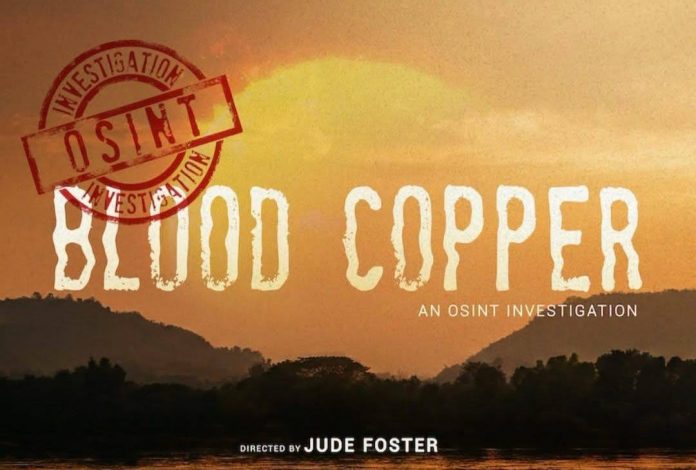
DVB collaborated with Myanmar Witness on the production of Blood Copper to combine documentary storytelling, investigative journalism, and OSINT methodologies. (Credit: DVB)

The Thai government rejected a direct request from the Chinese Embassy in Bangkok to block the screening of a documentary detailing severe human rights abuses linked to a Chinese-backed copper mine in Myanmar, press freedom advocates and prominent journalists confirmed this week.

The diplomatic friction centered on the June 15 screening of Blood Copper at the Foreign Correspondents’ Club of Thailand (FCCT).

The documentary, produced by DVB in collaboration with the investigative group Myanmar Witness, uses open-source intelligence (OSINT) to detail how Myanmar military forces have violently cleared villages in Sagaing Region to expand the Letpadaung Copper Mine.

According to sources, the Chinese Embassy explicitly pressured the Thai Ministry of Foreign Affairs to cancel the event. The Thai government ultimately declined to intervene, allowing the screening and panel discussion to proceed.

Pravit Rojanaphruk, a prominent Thai journalist and senior staff writer for Khaosod English, verified the incident, describing it as a “behind-the-scenes” display of heroism by Thai officials.

“The censorship attempt ultimately failed,” Rojanaphruk wrote on July 15. “This ‘behind-the-scenes’ record serves as a stark reminder of the ongoing threats to press freedom and freedom of expression and attempts to impose a Chinese media-censorship model on Thai media.”

Phil Robertson, director of Asia Human Rights and Labor Advocates (AHRLA) and a board member of the FCCT, characterized the embassy’s actions as part of an “accelerating campaign of transnational censorship and repression” that disregards Thai sovereignty.

“Over the past several weeks, we’ve seen the Chinese Embassy in Bangkok blatantly act to undermine media freedom in Thailand by seeking to censor this FCCT program, and then later by making menacing calls to media outlets,” Robertson said, referring to recent reports of embassy officials intimidating journalists who covered protests outside Chinese diplomatic missions.

“Fortunately, the Thai MFA pushed back against this brazen Chinese government campaign by declining to take action,” Robertson added.

A lucrative and deadly enterprise

The Letpadaung mining complex, located in Sagaing’s Salingyi Township, is a highly controversial joint venture between the Union of Myanmar Economic Holdings (UMEHL)—a military conglomerate—and Wanbao Mining, a subsidiary of the Chinese state-owned defense corporation Norinco.

For years, local communities have staged massive protests against land confiscation and severe environmental pollution linked to the site. Since the military seized power in a coup on Feb. 1, 2021, the area has become a fierce conflict zone.

Blood Copper utilizes satellite imagery, geolocation, and verified digital forensics gathered at significant risk by citizens on the ground. The film’s OSINT analysis proves that regime forces stationed at the mine are systematically attacking surrounding communities to expand the mining footprint.

The mine reportedly generates millions of dollars monthly, profits that rights groups argue flow directly into the military’s coffers to sustain its nationwide war against resistance forces.

Jude Foster, the director of Blood Copper, stated that Beijing’s push to silence the film exposes a deep sensitivity regarding the complicity of its state-owned enterprises in the regime’s atrocities.

“China’s pressure to stop the film screening is misplaced,” said Foster. “It should be stopping the Wanbao company’s collusion with the military regime and pressure it to honour its environmental and social responsibility commitments.”

Defending press freedom

The failed censorship attempt highlights the precarious environment for journalists operating in Southeast Asia, but also marks a significant defense of free expression by Thai authorities in the face of pressure from Beijing.

“The attack on Blood Copper also shows just how sensitive China is to the Burmese people’s massive opposition to the Letpadaung mining project,” Robertson noted. “The bottom line is China and its government-controlled companies are running amok in Myanmar, causing immense damage, but Beijing wants to hide that fact.”

The film’s creators emphasized that establishing a verified, evidence-based historical record is critical for future accountability, a task made possible only when platforms like the FCCT are protected from foreign interference.

“Our responsibility is to tell stories with integrity and allow audiences to engage with important issues through evidence and lived experiences,” said Chan Chan, the producer of the film and organizer of the DVB Peacock Film Festival.

“Freedom of expression and the press cannot just be arbitrarily wiped out in Thailand the same way it is done in China,” she added

Stay tuned to DVB English News for upcoming screenings of the 25-minute documentary film Blood Copper. Subscribe to the Daily Briefing for the latest on what’s happening in Myanmar.

Myanmar’s Hidden Crisis: Surviving War & Trauma [AUDIO]

0
Many rescued victims who were trafficked and forced to work at scam centres describe suffering from post-traumatic stress disorder and facing threats back home. (Credit: ILO)

Dr. Moe, a mental health practitioner and counsellor whose work focuses on trauma-informed care, joins us in the DVB Newsroom to discuss mental health for conflict-affected people in Myanmar, as well as psycho-education for adolescents, youths, and the wider public.

Contact