Thursday, July 23, 2026
Home Blog Page 68

Over 1,500 prisoners granted amnesty on Buddhist holiday; Aung San Suu Kyi sentence reduced

0
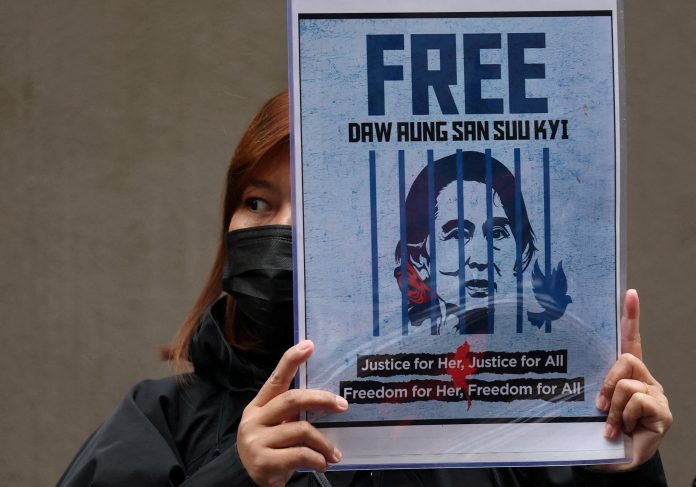
A Myanmar national living in Japan holds a placard of Myanmar's jailed State Counsellor Aung San Suu Kyi during a rally denouncing the military 2025-26 elections outside of the Myanmar embassy in Tokyo, Japan, on Dec. 14, 2025. (Credit: Reuters)

State Counsellor Aung San Suu Kyi’s 22-year sentence was reduced by one-sixth to 18 years in prison during an amnesty announced by Min Aung Hlaing for a total of 1,519 prisoners, including 11 foreigners, to mark Full Moon Day of Kason on Thursday.

“There [have been] rumors going around that she was going to be moved to house arrest or even potentially freed, but none of that seems to have materialized,” Kim Aris, Aung San Suu Kyi’s son, told DVB in an interview on April 20 – following the Myanmar New Year amnesty that reduced Aung San Suu Kyi’s 27-year prison sentence to 22.

The amnesty on April 17 was granted to a total of 4,514 prisoners, including President Win Myint and filmmaker Shin Daewe.

Min Aung Hlaing, inaugurated as president by a pro-military parliament on April 10, also announced that he would reduce the remaining sentences of all prisoners in Myanmar by one-sixth on April 30.

An official close to the regime’s Prisons Department told DVB on the condition of anonymity that over 200 inmates serving sentences for minor offences and nearing their release dates were freed from Yangon’s Insein Prison on April 30.

A source in the film industry told DVB that film director Aung Chan Lu, was released from Insein Prison only a few months into his seven-year sentence for “disrupting the elections” under the Election Protection Law in November.

Film director Zabu Tun Thet Lwin – arrested alongside Aung Chan Lu – was reportedly released. But DVB is unable to verify this claim independently. 

The Election Protection Law, enacted on July 29, carries a minimum sentence of three years in prison and a maximum penalty of death.

“Even if [my son’s] sentence is cut by one-sixth, he still has to stay in prison for 30 years,” the parent of an inmate at Yangon’s Insein Prison, convicted under the Election Protection Law, told DVB on the condition of anonymity. 

A total of 269 individuals have been charged, 84 people have been arrested, and nine people have been convicted under this law as of Jan. 31, according to DVB data. The heaviest sentence handed out so far was 49 years in prison. 

A former political prisoner told DVB on the condition of anonymity that he wants the regime to release more political detainees. DVB is awaiting figures of how many political prisoners will be freed in this amnesty. 

Four regime amnesties so far this year have reportedly freed a total of 22,391 prisoners. The Assistance Association for Political Prisoners (AAPP) reported that 22,047 people detained for opposing the military coup on Feb. 1, 2021 remain behind bars.

Myanmar’s military now looks set to resume offensive in bloody civil war

0
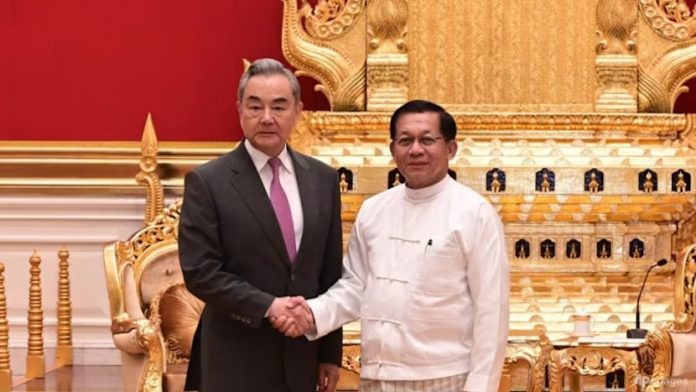
Chinese Foreign Minister Wang Yi meets Min Aung Hlaing, on the last leg of his regional tour, in Naypyidaw on April 25. (Credit: Regime)

A little more than a year ago, Myanmar’s military was on the back foot in the civil war, pushed out of great swaths of the country’s north by an alliance of seasoned militias, and forced into defensive action around the rest of the country by other established groups and new pro-democracy resistance forces.

Today the picture has changed.

With its ranks swollen by tens of thousands of new conscripts, the Myanmar military has reversed some of its losses and appears poised to resume the offensive, while some opposition groups have left the fight and infighting and supply issues have weakened others.

“I think we’re nearing a crescendo here where the [military] is going to reassert itself and the resistance movement is going to peter out,” said Morgan Michaels, a Singapore-based analyst with the International Institute of Strategic Studies (IISS) who runs its Myanmar Conflict Map project.

Still, he said, even if the broader resistance movement that has grown since the military seized power in 2021 stumbles, the conflict is not close to over.

“Armed resistance will always continue in Myanmar until there’s a comprehensive, negotiated political solution, but the [military] has retaken the strategic initiative and everything is in the [military’s] favor.”

Weariness after five years of civil war

Meantime, after five years of fighting that has seen tens of thousands killed, including some 8,000 civilians, and millions displaced from their homes, there is a general weariness, both among the forces fighting the military and the general population, said Aung Thu Nyein, a political analyst from Myanmar who now works in neighbouring Thailand.

“There are many saying that the local population doesn’t care much who will win the war, but [just want] to stop fighting,” he said in a text message.

There is also great pressure from China for stability in Myanmar which is a critical source for its rare earths elements and other natural resources, to ensure its mines and other operations are secure, he said.

Beijing has invested billions of dollars in Myanmar’s mines, oil and gas pipelines and other infrastructure and is a major arms supplier to the military, along with Russia.

It also carries significant influence with the paramilitary groups that operate in border areas with China, many of whose members are ethnically Chinese.

China seeks to protect its investments

China initially supported the Oct. 27, 2023, offensive against the military by three armed groups known as the Brotherhood Alliance, largely due to Beijing’s irritation that the regime in Naypyidaw had allowed organized crime operations to proliferate in border regions.

But it has since pulled the plug on arms and ammunition supplies to these armed groups and pressured them to stop fighting.

Of the Brotherhood Alliance members, both the Myanmar National Democratic Alliance Army (MNDAA) and the Ta’ang National Liberation Army (TNLA) agreed to ceasefires last year after Chinese-mediated talks, leaving the third member–the Arakan Army (AA)–the only still actively fighting the military in the western state of Rakhine.

The Brotherhood Alliance members are all long-standing paramilitary groups organized around ethnic minority lines known as Ethnic Armed Organizations (EAOs).

Aung San Suu Kyi’s ouster in the 2021 coup has also given rise to pro-democracy militias known as People’s Defense Force (PDF), many of which are affiliated with the shadow National Unity Government, organized by former members of Suu Kyi’s National League for Democracy (NLD) party and others.

Resistance fighters push for unity in face of military’s renewed power

In the face of an anticipated intensification of attacks by the military, there is a need for top-level coordination of resistance operations by established EAOs in concert with the National Unity Government (NUG), the Burma Liberation Democratic Front, a pro-democracy group that has been fighting in the Sagaing and Mandalay regions, told The Associated Press.

“Although there is a shared understanding of the need to overthrow the military dictatorship and move toward a future federal union, there are still gaps and differences in overall grand strategy and tactics,” the group told the AP in a written response to questions.

“There are still differences in positions, perspectives, and approaches. Many continue to hold onto ethnic, regional, and organizational interests and attachments.”

The group, which is part of an alliance of 20 PDFs, added that the military was actively “attempting to divide and weaken the situation by creating divisions between the public and revolutionary forces, among different ethnic groups, and even among revolutionary groups.”

The military officers who ousted the elected NLD government led by Suu Kyi in 2021 also successfully held elections recently, even though they were criticized by U.N. experts as neither free nor fair with opposition stifled.

Min Aung Hlaing, who as the military’s senior general led the country with an iron fist after ousting Suu Kyi, was sworn in as president on April 10.

Politically, the elections appeared to be a thinly veiled attempt to add a veneer of legitimacy to his rule to help improve relations with Southeast Asian neighbors and others as Myanmar struggles under international sanctions.

China, which had been pushing for the election, immediately congratulated Min Aung Hlaing and quickly sent its foreign minister to meet with him in person. The TNLA also sent a message of congratulations, pledging to uphold the ceasefire that China helped broker.

The conclusion of the elections also frees up more soldiers who had been used for widespread security at the polls, Michaels said.

Military offers to talk peace, but conditions unclear

In one of his first acts as president, Min Aung Hlaing invited the country’s armed resistance forces to new peace talks, including both the EAOs and the PDFs.

No mention was made of the NUG, which immediately denounced the offer as “aimed at prolonging people’s subjugation under military rule.”

The vague offer, reported in regime media, said the groups had until July 31 to take part in discussions, with the caveat that they should not come in with “unrealistic demands.”

There was no mention of what might happen if groups refused to take part in the process, and the regime in Naypyidaw did not respond to emails requesting comment.

In the meantime the military has continued its attacks, including pressing ahead with large-scale offensive in Sagaing to try and retake the northern city of Indaw, which was captured by PDFs with the support of the Kachin Independence Army (KIA) last year.

At the same time, it has been on the defensive in the east as it tries to hold off a push by the Karen National Liberation Army (KNLA) toward a military stronghold near the Thai border.

With the offer of talks, it seems likely Min Aung Hlaing is hoping to rekindle the Nationwide Ceasefire Agreement (NCA) made with about half of Myanmar’s EAOs by previous governments around a decade ago, which helped bring about relative calm.

But with seemingly little interest at the moment, more limited ceasefires may be the immediate goal, Michaels said.

“In the short term if you can agree to ceasefires with some groups, then you can redirect your resources toward other groups that are either unwilling to agree to a ceasefire or that the [military] is unwilling to agree to a ceasefire with,” he said.

“The [military] can always accept some degree of opposition and, in fact needs some level of active armed resistance to justify its rule and justify its behaviour. But the current level of armed resistance across the country is not tenable.”

AP

Employment agencies reluctant to secure jobs for conscripts; Myanmar migrant workers laid off in Thailand

0
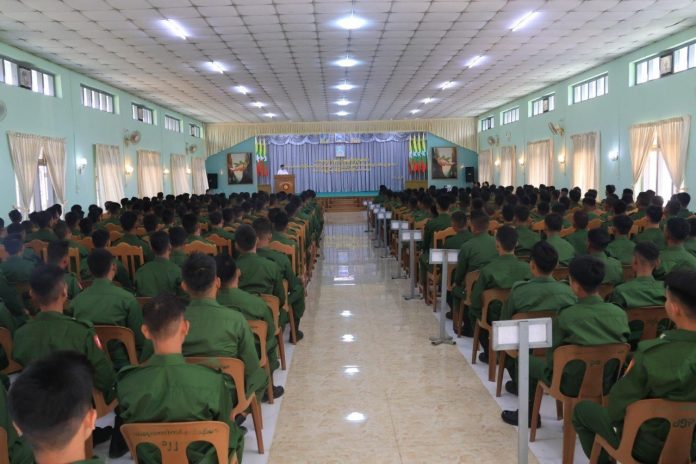
Military conscripts from the first intake drafted in 2024 at a ceremony marking the completion of their two-years of mandatory military service in Loikaw, Karenni State, on April 3. (Credit: Regime media)

Employment agencies reluctant to secure jobs for conscripts

During a “recent meeting” in the capital Naypyidaw, the regime’s Ministry of Labour directed the Myanmar Overseas Employment Agency Association (MOEAA) to facilitate potential job placements in Japan, Thailand, and Malaysia for conscripts who have completed their two-years of mandatory military service–a move denounced as a desperate incentive to lure more 18-35 year-old males to want to conscript. 

While the regime’s instruction is currently framed as an “encouragement” rather than a directive, agency operators are quietly resisting. A source from an overseas employment agency told DVB on the condition of anonymity that they are highly reluctant to cooperate, fearing that assisting the regime could destroy their credibility and expose them to public backlash or retaliatory attacks from resistance forces.

A labor group told DVB that the regime is now attempting to promise a streamlined path to work abroad—a process it has otherwise heavily restricted with mandatory taxes and forced remittances through state banks—in hopes to incentivize compliance with the conscription law, which was enforced on Feb. 10, 2024. To date, an estimated 110,000 males have been conscripted in 24 intakes since April 8, 2024. Read more

Myanmar migrant workers laid off in Thailand

Migrant workers from Burma in Thailand told DVB that thousands have been laid off from factories and workshops in Prachinburi and Chonburi provinces, located 84-50 miles (135-81 km) east and southeast of the Thai capital Bangkok, since March without prior notice due to rising oil prices and increasing production costs.

“Many of those laid off are in difficult situations. We are helping each other,” a migrant worker told DVB. The Worker Assistance Group for Myanmar, which assists migrant workers from Burma in Thailand, told DVB that the layoffs coincided with a document renewal period. This is when Thai employers issue documents to extend their workers’ stay in the country. This has left many at risk of being unable to remain.

The International Organization for Migration (IOM) states that 2,308,166 Burma nationals were registered as migrant workers in Thailand in March 2024. The number of undocumented migrant workers in Thailand remains unknown but is estimated to be over double the official number, according to IOM. 

Children walk through a refugee camp in Mae Hong Son Province, northern Thailand, on Aug. 27, 2025. (Credit: DVB)

Aid pledges have yet to improve life in Thai refugee camps

Aid workers assisting Myanmar refugees at Umpiem Mai camp in Thailand’s Tak Province and another camp in Mae Hong Son Province told DVB that there has been no significant improvement in healthcare services despite aid pledges from the E.U. for 15 million euros ($17 million USD) and Japan for 453 million yen ($2.95 million USD) in recent weeks.

“There are new donors which have already been confirmed, but we haven’t seen any noticeable changes yet,” a health worker at Umpiem Mai camp, located roughly 47 miles (87 km) south of the Thai-Burma border town of Mae Sot, told DVB on the condition of anonymity. An estimated 107,000 refugees live in nine camps along the Thai–Burma border.

The E.U. funds will strengthen healthcare, child protection, and livelihood opportunities for all refugees from Burma in Thailand. Japan pledged health assistance to 60,000 refugees living in Umpiem Mai, Mae La and Nu Po camps, which are located across the border from Karen State’s Myawaddy Township. Read more

News by Region

NAYPYIDAW—The regime’s Ministry of Labor announced that starting May 1 all migrant workers on leave must obtain a letter from their employer and the embassy of the host country before departing. The directive warns that those who fail to comply will be blacklisted and not allowed to leave the country.

The regime stated that the new measure is to “ensure safe migration and prevent human trafficking,” adding that if a migrant worker’s visa or work permit contains conflicting information with what’s on their Overseas Worker Identification Card (OWIC), then they must reapply at the labour ministry. 

KAREN—Migrants from Burma living in Thailand’s Mae Sot District in Tak Province confirmed DVB on Wednesday that the Thai-Myanmar Friendship Bridge 2, which connects Myawaddy to Mae Sot, remained closed despite reports from sources stating that it had reopened on April 28.

The border bridge was closed to trade on Aug. 18 during a regime crackdown on “illegal trade” from Thailand. Traders and bus drivers in Myawaddy told DVB that there are at least 10 police checkpoints searching for illegal Thai goods along the Asia Highway from Myawaddy to Yangon. Read more

KARENNI—The Interim Executive Council (IEC), a provisional government formed by resistance groups in 2023, told DVB that it’s investigating a shootout that killed one civilian and seven People’s Defence Force (PDF) members in Moebye town, located in Shan State’s Pekon Township, on Friday

Banyar Aung, the IEC secretary 2, told DVB that talks have been held between the Moebye PDF and “Alpha Zone 1,” which is under IEC command, without disclosing further details. Sources told DVB that the shootout occurred due to territorial disputes between the two armed groups. 

AYEYARWADY—Residents of Myaungmya Township told DVB that 26 homes and two warehouses were destroyed by fire on Tuesday–one day after nearly 300 market stalls burned down in Danubyu Township. Myaungmya and Danubyu are located 35-85 miles (56-137 km) east of the region’s capital Pathein. 

The regime’s regional authorities are investigating the cause of the fires in Myaungmya and Danubyu. No casualties were reported by residents in either town. On April 4, an unknown number of homes were destroyed by fire in Myaungmya, residents told DVB.  

(Exchange rate: $1 USD = 4,230 MMK) 

Stay up-to-date with the latest on #WhatsHappeninginMyanmar by subscribing for free to the DVB English News Daily Briefing newsletter.

Myanmar employment agencies reluctant to secure jobs for conscripts

0
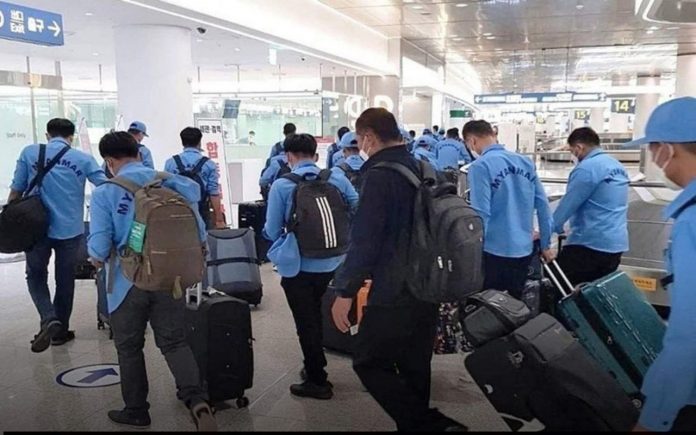
Myanmar migrant workers at Yangon International Airport before departing for South Korea on Dec. 16, 2025. (Credit: Regime media)

Myanmar’s military regime is attempting to use the promise of overseas employment to lure more young men into mandatory military service, a move that is facing resistance from employment agencies and arriving alongside new travel restrictions for existing migrant workers.

During a recent meeting in Naypyidaw, the regime’s Ministry of Labour instructed the Myanmar Overseas Employment Agency Association (MOEAA) to help secure jobs in Japan, Thailand, and Malaysia for conscripts who have completed their mandatory two-years of military service.

While the directive is currently framed as “encouragement” rather than a strict mandate, employment agency operators are highly reluctant to cooperate.

Speaking to DVB on the condition of anonymity, one agency source expressed fear that assisting the military regime could severely damage their credibility and expose them to public backlash or retaliatory attacks.

The carrot and the stick

The push to reward discharged soldiers with foreign jobs acts as a desperate “incentive” to encourage draft compliance, labor groups say, as widespread economic instability drives a mass exodus of Myanmar’s youth.

However, this supposed incentive is paired with a severe tightening of the regime’s grip on those already working abroad.

The Ministry of Labour in Naypyidaw recently announced that, starting May 1, all migrant workers returning home on leave must obtain official letters from their foreign employer and the host country’s embassy before they will be permitted to depart Myanmar again.

The regime claims the new rule is designed to “ensure safe migration and prevent human trafficking.” In reality, the regime warned that those who fail to comply will be blacklisted and barred from leaving the country.

These new hurdles compound existing restrictions imposed since the 2021 military coup. Overseas employment agencies report that the regime routinely stalls documentation to enforce mandatory tax payments and the forced remittance of foreign currency earnings through state-run banks.

A hollow promise for conscripts?

According to an October report by the United Nations Development Programme (UNDP), roughly 40 per cent of young people in Myanmar would leave the country if given the chance, driven by a collapsing economy and profound fears of military conscription.

By weaponizing this desire to leave, the military hopes to fill its dwindling ranks. Since the nationwide conscription law was enforced in February 2024, the regime has initiated 24 rounds of recruitment.

With a quota of 5,000 conscripts per intake, an estimated 110,000 men between the ages of 18 and 35 have been forced into the military since April 2024.

Yet, whether many conscripts will survive to see the promised benefit of foreign employment remains highly questionable.

Sources close to the regime revealed that out of the 5,155 conscripts from the very first intake, only 631 have been officially discharged and allowed to return home after completing their two years of mandatory military service.

With only a small fraction of recruits being officially discharged upon completing their service, the regime’s promise of an overseas job appears to be a highly elusive reward.

Photos show how toxic runoff from rare earth mines are risking Southeast Asia’s rivers

0
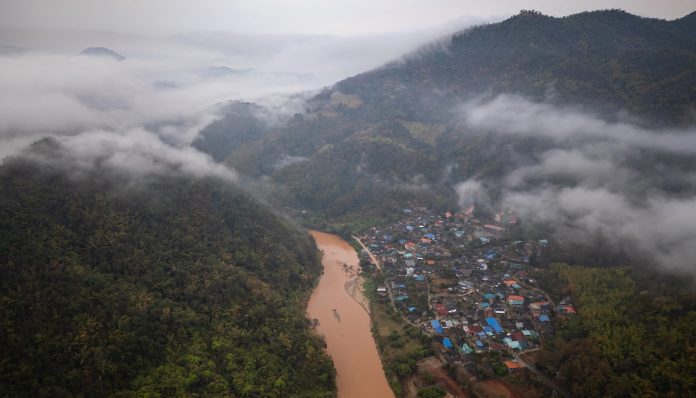
Mist covers the Thai village of Tha Ton, where the Kok River enters Thailand from Myanmar, on Feb. 20, 2026. (Credit: AP)

Chiang Saen, THAILAND (AP) — A lone finger-length fish was a disappointing start to 75-year-old Sukjai Yana’s day. He recast his net from the bow of his long-tail fishing boat, slowly drifting towards the confluence of the Mekong and Kok rivers in northern Thailand.

Thailand is bearing the brunt as toxic runoff from rare earth mines in upstream Myanmar and Laos seep into the Mekong Basin, threatening millions who rely on its waters for farms and fisheries.

Fisherman Sukjai Yana catches a small fish from the Kok River in Chiang Saen, Thailand, on Feb. 22, 2026. (Credit: AP)

These heavy metal toxins imperil Southeast Asia’s globally important, multi-billion-dollar produce industry, backbone of its developing economies.

“The Mekong and Kok Rivers are both a source of food and income, which gives life to the people,” said Sayan Khamnueng of the Living Rivers Association. “The river contaminants are the biggest transboundary issue we’ve ever faced.”

Researcher Khanasuan Kaeothip takes a water sample from the Kok River, in Chiang Saen, Thailand, on Feb. 17, 2026. (Credit: AP)

Thailand’s response to the spreading problem has been limited to monitoring levels of heavy metals and educating communities about health risks. That raises concerns for Cambodia and Vietnam, downstream.

“If the contamination continues … the new generation (will) have to move to the city because they cannot continue their farmer’s life,” said Sangrawee Suweerakarn of the Romphothi Foundation, an advocacy group for the Shan ethnic group.

Field workers collect garlic from a farm on the banks of the Kok River in Tha Ton, Thailand, on Feb. 21, 2026. (Credit: AP)
Researchers Khanasuan Kaeothip, left, and Warakorn Maneechuket prepare to take samples from the Kok River in Chiang Saen, Thailand, on Feb. 17, 2026. (Credit: AP)
Researcher Warakorn Maneechuket collects a fish sample at a Naresuan University laboratory in Phitsanulok, Thailand, on Feb. 19, 2026. (Credit: AP)
Fisherman Sukjai Yana steers a boat down the Kok River in Chiang Saen, Thailand, on Feb. 21, 2026. (Credit: AP)
Fish are caught in a net on the Kok River in Chiang Saen, Thailand, on Feb. 22, 2026. (Credit: AP)
The Golden Triangle border region between Thailand, left. Myanmar, center, and Laos, right, in Chiang Saen, on Feb. 22, 2026. (Credit: AP)

AP

Thai-Myanmar bridge remains closed as smuggling continues along Asia Highway

0
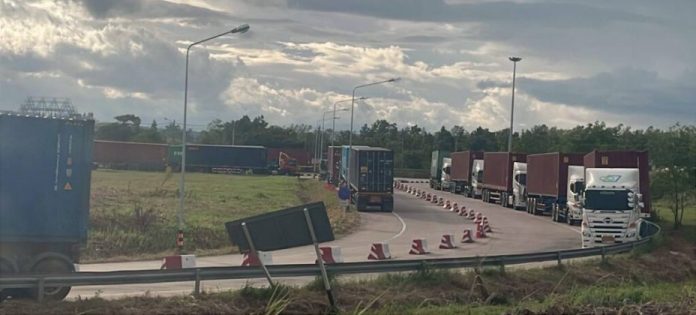
Cargo trucks waiting on the Thai side of the Thailand-Myanmar Friendship Bridge 2 after regime authorities halted all border trade and closed the gate on Aug. 18. (Credit: KIC)

Myanmar migrants in Thailand’s Mae Sot District in Tak Province told DVB that the Thai-Myanmar Friendship Bridge 2, which connects Myanmar’s Myawaddy Township in Karen State to Mae Sot, remained closed as of Wednesday, despite reports that it had reopened on Tuesday.

A migrant in Mae Sot told DVB on the condition of anonymity that they still don’t know the date of the bridge’s reopening. It has been closed since Aug. 18 due to a regime crackdown on “illegal trade.”

Traders and bus drivers in the Myanmar-Thai border town of Myawaddy told DVB on the condition of anonymity that there are at least 10 police checkpoints searching for illegal Thai goods along the Asia Highway, which drives up the price for these goods at markets in Yangon. 

The regime’s Karen State administration reopened a 27-mile (43 km) stretch of the highway called the Myawaddy-Kawkareik road on April 2.

But it only allows passenger vehicles to use it and bars cargo trucks from transporting goods along it. The Asia Highway and national roads connect Myawaddy to Yangon via the Karen State capital Hpa-An, which is located 81 miles (130 km) west of Myawaddy.

The Myawaddy-Kawkareik road had been closed due to a military counteroffensive launched against the Karen National Liberation Army (KNLA) in December 2023. The KNLA seized control of Myawaddy for 12 days in April 2024.

Cargo truck drivers told DVB that they smuggle goods from Thailand via roads in Karen State that cut through the forests and mountains to reach Hpa-An, then are able to use national roads via Mon State’s Bilin and Kyaikto townships to reach Yangon Region. 

Bilin and Kyaikto are located 70-87 miles (112-140 km) north of the Mon State capital Mawlamyine and 106-124 miles (170-199 km) east of Yangon. A driver in Mawlamyine told DVB that the regime’s Road Transportation Administration Department demand bribes of at least one tical (15.16 g) of gold per truck to release seized cargo trucks,

One tical of gold is priced around 10 million MMK ($2,300 USD). 

The final police checkpoint before reaching Yangon is in Bago Region’s Nyaungkharshey village-tract, located 38 miles (61 km) east of the region’s capital Bago and 88 miles (141 km) northeast of Yangon. 

Cargo truck drivers told DVB that the police at the Nyaungkharshey checkpoint rarely seize their trucks. But when they do, they confiscate all of its cargo.

Note: This report was updated at 8:30 p.m. Thailand time on April 29, 2026.

Contact