
Thursday, July 23, 2026
Home Blog Page 69

Rare earth mining is poisoning Mekong River tributaries, threatening ‘the world’s kitchen’

0
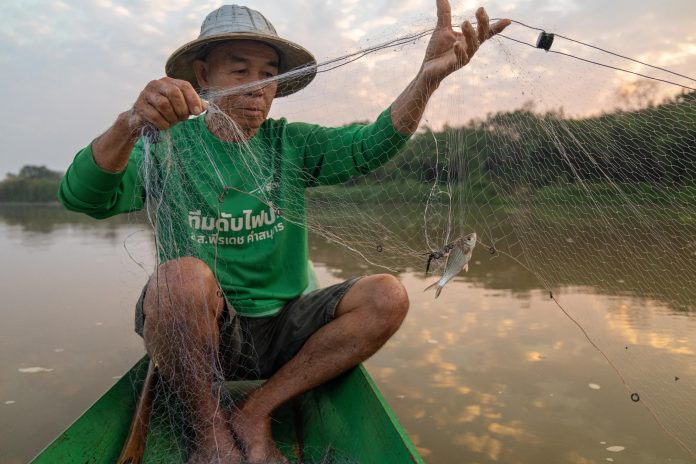
Fisherman Sukjai Yana catches a small fish from the Kok River in Chiang Saen, Thailand, on Feb. 22, 2026. (Credit: AP)

Chiang Saen, THAILAND (AP) — Perched on the bow of his long-tail fishing boat, 75-year-old Sukjai Yana untangled a handful of small fish from his net, disappointed by his catch and fretting over whether he can sell them.

Some days Yana earns nothing: demand for fish is falling due to worries over contamination of the Mekong River and its tributaries by toxic runoff from rare earth mines upstream that is threatening millions who rely on those waters for farms and fisheries.

Chiang Saen, a fishing hub in northern Thailand, has been Yana’s family’s home for decades. “I don’t know where else I’d go,” he said.

Yana is one of 70 million people in mainland Southeast Asia who depend on the nearly 3,100 mile (5,000 km) long Mekong River. Rising demand for rare earth materials is driving an unregulated mining boom centered in Myanmar, to the west, that is spreading to Laos, in the east.

The Mekong has long faced mounting pressures, from plastic pollution to hydropower dams hemming it upstream and sand mining devouring its banks. But experts warn that the toxic runoff from the mines could pose an existential threat.

Exposure to heavy metals such as arsenic, mercury, lead and cadmium raises risks of cancer, organ failure and developmental harm, especially for children and pregnant women.

Thailand is bearing the brunt of the mining boom as such toxins imperil its global food exports — from bags of rice in U.S. supermarkets to edamame snacks served in Japan and garlic used in Malaysian kitchens.

Responses remain local and limited, while smuggling and Myanmar’s civil war complicate regional fixes, raising concerns for downstream Cambodia and Vietnam.

Agriculture is the backbone of Southeast Asia’s economies, said Suebsakun Kidnukorn of Mae Fah Luang University in northern Thailand’s Chiang Rai, warning that rare earth mines are destroying “the world’s kitchen.”

Toxic runoff seeps into Thailand

While cutting banana bunches on a farm in the hilly Thai village of Tha Ton, 63-year-old Lah Boonruang taps his fingers to count the toxin-exposed crops he harvests — rice, garlic, corn, onion, mangoes and bananas.

He irrigates his fields with water from the Kok River, a Mekong tributary that flows into Thailand from Myanmar and is laden with toxins.

“Everyone is afraid of the toxins,” he said. “If we can’t export, a farmer is the first to die.”

Thailand is one of the world’s top rice exporters along with India and Vietnam. It exported over $10 billion USD worth of rice and fruits in 2024, according to trade figures that rank the U.S. as the top rice importer.

“Our worry is that toxins accumulate in the rice we export. This would make our rice farming industry, which is our culture, collapse,” said Niwat Roykaew, founder of the environmental institute The Mekong School in northern Thailand’s Chiang Khong.

Thai scientists have found elevated heavy metal pollution in other Mekong tributaries, like the Sai and Ruak rivers.

The Mekong starts in China and flows through five Southeast Asian nations before emptying into the sea. Millions rely on fish from the Mekong Basin for protein.

Warnings to ethnic minorities in the hills of northern Thailand to avoid using river water are painful for the Lahu, who are famed as fisher people, said Sela Lipo, 56, a Lahu elder.

“The Lahu’s way of life is always with a river,” he said. “The contaminated river has cut off our lifeline.”

Solutions are local and limited

Thailand’s government says it has little leverage against mining operations across the border in strife-torn Myanmar and Laos.

The Thai response has also been constrained by limited expertise, information and funds, said Aweera Pakkamart of Thailand’s Pollution Control Department.

Instead, public universities, local governments and regional organizations like the Mekong River Commission, have mainly focused on monitoring levels of heavy metals and educating communities about risks.

Recent water, fish and sediment samples from Mekong tributaries had high levels of dangerous heavy metals, such as arsenic, mercury, lead and cadmium, from rare earth mining, said Warakorn Maneechuket, a researcher at Thailand’s Naresuan University.

In a lab, she uses a scalpel to point out tell-tale signs of contamination — tumor-like growths, discolored scales, and unusual eye coloration — before dissecting a catfish caught from the Kok River.

The accumulation of heavy metals is insidious. Arsenic can cause organ failure. Mercury damages the nervous system. Lead impairs cognition and cadmium harms the kidneys.

To raise awareness of health risks, Tanapon Phenrat of Naresuan University helped develop a smartphone fish safety app, training fishers in Chiang Saen to use it to identify and upload images of suspicious fish.

Building a citizen-science database for northern Thailand can help quantify the scale and spread of contamination, he said.

“Each and every sample is very important,” he said.

Rare earth demand rises

The ubiquity of rare earth elements means demand keeps rising.

Rare earths are vital to modern technology, from smartphones and electric vehicles to missiles and jets. Despite the name, they are common. It is the costly mining and complex refining process, concentrated in China, that makes them scarce.

The U.S.-based Stimson Center has used satellite photo analysis to identify nearly 800 suspected unregulated rare earth and other mining sites along Mekong tributaries in Laos, Myanmar and Cambodia.

Many in Myanmar are in areas of active fighting. The war has driven a “diversification of mines” geographically, according to Regan Kwan of The Stimson Center, who has tracked expansion of mining to 26 sites along rivers in Laos.

Rare earths are mined by digging up rock or washing chemicals through soil to extract the minerals, creating toxic waste. The physical footprint of this process is recognizable in satellite data, Kwan said.

Myanmar is China’s leading supplier of heavy rare earths, exporting more than $4.2 billion USD worth of such materials to China between 2017 and 2024, mostly after a military takeover in 2021.

U.S. President Donald Trump made securing America’s supply of critical minerals and rare earths a key foreign policy objective.

Used in fighter jets like the F-35, submarines, Tomahawk missiles, radar systems and smart bombs, according to the U.S. government, the need for more supplies is growing as the U.S. replenishes and expands military stockpiles drawn down by the wars in Iran and Ukraine.

This is bad news for the river that sustains mainland Southeast Asia.

Conflicts in last century — which include the Vietnam War and the Khmer Rouge genocide — were the most devastating for the Mekong region, but toxic runoff ranks a close second, said Brian Eyler of the Stimson Center, who called it an “atomic bomb” for river basin.

It’s far more damaging than other threats like large dams and “it is not stopping.”

AP
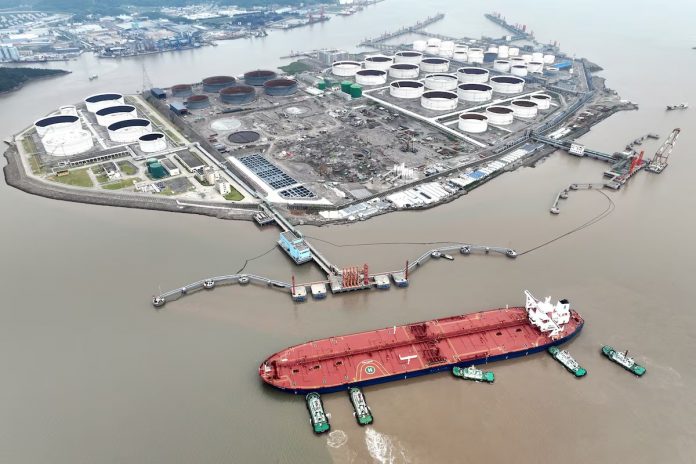
China approves higher May fuel exports though down from a year ago, sources say

0
An aerial view shows tugboats helping a crude oil tanker to berth at an oil terminal, off China's Waidiao Island in Zhoushan, Zhejiang province, on July 18, 2022. (Credit: Reuters)

China has approved an increase in refined fuel exports for ​May to regions other than Hong Kong, two trading ‌sources said on Wednesday, though levels remain below last year’s average.

The world’s largest oil importer will allow 500,000 metric tons of refined fuel exports ​next month, said the sources, who have direct knowledge ​of the matter. That is up from estimates from ⁠ship-tracking company Vortexa of April exports of about 320,000 ​tons.

Beijing has clamped down on its fuel exports since March to ​safeguard the domestic market from crude and fuel supply disruptions caused by closure of the Strait of Hormuz because of the U.S.-Israeli war with ​Iran.

Countries such as Cambodia, Laos, Australia, Bangladesh, Maldives and Myanmar ​are expected to receive fuels, with the Chinese government designating the volumes and ‌destinations, the ⁠two sources said.

The National Development and Reform Commission and Ministry of Commerce did not immediately respond to requests for comment.

Last year, China exported an average of about 1.6 million tons per ​month of gasoline, ​diesel and ⁠jet fuel to regions outside Hong Kong, Kpler ship-tracking data showed.

The small increases in shipments were ​a result of lobbying by state refiners to ​resume some ⁠overseas sales to capture strong export margins for all three fuels as surging crude costs and lagging Chinese pump fuel prices ⁠weigh ​on domestic processing margins, the sources said.

REUTERS

Thailand sees Australia and Japan as intermediaries in tackling Myanmar’s pollution of watercourses

0
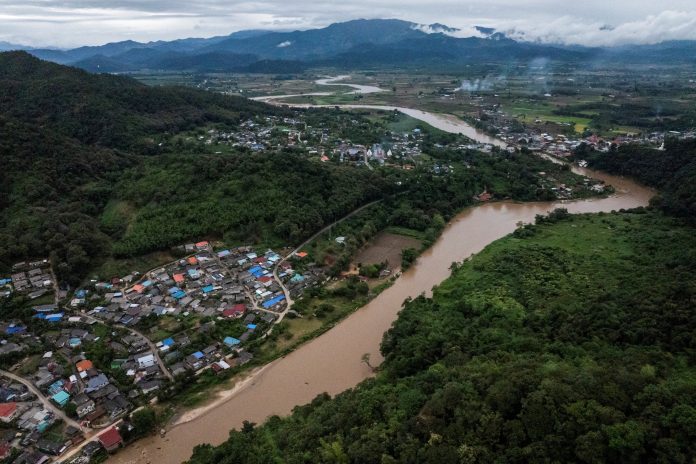
A drone view shows the Kok River, which flows through Tha Ton village in northern Thailand's Chiang Mai Province after entering Thailand from Myanmar which has become the main water source across Chiang Mai and Chiang Rai provinces, amid increased rare earth and gold mining at the river’s source in Myanmar, where unregulated operations may release toxic chemicals, according to a Stimson Center report on November 5, 2025. (Credit: Reuters)

Thailand’s Ministry of Natural Resources and Environment has announced plans to engage Australia and Japan as neutral intermediaries in efforts to address toxic heavy metal contamination of the Kok, Sai, Ruak, and Mekong rivers. The pollution is believed to be from rare earth mineral mining in Myanmar’s Shan State.

“Involving third-party nations is crucial for diplomatic transparency and long-term resolution,” said Natural Resources and Environment Minister Suchart Chomklin, following a high-level disaster management meeting chaired by Thai Prime Minister Anutin Charnvirakul on April 20.

According to the Thailand’s Pollution Control Department (PCD), high levels of arsenic have been detected in northern Thai watercourses, particularly during the dry season when lower water volumes lead to higher concentrations of sediment.

“Australia and Japan are major importers of these minerals, which pass through Thailand. Their involvement as mediators is essential because Myanmar may be more receptive to their technical findings than to direct claims from Thailand,” Suchart added.

The proposed cooperation would focus on gaining access to conduct water quality testing in Myanmar, deploying advanced technology to convert toxic river sediment into construction materials and alleviating public anxiety over the safety of drinking water, fish and crops.

PCD Director General Surin Worakijthamrong reported that, while arsenic levels in the Kok River fluctuate, levels in the Ruak and Mekong rivers remain above safe levels at almost every testing location.

To restore public trust, the PCD is seeking an emergency budget to install 18 automated monitoring stations. These would provide 24-hour real-time water quality data along the Kok, Mekong and Salween rivers.

“The goal is to ensure every village knows exactly when or whether the water is safe,” Suchart said. “We need to communicate clearly through health and local authorities.”

Despite the high sediment levels in raw river water, representatives from the Ministry of Public Health confirmed that processed tap water, agricultural produce and livestock remain safe to consume.

A joint investigation by several departments, including agriculture and livestock development, found that arsenic levels in vegetables, fruit and meat currently meet safety standards.

Health officials are, however, expanding surveillance of the health of over 1,400 farmers living in high-risk areas across seven districts.

The move highlights the complexity of the supply chain of rare earth elements, which are vital for modern electronics.

While China remains the dominant global producer, Myanmar has emerged as another significant source, with much of the ore transiting through Thailand to markets like Japan and Australia.

While the meeting in Chiang Mai focused primarily on immediate measures for dealing with forest fires and their contribution to PM2.5 airborne pollution, the contamination of the northern river basins has emerged as a critical transboundary challenge requiring urgent international intervention.

ThaiPBS World

The conditions of President Win Myint’s house arrest

0
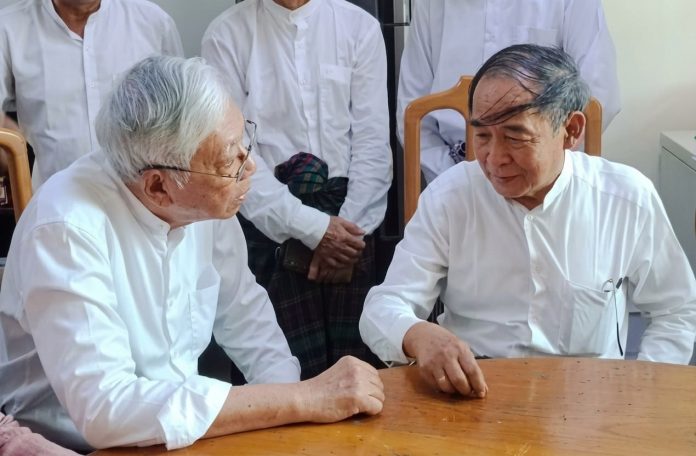
Former National League for Democracy President Htin Kyaw [left] with President Win Myint at his residence in Naypyidaw on April 17. (Credit: Htin Lin Oo)

A source close to the National League for Democracy (NLD) party told DVB that Myanmar President Win Myint’s residence in Naypyidaw, as well as homes of other NLD executive members, are under “strict surveillance.” Read more.

Military outpost seized in Karen State; UN expert slams global inaction on Myanmar in final human rights report

0
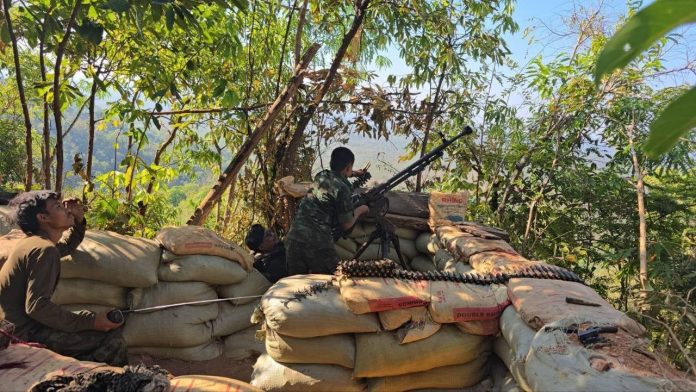
The Karen National Liberation Army on the frontline in Kawkareik Township, Karen State, fighting against regime forces in March. (Credit: CJ)

Military outpost seized in Karen State’s Hpapun

The Karen National Union (KNU) told DVB that its armed wing, the Karen National Liberation Army (KNLA), seized control of the regime’s Kabawtu outpost in Karen State’s Hpapun Township, known as Mutraw by the KNU, on Saturday. Hpapun, located 110 miles (177 km) north of the Karen State capital Hpa-An, is in KNU Brigade 5 territory.

Kler Doh, the KNU Brigade 5 spokesperson, told DVB that seven military outposts remain under regime control in Brigade 5 territory in northern Karen State, adding that the KNLA and its allied resistance forces are facing daily airstrikes carried out by the Burma Air Force. No casualties have been reported by the KNU. The regime in Naypyidaw doesn’t report military casualty figures.

Kler Doh claimed that the remaining seven regime outposts have been “besieged” by KNLA-led resistance forces, with Burma Air Force jets airdropping food, medicine and ammunition to regime forces stationed inside. Min Aung Hlaing, inaugurated as Burma’s president by a pro-military parliament on April 10, placed Karen’s Kawkareik and Kyainseikgyi townships under martial law on April 23.

EU extends sanctions against Myanmar until 2027

The E.U. on Monday extended its sanctions against Burma until at least May 2027, in ​an effort to maintain pressure on Min Aung Hlaing’s regime more than five years after he led a coup that ousted the elected National League for Democracy (NLD) government led by State Counsellor Aung San Suu Kyi and placed her in detention on Feb. 1, 2021

“The ​E.U. reiterates its strongest condemnation of the actions taken ​by the Myanmar military since the 2021 coup,” it stated, citing what it described as continuing grave human rights violations ​and widespread restrictions on fundamental freedoms. It called for ​an end to all violence and the release of people who ‌have ⁠been arbitrarily detained. 

The E.U. continues to ⁠withhold ​direct financial assistance to the regime in Naypyidaw. These measures include asset freezes, travel bans and ​an arms embargo for 105 individuals and 22 ​entities, which have been imposed since the ⁠2021 coup and the subsequent military crackdown on opposition to the coup in Burma. Read more

UN Special Rapporteur on the situation of human rights in Myanmar, Tom Andrews, speaks at a meeting in Bangkok, Thailand, on July 11, 2024. (Credit: Reuters)

UN expert slams global inaction in final report

Tom Andrews, the U.N. Special Rapporteur on the situation of human rights in Burma, issued an urgent call for the international community to step up justice and accountability efforts since the 2021 coup in his final report, titled From Impunity to Justice.

“The international community has done far too little to support those seeking justice and accountability,” said Andrews. “For the people of Myanmar, justice delayed is justice denied.” He called for international justice mechanisms to prosecute the military for crimes in Burma.

Andrews explicitly condemned the U.N. Security Council’s ongoing refusal to refer the crisis in Burma to the International Criminal Court (ICC), calling the failure an “abdication of responsibility and an indictment of the world’s commitment to justice.” Read more

Read our latest DVB English News op-ed: Written in Beijing, pitched in Washington, welcomed in Bangkok

News by Region

SHAN—One civilian and seven People’s Defense Force (PDF) members, including PDF leader “Aung Min,” were killed in southern Shan’s Pekon Township during a shootout between his PDF and members of a new resistance unit called “Alpha Zone 1” in Moebye town on Friday, sources told DVB. 

“This infighting hurts people’s confidence in the resistance,” a Moebye resident told DVB on the condition of anonymity. “Alpha Zone 1” was formed by the Karenni Nationalities Defence Force (KNDF) under the command of the Karenni State Interim Executive Council (IEC) on April 20. Read more

SAGAING—Residents in Chaung-U, Ayardaw, and Depayin townships told DVB that at least 100 homes and shelters were destroyed by rain and wind on April 25. The three towns are located 14-50 miles (22-80 km) southeast, northeast, and northwest of the region’s capital Monywa.

A Chaung-U resident told DVB that those displaced from their homes due to conflict, who are living temporarily at Internally Displaced Persons (IDP) camps, are in need of urgent food and shelter materials. IDPs in Chaung-U, Ayardaw and Depayin rely on assistance for basic needs.

MAGWAY—Residents of Saw Township told DVB that over 200 regime troops arrived in Kangyi village, located along the Saw-Mindat road which leads into Arakan State, on Sunday. Saw, located 163 miles (263 km) northwest of the region’s capital Magway, is partially controlled by the PDF.

A trader from neighbouring Arakan State told DVB that all trade between Magway’s Saw and Chin State’s Mindat Township has stopped. Residents have relied on trade from India, via Chin, into Arakan and Magway since a military blockade began after the Arakan Army (AA) launched an offensive in 2023

(Exchange rate: $1 USD = 4,200 MMK) 

Stay up-to-date with the latest on #WhatsHappeninginMyanmar by subscribing for free to the DVB English News Daily Briefing newsletter.

UN expert slams global inaction on Myanmar in final report

0
UN Special Rapporteur on the situation of human rights in Myanmar, Tom Andrews, speaks at a meeting in Bangkok, Thailand, on July 11, 2024. (Credit: Reuters)

The international community has failed the people of Myanmar by allowing the cycle of military atrocities and impunity to go unpunished, a U.N. human rights expert warned in a scathing final report on April 27.

Tom Andrews, the U.N. Special Rapporteur on the situation of human rights in Myanmar, issued an urgent call for global leaders to step up accountability efforts in a report titled From Impunity to Justice.

He emphasized that ending the country’s crisis requires not only dismantling the military’s capacity to oppress its people, but actively prosecuting the architects of its worst crimes.

“The international community has done far too little to support those seeking justice and accountability,” said Andrews. “For the people of Myanmar, justice delayed is justice denied.”

A system of unchecked impunity

Despite international investigators and local civil society groups gathering abundant evidence of war crimes—including the systematic targeting of civilian populations, the persecution of ethnic minorities, and widespread sexual violence—Andrews noted that not a single senior military official has faced justice.

While cases before international tribunals and under universal jurisdiction in foreign countries offer victims a “glimmer of hope,” Andrews warned that these efforts remain too narrow in scope to break the systemic impunity shielding Myanmar’s generals from prosecution.

Andrews explicitly condemned the U.N. Security Council’s ongoing refusal to refer the Myanmar crisis to the International Criminal Court (ICC), calling the failure an “abdication of responsibility and an indictment of the world’s commitment to justice.”

A looming genocide verdict

The U.N. expert laid out concrete steps for the international community to take, urging nations to expand the application of universal jurisdiction, broaden ICC investigations, and establish a reparations fund for victims.

He also issued a stark warning ahead of a pending judgment by the International Court of Justice (ICJ) regarding the genocide committed against the Rohingya minority.

Andrews specifically called out the United Kingdom—the U.N. Security Council’s penholder on Myanmar—and the Association of Southeast Asian Nations (ASEAN) to lead the charge.

“They must lead a coordinated international effort to isolate the new military-controlled government and pressure Myanmar to comply with any Court orders,” Andrews stated.

“In the case of a ruling against Myanmar, States must act swiftly and decisively to make clear that genocide is an intolerable stain on humanity’s conscience.”

Supporting local champions of justice

Despite the international paralysis, Andrews praised the relentless work of Myanmar’s local activists, human rights defenders, lawyers, and revolutionary bodies who are actively developing new institutions to hold perpetrators accountable.

He called on global powers to provide the technical support and long-term financial resources necessary to rebuild judicial institutions that have been hollowed out by decades of military domination.

“Opportunities to break the cycle of impunity that has gripped Myanmar are available,” Andrews concluded. “What is missing is the political will to seize them.”

UN

Contact