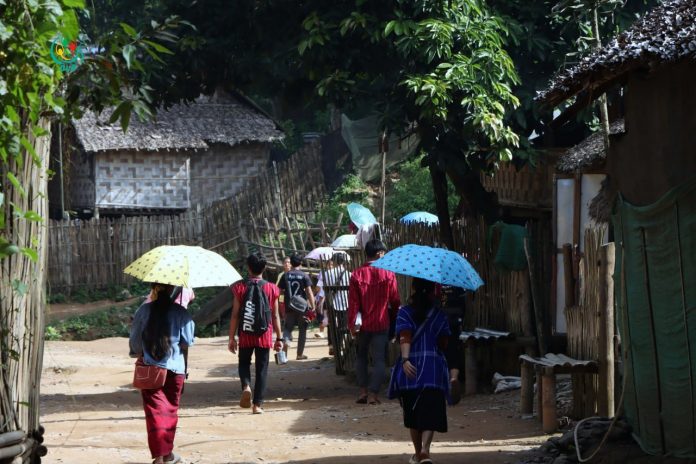
Children walk through a refugee camp in Mae Hong Son Province, northern Thailand, on Aug. 27, 2025. (Credit: DVB)
Aid workers assisting Myanmar refugees at Umpiem Mai camp in Thailand’s Tak Province and another camp in Mae Hong Son Province told DVB that there has been no significant improvement in healthcare services despite aid pledges from the E.U. and Japan in recent weeks.
“There are new donors which have already been confirmed, but we haven’t seen any noticeable changes yet,” a health worker at Umpiem Mai camp, located roughly 47 miles (87 km) south of the Thai-Myanmar border town of Mae Sot, told DVB on the condition of anonymity.
“There is a growing number of patients avoiding hospitals because they can’t afford the high cost… some have died,” the health worker told DVB, without sharing any figures.
She added that monthly stipends for herself and 22 colleagues – down from 220 in January 2025 when U.S. funding cuts were first announced – are expected to drop from 5,000-3,000 Thai baht ($135-80 USD) in the “coming months.”
The U.S.-based International Rescue Committee (IRC), which previously provided healthcare services in all nine camps along the Thai-Myanmar border, halted nearly all of its primary care operations following the announced cuts.
Besides the three camps in Tak Province, another four are located in Mae Hong Son Province bordering Myanmar’s Karenni State with one each in Kanchanaburi and Ratchaburi provinces bordering Myanmar’s Karen State and Tanintharyi Region.
“We aim to ensure that refugees have equitable access to essential services while building the skills and opportunities needed for self-reliance,” Darren Hertz, the IRC country director in Thailand, stated in the E.U. press release announcing the aid programme on April 20.
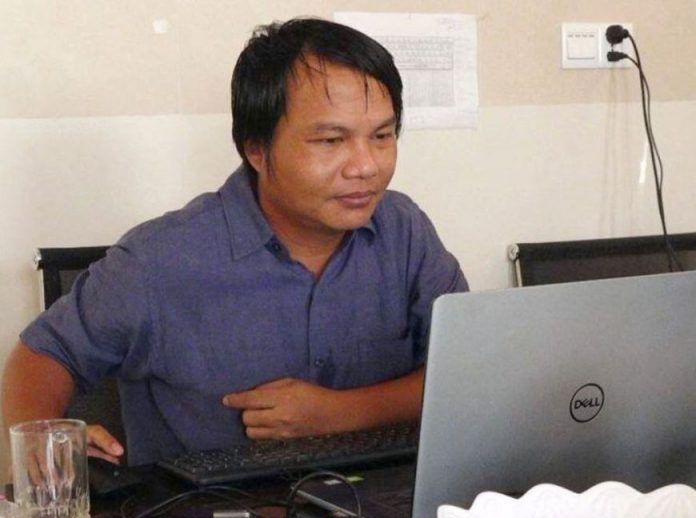
Sai Zaw Thaike at his desk at Myanmar Now’s office in Yangon in an undated photo before the 2021 military coup. (Credit: Myanmar Now)
Bangkok, April 27, 2026—The Committee to Protect Journalists calls on Myanmar’s military junta to immediately provide journalist Sai Zaw Thaike with adequate medical care after sources at Insein Prison in the country’s largest city Yangon said authorities have refused him treatment for grave health conditions.
Sai Zaw Thaike, a photojournalist with the independent Myanmar Now who is serving a 20-year prison sentence for treason, is suffering from severe kidney disease and hemorrhoids and requires urgent major surgery, according to a Myanmar Now report and confirmed to CPJ by the exile-run publication’s editor-in-chief Swe Win.
Prison authorities have refused to allow him access to either the prison hospital or an external medical facility, and are treating him only with oral medication, those sources said. It remains unclear whether the medicines required are even available inside the prison, they said.
“Every day that passes without journalist Sai Zaw Thaike receiving the surgery he needs is a day his life is placed at greater risk,” said Shawn Crispin, CPJ’s senior Southeast Asia representative. “Myanmar’s junta must immediately end its abuse of the reporter and grant him access to medical treatment without delay.”
Sai Zaw Thaike was arrested by the military in Sittwe in May 2023 while covering the destruction caused by Cyclone Mocha in Rakhine state. He was sentenced to 20 years in prison with hard labor later that year.
In January 2025, Sai Zaw Thaike was subjected to “daily physical abuse” and “retaliatory torture.”
The abuse was believed to be in response to Sai Zaw Thaike and two other prisoners informing visiting National Human Rights Commission representatives that prison staff were violating other inmates’ human rights, Myanmar Now said, citing a source connected to the prison.
Myanmar Now reported that it attempted to contact prison authorities for comment about the Sai Zaw Thaike’s condition, but received no response. CPJ also sought comment from junta officials via email but did not receive a reply.
Myanmar currently holds at least 18 journalists behind bars, according to CPJ data, and ranked second worldwide on CPJ’s annual prison census conducted on December 1, 2025.
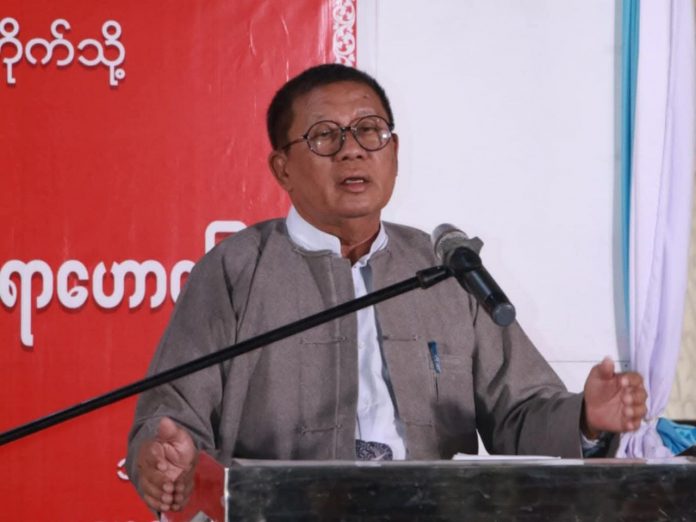
Writer Tin Nyunt gives a literary talk in Pyinmana Township, Naypyidaw, in November 2025. (Credit: Tin Nyunt)
Three detained over books deemed ‘critical’ of military
Sources told DVB that award-winning writer Tin Nyunt, his son—who reportedly published Tin Nyunt’s books—and an unnamed woman alleged to have sold his books via social media were arrested and charged under Section 505(a) of the Penal Code at the Thanlyin Township police station in Yangon Region on Friday. Section 505(a) penalizes spreading “fake news” and “incitement” against the military.
A book seller told DVB on the condition of anonymity that three of Tin Nyunt’s published books “criticize” military generals, including former regime leader and commander-in-chief Than Shwe who ruled Burma 1992-2011. The source added that all the three books were published during the National League for Democracy (NLD) administration 2016-21. Tin Nyunt won the Myanmar National Literature Award in 2017.
Former members of the Arakan Army (AA), the All Burma Students’ Democratic Front (ABSDF), the Kachin Independence Army (KIA), the People’s Defense Force (PDF), the People’s Liberation Army (PLA) and the Ta’ang National Liberation Army (TNLA), were reportedly part of a “mass defection” ceremony at the regime’s Central Regional Military Command (RMC) headquarters in Mandalay on Friday.
“The youngest one who defected from the PDF is a 15-year-old girl from Mandalay’s Myingyan [Township],” a military official at the ceremony told regime media. The Central RMC Commander Aung Htay and Chief Minister of Mandalay Region Myo Aung, also a member of military-proxy Union Solidarity and Development Party (USDP), attended the ceremony with members of the region’s parliament.
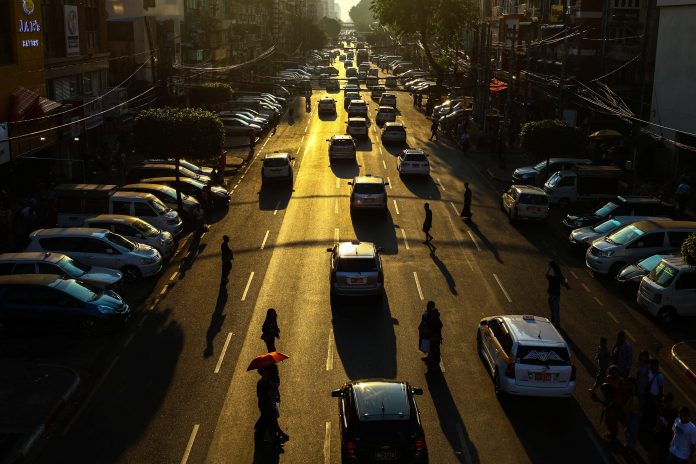
People and cars along a street at dusk in Yangon on March 27. (Credit: Reuters)
How Naypyidaw is weaponizing Myanmar’s energy crisis
The global energy crisis has hit Myanmar with rising fuel prices and shortages, but one economic expert warns that the military regime in Naypyidaw’s deeply entrenched financial policies are the true, lasting drivers of the country’s humanitarian disaster.
Development economist Jared Bissinger spoke to DVB about how external shocks are colliding with the regime’s mismanagement, leaving millions of civilians to bear the brunt of an economy on the brink since a military coup five years ago, on Feb. 1, 2021.
“What Myanmar has experienced post-coup is really the effects of economic policies that have caused so much of the country’s economic decline,” Bissinger told DVB. “These aren’t policies that are going away… What you’re seeing in Myanmar now is the result of those policies.” Read more
News by Region
YANGON—Traders told DVB on the condition of anonymity that fuel prices on the black market are up with one liter of gasoline at 10,000 MMK ($2.38 USD) and diesel at 12,000 MMK ($2.85 USD) despite a dip in reference rates from the regime’s Petroleum Products Regulatory Department on April 24.
One litre of 92-octane gasoline dropped 4,735-4,668 MMK ($1.12-1.11 USD) and 95-octane gasoline fell 4,945-4,909 MMK ($1.17-1.16 USD). Diesel prices decreased 6,485-5,752 MMK ($1.50-1.36 USD) per liter for regular and 7,755-7,012 MMK ($1.80-1.66 USD) for premium April 23-27, according to the regime.
SAGAING—Sources told DVB that an unknown number of residents in Yinmabin Township had fled their homes as over 400 regime troops from the Northwestern RMC headquarters in Monywa advanced on the town. Yinmabin is located 28 miles (45 km) west of the region’s capital Monywa.
A resident told DVB that a counteroffensive against the People’s Defence Force (PDF) is underway in Kani and Pale townships, which are located 37-39 miles (59-62 km) north and southwest of Monywa. Kani and Pale, placed under martial law on April 23, have been under PDF control since 2021.
SHAN—The regime state administration reportedly awarded 61 members of the anti-regime Pa-O National Liberation Organization (PNLO) over 150 million MMK ($35,700 USD) for surrendering with weapons to the Eastern RMC headquarters in the state capital Taunggyi on Sunday.
The PNLO members who surrendered are from Taunggyi, Nyaungshwe, Hsihseng, Pinlaung, and Mawkmai townships, as well as the Karenni State capital Loikaw. The PNLO armed wing, the Pa-O National Liberation Army (PNLA), operates in southern Shan and neighboring Karenni.
KARENNI—Residents of Nanmekhon town in Demoso Township told DVB that three civilians were killed in an Unmanned Aerial Vehicle (UAV), or drone, attack on Saturday. Nanmekhon, located nine miles (14 km) west of the state capital Loikaw, is partially controlled by the Karenni resistance.
A European Union flag flutters outside the European Commission headquarters in Brussels, Belgium on February 26, 2026. (Credit: Reuters)
The European Union on Monday extended its sanctions against Myanmar until at least May 2027, in an effort to maintain pressure on the country’s military more than five years after a coup toppled an elected government.
The measures include asset freezes, travel bans and an arms embargo for 105 individuals and 22 entities. They were first imposed after the February 2021 military coup and the subsequent crackdown on dissent.
“The E.U. reiterates its strongest condemnation of the actions taken by the Myanmar military since the 2021 coup,” the E.U. Council said, citing what it described as continuing grave human rights violations and widespread restrictions on fundamental freedoms.
It called for an end to all violence and the release of people who have been arbitrarily detained.
Earlier this month, coup leader Min Aung Hlaing was elected as president of Myanmar after an election denounced by Western governments as a sham to perpetuate military rule.
The United Nations says at least 3.6 million people have been displaced since the coup, and the Assistance Association for Political Prisoners (AAPP) has verified nearly 8,000 killings and close to 31,000 arrests, with more than 22,000 people remaining in detention.
The E.U. said it continues to withhold direct financial assistance to the administration and to suspend any aid that could be seen as legitimising the military leadership.
People and cars along a street at dusk in Yangon on March 27. (Credit: Reuters)
The global energy crisis has hit Myanmar with rising fuel prices and shortages, but one economic expert warns that the military regime in Naypyidaw’s deeply entrenched financial policies are the true, lasting drivers of the country’s humanitarian disaster.
Development economist Jared Bissinger spoke to DVB about how external shocks are colliding with the regime’s mismanagement, leaving millions of civilians to bear the brunt of an economy on the brink since a military coup five years ago, on Feb. 1, 2021.
“What Myanmar has experienced post-coup is really the effects of economic policies that have caused so much of the country’s economic decline,” Bissinger told DVB. “These aren’t policies that are going away… What you’re seeing in Myanmar now is the result of those policies.”
Military priorities amid fuel shortages
As the global supply of fuel tightens, Myanmar has become heavily dependent on importing it. All the while running a trade surplus. Transport costs have spiked, flights and bus routes are being canceled, and long queues at gas stations have become the norm.
In response, Naypyidaw has resorted to strict administrative controls rather than market solutions—implementing an “odd-even” driving system, QR codes, and mileage-based rationing. Meanwhile, the regime’s massive fiscal deficit leaves no room for public fuel subsidies.
Bissinger said that the regime’s response clearly highlights its priorities. The military controls the country’s financial and physical fuel infrastructure, including key depots around Yangon.
“They are going to and are prioritizing military use of fuel,” Bissinger told DVB. “If the military wants access, they get access. So it’s not a market-based system. It is very clearly a two-tier system… it means [civilians] get what’s left.”
Food insecurity and agricultural collapse
The energy shock means fertilizer prices have surged by roughly 80 per cent, hitting the agricultural sector hard. This price spike means Myanmar will have to import less or pay more to obtain the same amounts.
This comes on the heels of a difficult 2025 for Myanmar’s rice farmers, who already suffered low profits. Bissinger cited recent warnings from the World Food Programme (WFP), noting that a projected 50 per cent cut in fertilizer use could reduce rice yields by 10-15 per cent.
While higher global rice prices might eventually benefit some farmers, factory workers face a dire situation. Skyrocketing food prices, combined with supply chain disruptions and a lack of diesel to run factory generators, threaten to devastate the urban working class as wages aren’t rising fast enough.
The 2025 humanitarian needs and response plan for Myanmar had over 20 million people in need of humanitarian assistance, highlighted Bissinger, emphasizing that the fuel crisis will only deepen this severe food and job insecurity.
Poverty and currency manipulation
Beyond the immediate energy shock, Bissinger’s upcoming research points to deliberate regime policies that make poverty a natural outcome even in areas untouched by the ongoing civil war.
In regions like Yangon and Ayeyarwady, millions require humanitarian aid due almost entirely to economic controls. A prime example is the regime’s manipulation of the exchange rate, which means traders get fewer kyat for their crops.
By overvaluing the kyat, the regime is actively undermining the country’s export industries. This reduces the amount of foreign exchange into the official banking system and makes exports less competitive.
Traders are incentivized to keep some of their money outside of the country or try to send it via hundi—informal remittance networks relied upon by migrant workers–at a better rate, meaning less via official channels.
Furthermore, the regime has weaponized international financial standards to monopolize civilian wealth.
Under the guise of complying with the Financial Action Task Force (FATF) anti-money laundering regulations, Naypyidaw has severely cracked down on hundi even though in 2008 it noted that this traditional money transfer system was largely legitimate.
“The regime is doing this not because they want to address money laundering, but because they want to push everyone to use the official system and the banks so that they can get the foreign exchange coming into the country,” Bissinger told DVB.
Stay tuned to DVB English News for our upcoming Newsroom interview with Jared Bissinger, a visiting fellow with the Myanmar Studies Programme at the ISEAS – Yusof Ishak Institute and the research lead at Catalyst Economics.
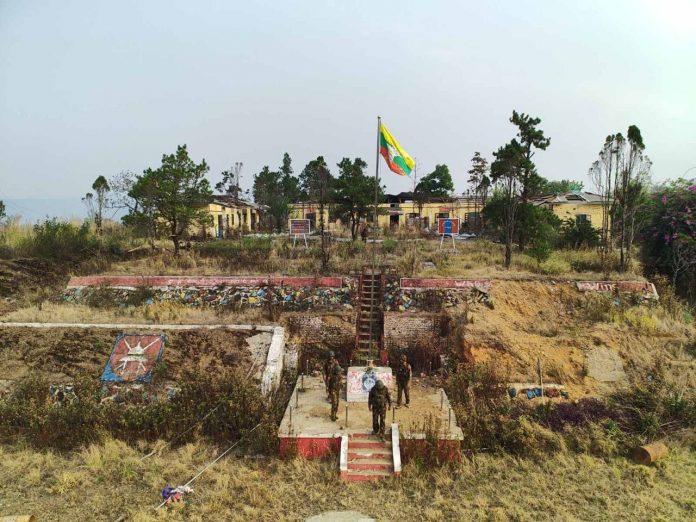
Regime troops raised the Burma flag at a military outpost in Chin State’s Falam town, after recapturing it from Chin resistance forces on April 25. (Credit: Regime)
Military retakes control of Chin State’s Falam town
The Chin National Defence Force (CNDF), a member of the Chin Brotherhood, told DVB on the condition of anonymity that fighting over control of Falam is ongoing. Chin World, the local news agency, reported that both Falam and its Surbung Airport were recaptured by regime forces on April 25.
Regime media reported that 19 “terrorists” were killed by regime forces, which is how Naypyidaw refers to resistance force members, but doesn’t disclose its casualties. The military launched a counteroffensive to retake Falam in October after taking Taingen, a strategic village that sits at the junction connecting northern to southern Chin, on Nov. 9. Taingen is located 91 miles (146 km) north of Hakha. Read more
Two Chinese charged by US for cyber scams in Myanmar
The U.S. Strike Force unsealed criminal complaints and arrest warrants against two Chinese nationals in connection with cryptocurrency investment fraud operations at the Shunda compound in Myawaddy Township, Karen State. Two managers, Huang Xingshan, also known as “Ah Zhe,” and “Huang Xing Saan” and Jiang Wen Jie, also known as “Jiang Nan” are charged with wire fraud conspiracy.
“We have charged the Chinese bosses who ran a scam compound in Burma, where trafficked workers were beaten and forced to steal from Americans,” said U.S. Attorney Jeanine Ferris Pirro on April 23. “My Office continues to work to identify funds stolen from victims, having now caused restraint of more than $700 million in cryptocurrency involved in money laundering from U.S. victims of fraud.”
The Shunda compound operated from at least January 2025 until approximately November 2025, when it was seized by the Karen National Liberation Army (KNLA). Workers at Shunda used cyber scams to defraud victims, including one American of $3 million USD, according to the FBI. Huang and Jiang were arrested on immigration charges by law enforcement in Thailand earlier this year. Read more
Chinese Foreign Minister Wang Yi meets Min Aung Hlaing, on the last leg of his regional tour, in Naypyidaw on April 25. (Credit: Reuters)
China’s top diplomat visits Naypyidaw
China’s top diplomat Wang Yi visited Naypyidaw on Saturday and met with Min Aung Hlaing as part of a regional tour aimed at strengthening Beijing’s political, security and strategic ties in Burma. Regime media reported that the Chinese Foreign Minister discussed enhancing Burma’s international relations and cooperation within the Association of Southeast Asian Nations (ASEAN).
Wang Yi’s visit to Naypyidaw comes after Min Aung Hlaing was sworn in as president on April 10 following an election that critics say was neither free nor fair and was designed to maintain the military’s grip on power five years after it ousted Aung San Suu Kyi’s civilian government.Min Aung Hlaing said that he was pleased that the Chinese President Xi Jinping sent his congratulatory message within hours of his election.
China is Burma’s biggest trading partner and a longstanding ally. Beijing has invested billions of dollars in Burma’s mines, oil and gas pipelines and other infrastructure and is a major arms supplier along with Russia. China is one of a small number of countries that have openly supported the 2025-26 elections and sent congratulatory messages to Min Aung Hlaing assumed the presidency. Read more
News by Region
ARAKAN—Residents of Ngapali town in Thandwe Township told DVB that three civilians were killed by airstrikes carried out by the Burma Air Force April 23-24. Thandwe, located 534 miles (939 km) south of the state capital Sittwe, was seized by the Arakan Army (AA) on July 16, 2024.
CHIN—The licenses of three media outlets, including Chin World and Khonumthung Media Group, were revoked under the Printing and Publishing Law on April 9. The regime claimed that the three publish content considered harmful to “national security, rule of law, and public peace.”
A total of nine other news agencies had their publication licenses revoked by the regime following the 2021 coup, including DVB, Khit Thit, 7 Day, Delta News Agency, Mizzima, Myanmar Now, The 74 Media, Myitkyina News Journal, and Tachileik News Agency, according to DVB data.
SAGAING—At least 10 civilians have been killed and over 10,000 residents have been displaced from their homes during fighting in Ayardaw Township from March 30 to April 21, residents told DVB. Ayardaw is located 25 miles (40 km) northeast of the region’s capital Monywa.
The People’s Defence Force (PDF) in Ayardaw told DVB that 200 aerial attacks have been carried out by regime forces during a military counteroffensive since March 30. Residents told DVB that Ayardaw’s Thaleba village was seized by the PDF on April 20 with fighting ending on April 22.
SHAN—The President’s Office and the Office of the Commander-in-Chief of Defence Services imposed a state of emergency in 15 townships on Friday, enacting martial law measures and transferring all civilian administrative and judicial powers to the military.
Namtu, Mabein, Kutkai, Namkham, Hsenwi, Kunlong, Namhsan, Manton, Hopang, Laukkai, Konkyan, Momeik, Kyaukme, Hsipaw, and Mongla townships are among the 60 total nationwide authorizing military tribunals for civilians with sentences as severe as the death penalty. Read more