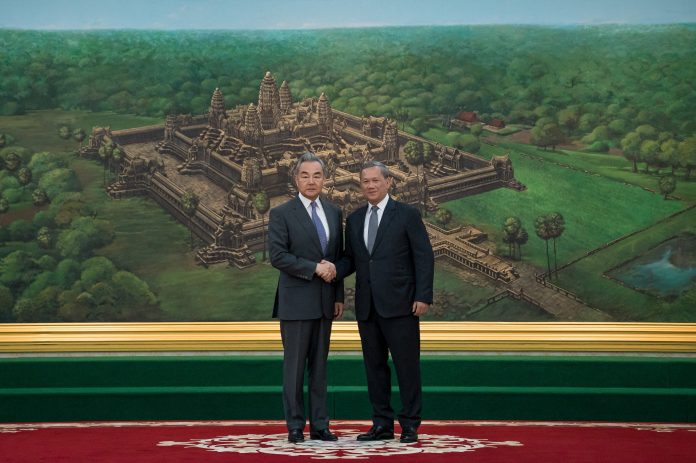
Cambodian Prime Minister Hun Manet with Chinese Foreign Minister Wang Yi ahead of their meeting at the Peace Palace in Phnom Penh, Cambodia, on April 22. (Credit: Reuters)
Cambodia and China on Wednesday held their first meeting of what is called a “2+2” Strategic Dialogue Mechanism, bringing together both countries’ foreign and defense ministers to deepen mutual political and security ties.
Chinese Foreign Minister Wang Yi and Defense Minister Dong Jun are visiting Cambodia to hold talks with their counterparts, Foreign Minister Prak Sokhonn and Defense Minister Tea Seiha.
These talks are an initiative proposed by Chinese President Xi Jinping during his state visit in April last year, aimed at boosting relations and the comprehensive strategic partnership between the two nations.
China has worked to increase its sphere of influence in Southeast Asia, and initiated the ministerial-level “2+2” dialogue format with Indonesia last year.
The Chinese Foreign Ministry announced Tuesday that Wang Yi will also visit Thailand and Myanmar following his stop in Cambodia.
While in Cambodia, both Chinese ministers are also to hold separate meetings with Senate President Hun Sen and Prime Minister Hun Manet.
Following the joint “2+2” meeting, Wang Yi on Thursday is scheduled to have in-depth discussions with Prak Sokhonn to discuss the implementation of existing cooperation frameworks and contributions to regional peace, security and stability.
No details of any of the meetings were immediately available from Cambodian officials.
China is the largest investor and aid donor for Cambodia, which stands as Beijing’s closest political partner in Southeast Asia. Their bilateral trade reached $19.73 billion USD last year, overwhelmingly in China’s favor.
The close relations fuel suspicions among analysts and the U.S. government that a Chinese-funded project to upgrade Cambodia’s Ream Naval Base will be used as a strategic military outpost by China.
Construction at the base, located on the Gulf of Thailand, last year saw the completion of a new pier to accommodate larger ships, a dry dock for repairs and other features.
Washington has publicly expressed the concern that Beijing has been secretly granted exclusive privileges to use the base, though Cambodian officials have repeatedly denied the accusations.
At the opening of the base expansion in April last year, Prime Minister Hun Manet specifically denied these allegations, declaring that the expansion wasn’t hidden from other countries.
Three months ago, the USS Cincinnati, with a crew of about 100, became the first U.S. Navy warship to dock at the facility since its Chinese-funded renovation was completed.
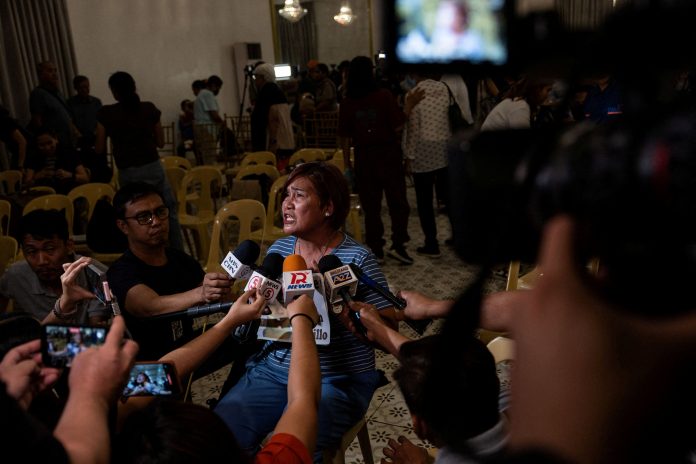
Nanette Castillo, mother of drug war victim Aldrin Castillo reacts after the International Criminal Court's rejection of former Philippine President Rodrigo Duterte’s challenge to the court’s jurisdiction over his alleged crimes against humanity charges in Quezon City, Philippines, on April 22. (Credit: Reuters)
Appeals judges ruled on Wednesday that the International Criminal Court (ICC) has jurisdiction over former Philippine President Rodrigo Duterte, dismissing a bid to throw out his trial over his alleged pivotal role in the murder of thousands of people.
Families of the victims who were watching the proceedings from the Philippines erupted in joy when the court verdict was read out. Duterte, who has been held in detention at the ICC in The Hague since his arrest in March 2025, was not in court.
The Philippines formally withdrew its ICC membership in 2018, and Duterte’s defence had argued that this meant the court had no jurisdiction over the case.
But the appeals judges confirmed a lower court ruling that the case could continue and rejected the defence’s demands to immediately release the 81-year-old former president.
They ruled that the fact that a preliminary examination – a precursor to a formal investigation – had already started before the Philippines withdrew its membership was enough to trigger continuing jurisdiction over the alleged crimes.
Prosecutors say Duterte created, funded and armed death squads to target and kill suspected narcotics peddlers and users when he was in power between 2016 and 2022.
Duterte has long insisted he instructed police to kill only in self-defence and has always defended the crackdown.
When the verdict was delivered, applause rang out among victims’ families who had gathered at a Philippine university to watch the proceedings. Some chanted: “Hold Duterte accountable.”
“No one is above the law, even Duterte,” said Nanette Castillo, whose son was killed during the brutal campaign.
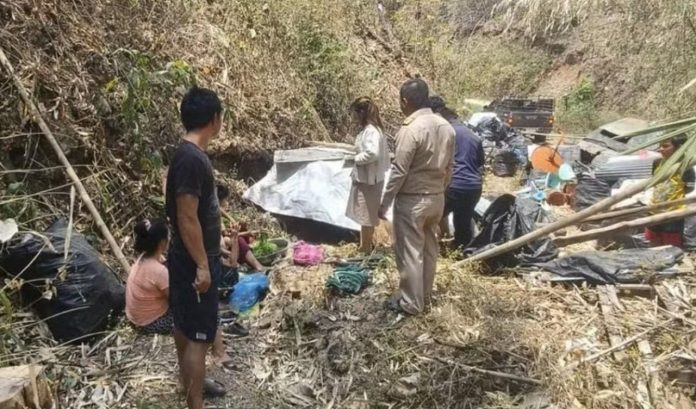
Residents of Mae Hong Son, Thailand, inspect the site where a bomb from the Myanmar Air Force landed on the Thai side of the border on April 20. (Credit: The Nation)
Bangkok has ordered heightened security across four western border provinces after a Myanmar Air Force bombing campaign in Karen State spilled over international lines, with at least one bomb landing in Thai territory on April 20.
Naypyidaw confirmed to Bangkok on Wednesday that the strikes were part of “internal fighting.” However, the cross-border escalation forced the immediate evacuation of Thai residents from Ban Mae Sam Laeb village in Mae Hong Son Province, prompting a stern rebuke from Thailand’s leadership.
“If there is fighting, it must remain on their side. Our country must not be affected,” Thai Prime Minister Austin Charnvirakul told local media on Wednesday. Security measures have since been intensified in Mae Hong Son, Chiang Mai, Chiang Rai, and Tak provinces.
Civilian targets devastated in Karen State
Directly across the border from the evacuated Thai village lies Ohmuhta, a settlement in Bu Tho Township under the control of Karen National Union (KNU) Brigade 5.
Eh Doh Wa, an information officer for the Karen Peace Support Network (KPSN), told DVB that Myanmar Air Force jets dropped nine bombs on Ohmuhta during the April 20 raid, completely destroying a local hospital and a church.
The assault follows a string of recent attacks on civilian infrastructure. The KNU reported that earlier airstrikes in Hpapun Township on April 14 destroyed a school and several homes, while a prior attack on an Ohmuhta healthcare facility on April 12 left an unknown number of patients injured.
“The military’s use of airstrikes to target areas under the control of resistance forces has gotten worse after the appointment of the new commander-in-chief,” a Karen military analyst told DVB on the condition of anonymity.
Inside Myanmar, the humanitarian toll is mounting. “Ethnic Karen villagers live in fear for their lives and are afraid to stay in their homes,” Eh Doh Wa told DVB, issuing an urgent plea for food, medicine, and shelter materials for the newly displaced.
KNU rejects peace talks in Naypyidaw
The escalation in violence comes just 10 days after Min Aung Hlaing was inaugurated as President by a pro-military parliament in Naypyidaw.
In the wake of the bombings, the KNU firmly dismissed Min Aung Hlaing’s recent proposal to hold peace talks with resistance forces on July 31.
“The KNU has already withdrawn from the [Nationwide Ceasefire Agreement] since the 2021 coup,” Saw Taw Nee, the KNU spokesperson, told Reuters. “We have no plans to return to negotiations or follow the NCA path.”
The ethnic armed organization is now urging the international community and the Association of Southeast Asian Nations (ASEAN) to move beyond rhetoric and take “practical action” against Naypyidaw to stop the systematic targeting of civilians in KNU-controlled territories.
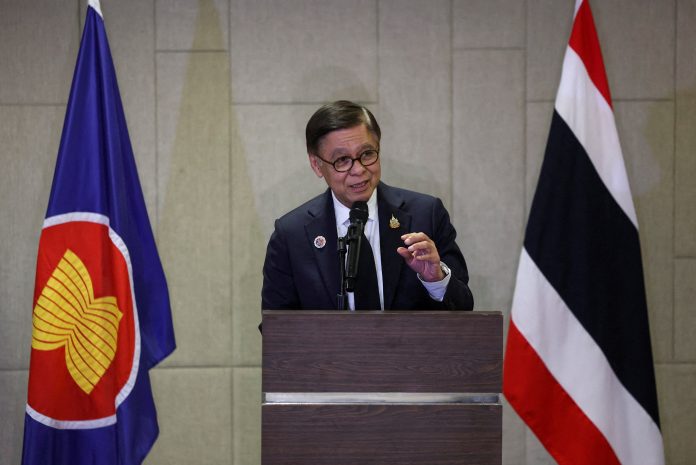
Thailand's Foreign Minister Sihasak Phuangketkeow speaks to media after a special meeting of ASEAN Foreign Ministers on the Thailand-Cambodia situation at Kuala Lumpur, Malaysia, on December 22, 2025. (Credit: Reuters)
Thailand wants to play a leading role in Myanmar’s bid to normalise its ties with regional bloc, the Association of Southeast Asian Nations (ASEAN), after five years on the sidelines, the Thai foreign minister said ahead of a meeting with Min Aung Hlaing in the capital Naypyidaw on Wednesday.
Min Aung Hlaing led a 2021 military coup that ended a decade of tentative democracy in Myanmar and sparked chaos and a civil war, prompting an intervention by ASEAN and the exclusion of senior Myanmar generals from its summits.
Min Aung Hlaing, 69, was inaugurated Myanmar’s president by a pro-military parliament on April 10, formalising his grip on power after a recent election that was dominated by an army-backed party in the absence of viable opposition.
“We want to support their return to ASEAN. Our policy is to have steps in our interactions to bring them back,” Thai Foreign Minister Sihasak Phuangketkeow told reporters.
“But certainly, for them to return to ASEAN, they must be able to proceed and respond to the concerns from ASEAN.”
Myanmar crisis a headache for ASEAN
The conflict in Myanmar has long frustrated ASEAN, with some members openly critical of the generals for paying only lip service to the bloc’s demands for progress on its Five Point Consensus, a regional peace plan that requires all sides to cease hostilities and start dialogue.
Myanmar remains part of ASEAN has been represented at top-level meetings by ministerial officials.
Few countries have endorsed Myanmar’s election or the new military-backed government, with some western nations dismissing the process as a sham designed to entrench the army’s control under the guise of civilian rule.
The 11-member ASEAN has yet to formally recognise the results of Min Aung Hlaing’s 2025-26 elections, which saw the military-backed Union Solidarity and Development Party (USDP) win the most seats and form a new administration. ASEAN leaders will hold a summit next month in the Philippines.
Sihasak welcomed Myanmar’s amnesty last week for thousands of prisoners, which included the release of ousted President Win Myint and a small sentence reduction for Nobel laureate Aung San Suu Kyi, who was Myanmar’s de facto leader at the time of the coup.
“We hope that these kinds of actions will take place more going forward, particularly the reduction of violence,” he said.
“Secondly, we know that there is a demand for humanitarian assistance in Myanmar, how they can open a space for ASEAN or international organisations to go in.”
In his inauguration address, Min Aung Hlaing said his priority was to promote peace and reconciliation in Myanmar and he would seek to improve international relations and normalise ties with ASEAN.
This week he invited opposition armed groups to start dialogue by the end of July, but two key rebel groups rejected the offer on Tuesday.
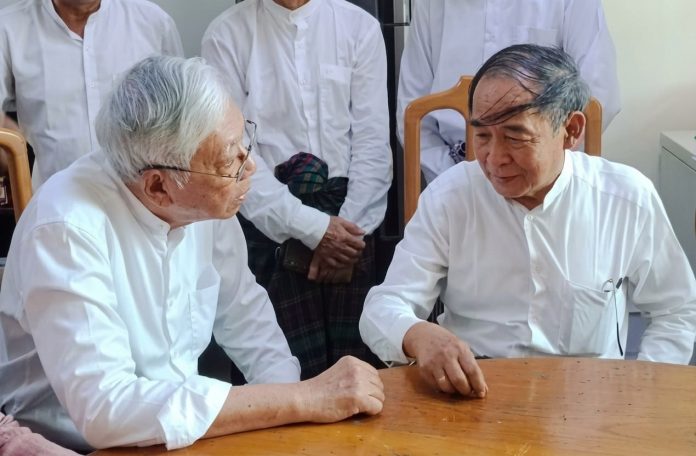
Former National League for Democracy President Htin Kyaw [left] with President Win Myint at his residence in Naypyidaw on April 17. (Credit: Htin Lin Oo)
President Win Myint’s home under surveillance
Sources close to the regime in Naypyidaw told DVB that over 30 security personnel, including soldiers and police, are stationed outside of President Win Myint’s family rental home, located in the capital’s Ottarathiri Township, and have been assigned to monitor activities outside since Sunday following his release from Bago Region’s Taungoo Prison in a Myanmar New Year amnesty on Friday.
A source in Naypyidaw told DVB on the condition of anonymity that Ye Moe, the Naypyidaw Council minister for security and border affairs, leads the operation. President Win Myint, 74, was sentenced to 14 years after being convicted of corruption and violating Section 130-A of the Penal Code, which alleges he “exerted influence” over the electoral body the Union Election Commission (UEC) during the 2020 elections, which were overturned during the military coup on Feb. 1, 2021.
Nay Phone Latt, the National Unity Government (NUG) spokesperson, told DVB that visiting Naypyidaw doesn’t signal recognition for Min Aung Hlaing’s presidency by Bangkok. The Thai Ministry of Foreign Affairs referred to the amnesty granted to 4,514 prisoners on April 17 as “a positive step by the Myanmar government.” Sihasak congratulated Min Aung Hlaing on becoming president on April 3.
The Karen Community Organizations Worldwide, which represents an unknown number of Karen civil society groups globally, called on Thai Foreign Minister Sihasak to cancel his trip to Naypyidaw. Aung Thu Nyeen, an independent political analyst, told DVB that Thailand wants to revive border trade with Burma, via the Asia Highway in Karen State, as one of the main reasons behind Sihasak’s visit to Naypyidaw.
Thai authorities inspect a 20,000-liter diesel tanker truck suspected of transporting fuel into Burma in Mae Sot, Tak Province, on March 20. (Credit: Thai police)
Crackdown on fuel smuggling along Thai-Myanmar border
Authorities in Mae Sot, Thailand announced that they seized approximately 16,000 liters of fuel, valued at around 700,000 Thai baht ($21,212 USD), bound for Myawaddy Township, Karen State on Monday. Mae Sot is located along the Thai-Burma border across the Moei (Thaungyin) River from Myawaddy, 80 miles (130 km) southeast of the Karen State capital Hpa-An.
On April 12, Thai authorities reportedly seized nearly 400 liters of fuel in Kanchanaburi Province headed across the border to Kyainseikgyi Township’s Payathonzu town, located 150 miles (241 km) south of Hpa-An. This follows the seizure of 1,260 liters of gasoline in the same district on April 4. Thai PBS reported that more than 20,000 liters of diesel bound for Myawaddy were seized in Mae Sot on March 22.
Over 335,000 liters of “illicit fuel” shipments were confiscated nationwide in March and April as part of a broader crackdown on cross-border smuggling, according to the Thai authorities. The fuel seizures come amid shortages and rising global energy prices linked to the ongoing conflict in the Middle East since the U.S. war in Iran began on Feb. 28.
News by Region
BAGO—Regime media reported that its social welfare minister Soe Win and the region’s Chief Minister Myo Swe Win visited Gyobingauk and Zigon townships on Sunday to provide assistance totaling 91 million MMK ($22,300 USD) for 67 households damaged by a windstorm on April 17.
Residents told DVB that destruction and loss was “extensive.” At least 1,100 homes were damaged. But many said they didn’t receive any assistance due to alleged links to the People’s Defence Force (PDF). The towns are 20 miles (32 km) apart and 93 miles (150 km) northwest of the region’s capital Bago.
NAYPYIDAW—Min Aung Hlaing, who was inaugurated president on April 10, told his cabinet on Monday that he will invite ethnic armed groups for peace talks by July 31. He invited the People’s Defence Force (PDF) to “return to the legal fold” within 100 days to be allowed to join the talks.
SAGAING—Residents of Homalin Township told DVB that two people were killed and at least 11 others were injured in Naungpakyit neighborhood after boats transporting gasoline exploded on Monday. Homalin is located 331 miles (533 km) north of the region’s capital Monywa.
A Homalin resident told DVB that a loud explosion was heard after 22 boats, which were transporting gasoline to gold-mining sites in Homalin, caught fire. Two vehicles were also destroyed. The Fire Services Department announced that it sent four trucks to extinguish the flames.
(Exchange rate: $1 USD = 4,135 MMK)
Stay up-to-date with the latest on #WhatsHappeninginMyanmar by subscribing for free to the DVB English News Daily Briefing newsletter.
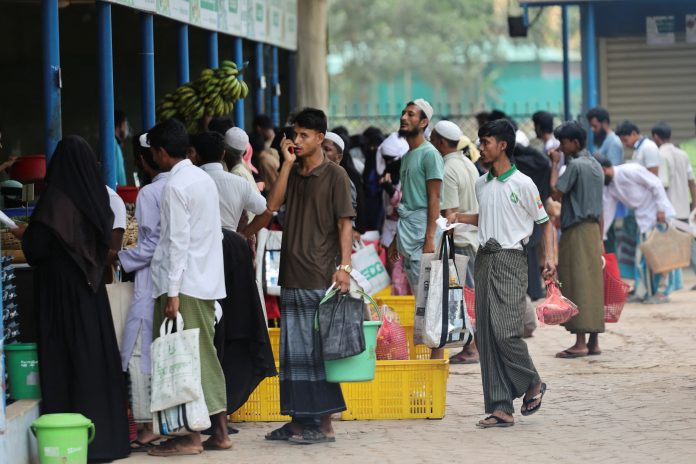
Rohingya refugees stand in queue to receive ration from the World Food Program, at a refugee camp in Cox's Bazar, Bangladesh, on April 18. (Credit: Reuters)
Nearly 8,000 people died or disappeared on migration routes last year, with sea routes to Europe the most deadly and many victims lost in “invisible shipwrecks”, a U.N. agency said on Tuesday.
“These figures bear witness to our collective failure to prevent these tragedies,” Maria Moita, who directs the International Organization for Migration (IOM) humanitarian and response department, told a press briefing in Geneva, Switzerland.
Though the 7,904 people dead or missing was down from an all-time high of 9,197 in 2024, the IOM said that was partly due to 1,500 suspected cases that went unverified due to aid cuts.
More than four in every 10 fatalities and disappearances came on sea routes to Europe. Many cases were so-called “invisible shipwrecks” where entire boats are lost at sea and never found, the IOM said in a chilling new report.
The West African route northwards accounted for 1,200 deaths, while Asia reported a record number of fatalities, including hundreds of Rohingya refugees fleeing violence in Myanmar or misery in crowded refugee camps in Bangladesh.
“Routes are shifting in response to conflict, climate pressures and policy changes, but the risks are still very real,” said IOM Director General Amy Pope in a statement.
“Behind these numbers are people taking dangerous journeys and families left waiting for news that may never come.”