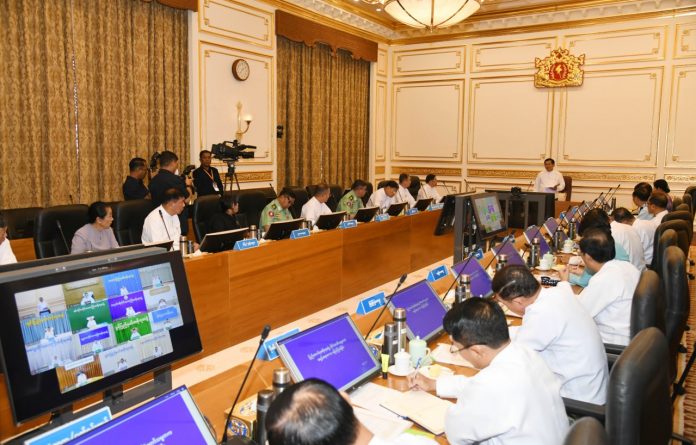
Min Aung Hlaing addresses his cabinet in the capital Naypyidaw on April 20. (Credit: Regime media)
Myanmar’s new military-backed administration led by Min Aung Hlaing, inaugurated as president by a pro-military parliament following highly controversial elections, wants to hold peace talks with opposition armed groups by the end of July, but two key rebel groups rejected the offer on Tuesday.
Regime media reported that Min Aung Hlaing, who led a coup five years ago that plunged Myanmar into a civil war that continues to rage, told a cabinet meeting in the capital Naypyidaw that he wanted rebel groups that were not part of a ceasefire deal to join talks to be held within 100 days.
“For groups that have not yet engaged in dialogue and negotiation, we also invite them to come participate in discussions by the final deadline of July 31,” said Min Aung Hlaing, mentioning opposition groups such as the Karen National Union (KNU), the Chin National Front (CNF), and the All Burma Students’ Democratic Front (ABSDF).
Min Aung Hlaing referred to signatories of the Nationwide Ceasefire Agreement (NCA) in his remarks, a deal that was in place before the 2021 coup threw it into question. Saw Taw Nee, a spokesperson for the KNU, dismissed Min Aung Hlaing’s proposal.
“The KNU has already withdrawn from the NCA since the 2021 coup. We have no plans to return to negotiations or follow the NCA path,” he said.
CNF spokesman Salai Htet Ni said his group was seeking a federal democratic system free of the influence of the military.
“Since we are fighting a military-political battle for this, we have nothing to discuss with those who currently call themselves an ‘administration’ after merely changing their appearance from the military,” he said.
Myanmar has been in turmoil following the 2021 coup that overthrew the democratically elected government of Nobel Peace Prize winner Aung San Suu Kyi, who was subsequently imprisoned for 27 years on charges her allies say were politically motivated.
In a Myanmar New Year amnesty on April 17, Min Aung Hlaing cut the 80-year-old’s sentence by one-sixth.
A pro-military parliament elected Min Aung Hlaing as president earlier this month, following a lopsided election that was derided by critics and Western governments as a sham to perpetuate military rule behind a veneer of democracy.
The new military-backed administration has only been recognised by a few countries.
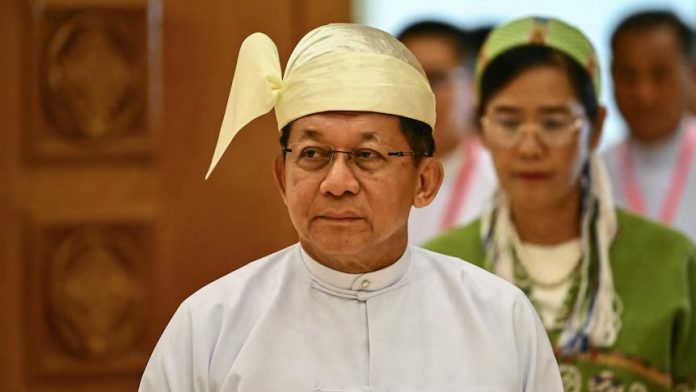
Min Aung Hlaing arrives at the Myanmar parliament in April. (Credit: AFP)
The leader of Myanmar’s new military-backed administration has invited the country’s armed resistance groups to fresh peace talks, regime media reported Tuesday, marking the first such call from Min Aung Hlaing since he was inaugurated president by a pro-military parliament on April 10.
Min Aung Hlaing’s call for talks was framed as part of a self-styled 100-day program that he announced at a cabinet meeting on Monday in the capital Naypyidaw prioritizing peace and stability as well as development, regime media reported.
Min Aung Hlaing took office after an election that critics say was neither free nor fair and was designed to maintain the military’s grip on power five years after it ousted Aung San Suu Kyi’s civilian government.
As military leader, Min Aung Hlaing led the takeover and headed the unelected military government.
The army’s seizure of power intensified longstanding armed resistance in Myanmar, as pro-democracy activists joined with ethnic armed groups that had been battling for decades for greater autonomy, leading to a civil war still affecting most of the country.
The military has had held a series of in-person peace talks with ethnic minority leaders starting in 2022 aiming to weaken the anti-military alliances, but with little result.
Regime media reported that on Monday Min Aung Hlaing said he is inviting ethnic armed groups to hold new talks by July 31.
However, Nay Phone Latt, a spokesperson for the National Unity Government (NUG), the main group coordinating opposition to military rule, said Tuesday that it and the People’s Defense Force (PDF) units under its command would continue to fight alongside other resistance forces until their goals are achieved.
“We all already understood that the military’s fake invitations are aimed at prolonging people’s subjugation under military rule,” Nay Phone Latt said.
Myanmar has 21 established ethnic armed organizations with a history of armed struggle, 10 of which signed multilateral ceasefire agreements known as Nationwide Ceasefire Agreements (NCA), in 2015 and 2018 under previous governments.
However, four of the signatories spurned the agreement and resumed fighting after the 2021 army takeover.
“Both NCA signatories and non-signatories are invited to participate in the peace process,” Min Aung Hlaing was quoted as saying. He also invited the armed guerrilla groups, collectively called the PDF — formed to fight to restore democracy after the army takeover — to participate and enter the legal fold within the 100-day period.
Other aspects of the 100-day program cover social and economic measures and infrastructure.
For several decades, Myanmar has seen a cycle of ceasefires bringing in intermittent periods of relative peace, but none has led to a comprehensive political settlement that would grant the ethnic groups the degree of autonomy they seek in the frontier regions where they are dominant.
The new initiative comes after the army regained the upper hand in the nationwide conflict in mid-2025 following a series of China-brokered ceasefires with major rebel groups and a boost in the army’s numbers after the activation of a conscription law in early 2024.
The army has retaken territory from ethnic militias, including the Three Brotherhood Alliance, which had launched powerful offensives along with pro-democracy resistance forces in northeastern Myanmar near the Chinese border and in western Myanmar.
The Ta’ang National Liberation Army (TNLA), a member of the alliance, congratulated Min Aung Hlaing on his presidency and said it looked forward to peace talks in a statement last Wednesday.
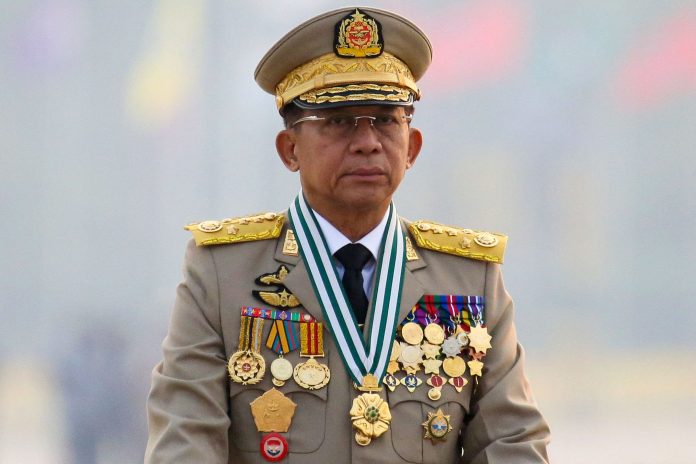
Myanmar military leader Min Aung Hlaing, who ousted the elected government in a 2021 coup, presides an army parade on Armed Forces Day in Naypyidaw on March 27, 2021. (Credit: Reuters)
The International Criminal Court (ICC) has confirmed to DVB that arrest warrants can be issued confidentially, or “under seal,” by the judges. A warrant for Myanmar’s Min Aung Hlaing was requested by ICC Chief Prosecutor Karim Khan on Nov. 27, 2024. Since then, there’s been no news from the ICC judges, leading some to speculate it may have already been issued “under seal.”
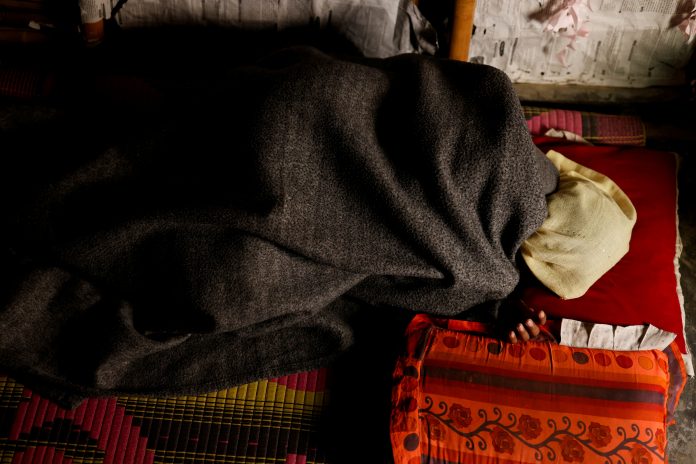
Rahila Begum, 25, a survivor from the boat that capsized in the Andaman Sea while carrying Rohingya refugees from Myanmar and Bangladeshi nationals, rests inside a shelter at a refugee camp in Cox's Bazar, Bangladesh, on April 16. (Credit: Reuters)
Rohingya refugee Rahila Begum spent two days adrift in the Andaman Sea this month, clinging to a wooden shard after her overcrowded boat capsized, one of the few survivors of a disaster that left 250 missing and feared dead.
She was among the thousands of Rohingya from Myanmar who brave hunger and accidents on rickety boats each year to flee desperate conditions in camps in southeastern Bangladesh for countries such as Indonesia and Malaysia.
Hundreds die en route from hunger or accidents at sea, but the numbers keep growing as shrinking food rations caused by dwindling international aid push yet more to make the dangerous crossing.
“I never thought I would survive,” said Begum, her voice thready from fever and aches as she sat, wrapped in a blanket, on a thin mat in her parents’ shack thrown together from tarpaulin sheets. “It felt like the end of my life.”
The 26-year-old was rescued by a passing Bangladeshi oil tanker after her boat, with nearly 300 aboard, sank this month on its way to Malaysia, and later handed to the country’s Coast Guard.
Bangladesh’s coastal district of Cox’s Bazar is home to nearly 1.2 million Rohingya refugees, many of whom fled persecution and fighting in Buddhist-majority Myanmar, where they are accused of being outsiders.
Trapped for years, denied the right to work, receiving only limited education and shrinking food aid, few see a future in Bangladesh and cannot risk returning to Myanmar.
The U.N. High Commissioner for Refugees (UNHCR) says nearly 900 Rohingya were reported missing or dead in the Andaman Sea and Bay of Bengal in 2025, making it the deadliest year on record for regional sea crossings, with more than 6,500 attempted.
Between January and mid-April this year, more than 2,800 Rohingya attempted such journeys, the agency says. “The Rohingya population is very young and aspires to a better life, but that hope is increasingly turning into desperation,” said Astrid Castelein, a UNHCR official.
“That is why youths and families are deciding to take these dangerous boat journeys.” Authorities have stepped up coastal patrols and surveillance of the camps to curb trafficking networks, a Bangladesh official said, speaking on condition of anonymity, but acknowledged that the scale of desperation made enforcement difficult.
‘Ration cuts means no meat or fish’
Begum’s arms and body are scarred with burns caused by spills of hot engine oil mixed with seawater. She left Myanmar in 2017 during a military crackdown that sent more than 730,000 Rohingya to Bangladesh amid accusations of killings, mass rape and arson – acts a U.N. fact-finding mission later described as “genocidal”, a charge Myanmar denies.
Things worsened after her marriage four years ago, she said. “I was beaten because I could not have children. I knew I had to flee. There was no life left for me here,” she said, adding that her husband had refused to take her back.
Rohingya refugees stand in queue to receive ration from the World Food Program, at a refugee camp in Cox’s Bazar, Bangladesh, on April 18. (Credit: Reuters)
This month the U.N. World Food Programme (WFP) began distributing food rations in Cox’s Bazar on the basis of households’ earning capacity. The monthly sums handed out range from $12 USD per person for the most vulnerable to $7 USD for those deemed food insecure, with families headed by children, women and the elderly getting the most support.
“My ration has been cut from $12 to $7 because I have an 18‑year‑old son,” said Mohammed Rafiq, 50, a father of four. “But does he earn anything?” The money was enough to buy only rice and cooking oil but not the fish or meat his children hanker for.
“We are living in inhumane conditions,” he added, fighting a lack of proper food, shelter, freedom, education and work. “Even if my children leave by sea one day, I would not be surprised.”
Rohingya turns trafficker after being trafficked
That desperation is often exploited by traffickers, many of whom are Rohingya themselves. Among them is a 24-year-old who identified himself by his nickname, Faisal, who said he had sent 20 people, three women and two children among them, on the capsized boat, but none survived the disaster.
He avoided the telephone calls of families seeking answers, he said. “They keep calling again and again … sometimes I just switch off my phone.” Faisal said he first travelled to Malaysia in 2018 with the help of traffickers before returning to the camps to enter the trade.
Although Bangladesh jailed him in 2020 for a year in a human trafficking case, that did not stop him from taking up the trade again after his release. Reuters could not independently confirm his account.
Such journeys usually peak during the calmer winter months, Faisal added, but many desperate to get away from the camps are now willing to take more risks. “They come to us asking for a way out,” he said. “They know the risks – some make it, some are arrested, some die.”
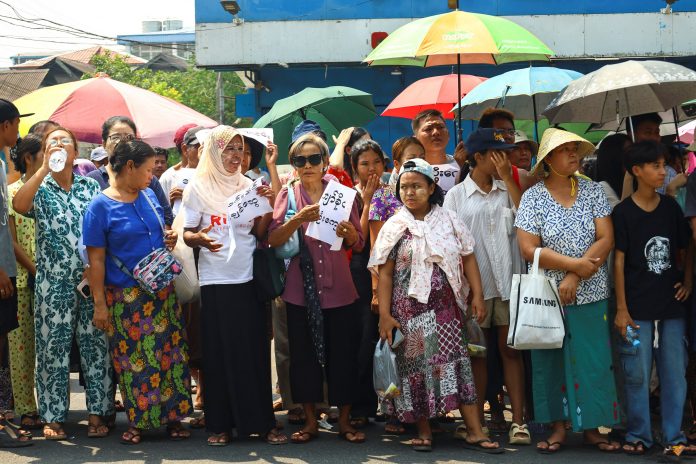
Family members wait outside of Yangon’s Insein Prison for the release of prisoners as part of an amnesty to mark Myanmar new year on April 17. (Credit: Reuters)
Calls for release of all political prisoners in Myanmar
The ASEAN Parliamentarians for Human Rights (APHR), a group of current and former MPs across Southeast Asia, called for the immediate and unconditional release of political prisoners, including State Counsellor Aung San Suu Kyi, on Monday. It also urged the Association of Southeast Asian Nations (ASEAN) not to recognize regime leader Min Aung Hlaing’s inauguration as Burma’s president on April 10.
“Since the coup, Min Aung Hlaing—who was not legitimately elected—and the junta have abused power to carry out arrests, pardons, bombings, and killings, acting beyond the law with no respect for human rights or democracy,” Mercy Chriesty Barends, the APHR chairperson and a member of Indonesian House of Representatives, stated in a press release on April 20.
The ASEAN 2026 chair Philippines welcomed the release of President Win Myint, calling the amnesty granted to 4,514 prisoners a “significant development.” It also demanded the release of all other political prisoners in Burma. The Assistance Association for Political Prisoners (AAPP) has documented that 22,170 people, who were arrested for opposing the military coup on Feb. 1, 2021, remain behind bars.
Aung San Suu Kyi’s son Kim Aris demands ‘proof of life’
Aung San Suu Kyi’s son Kim Aris demanded Min Aung Hlaing’s regime in Naypyidaw provide proof that his mother is alive and allow independent verification about her health and where she’s being held. He added that Aung San Suu Kyi has been cut off from the world, being unable to contact her family since being detained during the military coup on Feb. 1, 2021.
“I just want some proof that she’s alive more than anything else,” Aris told DVB in an interview on Monday, welcoming the release of Win Myint and 292 other political prisoners in an amnesty on April 17. He added that the amnesty granted to 4,514 prisoners is an attempt by the regime to ease international pressure and gain legitimacy without substantive political change.
Aung San Suu Kyi is serving a 27-year prison sentence after being convicted on charges viewed as politically motivated, including incitement, corruption, election fraud, and violations of the state secrets law. Her lawyer told Reuters that the regime reduced her sentence by one-sixth, which means by four-and-a-half years, on April 17. Read more
A Bangladesh Navy vessel in the Bay of Bengal, carrying Rohingya refugees to the Bhasan Char island in Noakhali district, on December 29, 2020. (Credit: Reuters)
Record number of Rohingya refugees died at sea last year, UN says
Nearly 900 Rohingya refugees were reported missing or dead in the Andaman Sea and Bay of Bengal in 2025, making it the deadliest year on record for the route, the U.N. High Commissioner for Refugees (UNHCR) stated on Friday. The dangerous sea crossings have continued into 2026, with more than 2,800 Rohingya embarking on such journeys up until April 13.
“No one would put their family on a risky boat, knowing that the chances of survival are really low, if the sense of desperation is not there,” said Babar Baloch, the UNHCR spokesperson. More than one in seven of the estimated 6,500 Rohingya who attempted the sea crossing last year were reported missing or dead, the highest mortality rate worldwide for refugee and migrant sea journeys.
In recent years, more than half of those attempting the crossings have been women and children, according to UNHCR. Their departures are driven by violence at home in Burma and desperate conditions in crowded refugee camps in Bangladesh. The Rohingya refugees hope to reach safety and opportunity in countries such as Malaysia, Indonesia or Thailand. Read more
News by Region
BAGO—A former political prisoner at Pyay Prison told DVB on the condition of anonymity that a lawyer named Phyo Wai Wai Myint, who is serving a 10-year sentence at the same prison after being convicted under Section 50(j) of Counter-Terrorism Law in 2022, is unable to receive medical treatment.
SAGAING—One civilian was killed and two were critically injured by airstrikes carried out by the Burma Air Force in Wetlet Township on Sunday. Wetlet, located 50 miles (80 km) east of the region’s capital Monywa, is partially controlled by the National Unity Government (NUG).
At least two homes were destroyed in four villages, according to resistance forces. Three Buddhist monks and four civilians were killed by airstrikes in Shwebo Township April 3-16. Shwebo is located 30 miles (49 km) northwest of Wetlet and 57 miles (91 km) northeast of Monywa.
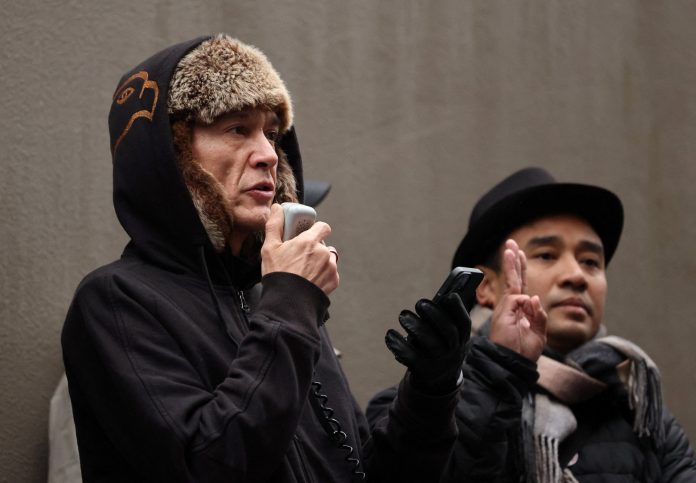
Aung San Suu Kyi’s son Kim Aris speaks at a protest outside of the Myanmar embassy in Tokyo, Japan, on Dec. 14. (Credit: Reuters)
Kim Aris, the youngest son of Myanmar’s jailed civilian leader Aung San Suu Kyi, has issued an urgent plea to the regime in Naypyidaw to provide “proof of life” for his 80-year-old mother on Monday. Aris has had no direct communication with Aung San Suu Kyi since the military seized power in a military coup on Feb. 1, 2021 and detained her.
“I just want some proof that she’s alive more than anything else,” Aris told DVB in an interview on April 20. “The world at large often thinks that she’s still under house arrest, whereas all this time she’s spent in jail.”
This appeal from Aris comes three days after Aung San Suu Kyi loyalist, President Win Myint, was transferred from prison to house arrest in Naypyidaw. But rumors regarding Aung San Suu Kyi’s transfer out of prison have failed to materialize.
Aris has not spoken to his mother Aung San Suu Kyi since before the 2021 coup. In the last five years, he has received only a single letter, which arrived nearly three years ago in response to a care package he sent to her at Naypidaw Prison.
The last independent verification of her condition in prison came five years ago from Sean Turnell, an Australian economist and former advisor to the National League for Democracy (NLD) party, who was imprisoned alongside her before being released in 2022.
Aung San Suu Kyi’s NLD administration governed Myanmar from 2016 up until it was ousted by Min Aung Hlaing’s military in the 2021 coup. Aris expressed deep concern over his mother’s deteriorating health, specifically her ongoing heart condition.
“Heart conditions need proper machinery to be diagnosed correctly, and I know that she won’t be getting that. I know that prison doctors in Burma will not be providing that,” Aris told DVB.
He directly challenged Min Aung Hlaing, who was inaugurated Myanmar’s president by a pro-military parliament elected in highly controversial polls which ended on Jan. 25, to allow independent verification of her status.
Aris suggested Myanmar grant access to Aung San Suu Kyi to the International Committee of the Red Cross (ICRC) or foreign diplomats based in Yangon. “If she is still alive and healthy, then let me talk to her,” Aris told DVB.
A bargaining chip for the regime?
Despite the reduction of her 27-year sentence by one-sixth on April 17, Aris dismissed this as meaningless. “She’ll still be over a hundred if she sees this sentence through,” he noted.
If the military does eventually move her to house arrest, Aris suspects she will not be permitted to return to their family home on University Avenue in Yangon.
Instead, he believes the regime will keep her close to their seat of power in Naypyidaw—not only to prevent her from speaking publicly but potentially to use her as a bargaining chip in the ongoing civil war started by resistance forces against the military.
“They’re quite vulnerable in Naypyidaw,” Aris observed. “It’s quite close to the frontline, so it might be good for them to have her nearby. I think [Min Aung Hlaing] has his own agenda where she’s concerned.”
A call to the international community
Aris also criticized the international community for its waning focus on his mother’s plight. Unlike Aung San Suu Kyi’s previous 15 years of house arrest under former military regimes, where global leaders consistently advocated for her release, international pressure has largely stalled in recent years.
He warned that some foreign governments may attempt to use Myanmar’s recent “sham” 2025-26 elections as an excuse to normalize relations with the regime.
“They need to understand that they’re doing business with a bunch of crooks, and they can’t expect good results,” Aris told DVB.
Despite the dire situation facing his mother and over 22,000 other political prisoners held since the 2021 coup, Aris expressed a faint hope that Min Aung Hlaing’s elevation to the presidency might make him feel secure enough to ease restrictions.
“I think there’s very little reason for him to fear anything by moving her to house arrest,” Aris told DVB, urging a return to negotiations. “The bloodshed that’s still going on in Burma can’t continue forever.”