

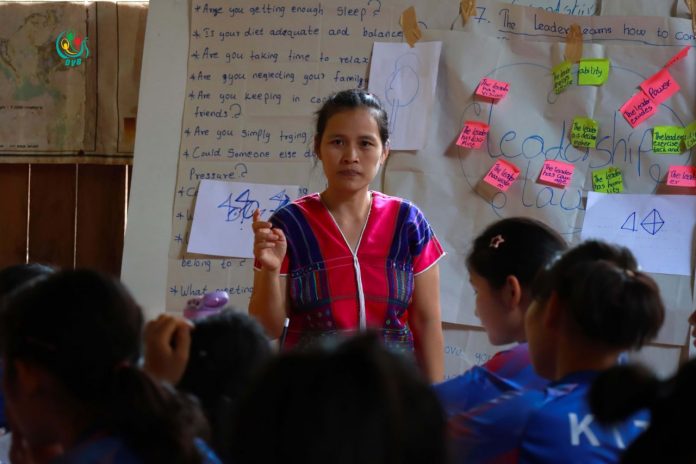
Access to education in remote areas of Myanmar, including at Internally Displaced Persons (IDP) camps, is a challenge. To address this, the Karen Teacher Training College (KTTC) was established to provide qualified teacher training for schools across Karen State. Read more and check out our photos.
A visit to Myanmar’s Karen Teacher Training College
Gyrocopter attacks kill 17 in Sagaing Region capital; 292 political prisoners freed in Myanmar New Year amnesty
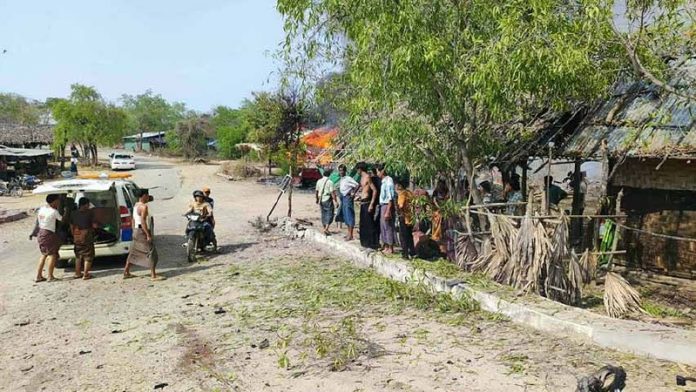
Gyrocopter attacks kill 17 in Sagaing Region capital
Residents of Sagaing Region’s Monywa Township told DVB that the death toll from a regime gyrocopter attack on Kyaukkar village on Thursday has risen to 17 on Saturday. They added that two gyrocopters had departed the regime’s Northwestern Regional Military Command (RMC) headquarters in the Sagaing Region capital Monywa. Gyrocopters are miniature helicopters used for short-range, low-level attacks typically on defenceless targets, according to security analyst Anthony Davis.
A Monywa resident told DVB on the condition of anonymity that three civilians were killed and 14 out of the 20 injured died while receiving treatment at a hospital run by the National Unity Government (NUG). “The military has repeatedly used paramotors and gyrocopters to bomb peaceful gatherings and protected civilian sites—schools, hospitals, monasteries, and houses—across Myanmar’s central lowlands,” according to a Fortify Rights report on Jan. 26.
“The Myanmar military has found new ways to kill civilians from the sky using paramotors and gyrocopters equipped with manually-dropped, unguided explosives,” Fortify Rights added. At least 14 people were killed and 54 others were injured in 29 aerial attacks carried out by regime forces nationwide during the Thingyan Water Festival April 13-16. At least 29 civilians were killed in 51 regime air- and artillery attacks during last year’s Thingyan, according to DVB data.
President Win Myint released in Myanmar New Year amnesty
President Win Myint was released from Bago Region’s Taungoo Prison by Min Aung Hlaing in a Myanmar New Year amnesty, which included 4,514 prisoners, on Friday. Myo Nyunt, an executive member of the National League for Democracy (NLD) party, confirmed to DVB that Win Myint has been reunited with his family at their rental home in Naypyidaw on April 17.
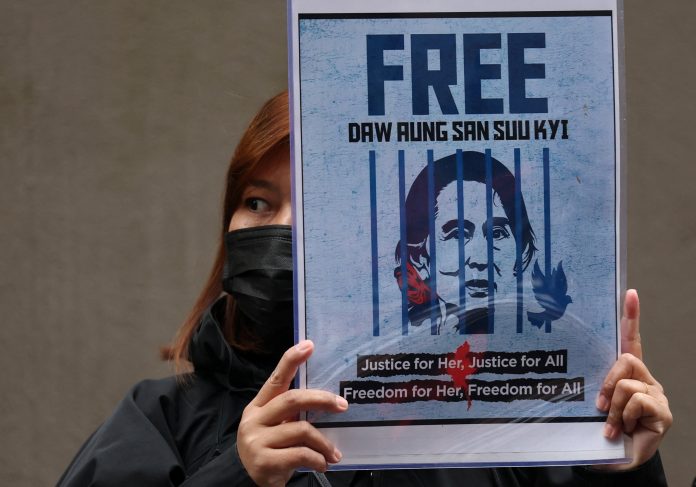
President Win Myint was ousted in the military coup led by Min Aung Hlaing on Feb. 1, 2021 and has been held in detention over the last five years. State Counsellor Aung San Suu Kyi, who was also detained during the 2021 military coup, remains in prison. One of Aung San Suu Kyi’s lawyers told Reuters that her 27-year sentence will be reduced by one-sixth.
One of her lawyers told DVB that she’ll be transferred from prison to house arrest. But no location was disclosed. Win Myint was sentenced to 14 years after being convicted by a regime court of corruption and Section 130-A of the Penal Code which penalizes the “exertion of influence” over Myanmar’s electoral body, the Union Election Commission (UEC), during elections held prior to the coup in 2020. Read more

At least 292 political prisoners freed on April 17
The Political Prisoners Network Myanmar (PPNM) reported on Saturday that 1,686 inmates, including 292 political prisoners, have been released since Friday. The PPNM claimed that Min Aung Hlaing is “trying to fool” the international community by releasing fewer prisoners than the 4,514 he originally announced on Friday.
A source close to Pathein Prison in the Ayeyarwady Region capital told DVB on the condition of anonymity that Tin Min Htut, the NLD secretary in Ayeyarwady, was released on April 17. The source added that 14 political prisoners were among the total 311 inmates freed from five prisons across Ayeyarwady on April 17.
A total of 20,872 prisoners have been granted an amnesty so far this year in three rounds with the two previous occurring on Peasants’ Day March 2, and Independence Day Jan. 4. The Assistance Association for Political Prisoners (AAPP) reported that 22,170, who were arrested for opposition to the 2021 military coup, remain behind bars.
News by Region
YANGON—Sources at Insein Prison told DVB that filmmaker Shin Daewe was among those released in an amnesty announced by Min Aung Hlaing on Friday to mark the New Year. “She’s reunited with her family,” Shin Daewe’s husband Ko Oo confirmed to DVB, adding that she’s in good health.
Yangon’s Insein Prison Court handed a life sentence to Shin Daewe, 52, under the Counter-Terrorism Law on Jan. 11, 2024. The award-winning filmmaker and former DVB reporter was arrested at Aung Mingalar Highway Bus Station in Yangon on Oct. 15, 2023, while picking up a drone. Read more
KARENNI—The Karenni State Interim Executive Council (IEC), a provisional government established by resistance groups in 2023, announced on Friday that it had granted an amnesty to 234 prisoners jailed in prisons run by the IEC across the state.
Khu Oo Reh, the IEC chairperson, did not provide DVB with any details regarding those who were released from prisons across Karenni. Mese, Shadow and Hpasawng townships are under resistance control while Demoso, Hpruso, Bawlakhe and the state capital Loikaw are under regime control.
CHIN—The Chin National Defence Force (CNDF) stated on Wednesday that four members of the Chin resistance were killed during a CNDF-led seizure of a military outpost in Falam Township’s Khunli village on April 14. Falam, located about 68 miles (109 km) north of the state capital Hakha, was seized by the Chin Brotherhood in April 2025.
A CNDF spokesperson told DVB that fighting against regime forces in Falam is ongoing. More than 300 military personnel from Tedim Township, located 47 miles (76 km) south of Falam, were deployed at the outpost. A military counteroffensive to regain control of Falam began in January.
(Exchange rate: $1 USD = 4,115 MMK)

Watch our latest Newsroom interview with ICC Spokesperson Oriane Maillet on DVB English News YouTube or Spotify. Listen wherever you get podcasts.
Myanmar victims lodge formal class-action lawsuit against Telenor

A major class-action lawsuit has officially been filed in Norway against telecommunications giant Telenor, alleging the company shared sensitive user data with Myanmar’s military, resulting in severe harm to pro-democracy activists and civilians following the coup on Feb. 1, 2021.
Joseph Wilde-Ramsing, the Director of Advocacy at the Center for Research on Multinational Corporations (SOMO), confirmed to DVB the formal filing of the litigation on behalf of victims. The legal action is being represented by the Swedish non-profit Justice and Accountability Initiative (JAI).
“This is a big moment,” Wilde-Ramsing said. “We have been on a five or six-year journey trying to defend the rights of the victims there and get some justice and accountability for them.”
The lawsuit currently centers on 1,253 phone numbers identified as having been specifically requested by the military and provided by Telenor.
Wilde-Ramsing added that this is an opt-out class-action lawsuit, meaning all individuals associated with those numbers are automatically included unless they choose to withdraw.
He expects the number of claimants to grow significantly as the legal process forces Telenor to disclose the full extent of its data sharing during discovery.
The case demands both financial compensation for victims who suffered quantifiable harm—such as the loss of a livelihood or the murder of a family member—as well as non-pecuniary damages for the widespread stress and hardship caused by the data breach.
A shift from the “disengagement” argument
This formal lawsuit represents a sharp escalation from previous accountability efforts. An earlier complaint filed in 2021 through the National Contact Point for Responsible Business Conduct Norway (NCP Norway) primarily focused on Telenor’s “irresponsible disengagement” when it sold its Myanmar operations to a military-linked company.
In December, the NCP Norway issued a statement declaring that Telenor had failed to uphold the Organisation for Economic Co-operation and Development (OECD) guidelines for responsible business conduct both upon entering and exiting Myanmar.
However, the current lawsuit focuses on actions taken before Telenor left the country.
Wilde-Ramsing told DVB that the litigation is built on hard evidence provided by whistleblowers proving that Telenor actively shared data on specific individuals targeted by the military junta following the 2021 coup while still operating in Myanmar.
“The new case was about the sharing of data that they were doing while they were still there on specific individuals that the junta was interested in and was requesting,” said Wilde-Ramsing.
Precedent for corporate data control
Beyond securing compensation for Myanmar victims, advocates hope the lawsuit sets a global precedent regarding corporate accountability and user data control in authoritarian contexts.
Wilde-Ramsing told DVB about a specific instance where a user, recognizing the danger the 2021 coup presented, explicitly asked Telenor to delete his data. The company refused.
“This case just shows how dangerous everyday or run-of-the-mill data, which can be very sensitive in certain contexts… can very easily be weaponized when it gets into the hands of bad actors,” said Wilde-Ramsing.
“Why is the company allowed to say, ‘No, we’re not going to [delete your data] because we need it for our purposes, whether that be making money or selling it to a junta?'”
A long legal road ahead
While plaintiffs are seeking a resolution, Wilde-Ramsing and JAI are preparing for a protracted legal battle that could last up to five years, anticipating that Telenor may fight the claims up to the Norwegian Supreme Court.
Despite the long road, victims remain committed to securing a public victory. Wilde-Ramsing emphasized that the plaintiffs are not interested in a quiet settlement that absolves the company without an admission of wrongdoing.
“Justice—just the principle of this case—is very important, even more important for them than the financial compensation.”
“We want to have recognition that Telenor has violated the law and this type of corporate behavior is irresponsible and unacceptable,” he concluded.
Myanmar frees over 4,000 prisoners in New Year amnesty
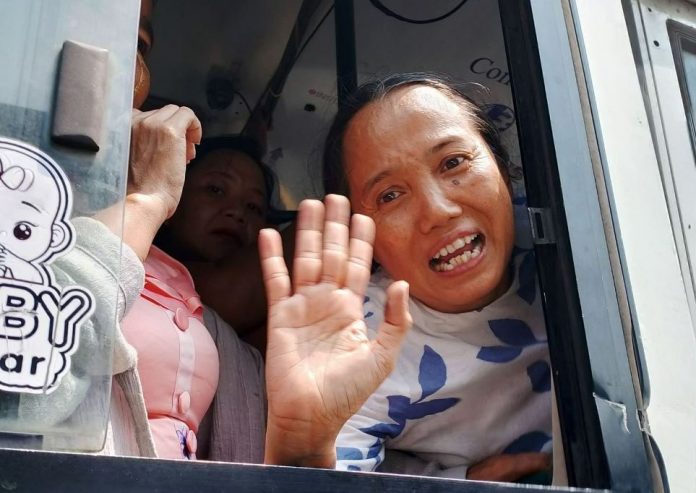
President Win Myint and journalist Shin Daewe were released in a prisoner amnesty to mark the Myanmar New Year on April 17. State Counsellor Aung San Suu Kyi had her 27-year sentence reduced by one-sixth. Read more.
Myanmar’s political prisoners are not bargaining chips
Guest contributor
Salai Za Uk Ling
The demand to free political prisoners in Myanmar is urgent, necessary, and morally undeniable. But it must also be said clearly, these individuals should never have been arrested in the first place.
Their detention is not a legal matter, it is an injustice.
Since the 2021 military coup, the scale of repression has been staggering. According to the Assistance Association for Political Prisoners, as of April 10, 2026, at least 30,870 people have been arrested, with 22,170 still detained, including those sentenced.
Thousands have been killed, while only a fraction have been released.
These figures expose a brutal reality. Arrest, detention, torture, and killing are not isolated acts, they are part of a systematic campaign to silence dissent and control a population.
Yet amid this ongoing crisis, the Myanmar military has learned to manipulate the narrative. The release of political prisoners, long demanded by the international community, is increasingly used as a calculated political tool.
Amnesties are timed, releases are staged, headlines are shaped.
What follows is predictable. Some governments begin to interpret these gestures as signs of progress, calls for engagement grow, pressure eases, and the regime gains breathing space.
Governments must not interpret prisoner releases as a basis for re-engagement or normalization under any circumstances.
This is not reform; it is political theatre.
That theatre is now expanding. Following a deeply flawed electoral process, the military has sought to recast itself as a civilian authority, installing a military-dominated, civilian-clad administration since April 10.
This rebranding is part of a broader attempt to manufacture legitimacy while the structures of repression remain firmly in place.
The timing of prisoner releases must also be understood in this context. Another amnesty took place on Myanmar New Year, a symbolic moment traditionally associated with cleansing and renewal.
But political repression cannot be washed away through ritual, nor can legitimacy be manufactured through staged elections and timed releases.
President Win Myint was released. This move could be framed as a breakthrough, a powerful and symbolic gesture intended to signal change. But it would be a mistake to mistake symbolism for substance.
Any selective release, especially of prominent figures, must be understood as part of a broader strategy to secure political concessions, not evidence of systemic change.
The release of a few cannot mask the continued detention of thousands, nor the ongoing arrests that take place every day.
Even as some are released, new arrests continue daily, ensuring that the overall system of repression remains unchanged.
The demand must remain clear and uncompromising, release everyone, and dismantle the legal and political machinery that enables arbitrary arrest, including emergency provisions, military tribunals, and repressive laws used to criminalize dissent.
The fundamental truth must not be obscured, releasing political prisoners is not a concession. It is the bare minimum obligation of any authority that claims to uphold the rule of law.
A regime cannot claim credit for partially undoing violations it should never have committed. If this distinction is blurred, the consequences are serious.
Selective releases risk becoming a mechanism through which legitimacy is gradually rebuilt, while arrests continue, airstrikes intensify, and entire communities remain under attack. The system of repression remains intact, even as its image is carefully managed.
Without credible legal consequences, this cycle of arrest, release, and re-arrest will continue indefinitely.
This is where the conversation must shift, from gestures to consequences.
There is growing recognition within the United Nations system that universal jurisdiction is an essential pathway to justice in Myanmar.
At the Human Rights Council’s 61st session, multiple mandates and mechanisms underscored the importance of accountability efforts beyond Myanmar’s borders.
Importantly, this is no longer theoretical.
In the Philippines, a universal jurisdiction case has already been initiated against Myanmar military leaders.
In Timor-Leste, proceedings are moving forward. More recently, activists in Indonesia have filed a genocide complaint targeting Myanmar’s top leadership.
Taken together, these efforts reflect a growing regional willingness to confront impunity.
They also present the Association of Southeast Asian Nations (ASEAN) with a critical opportunity.
For years, ASEAN’s response has centered on the Five-Point Consensus. While it remains an important framework, it has been repeatedly ignored and selectively engaged by the Myanmar military.
Continued reliance on dialogue without consequence risks enabling the very abuses ASEAN seeks to resolve.
What has been missing is leverage.
Universal jurisdiction provides that leverage, not as a replacement for ASEAN’s consensus, but as a necessary complement to it. It introduces consequence into a process that has too often relied on persuasion alone.
This is a language the military understands.
For countries like the Philippines, particularly in its role as ASEAN 2026 Chair, this moment calls for principled leadership.
The Philippines has a responsibility to ensure that the region does not drift toward normalization based on staged prisoner releases and manufactured political transitions.
Supporting the unconditional release of all political prisoners remains essential, but it must be matched by a firm refusal to treat such gestures as reform.
Engagement must be grounded in measurable change, ending attacks on civilians, allowing humanitarian access, and advancing credible accountability.
Above all, clarity is needed.
Myanmar’s political prisoners are not bargaining chips. They are victims of a system that continues to operate with impunity.
They should never have been imprisoned. Their release is not progress, it is a correction of injustice.
The demand remains simple, free them all. It must be backed by consequence.
Salai Za Uk Ling is executive director of the Chin Human Rights Organization, a nongovernmental organization established in 1995 to protect civilians, document atrocity crimes, and advance justice for the Chin people and other ethnic communities in Myanmar. He has a pending war crimes complaint against top officials of the Myanmar junta before the Philippine Department of Justice under the international humanitarian law.
DVB publishes a diversity of opinions that does not reflect DVB editorial policy. We’d like to hear what you think about this or any of our stories: [email protected]
World Court celebrates 80-year anniversary as international law under strain
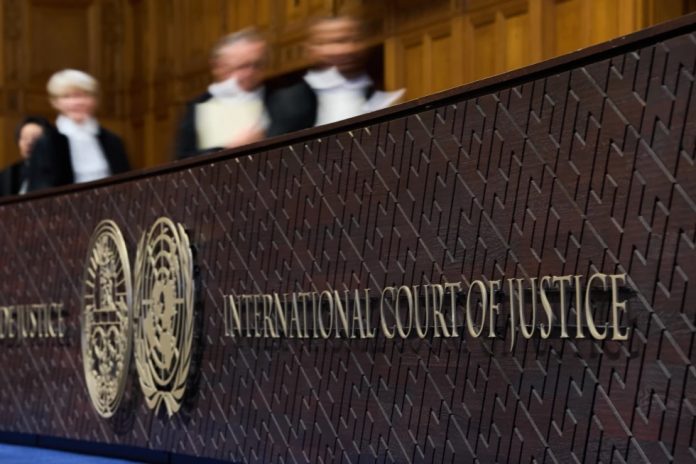
The United Nations secretary-general warned on Friday that international law was eroding before the world’s eyes, during a speech celebrating the 80th year anniversary of the World Court.
“The force of law must always prevail over the law of force,” António Guterres told dignitaries gathered in the ornate Great Hall at the International Court of Justice in The Hague.
The celebration at the highest court of the United Nations stood in contrast to the strain on the international legal framework.
U.S. President Donald Trump recently threatened to blow up every bridge and power plant in Iran, an action that would be so far-reaching that some experts in military law said it could constitute a war crime.
Sudan just entered its fourth year of war between the military and paramilitary forces and Russia continues to attack Ukraine in violation of an order from the ICJ.
“Powerful states have thrown out the rule book and perform disdain for international law,” Janina Dill, an expert in international law at Oxford University, told The Associated Press.
The court is the busiest it has been in its history, grappling with the Gaza conflict, the war in Ukraine and even climate change.
In his address to the ceremony, presiding judge Yuji Iwasawa said the court responds to these challenges simply by carrying out its function of “interpreting and applying international law rigorously and in good faith.”
Set up in the aftermath of World War II, the ICJ adjudicates disputes between countries. Certain U.N. bodies, including the General Assembly, can request advisory opinions from the court’s 15 judges.
All 193 U.N. member states are members of the ICJ, though not all of them automatically recognize its jurisdiction.
When the court held its inaugural session in 1946, it only counted 51 countries as its members. That event was attended by Queen Juliana of the Netherlands. Her grandson, King Willem-Alexander, attended the 80th anniversary celebration on Friday.
A year after the opening, the United Kingdom filed the court’s first case when it brought a complaint against Albania over damage to naval ships on the Corfu Channel.
The judges are currently considering allegations of genocide against Myanmar for the country’s treatment of the Rohingya ethnic minority and against Israel for its military actions in Gaza. Both countries deny the allegations.
Some disputes on the court’s docket predate its existence. Guyana has asked the court to weigh on a border dispute with neighboring Venezuela, a legal battle which has been waged since 1899.
AP