Thursday, July 23, 2026
Home Blog Page 77

Aung San Suu Kyi to be freed earlier as Myanmar releases President Win Myint from jail

0
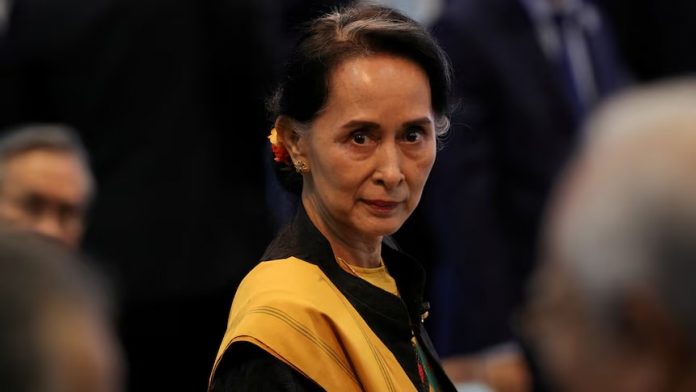
Aung San Suu Kyi has been in detention since a military coup in 2021 ousted Myanmar's government. (Credit: Reuters)

The jail sentence of Myanmar’s imprisoned ex-leader Aung San Suu Kyi has been reduced. It comes as thousands of prisoners are released, including the country’s former president, Win Myint. The U.N. has called for the immediate release of Aung San Suu Kyi and others “detained unjustly” since the 2021 coup.

The prison sentence of Myanmar’s imprisoned leader Aung San Suu Kyi has been reduced as her ally, former president Win Myint, is released from jail as part of a mass amnesty.

Aung San Suu Kyi was serving a 27-year sentence for a range of politically-motivated offences ranging from incitement and corruption to election fraud and violating a state secrets law.

But, as part of a widespread pardon, the 80-year-old’s sentence has been cut by at least four years.

It is not clear whether the Nobel Peace Prize winner will be allowed to serve the rest of her sentence under house arrest or when she may be eligible for release.

Aung San Suu Kyi has not been seen in public since her trial ended and her whereabouts is unknown. 

All people in Myanmar serving a jail term under 40 years had their sentence reduced by one-sixth on Friday – in a move ordered by the country’s coup leader Min Aung Hlaing, who was inaugurated as president by a pro-military parliament on April 10.

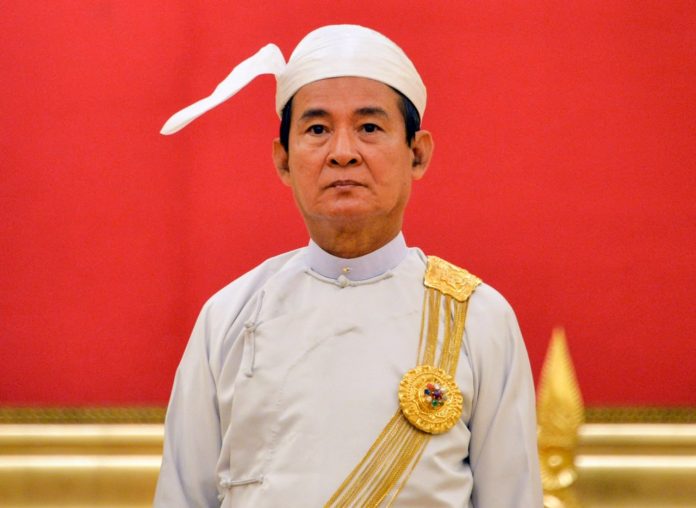
He also ordered the release of more than 4,500 prisoners including Suu Kyi’s ally, Win Myint, who served as Myanmar’s president from 2018 until the 2021 military coup.

Win Myint was “granted a pardon and the reduction of his remaining sentences under specified conditions”, Myanmar’s state broadcaster MRTV reported.

While Win Myint occupied the top spot, it functioned as a ceremonial role because Aung San Suu Kyi was barred from holding the presidency under a military-drafted constitution.

The 2021 coup plunged the southeast Asian country into civil war.

U.N. rights chief Volker Türk was relieved by the “long overdue release” of Win Myint but called for the immedate release of Suu Kyi.

“All those detained unjustly since the coup — including state counsellor Aung San Suu Kyi — need to be released immediately and unconditionally,” he said on X.

“There must be an end to the unrelenting violence against all of Myanmar’s people.”

Amnesties typically take place in Myanmar each year to mark Independence Day in January and New Year in April.

2025 deadliest year for Rohingya refugees

While Suu Kyi remains a wildly popular figure, her reputation did suffer when she defended Myanmar’s militiary at the International Court of Justice against allegations of ethnic cleansing towards Rohingya people.

Hundreds of thousands of Rohingya people have fled war-torn Myanmar for Bangladesh and other countries.

New figures released by the United Nations showed last year was the deadliest on record for Rohingya refugees fleeing by sea, with deaths continuing to soar in 2026.

“In 2025, nearly 900 Rohingya refugees were reported missing or dead in the Andaman Sea and Bay of Bengal,” the United Nations refugee agency’s spokesman Babar Baloch said.

Baloch added that equated to one in seven Rohingya people trying to take the journey ending up missing or dead which was “the highest mortality rate worldwide of any major route for refugee and migrant sea journeys”.

Rohingya people mainly leave from huge camps in Bangladesh’s Cox’s Bazar where more than one million refugees have fled to from war-torn Myanmar. 

The UN estimated 200,000 Rohingya refugees had taken that dangerous sea crossing since 2012.

ABC

Myanmar’s coup leader seeks legitimacy as family wealth surfaces in Thailand

0
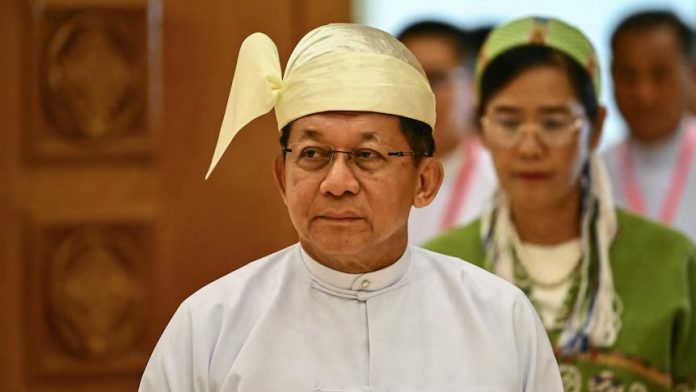
Min Aung Hlaing arrives at the Myanmar parliament in April. (Credit: AFP)

When Sean Turnell, a former economic advisor to Aung San Suu Kyi, was thrown into prison after Myanmar’s military seized power in a coup, he pieced together the commander-in-chief’s character from an unlikely source: his cellmates.

“People I spoke to in prison had been in his same class at the military academy. They said he had always been a very insecure guy, always on the lookout to go one better,” he recalled.

It came as little surprise, then, that Min Aung Hlaing’s ambitions extended to reaching the presidency whatever the cost.

Last Friday, he was sworn in as Myanmar’s president following an election widely condemned as a sham.

Aung San Suu Kyi, the country’s former democratically elected leader, was excluded from the poll.

Turnell was released from prison in late 2022, but five years after the coup that toppled her government, Aung San Suu Kyi remains locked up.

Under Min Aung Hlaing’s command, Myanmar’s military stands accused of bombing civilians, torching villages and committing war crimes against the Rohingya, and investigations are being conducted by the International Criminal Court and the International Court of Justice.

Analysts say Min Aung Hlaing has consolidated power more aggressively than any of his predecessors.

Same general, new clothes

Curtin University associate professor Htwe Htwe Thein warns that if other countries stay silent, it will look like they accept Min Aung Hlaing as president.

“My biggest fear is that the international community — especially those in South-East Asia — will start to recognise and accept him slowly,” Dr Thein said.

“While it may appear a civilian government, it is civilian clothing only, but people may look at the images of parliament sitting and say, ‘Good enough.'”

The election was held in only a third of the country, and the main opposition parties were excluded. Myanmar has been in a brutal civil war since the 2021 coup.

“The parliament that voted him in was stacked with military loyalists,” Dr Thein said. She said the first thing Min Aung Hlaing should do is stop the bombing of civilians. “Even the day after last year’s earthquake, he kept bombing,” she added.

Dr Thein believes that Min Aung Hlaing is following a well-worn playbook used by past military rulers in the country, such as Ne Win, Than Shwe and Thein Sein, by methodically purging anyone whose loyalty was in doubt.

“He kicked out those he didn’t fully trust, or even suspected of disloyalty. He got rid of those with competency because competence threatened him,” she said.

Among his most trusted new appointments is former spy chief Ye Win Oo. Widely known as Min Aung Hlaing’s “eyes and ears”, he now heads the military.

“[Ye Win Oo is] a dangerous figure who has spent a lot of time purging a lot of people,” Turnell told the ABC.

Military buying Thai mansion, investigators say

While Min Aung Hlaing was ordering air strikes, his family was quietly acquiring luxury property in Bangkok, according to investigators.

In 2022, a 98 million Thai Baht ($4.3 million USD) mansion in the Thai capital was purchased through a structure that, on paper, appears legal, but which investigators allege may have been designed to circumvent sanctions.

The ownership is linked to a company registered under a business category unrelated to real estate, which investigators say could obscure the identity of the true buyers.

The deal was reportedly brokered by Tun Min Latt, a well-connected junta associate, who is said to have negotiated directly with Thai developer Charn Issara and moved funds through multiple Thai banks, according to activist group Justice for Myanmar, which uncovered the money trail.

“Under Thai law, there are multiple grounds for asset seizure — authorities could act immediately if there was the political will,” Justice For Myanmar spokeswoman Yadanar Maung said.

“Acts of corruption constitute a predicate offence under Section 3 of Thailand’s Anti-Money Laundering Act, even if committed overseas, and the law provides grounds for seizure by the state.”

US-based non-profit The Sentry, which worked alongside Justice For Myanmar, said the pattern was familiar.

“Myanmar junta leaders, like other illicit regimes and corrupt leaders around the world, follow similar patterns: steal wealth through corruption, use family members and corporate entities to launder the proceeds, then conceal and store it in foreign real estate,” said Laura Ferris, a money laundering expert at The Sentry.

She alleged that “in addition to using the Thai banking system to support the junta’s military actions, junta leaders and their family members are using Thai real estate to launder and store the proceeds of their crime”.

The ABC contacted the Department of Business Development, the anti-corruption authority and the securities exchange commission in Thailand, and the Charn Issara Development Public Company, but has not received any responses.

Justice for Myanmar said it had lodged complaints with Thai authorities.

The gaps in sanctions on Myanmar

Western sanctions designed to isolate Min Aung Hlaing’s inner circle following the 2021 coup have been imposed, but gaps remain.

His children Aung Pyae Sone and Khin Thiri Thet Mon are sanctioned by the United States and Canada, but analysts say sanctions on extended family networks remain uneven, particularly across different countries and regions.

Meanwhile, regional Asian governments have largely remained silent on Myanmar.

“Asian countries don’t really go after one another on a human rights basis,” Dr Thein told the ABC. “They have a history of non-interference.”

The U.S., U.K., E.U. and Canada have sanctioned at least 179 individuals and 154 business entities.

Australia has imposed sanctions on 21 individuals and seven entities, as well as implementing an arms embargo against Myanmar.

When asked if Canberra would align with allies in applying more sanctions, a Department of Foreign Affairs and Trade spokesperson told the ABC, “Australia sanctions regime leaders responsible for deposing democratically elected leaders and for repression and violence toward the people of Myanmar.”

“[Sanctions] also seek to limit access to funds and military material that enable ongoing violence against the Myanmar people,” they said.

But Turnell said Australia needed to do more, including implementing further recommendations.

“One breakthrough is the Australian Senate Committee on Democracy and Human Rights recommending the sanctioning of Myanmar’s Central Bank — the main financier of the military and its primary vehicle for weapons procurement,” he said.

Former U.N. Special Rapporteur Yanghee Lee put it more starkly.

“The international community needs to get off the fence by fully backing the people’s genuine will and ostracising the junta in its current [form] and any future form it takes,” Lee said.

She has called for countries to work with the parallel government, the National Unity Government (NUG), and to isolate Min Aung Hlaing.

Turnell warned of the risk of countries falling for the military’s legitimisation campaign, which includes hiring PR firms to help with its image.

“I worry, because the Trump administration, as we’ve seen, is always willing to do deals — and I worry they may do a deal for rare earths,” he said.

“There is a low bar for a lot of countries willing to accept the regime just to move past the Myanmar problem. Min Aung Hlaing will do anything to maintain power.”

ABC

UN rights chief calls for release of all political prisoners in Myanmar

0
Family members wait outside Yangon’s Insein Prison for the release of prisoners as part of an amnesty to mark Myanmar's New Year on April 17. (Credit: Reuters)

Authorities in Myanmar released the country’s ousted president from prison on Friday, along with some 4,000 other people, as part of an amnesty to mark the traditional New Year festival.

President Win Myint had been in jail since February 2021 when the military overthrew Myanmar’s democratically elected government in a coup, which sparked nationwide protests and subsequent armed resistance movements across the country.

Other senior officials, including State Counsellor Aung San Suu Kyi, remain behind bars.

Release all detainees: Guterres

In response to the developments, U.N. Secretary-General António Guterres highlighted the need to continue to find a resolution to the crisis in Myanmar.

“The Secretary-General takes note of the announcement of amnesty, including the release of prisoners, reductions of sentences and commuting death penalties to life imprisonment, and the news about the release of President Win Myint,” U.N. Spokesperson Stéphane Dujarric said in a note to journalists.

“He underscores the need for meaningful efforts to ensure the swift release of all those arbitrarily detained, including State Counsellor Daw Aung San Suu Kyi, and to create conditions conducive to a credible political process.”

The Secretary-General further encouraged continued dialogue between all relevant stakeholders and his Special Envoy, Julie Bishop, on how the U.N. alongside regional bloc, the Association of Southeast Asian Nations (ASEAN), and other partners “can help support efforts towards a peaceful solution in the interests of the people of Myanmar as called for by the Security Council and General Assembly.”

UN Human Rights Chief ‘relieved’

The U.N. High Commissioner for Human Rights welcomed Friday’s news.

Volker Türk tweeted that he was “relieved” by the long overdue release of Myanmar’s jailed President Win Myint and other prisoners, as well as the commutation of death sentences.

“All those detained unjustly since the coup – including State Counsellor Aung San Suu Kyi – need to be released immediately and unconditionally,” he said. “There must be an end to the unrelenting violence against all of Myanmar’s people.”

UN

Did Thailand recognize Min Aung Hlaing as Myanmar president?

0
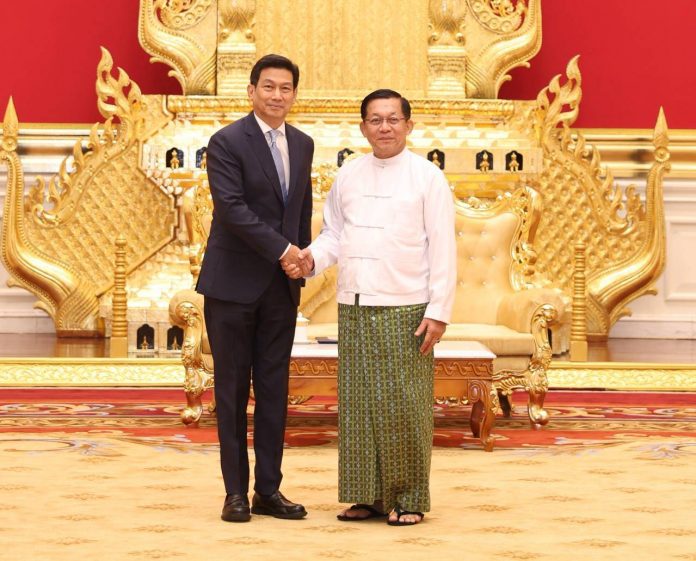
Regime leader Min Aung Hlaing with Parnpree Bahiddha-Nukara, Thailand’s Chief Advisor and Special Envoy of Deputy Prime Minister and Minister of Foreign Affairs Sihasak Phuangketkeow, at the presidential inauguration ceremony in Naypyidaw on April 10. (Credit: Thai MOFA)

Guest contributor

Kannikar Petchkaew

Anutin Charnvirakul, the Prime Minister of Thailand, has made headlines as the first leader in the 11-member Association of Southeast Asian Nations (ASEAN) countries to send a congratulatory message to Min Aung Hlaing, the military general and architect of the 2021 coup who assumed the presidency in Myanmar.

He broke “ASEAN rank,” The Irrawaddy reported.

In his letter to Min Aung Hlaing, Anutin stated the two countries “have long enjoyed close and friendly relations grounded in mutual respect, shared interests, and strong people-to-people ties” and that Thailand stands ready to support Myanmar’s efforts towards peace, stability, and national development.

“I am confident that, under Your Excellency’s able leadership, relations between our two countries will continue to grow from strength to strength,” Anutin added.

The full copy of this letter could be found only in The Global New Light of Myanmar. It spent almost the entire week publishing congratulatory letters from foreign leaders in its pages. Including another letter from Thailand’s Minister of Foreign Affairs.

It also published a photograph of Parnpree Bahiddha-Nukara, Thailand’s Chief Advisor and Special Envoy of the Deputy Prime Minister and Minister of Foreign Affairs, shaking the hand of Min Aung Hlaing during a visit to Naypyidaw on April 10.

This photo of a high-level Thai diplomat meeting with Min Aung Hlaing in recognition of his presidency was later shared by Myanmar and Thai media. 

There’s no surprise about this in Bangkok. With or without Anutin as Prime Minister, Thailand will always work on its own when it comes to Myanmar within ASEAN even if the 2026 Chair the Philippines has decided not to recognize Min Aung Hlaing as president of Myanmar. Yet.

No letter of congratulations from the Philippines’ President Ferdinand Marcos Jr. was published in The Global New Light of Myanmar. Instead, Malacañang Palace said it would “continue to engage” Myanmar in carefully neutral language.

“The Philippines will continue to engage relevant authorities and stakeholders in Myanmar through Foreign Affairs Secretary Ma. Theresa Lazaro, in her capacity as Special Envoy of the ASEAN Chair to Myanmar, as well as through our respective embassies,” the palace stated.

Lazaro announced a few weeks ago that ASEAN is considering a review of its Five-Point Consensus on Myanmar, as the Philippines carries on after Indonesia and Malaysia believing in this peace plan drafted five years ago, in April 2021.

Thailand never shies away from the fact that it protects its own economic interests over any other country’s political or humanitarian concerns. Despite the sanctions against the military junta in Myanmar, Thailand is its biggest client for natural gas.

While ASEAN, under heavy criticism since 2021 for being unable to help Myanmar solve its problems, has at least barred junta leaders from high-level summits.

Thailand, on the other hand, has hosted informal meetings with Myanmar junta officials. It has also supported humanitarian aid delivery through state channels and emphasized “constructive engagement” rather than isolation.

What’s wrong with Bangkok? Why does it behave so differently from Manila and other ASEAN countries? Geographic reality has it all.

While Manila is a three-hour flight away. Thailand shares an 2,400-km-long porous border with Myanmar and has long faced armed conflict spillover, refugees, and disrupted trade.

The calculus is easy to read. Bangkok wants to prevent war from producing uncontrolled refugee flows, conflict along the border, as well as transnational crime, and economic disruption. 

Thai policy over Myanmar is usually framed around stability, manageability, and engagement with whoever holds power across the frontier, rather than around sanctions or political isolation. 

It is best understood as security management first and principle second, neither a straightforward supporter of Myanmar’s military nor a consistent defender of Myanmar’s democratic opposition. 

Thailand is a pragmatic border state trying to preserve leverage and protect its own interests. This reflects its longstanding doctrine of working with whoever controls Naypyidaw.

Despite the flashy headline in The Global New Light of Myanmar stating that Min Aung Hlaing is the “elected president,” Thailand has no reason to rush to congratulate him.

If you ask yourself, why has this country not taken a stand against the dictatorship and the violence inflicted on its own people?

Thailand has lived under its own military junta long enough to know that withholding recognition would not dislodge the military from power—but it would narrow Thailand’s room to manage immediate security risks along its border.

Thai foreign policy is also shaped by domestic realities. With a long history of military influence in politics, the country’s civil–military dynamics tend to favor a stability-first approach in diplomacy, often taking precedence over human rights-based positioning.

And if this looks like a full-throated endorsement from Bangkok, there are some fun facts for us to consider.

Beyond the prominently displayed coverage in the Global New Light of Myanmar, there is little trace of Anutin’s congratulatory message on official Thai state websites. 

Neither the Thai government’s social media nor the Ministry of Foreign Affairs of Thailand—which routinely publicizes high-level meetings and diplomatic gestures—posted any acknowledgment, imagery, or statement marking the occasion.

The only official trace is more subdued: photographs on the foreign ministry’s website showing Parnpree delivering congratulations in his capacity to the new president as chief advisor and special envoy to the minister.

But what appeared in the report was a visit by a “former deputy prime minister and minister of foreign affairs of Thailand”; Parnpree had resigned from these positions in mid-2024.

Parnpree is a credible envoy—a seasoned diplomat, a former foreign minister and deputy prime minister, and a figure who has dealt directly with border tensions as fighting between the Myanmar military and ethnic armed groups has spilled into Thai territory.

But it is equally accurate to say that, today, he serves only as an advisor.

No congratulatory message to Myanmar’s new president appears on the ministry’s official website. Yet the letter sent to Aung San Suu Kyi after her 2015 landslide victory is still publicly available there today.

What emerges in Naypyidaw is not a clear signal of diplomatic embrace but a carefully managed ambiguity: acknowledgment without amplification, contact without visibility.

A single advisor, dispatched without fanfare and largely absent from official channels, delivered the message, leaving open a more pointed question.

If recognition is meant to signal legitimacy, what does it mean when it is delivered so quietly that it is almost invisible?

To me. It’s like being invited out with friends but told, gently, no photos. 


Kannikar Petchkaew is an independent journalist who has spent over 30 years covering mainland Southeast Asia. With two decades devoted to the suffering of the people of Myanmar. 

DVB publishes a diversity of opinions that does not reflect DVB editorial policy. We’d like to hear what you think about this or any of our stories: [email protected]

Record number of Rohingya refugees died at sea last year, UNHCR says

0
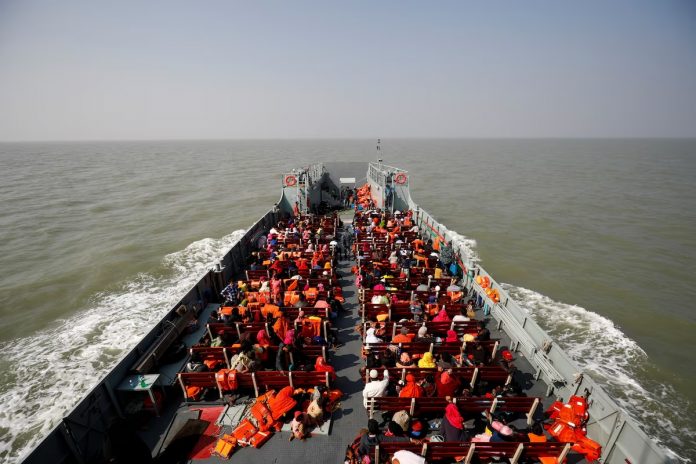
A Bangladesh Navy vessel in the Bay of Bengal, carrying Rohingya refugees to the Bhasan Char island in Noakhali district, Bangladesh, on December 29, 2020. (Credit: Reuters)

Nearly 900 Rohingya refugees were reported missing or dead in the Andaman Sea and Bay of Bengal in 2025, ​making it the deadliest year on record for the route, the United ‌Nations refugee agency said on Friday.

More than one in seven of the estimated 6,500 Rohingya refugees who attempted the sea crossing last year were reported missing or dead, the highest mortality rate worldwide for refugee and ​migrant sea journeys, UNHCR spokesperson Babar Baloch told reporters in Geneva.

The dangerous sea crossings ​have continued into 2026, with more than 2,800 Rohingya embarking on such journeys ⁠up until April 13 this year, Baloch said. In recent years, more than half ​of those attempting the crossings have been women and children, UNHCR said.

“No one would put their ​family on a risky boat, knowing that the chances of survival are really low, if the sense of desperation is not there,” Baloch said.

Deadly maritime journeys have become a recurring feature of a long-running humanitarian crisis ​resulting from conflict in Myanmar, as members of the Rohingya Muslim minority continue to risk ​their lives on overcrowded, unseaworthy boats in search of safety and opportunity.

Their departures are driven by violence ‌at home ⁠and desperate conditions in crowded refugee camps in Bangladesh. They hope to reach safety and opportunity in countries such as Malaysia, Indonesia or Thailand.

This week, the U.N. refugee and migration agencies said around 250 people were missing after a boat that departed from Teknaf in southern Bangladesh ​carrying Rohingya refugees and ​Bangladeshi nationals capsized in ⁠the Andaman Sea.

Global donor funding cuts, which are impacting humanitarian support, are driving desperation among some of the one million Rohingya refugees currently ​in Bangladesh, Baloch said.

“This sad and tragic trend continues, this sense ​of desperation among ⁠the Rohingya population,” he said.

UNHCR has requested $200 million USD this year to support the Rohingya population living in the Cox’s Bazar camp and on the island of Bhasan Char who rely entirely on ⁠humanitarian ​assistance including food, water, shelter and health.

However, it is ​currently only 32 per cent funded.

Over 1.3 million Rohingya refugees and asylum-seekers remain displaced across the region, including 1.2 million in ​Bangladesh according to UNHCR.

REUTERS

President Win Myint freed in broad Myanmar prisoner amnesty

0

Myanmar’s President Win Myint was freed Friday as part of a broad prisoner amnesty by Min Aung Hlaing, who was inaugurated as president by a pro-military parliament on April 10, to mark the traditional Myanmar New Year.

The pardon order applied to more than 4,500 prisoners, but it was not immediately clear how many people imprisoned for opposing military rule were included and there was no sign that 80-year-old former leader Aung San Suu Kyi would be freed as well.

Win Myint is Aung San Suu Kyi’s longtime loyalist and was elected as president in 2018. He served as president under State Counsellor Aung San Suu Kyi because the military-drafted constitution barred her from holding the presidency.

Both were arrested during the military coup on Feb. 1, 2021. Win Myint was later given 12-year combined prison sentences for several offenses, which was reduced to eight years in 2023.

Regime-run MRTV television reported that Win Myint, who was in a prison in Taungoo Township in Bago region, had received amnesty.

Outside Insein Prison in Yangon, buses carrying prisoners were welcomed by relatives and friends who had been waiting since early morning. Among those released was filmmaker Shin Daewe, who was sentenced to life imprisonment under a counterterrorism law in January 2024.

The amnesty comes a week after Min Aung Hlaing was sworn into office following an election that critics say was neither free nor fair and was orchestrated to keep the military’s iron grip on power.

Aung San Suu Kyi expected to be transferred to house arrest

Regime-run media in Myanmar said in addition to the 4,335 prisoners pardoned, nearly 180 foreigners would be released and deported.

If the freed prisoners reoffend, they will have to serve the rest of their original sentences in addition to any new sentence, according to the terms of their release. A separate report said death sentences were commuted to life imprisonment, life sentences were reduced to 40 years and prison terms of less than 40 years were cut by one-sixth.

Under that measure, Aung San Suu Kyi’s 27-year sentence would be reduced by 4 1/2 years, leaving her with 22 1/2 years still to serve.

A senior military officer from the capital, Naypyidaw told the Associated Press on Friday that she will be transferred to house arrest as part of the clemency. He spoke on condition of anonymity because he wasn’t authorized to release information.

Aung San Suu Kyi has been serving a prison term on a variety of criminal convictions at an undisclosed location in Naypyidaw and has been moved to house arrest at least once in April 2024.

In his inauguration speech last week, Min Aung Hlaing said his government would implement amnesties that contribute to social reconciliation, justice and peace and support the country’s overall development.

Prisoner releases are common on holidays and other significant occasions in Myanmar.

Since the 2021 military coup, nearly 8,000 civilians have been killed and some 22,170 political detainees, including Aung San Suu Kyi, remain jailed, according to the Assistance Association for Political Prisoners (AAPP), a rights monitoring group.

Total deaths in the ongoing conflict are estimated to be much higher.

Many political detainees have been held on incitement charges, a law widely used to arrest critics of the government or military and punishable by up to three years in prison.

Others have been prosecuted under a counterterrorism law that carries a potential death penalty and has been used to target political and armed opponents, journalists and other dissenters.

The human rights advocacy group Burma Campaign UK said in its statement on Friday that the slow, staged release of political prisoners is designed to gain positive publicity while making no real reforms.

“If the Burmese military regime were genuine about reform, they could release all 14,000 political prisoners today,” said the group’s advocacy and communications officer Minn Tent Bo, referring to the country’s former name.

“These people should not have been arrested in the first place. The Burmese military could stop arresting activists and could repeal all repressive laws. They haven’t done that.”

AP

Contact