
Thursday, July 23, 2026
Home Blog Page 8

Myanmar regime escalates surveillance and cracks down on Aung San symbols ahead of Martyrs’ Day

0
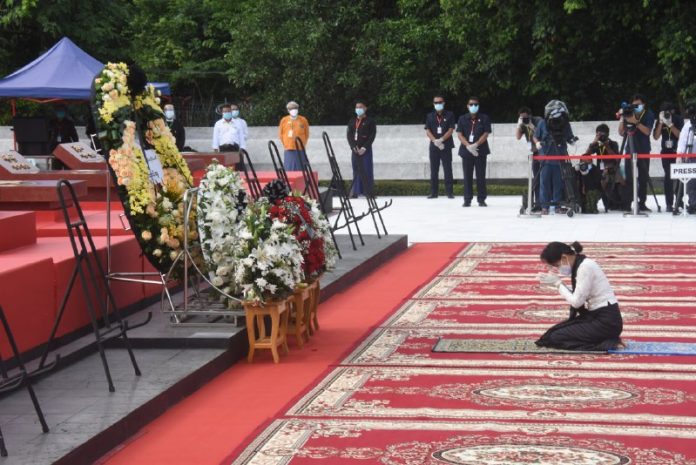
State Counsellor Aung San Suu Kyi pays tribute at the Martyrs' Mausoleum in Yangon on July 19, 2020, during the National League for Democracy administration prior to the 2021 military coup. (Credit: NLD Ministry of Information)

The regime in Naypyidaw has ordered heightened surveillance and a crackdown on public commemorations ahead of Myanmar’s 79th Martyrs’ Day on July 19.

According to sources within the regime’s General Administration Department (GAD) under the Ministry of Home Affairs, officials have been instructed to tightly monitor public spaces and online activity to prevent any anti-regime demonstrations or flash mob protests.

The date holds immense historical weight in Myanmar, marking the July 19, 1947 assassination of independence hero General Aung San—the father of jailed State Counsellor Aung San Suu Kyi—alongside seven other pre-independence cabinet members and a security guard.

A crackdown on commemorations

For decades, the public holiday has been a focal point for national mourning and, increasingly, pro-democracy sentiment. In response, the regime is deploying an array of tactics to suppress any public displays of reverence:

  • Undercover Operations: “Soldiers, police and administration officials will be deployed at public spaces and road junctions in plainclothes,” an official inside Yangon Region’s Mingalardon Township regime administration told DVB on the condition of anonymity.
  • Digital Monitoring: The source confirmed that authorities will also be actively monitoring social media comments and posts for dissenting viewpoints or calls to protest.
  • Targeting Traditions: In a micro-level crackdown on tradition, ward administrators have been instructed to specifically monitor households that distribute boiled peas and flatbread to passersby. This simple meal was reportedly a favorite of General Aung San and is traditionally shared on Martyrs’ Day as a tribute to his humble lifestyle.

Meanwhile, Aung San Suu Kyi remains held incommunicado by the regime in Naypyidaw. The Nobel Peace Prize laureate has been barred from her traditional practice of paying tribute to her father at the Martyrs’ Mausoleum in Yangon every July 19 since the military coup on February 1, 2021.

The broader campaign of erasure

Activists argue the surveillance on Martyrs’ Day is part of a much broader, systematic campaign orchestrated by regime leader Min Aung Hlaing to entirely erase General Aung San’s legacy and dismantle symbols of the pro-democracy movement.

As the regime continues its aggressive campaign to rewrite the nation’s history, the heavy surveillance ahead of Martyrs’ Day underscores its fear of the enduring power of General Aung San’s image.
Ethnic Danu political leader and businessman found dead in southern Shan State

0
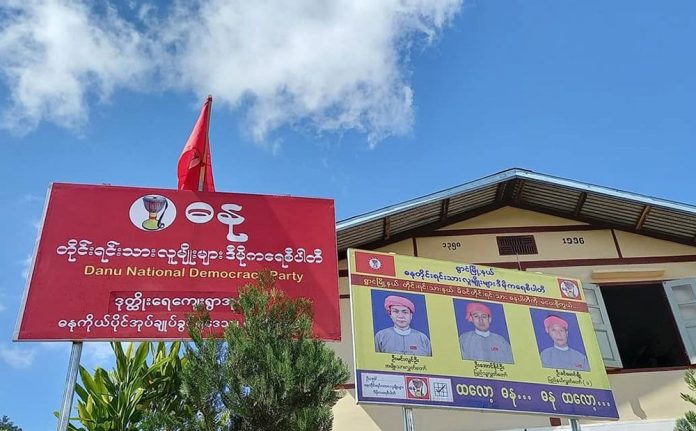
A Danu National Democracy Party billboard was installed in Ywangan Township, southern Shan State, ahead of the regime’s 2025-26 elections (Credit: DNDP)

The bodies of a prominent ethnic political leader and a local businessman were discovered on Tuesday in Nyaungpingwa village, located within the Danu Self-Administered Zone (SAZ) of southern Shan State.

According to a Ywangan Township resident, the victims were identified as San Tint, the vice-chair of the Danu National Democracy Party (DNDP), and Aung Win Sein, a local businessman.

The two men were reportedly abducted from their homes in Myinkyadoe village by an unidentified armed group on July 14. Their bodies were recovered later that same day.

Tensions and warnings

While no group has claimed responsibility for the double homicide, local sources indicated that San Tint had previously been warned by a local branch of the People’s Defense Force (PDF).

The resistance group had reportedly cautioned him against assisting regime forces operating in Ywangan, located approximately 80 miles (129 km) southeast of the Shan State capital Taunggyi.

The DNDP has not yet issued a public statement regarding the assassination of its vice-chair, and attempts to reach the party for comment have gone unanswered.

The DNDP and regional instability

Formed in July 2012, the DNDP serves as a political vehicle for the ethnic Danu nationality. The Danu population is primarily concentrated across six townships within the Danu SAZ: Taunggyi, Lawksawk, Ywangan, Pindaya, Kalaw, and Nawnghkio.

Despite widespread boycotts of the military regime’s 2025-26 elections, the DNDP fielded candidates in seven Shan townships, ultimately winning one seat in the Pyithu Hluttaw, or lower house of parliament.

Since the February 2021 military coup, Ywangan has transformed into a highly volatile and complex battleground. Civilians and local administrators are frequently caught in the crossfire between numerous armed actors vying for control.

The region is currently contested by:

  • Pro-Regime Forces: Myanmar military regime troops, Pyu saw htee militias, and the Pa-O National Organization (PNO).
  • Resistance Groups: Local People’s Defense Force (PDF) units, the Danu State National Defense Army (DSNDA), and the Danu People’s Liberation Army (DPLA).

Over 500 feared dead as officials investigate reports of boats capsizing with Rohingya refugees

0
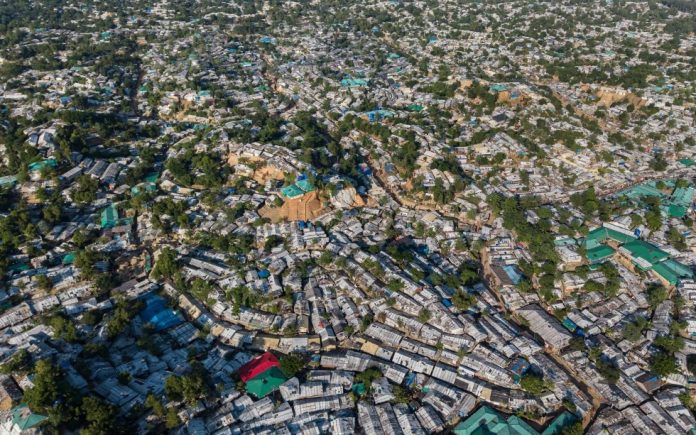
An aerial view of a refugee camp in Cox’s Bazar, Bangladesh, which is hosting over one million Rohingya from Myanmar, on Nov. 25, 2025. (Credit: AP)

More than 500 people are feared dead after reports that two boats carrying members of Myanmar’s persecuted Rohingya minority have capsized in the Bay of Bengal, officials said Thursday.

According to preliminary information, the two boats left Myanmar’s western state of Rakhine in late June carrying mostly Rohingya passengers, including some who had traveled from refugee camps across the border in Bangladesh, according to a statement from the International Organization for Migration (IOM) and the United Nations High Commissioner for Refugees (UNHCR).

One boat, believed to have been carrying around 250 people, lost contact shortly after departure. A second boat, reportedly carrying 280 people, is believed to have sunk off the coast of Ayeyarwady Region on July 8.

″While the incidents and casualty figures have yet to be officially confirmed, UNHCR and IOM are gravely concerned by the potentially devastating loss of life,” the agencies said.

The Rohingya, who have in recent years fled both Myanmar and Bangladesh’s squalid refugee camps by the thousands, typically avoid such boat journeys at this time of year, when monsoons are frequent and conditions at sea are particularly dangerous.

The UNHCR and IOM noted this in their statement, saying that recent torrential rain and flooding across the region would have made such journeys especially risky.

Around 1.2 million stateless, predominantly Muslim Rohingya remain trapped in overcrowded refugee camps in Bangladesh after fleeing waves of violence by Myanmar’s security forces.

The refugees have no way to safely return to Myanmar, where the military that killed thousands of Rohingya in 2017 during what the United States declared a genocide remains in charge of their homeland.

The Rohingya still living in Myanmar face severe restrictions and many are confined to internment camps.

Steep cuts to foreign aid by the U.S. and other countries have led to ration cuts in Bangladesh’s refugee camps, while the ruling military and an ethnic armed organization in Rakhine have fought for control of the region.

The unrest has led to an increasing number of Rohingya attempting to make the dangerous ocean crossing to Malaysia on rickety boats. Thousands have died in the process, including babies, children and pregnant women.

Local maritime authorities have frequently abandoned the Rohingya at sea, often ignoring reports of boats in distress.

The IOM and UNHCR said on Thursday that the latest potential tragedy at sea underscores the continued lack of sustainable solutions for the Rohingya, and urged the international community to support those trapped in Bangladesh’s camps.

“Stronger regional and international efforts are needed to prevent further loss of life along one of the world’s deadliest maritime routes, including through enhanced search and rescue efforts, access to asylum and protection, and actions against smuggling and trafficking networks,” the agencies said.

More than 6,500 Rohingya fled and nearly 900 were reported dead or missing in 2025, the deadliest year for Rohingya who tried to leave by boat.

The figure represents the highest mortality rate of any major route for refugee and migrant sea journeys in the world, the UNHCR said.

AP

Myanmar’s resistance forces engage with ASEAN Special Envoy amid renewed peace talks push

0
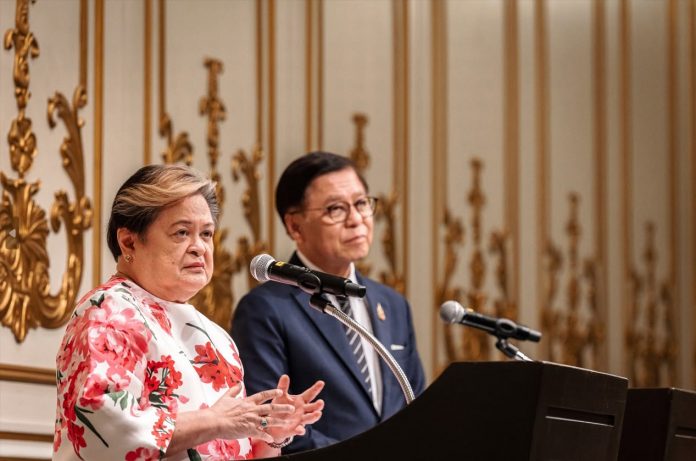
The ASEAN 2026 Chair the Philippines’ Special Envoy on Myanmar Ma. Theresa P. Lazaro with Thailand’s Foreign Affairs and Deputy Prime Minister Sihasak Phuangketkeow at a press conference in Bangkok, Thailand, on July 12. (Credit: Thai Ministry of Foreign Affairs)

Myanmar’s National Unity Government (NUG) and prominent ethnic armed organizations have engaged in direct discussions with regional diplomats, following a controversial series of informal meetings between the Association of Southeast Asian Nations (ASEAN) and the regime in Naypyidaw.

The flurry of diplomatic activity highlights a renewed push by neighboring countries to address the crisis in Myanmar since the military coup on Feb. 1, 2021, though resistance groups remain firm on their demands for genuine, inclusive political dialogue.

NUG urges broad stakeholder engagement

On July 15, the NUG released a statement confirming that its Foreign Minister, Zin Mar Aung, held a video conference with Ma. Theresa P. Lazaro, the Philippines’ Special Envoy on Myanmar representing the ASEAN 2026 Chair.

During the call, Zin Mar Aung emphasized that any effective implementation of ASEAN’s faltering Five-Point Consensus—a 2021 peace plan calling for an immediate halt to violence and the release of political prisoners—must include a “broad range” of stakeholders.

She noted that Lazaro’s recent, unprecedented direct meetings with ethnic armed groups would provide ASEAN with a clearer understanding of the complex political realities on the ground in Myanmar.

EAOs and the meetings in Thailand

The NUG’s diplomatic engagement directly follows closed-door talks held between Lazaro, Thai Foreign Minister Sihasak Phuangketkeow, and several prominent Ethnic Armed Organizations (EAOs) in Thailand.

On July 15, the Steering Council for the Emergence of a Federal Democratic Union (SCEF)—an umbrella political body encompassing several major resistance groups—confirmed that its members had met with Lazaro. The participating groups included:

  • Karen National Union (KNU)
  • Karenni National Progressive Party (KNPP)
  • Kachin Independence Organization (KIO)
  • Chin National Front (CNF)

The SCEF swiftly issued a statement clarifying the nature of the meeting. It emphasized that their discussions with Lazaro were held strictly “separately” from the July 13 meeting with the regime’s National Solidarity and Peacemaking Negotiation Committee (NSPNC) in Chonburi District.

The SCEF stressed that their engagement did not constitute a formal political dialogue or negotiation process with the regime.

Instead, the SCEF used the platform to reiterate its core demands, calling on ASEAN to enforce the Five-Point Consensus and pressuring regime leader Min Aung Hlaing to end violence against civilians, release all political prisoners, and allow unhindered humanitarian aid into conflict zones.

Thailand offers to mediate

The meetings reflect a growing consensus among regional diplomats that the prolonged civil war has reached a stalemate.

During a press briefing on July 15 at the Ministry of Foreign Affairs in Bangkok, Thai Foreign Minister Sihasak stated that both regime officials and resistance factions now agree there is “no military solution” to the conflict that has raged since the 2021 coup.

He announced that Thailand is prepared to actively facilitate future peace talks and provide a secure venue for inclusive dialogue.

A controversial thaw with the regime

The engagement with resistance forces appears to be a balancing act following intense international backlash against ASEAN.

On July 12, regime Foreign Minister Tin Maung Swe attended an “informal” meeting of ASEAN foreign ministers in Bangkok. The invitation marked a highly controversial break from the bloc’s five-year policy of excluding senior regime officials from high-level summits due to their failure to halt atrocities.

Regional relations may thaw further in the coming weeks, as Min Aung Hlaing is expected to make his first official state visit to Thailand in early August. The trip would mark his second visit to an ASEAN member state since assuming the presidency in April.

NUG meets with ASEAN Special Envoy to discuss Myanmar; Calls for action in Bangladesh after 17 Rohingya killed

0
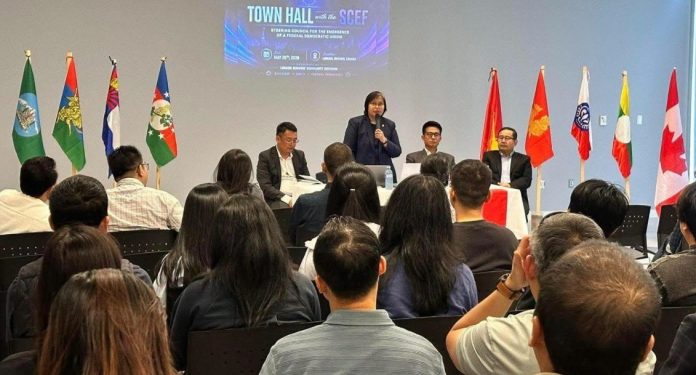
National Unity Government Foreign Minister Zin Mar Aung and Presidential Advisor Kyaw Zaw discuss federal democracy in Myanmar on-stage with Andrew Nimrod from the Karen National Union and Neineh Plo from the Karenni State Interim Executive Council at a town hall in London, Ontario, Canada, on May 31. (Credit: NUG)

NUG meets with ASEAN Special Envoy to discuss Myanmar

The National Unity Government (NUG) spoke to the Association of Southeast Asian Nations (ASEAN) Special Envoy on Burma, Ma. Theresa P. Lazaro, on an undisclosed date this week, BBC Burmese reported. This follows Lazaro’s meeting with representatives from Burma’s ethnic armed groups and the regime’s National Solidarity and Peacemaking Negotiation Committee (NSPNC) in Thailand’s Chonburi District on July 13.

“The central challenge facing ASEAN today is not the absence of diplomatic engagement,” the NUG stated in a press release on July 12. “It is the military junta’s continued refusal to implement the commitments it accepted under the Five-Point Consensus.” Regime leader Min Aung Hlaing agreed to the framework after the military coup on Feb. 1, 2021, but he didn’t implement its objectives upon his return to Burma in April 2021.

The NUG called on ASEAN to ensure that any future engagement includes all relevant stakeholders. This comes after regime Foreign Minister Tin Maung Swe attended an “informal” meeting of ASEAN foreign ministers in Bangkok on July 11. Min Aung Hlaing is expected to make his first official visit to Thailand in early August, which would be his second to an ASEAN member state since assuming the presidency on April 10.

Calls for action in Bangladesh after 17 Rohingya killed by landslides

Human Rights Watch (HRW) demanded immediate action following deadly landslides in Bangladesh’s Cox’s Bazar district that claimed at least 17 Rohingya lives and forced more than 3,000 from their homes in July. Bangladesh hosts 1.2 million Rohingya refugees in camps with families packed into bamboo and tarpaulin structures on steep, deforested slopes that become death traps during monsoon season, HRW stated.

The U.N. High Commissioner for Refugees (UNHCR) has repeatedly cautioned about fatalities and injuries in the overcrowded settlements from cyclones, flooding, and earth movements. HRW called on Bangladesh authorities, the U.N., and international donors to address severe overcrowding and restore funding for embankments, drainage systems, access roads, and emergency relocation sites in the sprawling camps.

“Every monsoon is becoming increasingly deadly for Rohingya refugees in Bangladesh, with denuded hills sliding away under makeshift structures, as the funding to buttress the camps has dried up,” said Meenakshi Ganguly, deputy Asia director at HRW. “These are not simply natural disasters, but a predictable outcome of policies that put refugees’ lives at risk,” she said. Read more on our website

Residents pay tribute to Myanmar’s independence hero, General Aung San, at a statue during a regime-sponsored Martyrs’ Day ceremony in Bogyoke Park, Yangon, on July 19, 2022. (Credit: Regime)

Legal experts challenge regime’s removal of Aung San statues

The Burma Lawyers’ Council (BLC) is contesting the regime’s legal basis for its nationwide campaign to dismantle statues of Burma’s independence hero, General Aung San. Following a surge in public outrage regarding the clandestine removals, regime spokesperson Khaing Khaing Soe claimed on July 10 that Naypyidaw is acting in accordance with the Protection and Preservation of Ancient Monuments Law (1962).

She argued that the statues were not being outright banned, but rather, “substandard” statues with “incorrect proportions and shapes” were being removed for lacking the appropriate “dignity” befitting the General. Legal experts argue the regime’s defense is fundamentally flawed and legally ambiguous. 

Myint Thein Aung, the General Secretary of the BLC, told DVB that the regime’s explanation “lacks legal clarity” because the spokesperson failed to provide any objective criteria or transparent process used to determine which statues are deemed “substandard.” Furthermore, the BLC asserts that the unilateral destruction of these monuments—most of which were erected using public donations—violates the law rather than upholds it. Read more on our website

News by Region

ARAKAN—Nearly 100,000 displaced residents from Mrauk-U, Minbya, Ponnagyun, Kyauktaw, Rathedaung, Maungdaw, and Buthidaung townships began returning to their homes on Monday as floodwaters slowly receded. In Gwa Township, residents are facing floods and military bombardment.

Local aid organizations are urgently calling for food, clean water, medicine, and mosquito nets. Relief workers warn that the lack of clean drinking water has drastically increased the risk of waterborne and mosquito-borne diseases in the flood-affected communities. Read more on our website

KACHIN—A report released by Kachin Human Rights Watch on July 13, documented more than 130 civilians, including seven children, were killed in regime airstrikes, drone attacks and artillery attacks in 2025. The report stated that nearly 250,000 people have been displaced from their homes across the state. 

The report titled “Inhumane Acts,” recorded more than 550 military attacks, including the use of airstrikes and artillery, during the two months following the March 28, 2025 earthquake despite a declared ceasefire. KHRW called for a global arms embargo and sanctions on aviation fuel against the regime. 

SAGAING—The People’s Defense Force (PDF) in Monywa told DVB that three civilians, including a pregnant woman, were killed and one man was injured during a gyrocopter attack in Ayadaw Township’s Kanyin village on Tuesday. Ayadaw is located 43 miles (26 km) northeast of the region’s capital Monywa. 

The PDF added that three gyrocopters from Monywa’s Northwestern Regional Military Command (RMC) carried out the attack on the village. A gyrocopter is a miniature helicopter used for short-range, low-level attacks typically on defenceless targets, according to security analyst Anthony Davis.  

(Exchange rate: $1 USD = 4,300 MMK) 

Opposing sides in Myanmar conflict open to dialogue, Thai foreign minister says

0
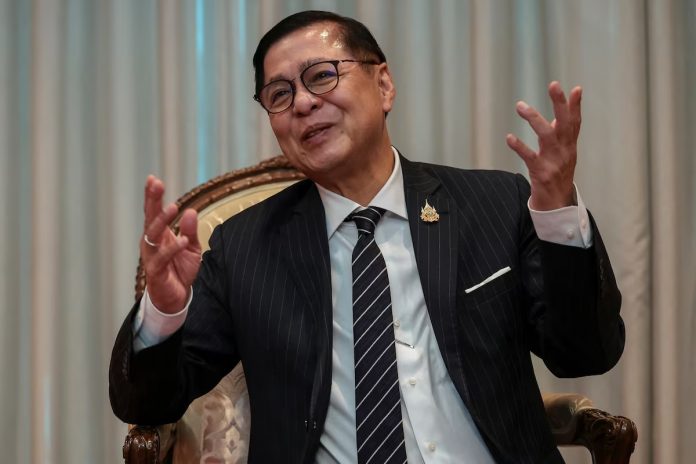
Thailand's Foreign Affairs and Deputy Prime Minister Sihasak Phuangketkeow speaks with Reuters about Myanmar diplomacy and the upcoming ASEAN summit at the Ministry of Foreign Affairs, in Bangkok, Thailand, on May 5, 2026. (Credit: Reuters)

ASEAN’s special envoy on Myanmar has held separate talks with the country’s regime-backed negotiators and some ethnic armed groups, with all sides ​recognising there is no military solution to the civil war, ‌Thailand’s Foreign Minister Sihasak Phuangketkeow said.

Thailand is ready to serve as a facilitator and provide a venue for future peace talks, he said, marking a significant ​step toward reviving ASEAN’s stalled peace initiative for Myanmar, where an estimated ​100,000 people have been killed and millions displaced since ⁠a 2021 coup.

Here is more detail about the meetings, provided by ​Sihasak in a press briefing on Wednesday:

  • Association of Southeast Asian Nations foreign ​ministers on Sunday held the first in-person talks with their Myanmar counterpart since the coup that deposed Nobel laureate Aung San Suu Kyi’s government and sparked the ​civil war.
  • A day later, ASEAN’s special envoy Maria Theresa Lazaro, the ​foreign minister of the Philippines, and Sihasak met six ethnic armed groups, including the Karen National ‌Union ⁠and the Karenni National Progressive Party.
  • The groups were open to dialogue but are yet to reach a common position, which they are currently working on, Sihasak said.
  • Lazaro and Thai officials also met the Myanmar regime’s National ​Solidarity and Peacemaking ​Negotiation Committee.
  • All sides ⁠recognised that a military solution was not in their interests, he said.
  • “We hope that eventually we could ​find some common ground where we can begin some ​talks,” Sihasak ⁠said. “At the moment it is going to be probably talks for talks: How to conduct the talks, where to conduct the talks.”
  • Thailand and ASEAN ⁠hope ​to meet Aung San Suu Kyi, who ​has been detained since the coup, face to face.
  • Thailand has not abandoned ASEAN’s peace plan ​for Myanmar, known as the “Five-Point Consensus”.

REUTERS

Contact