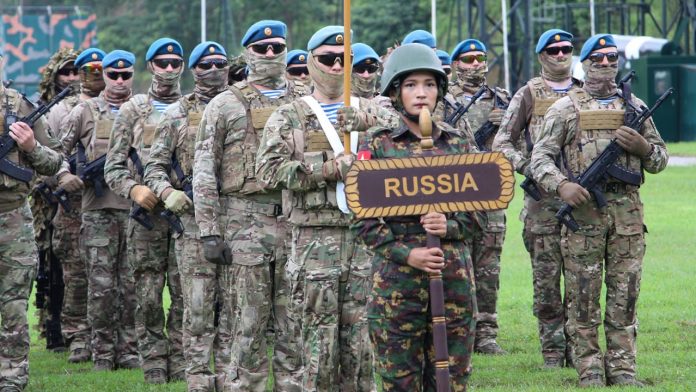
Myanmar and Russian soldiers during an opening event of the bilateral training at the National Defence College in Naypyidaw on an undisclosed date. (Credit: Russian Ministry of Defence)
Russian soldiers have been actively training Myanmar’s special operations forces in the capital Naypyidaw, marking a significant escalation in the military alliance between Moscow and the regime.
The joint exercise, dubbed “Tropical Storm,” is taking place at the National Defence College in Naypyidaw from July 6 to 17. The training operation follows the signing of a pivotal five-year military cooperation agreement between Moscow and Naypyidaw earlier this year on Feb. 3.
Pyae Sone Lin, chief of the regime’s Military Training Directorate, described the exercises in a video released on July 14. He stated that the training represents the “next stage” in an “intensively strengthening” relationship between the two militaries that has deepened since the military coup on February 1, 2021.
Moscow’s growing role in Myanmar’s war
Russia has become an indispensable lifeline for the Myanmar regime as it battles widespread armed resistance across the country.
To maintain its grip on power, the regime has increasingly relied on Russian military hardware. A July 2025 ACLED report highlighted that Moscow has steadily supplied the regime with munitions, unmanned aerial vehicles (UAVs), and anti-UAV defense systems.
The influx of foreign airpower has had a devastating impact on the ground. Unable to control vast swathes of territory with ground infantry alone, the Myanmar Air Force has drastically escalated its aerial bombardment of civilian and resistance targets.
According to data tracking, airstrikes have surged more than 30-fold since the coup began:
The crisis began when the military ousted the democratically elected National League for Democracy (NLD) administration. State Counsellor Aung San Suu Kyi, the leader of the ousted government, has been held incommunicado by the regime in Naypyidaw for over five years.
The ethnic Kokang armed group, the Myanmar National Democratic Alliance Army (MNDAA), has officially begun establishing “civilian-led administrations” across four newly designated districts within its controlled territory in northern Shan State.
The MNDAA clarified that the move is not an attempt to secede from Myanmar. Instead, the group asserts it is “reforming” its governance structure under a newly created Special Region 1.
Established in January, the region operates with Laukkai as its capital and encompasses the four districts of Laukkai, Kutkai, Hsenwi, and Monekoe—spanning a massive area 31 to 124 miles (49-200 km) north of the regional capital, Lashio.
Transitioning to civilian governance
To facilitate this transition, the MNDAA claims it has actively directed local populations to take charge of civil matters.
Following a July 10 town hall meeting in Hsenwi, a resident told DVB, “We have been told during the meeting with the MNDAA last week that we must take the lead with administration. They said they don’t want to be involved [in governance].”
According to an anonymous MNDAA source, the new administrative framework is designed to allow ethnic Shan and Kachin populations residing in MNDAA-controlled territories to be governed by civilians from their own respective communities.
Operating alongside its Brotherhood Alliance allies—the Ta’ang National Liberation Army (TNLA) and the Arakan Army (AA)—the MNDAA successfully ousted the military-aligned Kokang Border Guard Force (BGF) from the Kokang Self-Administered Zone of Laukkai and Konkyan townships.
During the offensive, the MNDAA captured several highly strategic Myanmar-China border towns, including:
This localized consolidation follows a broader strategic withdrawal orchestrated by Beijing. Under a China-brokered ceasefire agreement enacted on January 11, 2025, the MNDAA formally handed Lashio back to the military regime on April 22, 2025.
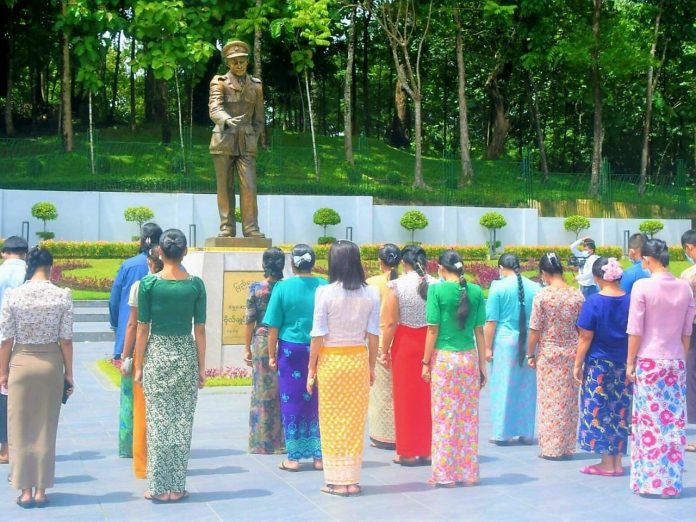
Residents pay tribute to Myanmar's independence hero, General Aung San, at a statue during a regime-sponsored Martyrs’ Day ceremony in Bogyoke Park, Yangon, on July 19, 2022. (Credit: Regime)
The Burma Lawyers’ Council (BLC) is fiercely contesting the military regime’s legal justification for its escalating, nationwide campaign to dismantle statues of Myanmar’s independence hero, General Aung San.
Following a surge in public outrage and media coverage regarding the clandestine removals, regime spokesperson Khaing Khaing Soe claimed on July 10 that Naypyidaw is acting in accordance with the Protection and Preservation of Ancient Monuments Law (1962).
She argued that the statues were not being outright banned, but rather, “substandard” statues with “incorrect proportions and shapes” were being removed for lacking the appropriate “dignity” befitting the General.
A lack of legal clarity and criteria
Legal experts argue the regime’s defense is fundamentally flawed and legally ambiguous. Myint Thein Aung, the General Secretary of the BLC, told DVB that the regime’s explanation “lacks legal clarity” because the spokesperson failed to provide any objective criteria or transparent process used to determine which statues are deemed “substandard.”
Furthermore, the BLC asserts that the unilateral destruction of these monuments—most of which were erected using public donations—violates the law rather than upholds it. The BLC argues the demolitions constitute criminal mischief under Section 425 of the Penal Code, an offense that carries a prison sentence of up to seven years.
A legal expert speaking on the condition of anonymity pointed out that while the regime targets statues erected during the National League for Democracy (NLD) administration, which governed Myanmar from 2016 up until it was ousted during the military coup on Feb. 1, 2021, an unknown number of the removed statues were actually built long before the NLD took power.
The regime previously renamed the General Aung San Bridge (connecting Mawlamyine to Belu Island) to the Thanlwin Bridge in June 2021. The NLD issued a formal statement on July 8, decrying the systematic removals as a calculated attempt by the military to “destroy Myanmar’s national identity and history”.
A history of controversy
The monuments have long been a flashpoint in Myanmar’s complex political landscape. Even during the civilian NLD administration (2016-2021), the installation of Aung San statues faced severe opposition in ethnic minority regions.
In 2017, local political parties and civil society organizations in Kachin, Mon, and Chin states successfully blocked NLD proposals to install the statues. In February 2019, police were accused of injuring over 20 protesters who staged a public rally against the unveiling of a statue in the Karenni State capital Loikaw.
Despite the historical complexities, the current regime’s aggressive, nocturnal demolition campaign is widely viewed not as a response to ethnic grievances, but as a deliberate strategy to dismantle symbols of the pro-democracy resistance.
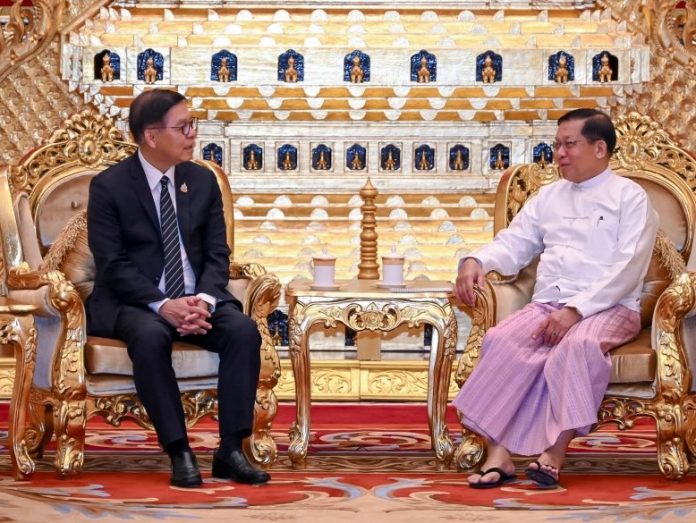
Regime leader Min Aung Hlaing with Thailand's Foreign Affairs and Deputy Prime Minister Sihasak Phuangketkeow in Naypyidaw on April 22. (Credit: Reuters)
Min Aung Hlaing to visit Thailand in August
Min Aung Hlaing is expected to make his first official visit to Thailand since assuming the presidency in early August, according to anonymous sources in the Association of Southeast Asian Nations (ASEAN) on Monday. The trip would mark his second “official” visit to an ASEAN member state since the regime’s “sham” 2025-26 elections, which ended on Jan. 25, and resulted in a pro-military parliament and administration led by him.
Military claims strategic road in Sagaing Region ‘secured’
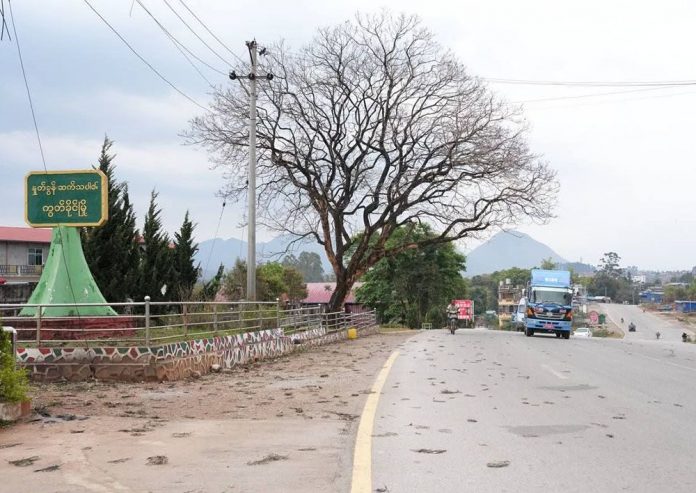
The People’s Defence Force (PDF) and political leaders in Sagaing Region told DVB that the regime’s claim of it regaining control over the 120-mile (193 km) long Kalewa-Monywa road on July 7 is “propaganda,” as fighting between regime and resistance forces continues in Mingin Township this week. Mingin, located along the Kalewa-Monywa road is 114 miles (183 km) northwest of the Sagaing Region capital Monywa.
Soe Win Swe, a member of the Sagaing Forum Federation, told DVB that the regime wants to “raise the morale of its soldiers.” The Kalewa-Monywa road is located along the 870-mile (1,400 km) India-Myanmar-Thailand Trilateral (IMTT) Highway that connects India’s northeastern Manipur State to Thailand’s Tak Province, via Burma. The counteroffensive in Sagaing began in April following the recapture of Tigyaing town.
The PDF in Yinmabin Township told DVB that regime forces had recaptured 20 per cent of the Kalewa-Monywa road while resistance forces remained in control of the remaining 80 per cent. Residents told DVB that regime forces are unable to secure the 81-mile (130 km) long Kalay-Khampat-Tamu road despite regaining control of Khampat on June 20. Yinmabin is located 29-108 miles (46-173 km) west of Monywa and south of Mingin.
Myanmar film director Aung Phyoe on stage with co-producers of his award-winning film Fruit Gathering, which won a Crystal Globe Award at the 60th Karlovy Vary International Film Festival in Czech Republic, on July 11. (Credit: Karlovy Vary International Film Festival)
Myanmar film wins top award at festival in Czech Republic
Filmmaker Aung Phyoe has made cinematic history, capturing the prestigious Grand Prix – Crystal Globe for Best Film at the 60th Karlovy Vary International Film Festival (KVIFF) for his debut Burmese language feature film with English subtitles titled Fruit Gathering (Thit-thee Khu).
The award, which carries a $25,000 USD cash prize shared equally between the director and producers, was presented during the festival’s closing ceremony on July 11. The milestone marks the first time a film from Burma has ever competed in—let alone won—the top category at the historic European festival.
Fruit Gathering is a 97-minute romantic drama set against the backdrop of contemporary Yangon’s industrial zone. The film explores a subtle, slow-burning, same-sex relationship between two young female garment factory workers navigating grueling workdays and societal repression. Read more on our website
News by Region
ARAKAN—Residents in Kyauktaw and Mrauk-U townships told DVB that their KBZ bank accounts and mobile wallets have been suspended since the first week of July. Kyauktaw and Mrauk-U, located 96-142 km (60-88 miles) north of the state capital Sittwe, were seized by the Arakan Army (AA) in 2024.
A mobile financial service provider from Kyauktaw Township told DVB that he lost up to 200 million MMK ($46,511 USD) due to the termination of his KBZ Pay account. Kyauktaw and Mrauk-U residents added that service fees for withdrawing 100,000 MMK ($23 USD) costs between 6,000-8,000 MMK ($1.30-1.80 USD).
MON—The regime’s Department of Meteorology and Hydrology (DMH) reported on Tuesday that the Bilin River had receded below the danger level of 1,022 centimeters after continuous rainfall caused it to overflow–forcing over 10,000 residents from 20 low-lying villages in Bilin Township to relocate to higher ground since Friday.
Residents told DVB that they feared recurring floods and wouldn’t be returning home yet. An aid worker told DVB on the condition of anonymity that displaced residents need drinking water and food at nine temporary camps. Bilin is located 69 miles (111 km) north of the state capital Mawlamyine.
YANGON—Police seized illegal drugs worth an estimated seven billion MMK ($1.62 million USD) in Dala Township on July 8, regime media reported. It added that 10 people were arrested in Dala, which is located nine miles (14 km) south of Yangon, in connection with the seizure. No charges have been announced.
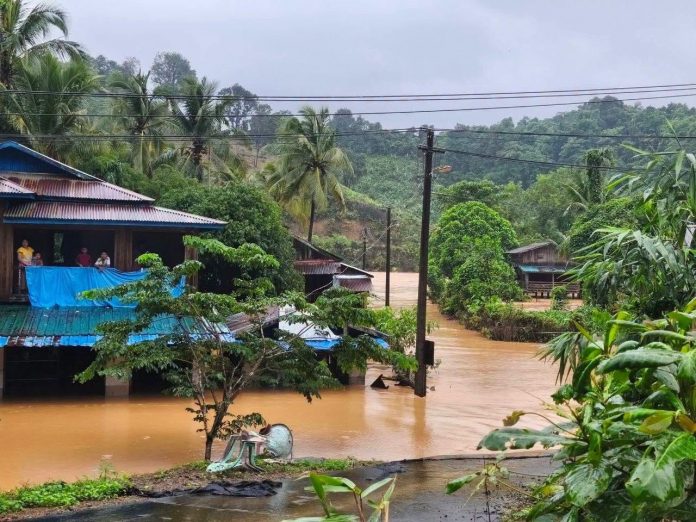
Floodwaters inundate homes and villages in Gwa Township, Arakan State, on July 13. (Credit: Lay Waddy FM)
Nearly 100,000 displaced residents across Arakan State began returning to their homes on Monday as floodwaters slowly receded. However, the humanitarian crisis remains severe, compounded by continuous military bombardments in the state’s southern Gwa Township.
According to residents and local relief workers, at least five people were killed by the severe flooding triggered by heavy rainfall that began on July 6.
Widespread flood damage and health risks
While water levels have dropped in heavily impacted townships—including Mrauk-U, Minbya, Ponnagyun, Kyauktaw, Rathedaung, Maungdaw, and Buthidaung—the destruction left behind is extensive.
Agricultural Ruin: A resident of Mrauk-U reported that vital paddy fields have been decimated by the inundation.
Infrastructure and Water Supply: Homes situated near streams were severely damaged, and crucial drinking-water ponds across several villages were completely submerged and contaminated.
Local aid organizations are urgently calling for food, clean water, medicine, and mosquito nets. Relief workers warn that the lack of clean drinking water has drastically increased the risk of waterborne and mosquito-borne diseases in the flood-affected communities.
The disaster aligns with a July 9 warning from the Global Flood Awareness System (GloFAS), which cautioned that the torrential rains would trigger the worst flooding Arakan has seen in twenty years.
A dual crisis in Gwa Township
While floodwaters have receded in the north, Gwa residents are facing a dual crisis of persistent flooding and intense military bombardment.
On Monday, July 13, the Myanmar Air Force conducted six bombing runs over areas near three villages in Gwa, dropping more than 50 bombs. While no casualties from this specific barrage have been reported yet, an unknown number of homes were destroyed.
“Even when people were already suffering from floods, they did not stop attacking Gwa,” a resident told DVB on the condition of anonymity.
The recent bombings follow a deadly week of escalation in the township:
July 8: Four Myanmar Navy warships fired over 80 artillery shells into coastal areas of Gwa, injuring at least six civilians, including two children.
July 10: Airstrikes on two villages in Gwa killed four civilians and injured one.
A strategic flashpoint
Gwa has become a major military flashpoint following recent territorial gains by the Arakan Army (AA). The armed ethnic group seized control of Gwa in late 2024.
Tensions in the immediate region escalated further on July 7, when the AA announced it had captured two regime outposts in neighboring Ayeyarwady Region’s Yegyi Township, located just 40 miles east of Gwa.
As regime forces lose ground to the AA, it has increasingly relied on its air force and naval artillery to bombard civilian and resistance-held areas, creating a dire situation for residents already struggling to survive the region’s extreme weather.
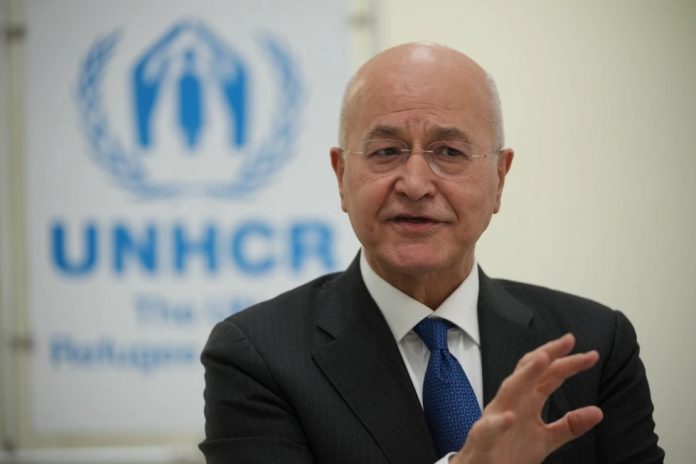
UNCHR High Commissioner Barham Salih in Rome, Italy, on Jan. 26, 2026. (Credit: AP)
The United Nations refugee agency is investigating reports that two boats carrying members of Myanmar’s persecuted Rohingya minority have capsized in the Bay of Bengal.
The U.N. High Commissioner for Refugees (UNHCR) said in a statement Tuesday that the boats reportedly departed Myanmar’s Arakan (Rakhine) State in late June before sinking.
“We are deeply concerned by the potential loss of life and are working to verify further details,” the UNHCR said.
The U.N. declined to release additional details, including how many Rohingya were believed to be on board or the approximate location where the boats sank.
Around 1.2 million stateless, predominantly Muslim Rohingya remain trapped in squalid, overcrowded refugee camps in Bangladesh after fleeing waves of violence by Myanmar’s security forces.
The refugees have no way to safely return to Myanmar, where the military that killed thousands of Rohingya in 2017 during what the United States declared a genocide remains in charge of their homeland.
The Rohingya still living in Myanmar face severe restrictions and many are confined to internment camps.
Steep cuts to foreign aid by the U.S. and other countries have led to ration cuts in Bangladesh’s refugee camps, while the ruling military and an ethnic armed organization in Rakhine have fought for control of the region.
The unrest has led to an increasing number of Rohingya attempting to make the dangerous ocean crossing to Malaysia on rickety boats.
Thousands reportedly have died in the process, including babies, children and pregnant women. Local maritime authorities have frequently abandoned the Rohingya at sea, often ignoring reports of boats in distress.
“Saving lives and rescuing those in distress at sea is a humanitarian imperative and a longstanding duty under international maritime law,” the UNHCR said Tuesday, calling on nations to step up search and rescue efforts and urging regional authorities and the international community to take more action.
More than 6,500 Rohingya fled and nearly 900 were reported dead or missing in 2025, the deadliest year for Rohingya who tried to leave by boat.
The figure represents the highest mortality rate of any major route for refugee and migrant sea journeys in the world, the UNHCR said.
More than 5,400 Rohingya refugees have fled by boat so far this year, with 540 reported missing or dead.