
Thursday, July 23, 2026
Home Blog Page 81

Oil tankers transiting Strait of Hormuz since start of Iran war

0
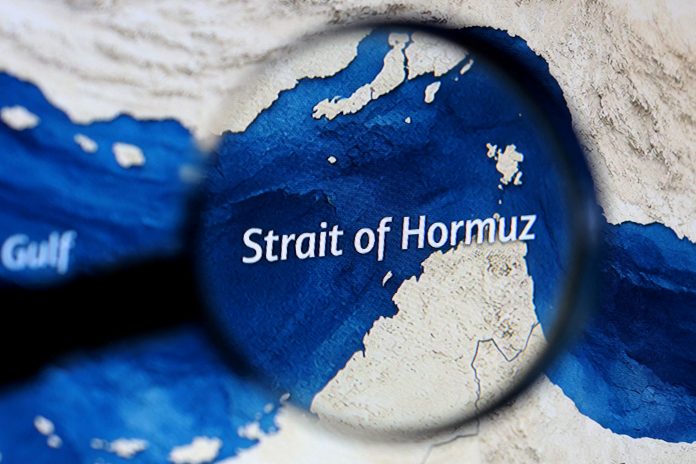
A map showing the Strait of Hormuz in this illustration taken March 23, 2026. (Credit: Reuters)

The U.S. blockade on vessels entering or leaving Iranian ports adds to uncertainty over shipping through the Strait of Hormuz, which has been all-but-shut since the start of the Iran war.

Ordinarily, roughly one fifth of global oil and gas exports transit the Strait of Hormuz.

Here’s a look at ​some of the non-Iranian oil tankers that have passed the strait since the start of the U.S-Israeli war with Iran on February 28, ‌listed by cargo destination.

Malaysia

Liberia-flagged Very Large Crude Carrier (VLCC) Serifos entered and exited the Hormuz Passage trial anchorage that bypasses Iran’s Larak Island on April 10.

The tanker, carrying crude loaded from Saudi Arabia and the United Arab Emirates in early March, is expected to arrive at Malaysia’s Malacca port on April 21.

Ocean Thunder, loaded with Iraqi crude and chartered by a unit of Malaysian state energy ​firm Petronas, transited the waterway on April 5 and is expected to discharge its cargo of 1 million barrels of Basrah Heavy crude in Malaysia’s ​Pengerang on April 18.

Both tankers are among seven Malaysia-linked vessels cleared by Iran to transit the strait, two people familiar with ⁠the matter told Reuters.

China

China-flagged VLCCs Cospearl Lake and He Rong Hai exited the Strait of Hormuz on April 11. Cospearl Lake, laden with Iraqi oil, is expected to ​arrive at China’s Zhoushan port on May 1. He Rong Hai is heading to Myanmar to discharge its Saudi crude cargo.

Both VLCCs are chartered by Unipec, the trading arm ​of Chinese energy giant Sinopec.

VLCC Dhalkut, which passed the strait on April 2, is heading to Myanmar to discharge Saudi crude on April 22, Kpler data showed. Crude discharged at Myanmar typically goes to PetroChina’s Yunnan refinery.

On March 31, a Chinese foreign ministry spokesperson said that three Chinese ships recently sailed through the Strait of Hormuz after coordination with relevant parties.

India

At least two VLCCs and ​two suezmax tankers exited the Gulf in March and April to offload crude at India.

VLCC Habrut, which crossed the strait on April 2, is heading to Paradip to ​discharge Abu Dhabi crude for Indian Oil Corp on April 15.

Meanwhile, VLCC Marathi discharged Saudi crude at the Sikka port for Reliance Industries on March 28, Kpler data showed.

The Liberia-flagged Smyrni ‌suezmax tanker ⁠exited the strait on March 12 and discharged 1 million barrels of Saudi crude at Mumbai for state refiner Hindustan Petroleum Corp on March 16, the data showed.

Another suezmax Shenlong left the strait on March 6 and discharged the same amount of Saudi crude at Mumbai on March 11.

Gabon-flagged tanker Msg, laden with residue fuel, is heading to India’s Pipavav port after passing the strait on April 9, Kpler data showed.

Liberia-flagged Navara, which sailed through the strait on March 31, discharged fuel oil at ​Sikka port on April 8, the data ​showed.

Two India-bound liquefied petroleum gas (LPG) tankers ⁠carrying about 94,000 metric tons of the cooking gas have safely transited the Strait of Hormuz and are heading towards India, the government said in late March.

BW Tyr discharged at Mumbai and Pipavav between April 5 and April 7, while BW Elm discharged ​at three Indian ports between April 6 and April 15, Kpler data showed.

Prior to this, four other Indian-flagged LPG tankers ​have moved out of ⁠the strait — Shivalik, Nanda Devi, Pine Gas, and Jag Vasant.

Pakistan

Two Pakistan-flagged tankers entered the Gulf on April 12. The Aframax tanker Shalamar is heading to the United Arab Emirates on Monday to load Das crude, the data showed, while the Panamax-sized Khairpur is heading to Kuwait to load refined products, according to the data.

Aframax tanker P. Aliki passed through the strait on March 28 ⁠and discharged ​Saudi crude at Karachi on March 31.

Thailand

A Thai oil tanker owned by Bangchak Corporation has safely passed through ​the Strait of Hormuz following diplomatic coordination between Thailand and Iran, and was not required to pay to escape the blockade, a Thai official and the oil major that owns the vessel said on ​March 25.

The Suezmax tanker Pola discharged 1 million barrels of Khafji crude at Thailand and Singapore, Kpler data showed.

REUTERS
Resistance forces dismiss regime plan to reopen Union Road in Karenni State

0
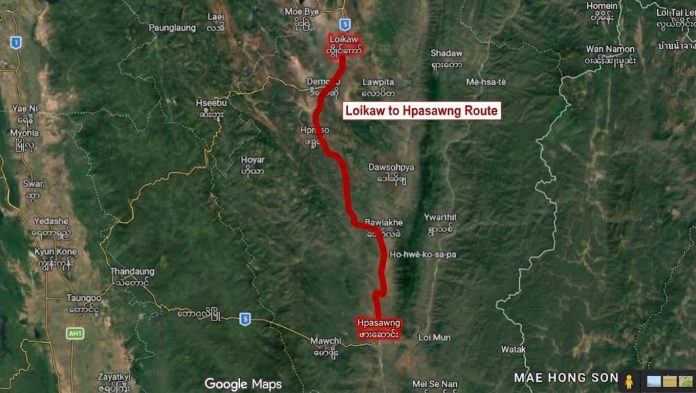
A map showing the 73-mile-long Union Road connecting the Karenni State capital Loikaw to Hpasawng Township. (Credit: Google Maps)

The Karenni Nationalities Defence Force (KNDF) told DVB on Tuesday that a regime plan – made in a statement on Feb. 14 – to reopen the 73 mile (117 km) long Union Road connecting Hpasawng Township to the Karenni State capital Loikaw is “unrealistic.”

The KNDF spokesperson Tar El Soe told DVB that the road spans Demoso, Hpruso, and Bawlakhe townships, adding that it took regime forces one year of fighting against resistance forces to reach southern Hpasawng town from Loikaw.

Regime forces recaptured Hpasawng from the resistance on Feb. 15. They are also reportedly attempting to reassert control over the 11 mile (17 km) long Demoso-Hpruso Road and 23 miles (37 km) long Bawlakhe-Hpasawng Road. 

Sources close to the Karenni resistance told DVB that fighting with regime forces occurs “daily” as a military counteroffensive has been pushing towards Karenni’s Mawchi town since Feb. 25.

One source told DVB on the condition of anonymity that regime troops have regained control of most of the 19 mile (30 km) long road connecting Mawchi and Hpasawng. He added that regime forces have yet to enter Mawchi, which is located 92 miles (148 km) south of Loikaw, and was seized by the KNDF in 2024.

Another source told DVB that Mawchi is a “vital” revenue stream for the resistance due to its lead and tungsten mines, adding that regime forces conduct reconnaissance missions over the town using unmanned aerial vehicles (UAVs), or drones.

Aid workers told DVB that they have had to halt food and water donations to camps for Internally Displaced Persons in Demoso Township, as gasoline prices reached 15,000 MMK ($3.50 USD) per liter this month due to shortages triggered by the start of the war in Iran on Feb. 28.

“The gasoline price quadrupled in one month. We can’t afford to operate cargo trucks anymore,” an aid worker in Demoso told DVB on the condition of anonymity.

Demoso town, located 11 miles (17 km) south of Loikaw, was recaptured by regime forces on Aug. 19, but the rural areas are reportedly still under resistance control.

Banyar Aung, the Karenni Interim Executive Council (IEC) secretary 2, told DVB that it has a plan to tax-exempt gasoline to reduce prices and ease the burden on residents. 

A volunteer at an IDP camp sheltering over 100 civilians in western Demoso told DVB that people are now suffering from skin diseases due to water shortages as they’ve begun to reuse contaminated water.

Residents told DVB that a military road blockade into Karenni, as well as ongoing fighting between regime and resistance forces, contributed to a shortage of food and water in the IDP camps.

On Feb. 17, resistance forces destroyed a bridge over the Thanlwin River to stop regime troops from advancing from Hpasawng into Mese town, which is under Karenni resistance control.

Myanmar New Year begins with traditional Thingyan Water Festival

0
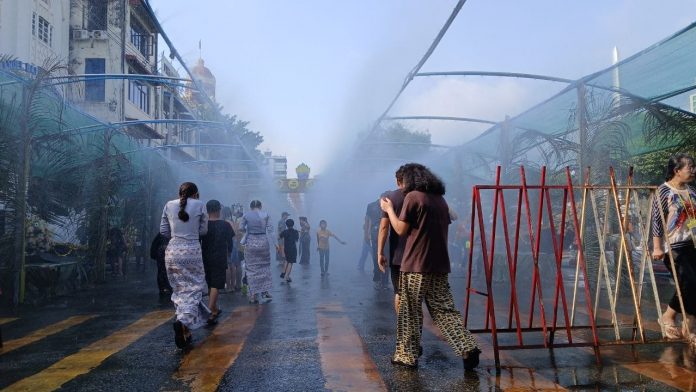
A "Walking Thingyan" water splashing pedestrian zone in front of City Hall and Maha Bandoola Park in downtown Yangon on April 13. (Credit: DVB)

The regime administrations in Yangon, Mandalay, Bago, Tanintharyi, and Sagaing regions, as well as Naypyidaw, Mon, Karen, and Shan states, hosted “Walking Thingyan” water splashing pedestrian zones to kick off Myanmar’s annual Thingyan festival on Monday. 

“The [regime] is spreading propaganda claiming that citizens are enjoying the festivities in order to welcome and promote the military dictatorship,” sources close to the regime administrations told DVB on the condition of anonymity. 

A regime-appointed administrator told DVB that civil servants in Naypyidaw, as well as the other eight states and regions, have been ordered by their superiors to join the festivities held during the Thingyan water festival April 13-16. 

“Commodity prices are rising and there are concerns of security if we are going outside. Our family decided to stay indoors, making traditional snacks for ourselves and our neighbors,” a resident from Yangon’s Thingangyun Township told DVB on the condition of anonymity. 

Regime media reported that newly-appointed regime chief minister for Yangon Region Aung Naing Thu attended the opening ceremony at the Yangon City Maha Thingyan Pavilion in front of Yangon City Hall on April 13. 

“Walking Thingyan” water festival pavilions are set up each year at Mahabandoola Park in downtown Yangon, People’s Park near Shwedagon Pagoda, Inya Road in Kamaryut Township, and other areas of the city. 

The Myanmar communities in the U.S., Australia, Japan, South Korea and Thailand celebrated Thingyan over the weekend before it officially began on April 13. 

Nearly 30,000 people joined Myanmar’s biggest cultural event in Japan as a Thingyan Water Festival was held at Kiba Park in Tokyo April 11-12.    

The U.S. Secretary of State Marco Rubio released a statement on April 12 to welcome the Burmese New Year, adding that the U.S. “remains committed to supporting efforts to end the crisis” in reference to the civil war in Myanmar that began after the 2021 coup. 

Rubio expressed his hope for peace to be achieved in Myanmar. 

“[This] indicates that the U.S. will continue to support Myanmar politically,” James Shwe, a democracy activist from Myanmar living in the U.S., told DVB. 

The embassies of Canada, the U.K. and the E.U. also released statements to commemorate the Thingyan Water Festival and Burmese New Year, condemning the violence against civilians in Myanmar, as well as the ongoing detention of political prisoners. 

The three countries expressed solidarity and hope for the Myanmar people in the new year. 

The Association of Southeast Asian Nations (ASEAN) stated that the Thingyan Water Festival serves as a time for forgiveness and rebirth, purging old habits, and starting over in the new year.   

The embassies of Norway, Thailand and China also released similar statements on April 13. 

It’s been over six years since the COVID-19 pandemic cancelled the Thingyan Water Festival in 2020. This was followed by the military coup on Feb. 1, 2021, which cancelled the festival again. Since then it was slowly growing back to its pre-COVID numbers of festivalgoers.

This is until a 7.7 magnitude earthquake on March 28, 2025 impacted Thingyan for 424,063 citizens, and cancelled the water festival for 279,111 who were temporarily displaced from their homes in the six hardest-hit regions. 

Around 4,477 people were killed and 11,366 were injured during the quake, according to DVB data

The Thingyan Water Festival marks the traditional New Year every April, usually April 13-16. Thingyan takes place over four days: A Kyo Nei, or the opening day, A Kya Nei, or the decent day, A Kyat Nei, or the traditional day, and A Tat Nei, or the ascending day. 

Beyond water splashing to wash away misdeeds, Thingyan includes acts of merit to family, Buddhist monks, and others. Thingyan was officially recognized as a UNESCO Intangible Cultural Heritage of Humanity on Dec. 5, 2024.

UK city unveils world’s first-ever permanent Rohingya genocide memorial

0
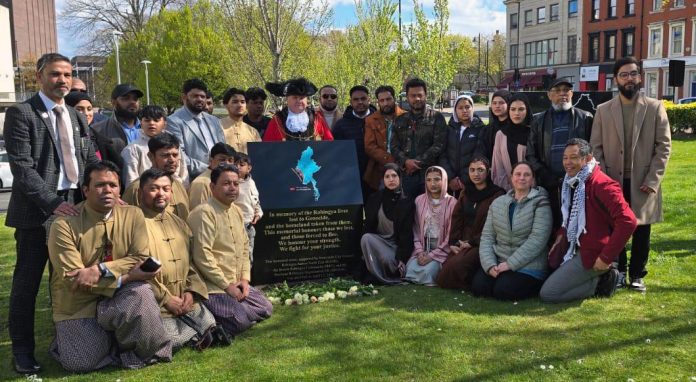
Rohingya community members, civic leaders and supporters gather at the unveiling of a permanent Rohingya genocide memorial in Newcastle’s Peace Garden on April 12. (Credit: BROUK)

Newcastle upon Tyne became the first city in the U.K., and around the world, to unveil a permanent memorial dedicated to the victims and survivors of the Rohingya genocide, which culminated in the 2017 Myanmar military “security clearance” operations in Rakhine State and has continued with attacks on the Rohingya following the 2021 military coup.

Nearly one million Rohingya have fled their homes in Myanmar into Bangladesh, where they are confined to refugee camps with no formal education, work opportunities, or freedom of movement. The U.S. government declared the Myanmar military attacks on the Rohingya a genocide in 2022.

The Myanmar military defended itself against allegations of genocide during legal proceedings in January at the International Court of Justice (ICJ). The ICJ case, brought by Gambia in 2019, accuses Myanmar of carrying out genocide against the Rohingya in 2017.

The International Criminal Court (ICC) Chief Prosecutor Karim Khan requested an arrest warrant be issued against Min Aung Hlaing – for crimes against humanity committed against the Rohingya – by the ICC Pre-Trial Chamber 1 on Nov. 27, 2024

An arrest warrant was issued by a court in Argentina for Min Aung Hlaing, along with 24 other senior Myanmar military and government officials, on Feb. 28, 2025.

The case was filed by the Burmese Rohingya Organisation UK (BROUK) on Nov. 13, 2019 for genocide against the Rohingya under the legal principle of universal jurisdiction, which allows prosecution in national courts for crimes committed anywhere in the world.

This new permanent Rohingya genocide memorial stone, situated in the Newcastle City Council’s Peace Garden, was officially unveiled following a ceremony at the Council Chamber on April 12.

A procession to the site was led by the Lord Mayor of Newcastle, Councillor Henry Gallagher, and the Mayor of Sunderland, Councillor Ehthesham Hoque, who formally unveiled the stone.

The initiative was spearheaded by Newcastle City Councillor and human rights advocate Habib Rahman, the Rohingya Action North East (RANE), the British Rohingya Community (BRC), and BROUK.

“This is a historic moment not just for Newcastle, but for the global community,” Rahman stated during the unveiling on April 12.

“Today we honour the lives lost, the resilience of survivors, and send a clear message that genocide must never be ignored or forgotten. The Rohingya people have endured decades of persecution, culminating in a campaign of mass violence, displacement, and atrocities that forced over a million people to flee their homes,” he added.

For the Rohingya community, this memorial marks a vital step toward international acknowledgment of the persecution it has faced over decades in Myanmar, which has led to Rohingya displacement to other countries in Southeast Asia and around the world as many have been resettled to third countries, including the U.K.

“For too long, our suffering has been denied, ignored, and pushed aside while the world failed to act,” said Tun Khin, the BROUK President. “This memorial is a powerful symbol that our pain is acknowledged, that our voices matter, and that the truth cannot be erased,” he added.

Nijam Uddin from BRC noted that the Newcastle City Council’s Peace Garden provides a place for reflection and dignity. “It also serves as a vital tool to educate future generations so that such atrocities are never repeated,” he added.

This memorial is intended to stand as a testament to the Rohingya community’s enduring call to the international community that justice and accountability is needed in Myanmar. The permanent Rohingya genocide memorial stone was crafted by Nationwide Headstone Company Ltd and jointly funded by BRC, BROUK, and RANE.

Myanmar’s Union Consultative Council formed; National Defence and Security Council reformed

0
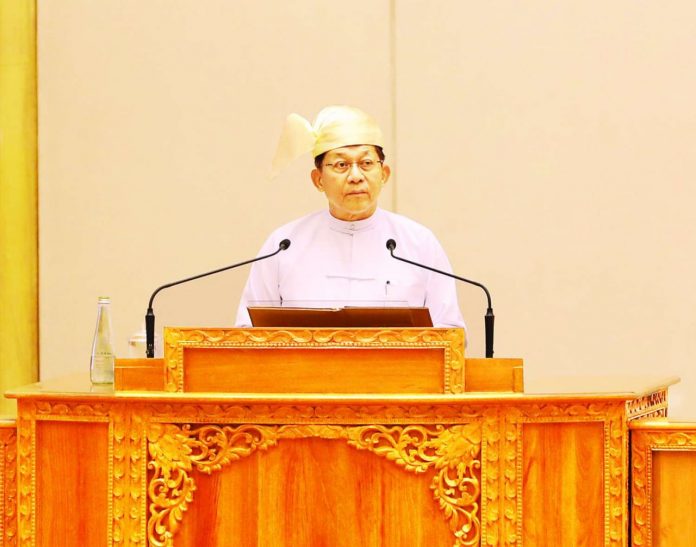
Min Aung Hlaing addresses the Pyidaungsu Hluttaw, Myanmar's bicameral legislature, after his inauguration as president on April 10. (Credit: Regime)

Min Aung Hlaing, inaugurated as president in the capital Naypyidaw on April 10 after receiving the most votes by pro-military lawmakers in the legislature, formed an 11-member Union Consultative Council (UCC) under the leadership of regime deputy and former deputy Commander-in-Chief Soe Win on Friday. 

“The chairmanship position [of the UCC] is a consolation prize for Soe Win,” a source close to the regime in Naypyidaw told DVB on the condition of anonymity, adding that the UCC has “no [real] power.” 

Soe Win transferred his deputy Commander-in-Chief position to the Chief of the General Staff Kyaw Swar Lin on March 30. Maung Maung Aye, the regime’s former defence minister, was appointed as the UCC secretary. 

The UCC was established by Min Aung Hlaing on Feb. 3 to advise the new pro-military Union Solidarity and Development Party (USDP)-led administration, which won a landslide victory in the regime’s 2025-26 elections – called a “sham” by the U.N. and western nations – without any opposition parties on the ballot.

The UCC is a new body meant to advise on security, peace, lawmaking, and international relations “without overriding the powers of the executive and judicial branches.” 

Following his inauguration as president on April 10, Min Aung Hlaing reformed his 11-member National Defence and Security Council (NDSC), which had placed Myanmar under a state of emergency on Feb. 1, 2021 during his military coup when he ousted the democratically elected National League for Democracy (NLD) government and jailed State Counsellor Aung San Suu Kyi and President Win Myint.

Both Aung San Suu Kyi, 80, and Win Myint, 74, have been held in detention by Min Aung Hlaing’s regime for over five years, serving lengthy prison sentences handed down by regime courts.

Under Min Aung Hlaing’s command, the NDSC extended the state of emergency every six months up until July 31, 2025 when it ended and elections were called. Min Aung Hlaing’s regime, established in Naypyidaw after the 2021 coup, held polls from Dec. 28, 2025 to Jan. 25.

Under Myanmar’s 2008 Constitution, the president can declare a state of emergency with consent from the NDSC, which now includes the two vice-presidents Nyo Saw and Nan Ni Ni Aye, as well as the two parliament speakers Aung Lin Dwe and Khin Yi. 

The NDSC will also include the Commander-in-Chief Ye Win Oo and his deputy Kyaw Swar Lin, as well as the Minister of Defence Tun Aung, the Minister of Foreign Affairs Tin Maung Swe, the Minister of Home Affairs Nyunt Win Swe, and the Minister of Border Affairs Phone Myat. 

On April 10, Aung Lin Dwe formally announced the abolition of Min Aung Hlaing’s newly-named regime, called the “State Security and Peace Commission.” 

It was previously known as the “State Administration Council,” which was formed after the 2021 coup and replaced on July 31 once the state of emergency – in place since Feb. 1, 2021 – was lifted.

People’s Defence Force seizes military outposts in Bago Region and Mon State

0
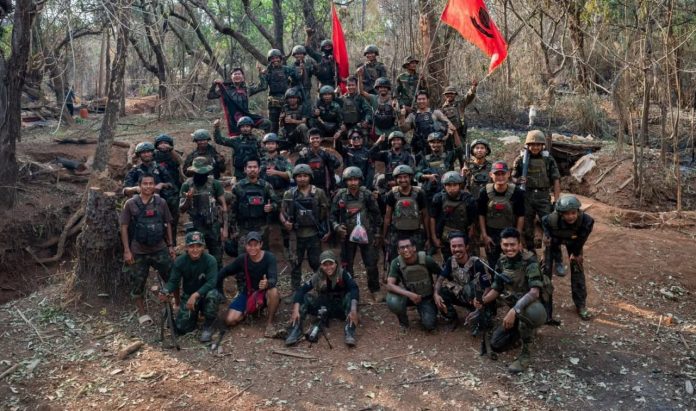
The People’s Defence Force, which operates in Mon State and Bago Region, after seizing the two regime outposts on an unspecified date and at an unknown location. (Credit: PDF)

The People’s Defence Force (PDF) operating in Mon State’s Bilin Township and Bago Region’s Shwegyin Township stated on Sunday that 13 regime troops were killed during a battle to seize two regime outposts April 7-12. 

It added that the Karen National Liberation Army (KNLA) and the All Burma Students’ Democratic Front (ABSDF) seized control over the two outposts from regime forces.

Shwegyin, located 64 miles (102 km) north of the region’s capital Bago, is located in Karen National Union (KNU) Brigade 3 territory. Bilin, located 69 miles (111 km) north of the Mon State capital Mawlamyine, is located in KNU Brigade 1 territory.

The PDF and allied resistance forces killed five, wounded 10 others, and detained two regime troops during five days of fighting before seizing the Bilin’s Laykay outpost on April 12, it stated on April 12.

Eight regime troops were killed while at least 30 others abandoned the Letyet outpost in Bago’s Shwegyin when it was seized by the PDF on April 7. 

Over 13,000 residents from 13 villages in Bilin were displaced from their homes due to the fighting, according to the KNU. 

At least 30 homes and two monasteries in Bilin were either damaged or destroyed by airstrikes carried out by the Myanmar Air Force April 1-5, the KNU added.  

At least 10 regime troops were killed and 20 others were injured by KNLA-led resistance forces, including the PDF, during a rescue of over 300 civilians used by regime forces as “human shields” in Yei Twin Gone village tract of Bago’s Nyaunglebin Township on an unspecified date, according to the National Unity Government (NUG).

It added that at least 11 PDF and KNLA members were killed during this operation. Nyaunglebin, 50 miles (80 km) north of Bago and 73 miles (117 km) west of Shwegyin, is in KNU Brigade 3 territory.

Contact