Guest contributor
James Shwe
When Vietnam’s National Assembly elected To Lam as President on April 7, the U.S. State Department sent a warm congratulatory letter the same day.
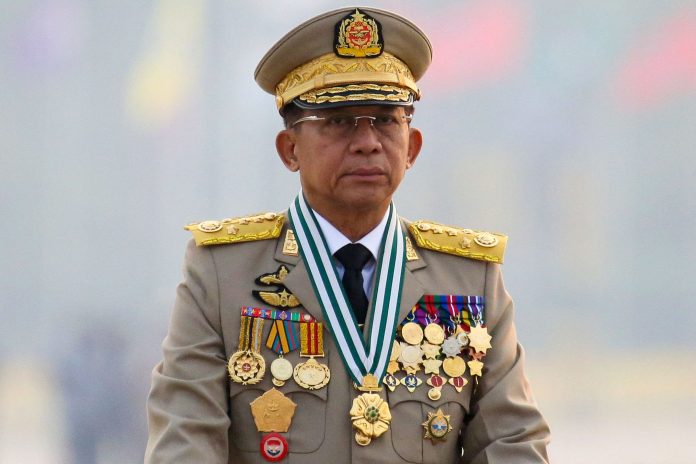
When Min Aung Hlaing took the presidential oath in Naypyidaw on April 10, more than fifty foreign delegates from over twenty countries attended. Chinese President Xi Jinping’s special envoy, Jiang Xinzhi, was the most prominent guest.
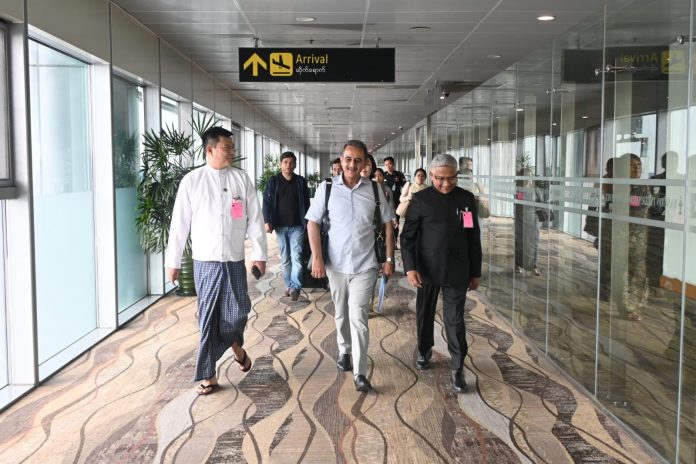
India’s Minister of State for External Affairs hand-delivered a congratulatory letter from Prime Minister Narendra Modi, invoking New Delhi’s “Neighbourhood First” policy. Russia, Belarus, Cambodia, and Thailand sent senior delegations.
Washington sent nothing. Japan — which halted all new official development aid to Myanmar after the 2021 coup — sent nothing either.
That contrast tells you everything the junta’s million-dollar lobbying operation cannot: the United States knows the difference between a partner and a coup leader.
What it must now decide is whether to act on that knowledge — before the window of diplomatic leverage closes further.
A transition in name only
Min Aung Hlaing resigned as Commander-in-Chief on March 30 to satisfy Myanmar’s 2008 Constitution — which he himself has never amended.
His handpicked replacement immediately reaffirmed commitment to Min Aung Hlaing’s own military doctrine. The armed forces did not change hands. They were secured.
In his address to parliament, Min Aung Hlaing repeated long-standing and unfounded allegations of voter fraud in the 2020 election and declared that Myanmar had returned to a democratic path through a “clean” vote.
He pledged “appropriate amnesties to support social reconciliation, justice, and peace” — but democracy advocates called the gesture superficial. He outlined no ceasefire plans and gave no indication that Aung San Suu Kyi, held since the 2021 coup, would be released.
The cabinet confirms the same conclusion. Of 30 Union Ministers, 12 are individually sanctioned by the U.S., E.U., U.K., Australia, or Canada — 40 per cent.
Eighteen ministers — 60 percent — have confirmed careers in the Tatmadaw, the highest military saturation of any Myanmar cabinet since at least 1988.
Even the previous government’s token ethnic inclusion has been removed: Jeng Phang Naw Taung, a Kachin civilian who held a combined portfolio under the regime, was dropped entirely.
Foreign Minister Tin Maung Swe’s entire recent career is China and North Korea — Ambassador to Beijing and concurrently to Pyongyang.
Every major economic portfolio is held by a sanctioned minister; under Office of Foreign Assets Control (OFAC) designation, the Finance Minister cannot access the U.S. dollar clearing system or engage credibly with the International Monetary Fund (IMF) or World Bank.
This is a government built for durability under siege, not for effective administration.
Officials ostensibly removed from the cabinet have simply been repositioned. On inauguration day, Min Aung Hlaing signed into existence a Union Consultative Council (UCC) and named 11 members.
Six of the eleven — 55 per cent — are individually sanctioned by the U.S., E.U., or Canada: chairman Soe Win (OFAC and E.U.), Ko Ko Hlaing (OFAC), Than Swe (E.U., former Ambassador to Washington 2012–2021), Admiral Moe Aung (E.U., former Navy Commander-in-Chief), Mahn Nyein Maung (OFAC and E.U., former Karen National Union leader), and Dwe Bu (Canada).
Ko Ko Hlaing — whose removal from the President’s Office was supposed to signal reform — was quietly embedded in the UCC covering those same domains.
Myanmar Now’s reporting describes the council as a vehicle designed to “sideline close allies while preserving their status and co-opting other political actors without empowering them.”
Ethnic representation is present in name only — former leaders stripped of command authority.
The new Commander-in-Chief Ye Win Oo is not on the UCC, confirming that Min Aung Hlaing does not need it to retain control of the military.
The parallel is the one Myanmar Now draws directly: Ne Win installed himself as president through a rubber-stamp parliament, formally relinquished the army chief position, and continued to exercise ultimate control until nationwide protests forced him from power in 1988.
The structure is familiar. Only the name is new.
The lobbying machine, exposed
The junta has spent millions to obscure this in Washington.
Foreign Agents Registration Act (FARA) filings show the DCI Group holds a $3 million USD annual contract with Myanmar’s Ministry of Information.
Within hours of the April 3 election, a propaganda website — MyanmarDemocracyNow.com — appeared describing the events as a “peaceful transition of power.”
Its own footer carries the mandatory FARA disclosure identifying it as material distributed on behalf of the junta.
That is not speculation. It is a legally required statement.
The lobbying has already produced one visible return: in July 2025, OFAC removed several Myanmar-linked entities from the Specially Designated Nationals (SDN) list following a letter from Min Aung Hlaing to President Donald Trump.
Core sanctions on senior generals remain — and those same generals now sit in the new cabinet.
A US Commission on International Religious Freedom (USCIRF) 2026 report documented 379 religious sites destroyed and 259 clergy and civilians killed in places of worship in 2025 alone, and has recommended Congress ban Countries of Particular Concern from hiring U.S. lobbyists.
The BRAVE Burma Act, which passed the House unanimously, has now been introduced in the Senate with bipartisan sponsorship from Senators Van Hollen, Young, McConnell, and Merkley.
Accountability on multiple fronts
On April 6, a coalition of Indonesian civil society figures — including former Attorney General Marzuki Darusman — filed a criminal complaint accusing Min Aung Hlaing of genocide.
It was accepted under Indonesia’s new penal code, the first such case within the Association of Southeast Asian Nations (ASEAN) under universal jurisdiction.
Argentina has already issued arrest warrants for 25 Myanmar officials; Timor-Leste has launched its own legal proceedings.
Yet the International Criminal Court (ICC) Pre-Trial Chamber I has still not issued the warrant
ICC Prosecutor Karim Khan applied for in November 2024 — more than sixteen months ago. Putin’s warrant took 23 days. Gaddafi took six weeks. Every month of inaction strengthens the message of impunity.
The fuel that keeps the bombs falling
Iran’s shadow fleet delivered approximately 175,000 metric tonnes of jet fuel between October 2024 and December 2025.
Imports surged 69 per cent in 2025, enabling more than 1,022 airstrikes on civilian targets — displacing nearly 3.7 million people, the largest internal displacement crisis in Southeast Asia.
Canada is the only country to have categorically banned aviation fuel exports to Myanmar. The BRAVE Burma Act would extend that pressure. The Senate must act.
The question the inauguration poses
Beijing attended. New Delhi sent a congratulatory letter from Prime Minister Modi himself. Washington did not.
ASEAN did not recognize the inauguration, and the Philippines has made clear Min Aung Hlaing will not receive political representation at the May summit.
The democratic resistance has built the Steering Council for the Emergence of a Federal Democratic Union — the most institutionally coherent opposition since the coup. Southeast Asian courts are now accepting genocide complaints that ASEAN itself has refused to hear.
The lobbyists are claiming normalization is achievable. The cabinet, the sanctions lists, the fuel dependency, the sixteen-month ICC delay, and the empty seat at the inauguration say otherwise.
The question is not whether Min Aung Hlaing is Myanmar’s president. The question is whether Washington will treat his inauguration as a reason to engage, or as a deadline to act.
James Shwe is a Myanmar American professional engineer and advocate for democracy in Myanmar, affiliated with the Los Angeles Myanmar Movement.
DVB publishes a diversity of opinions that does not reflect DVB editorial policy. We’d like to hear what you think about this or any of our stories: [email protected]